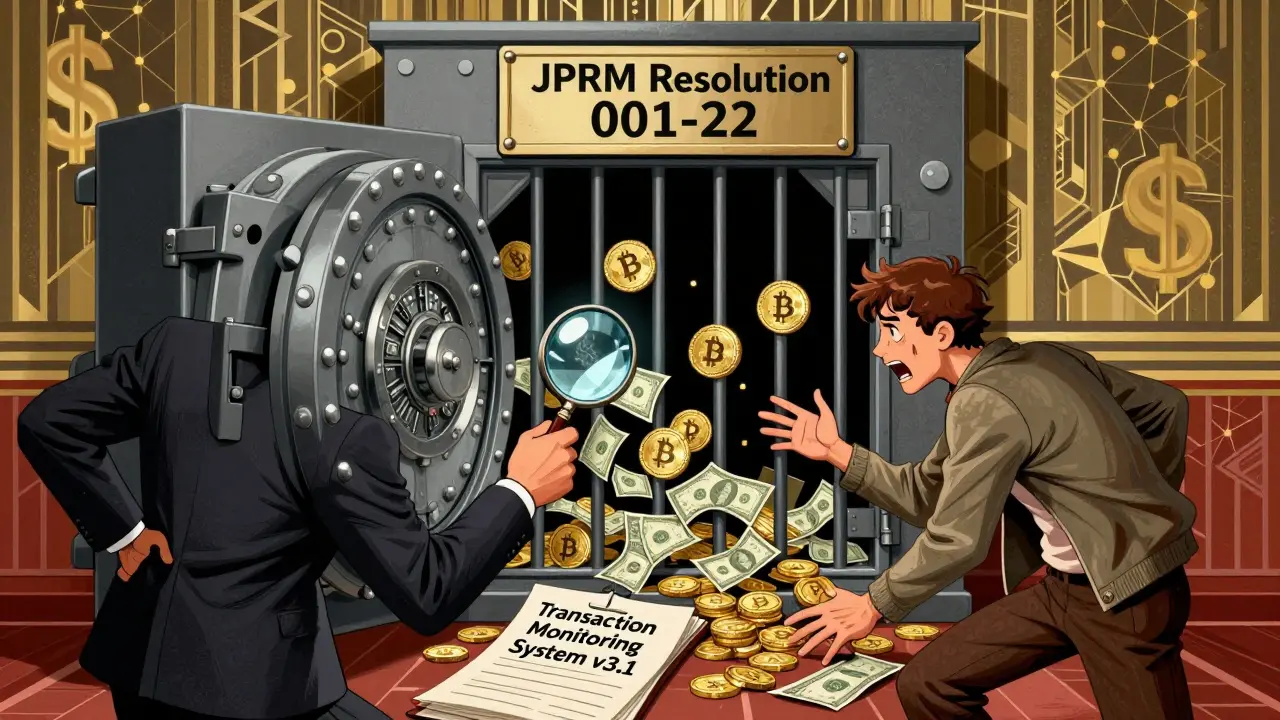
When Ecuador fully dollarized its economy in 2000, it made the US dollar the only legal tender. That decision was meant to bring stability. But in 2022, the Central Bank of Ecuador took a new step: it blocked all banking transactions involving cryptocurrency. Today, if you try to send Bitcoin to a local exchange from your Banco Pichincha account, the transaction will be flagged, frozen, or outright rejected. This isn’t a temporary policy-it’s a tightly enforced rule backed by multiple government agencies, and it’s reshaping how people in Ecuador interact with digital money.
How the Ban Works: It’s Not Just One Rule
The crypto ban in Ecuador isn’t a single law. It’s a layered system built over three years. The foundation is Article 94 of the Monetary Code, which says only the US dollar counts as legal tender. Then came JPRM Resolution 001-22 in January 2022, followed by Resolution 002-23 in March 2023. These official documents explicitly say banks and financial institutions cannot process crypto payments, deposits, or transfers. The Central Bank of Ecuador (BCE) doesn’t claim the power to ban private crypto ownership. But it has the power to ban banks from touching it-and that’s where the real control lies.The Superintendency of Banks (SB) enforces this by requiring every bank to install a Transaction Monitoring System (TMS) Version 3.1. This software is programmed to detect 47 specific patterns linked to cryptocurrency activity. If someone sends $200 or more to Binance, OKX, or Mercado Bitcoin, the system triggers an automatic alert. Banks then freeze the account for 3 to 14 days. Repeat offenses can lead to fines, sanctions, or even loss of banking privileges. As of July 2025, 47 unlicensed crypto service providers were publicly listed by the SB, and 12 financial institutions were fined a total of $1.2 million in 2024 for violating these rules.
What You Can and Can’t Do
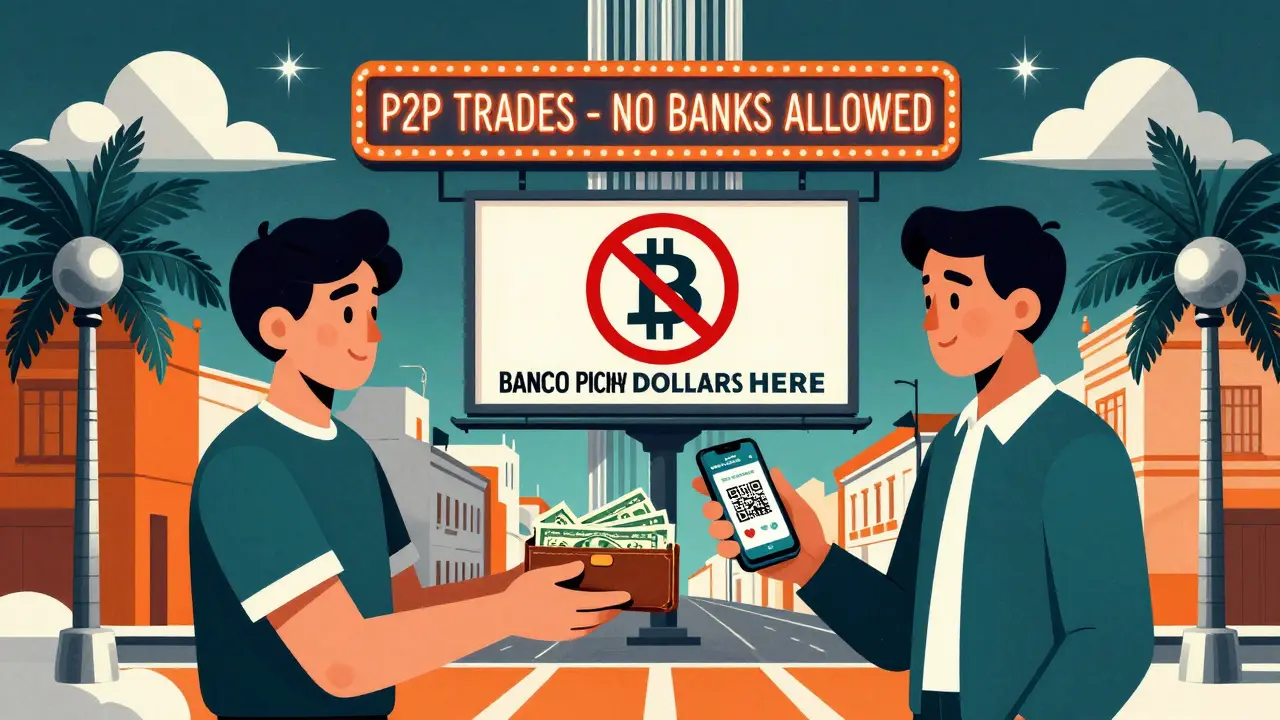
Here’s the confusing part: you can still own Bitcoin, Ethereum, or USDT. You can still buy and sell them privately. You just can’t use your bank account to do it. The ban targets financial institutions-not individuals. That creates a strange reality. People aren’t breaking the law by holding crypto. But they’re breaking bank rules by trying to move it through the system.So what’s allowed? Private peer-to-peer trades. Selling crypto to a friend in cash. Using Telegram groups to find buyers. Converting crypto to stablecoins like USDT, then trying to deposit it as a regular USD transfer (which sometimes works, but often gets flagged). You can’t use crypto to pay for groceries, rent, or services. You can’t sign contracts in Bitcoin. You can’t link a crypto wallet to your debit card. And if a business accepts crypto as payment, it risks a fine up to $50,000 under Article 144 of the Monetary Code.
The government also taxes crypto gains. The Internal Revenue Service (SRI) treats crypto profits as taxable income. Individuals pay up to 35%, corporations up to 25%. But enforcement is patchy. Many users never report because they can’t prove their transactions without bank records.
How People Are Bypassing the Ban
With banks shut off, Ecuadorians have built a shadow economy around crypto. The most common workaround? Peer-to-peer (P2P) trading. According to a July 2025 Reddit analysis of 247 user reports, 87% of those who tried bank transfers got blocked. So they turned to local sellers. A user might buy Bitcoin from someone in Quito using cash, then send the crypto to a foreign exchange like Binance. But this isn’t safe. There’s no buyer protection. Scams are common. Trustpilot reviews from Ecuadorian users show an average rating of 3.2/5 for P2P trades, mostly because of delayed payments and fraud.Another method? Stablecoins. Over 74% of surveyed users convert their crypto to USDT before attempting bank transfers. The idea is to disguise the transaction as a regular USD deposit. Some get through. Others lose funds. In Q2 2025 alone, 147 users reported frozen accounts totaling $382,000 after trying this trick. Banks are getting smarter. TMS Version 3.1 now flags even small, repeated transfers that look like stablecoin laundering.
Then there are workarounds that don’t involve banks at all: gift card exchanges, prepaid dollar cards from non-bank issuers, and cross-border services like Wise. These account for 22%, 17%, and 31% of OTC volume respectively. But they come with fees averaging 4.8%-nearly four times higher than what you’d pay in a country where crypto banking is legal.
Who’s Affected the Most?
About 385,000 Ecuadorians-2.2% of the population-use cryptocurrency. Many are young, tech-savvy, or part of the informal economy. But the biggest group? Remittance recipients. Ecuador receives over $2 billion in remittances yearly, mostly from the US. Traditional services like Western Union charge 6.5% on average. Crypto could slash that to under 1%. But with banks blocking transfers, people can’t use crypto for this. Instead, they rely on expensive middlemen or risk sending cash through informal channels.Miners are another group hit hard. In 2023, Ecuador had about 100 crypto mining operations. By mid-2025, that jumped to 1,023. But none have bank accounts. They pay for equipment, electricity, and maintenance through third-party processors charging 3-5% extra. That eats into profits. Some miners are leaving the country.
And then there are the unbanked. Over 42% of Ecuadorian adults have no bank account. For them, crypto could be a lifeline. But without access to banks, even P2P trading becomes risky. Many can’t afford smartphones, data plans, or the time to learn complex workarounds. The ban doesn’t just restrict crypto-it deepens financial exclusion.
Why Is Ecuador So Strict?
The BCE says it’s about protecting dollarization. They fear that if people start using Bitcoin or USDT as an alternative currency, confidence in the US dollar could weaken. They point to Argentina, where crypto adoption surged amid inflation and currency controls. The BCE argues Ecuador can’t afford that risk. Central Bank Advisor Dr. Carlos de la Torre told the Financial Times in May 2025: “Our dollarized economy cannot risk alternative monetary instruments that might undermine confidence in the US dollar.”But critics say the policy is backward. Dr. María Fernanda Espinosa, a former UN official, wrote in a Brookings paper that the ban creates “unnecessary friction in financial inclusion.” Her institute estimates Ecuador loses $18 million a year in potential savings from blockchain-based remittances. The IMF also raised concerns in its 2025 report, noting that 63% of crypto transactions now happen through unregulated Telegram OTC desks. That’s not safer-it’s harder to monitor, and more vulnerable to fraud.
What’s Next? A Bill That Might Change Everything
In May 2025, National Assembly member Shirley Rivera introduced Bill 6538. It proposes a legal framework for crypto exchanges. Key points: minimum $500,000 capital, mandatory proof-of-reserves audits, real-time monitoring linked to the Financial Analysis Unit (UAF), and licensing by the BCE. If passed, it could end the current gray zone.But don’t expect it soon. The bill was sent to three congressional committees. Industry analysts at Andean Financial Review estimate it will take at least 18 months to pass-if it passes at all. Meanwhile, the BCE is quietly testing a Central Bank Digital Currency (CBDC). If launched in Q4 2025 as planned, it could either compete with private crypto or coexist with it. Either way, it signals that the government is preparing for a digital future-just not one that includes Bitcoin.
The Bigger Picture: Ecuador vs. Latin America
Ecuador’s crypto market is tiny. At $185 million, it’s just 1.1% of Latin America’s total. Brazil’s is $1.2 billion. Argentina’s is $750 million. Why? Because those countries have clear rules. They license exchanges. They allow bank integration. They treat crypto like an asset class, not a threat.Ecuador’s approach has scared off investors. In 2024, only $12.7 million flowed into Ecuadorian blockchain startups. Brazil got $210 million. That’s not a coincidence. It’s policy. Startups can’t operate without banking access. Venture firms won’t fund companies that can’t move money.
And yet, demand hasn’t disappeared. It’s just gone underground. The average Ecuadorian crypto user maintains 3.2 separate exchange accounts and spends 8.7 hours a month managing transfers-nearly four times longer than users in Colombia, where the rules are clearer. That’s not innovation. That’s friction.
What Should You Do If You’re in Ecuador?
If you’re using crypto here, you’re navigating a minefield. Here’s what works:- Use P2P platforms like LocalBitcoins or Paxful with trusted traders. Avoid large transfers.
- Stick to USDT. It’s the most reliable stablecoin for moving value in Ecuador.
- Never try to deposit crypto directly into your bank account. Use cash or gift cards instead.
- Keep records of every transaction-even if you don’t report it. You’ll need them if something goes wrong.
- Use non-bank payment services like Wise for cross-border transfers. They’re your best bet.
- Don’t use crypto to pay for goods or services. You’re asking for trouble.
And if you’re thinking of starting a crypto business? Forget it. You’ll need $200,000 in capital, a legal entity, and 17 business days just to verify your identity. There are only three law firms in the whole country that specialize in crypto. Good luck finding help.
Can I legally own cryptocurrency in Ecuador?
Yes. Ecuador does not ban private ownership or trading of cryptocurrency. You can buy, hold, and sell Bitcoin, Ethereum, or stablecoins without breaking the law. The ban only applies to banks and financial institutions-they cannot process, facilitate, or support crypto transactions. Your personal wallet is not illegal.
Why do banks block crypto transactions?
Banks are legally required to block crypto transactions under resolutions issued by the Junta de Política y Regulación Monetaria y Financiera (JPRM). The Central Bank of Ecuador mandates that all financial institutions use a Transaction Monitoring System that flags over 47 crypto-related patterns. Violations risk fines, sanctions, or loss of operating licenses. Banks comply to avoid penalties.
Can I use crypto to send money to family abroad?
Not through banks. You can send crypto to someone overseas, but they won’t be able to cash it out easily in Ecuador if they’re using local banks. The best option is to send crypto to a trusted recipient who can convert it to cash locally and send you USD via a non-bank service like Wise or Western Union. This avoids banking restrictions but adds complexity and fees.
Are there any legal crypto exchanges in Ecuador?
No. As of 2025, there are no licensed crypto exchanges operating in Ecuador. All exchanges, including Binance and OKX, are considered unauthorized by the Superintendency of Banks. They operate through P2P channels, not direct bank integrations. Any company claiming to be a licensed Ecuadorian exchange is likely misleading users.
What happens if I get caught using crypto through my bank?
Your account will likely be frozen for 3-14 days. First-time offenders usually get a warning and temporary hold. Repeat violations can lead to permanent account closure, reporting to the Superintendency of Banks, or even being added to a national financial blacklist. You won’t be arrested, but you’ll lose access to your money and may face difficulty opening new accounts.
Will Ecuador ever lift the crypto ban?
It’s possible, but not soon. Bill 6538 proposes a licensing system, but it’s stuck in committee and could take 18+ months to pass. The Central Bank is also testing a digital currency (CBDC), which may replace private crypto rather than coexist with it. Unless pressure from users, remittance needs, or regional trends forces change, the ban is likely to stay in place through 2027.
Final Thoughts
Ecuador’s crypto ban isn’t about stopping innovation. It’s about control. The government wants to keep the US dollar as the only digital lifeline for its economy. But in doing so, it’s cutting off millions from a tool that could reduce fees, increase access, and empower the unbanked. The ban works for banks. It doesn’t work for people.For now, crypto in Ecuador exists in the shadows-in Telegram chats, cash deals, and risky P2P trades. It’s not dead. But it’s not thriving either. And until the rules change, that’s the reality for anyone trying to use digital money in a country that refuses to acknowledge it exists.


Paul Jardetzky
February 3, 2026 AT 08:00Jim Laurie
February 4, 2026 AT 13:39Brendan Conway
February 5, 2026 AT 09:11Katie Haywood
February 5, 2026 AT 12:42Matt Smith
February 6, 2026 AT 23:52Alex Garnett
February 8, 2026 AT 10:17Ryan Chandler
February 8, 2026 AT 15:40Ajay Singh
February 9, 2026 AT 22:31Olivette Petersen
February 10, 2026 AT 11:03Michelle Anderson
February 11, 2026 AT 00:41Danica Cheney
February 11, 2026 AT 16:46Kyle Pearce-O'Brien
February 11, 2026 AT 22:24Matthew Ryan
February 12, 2026 AT 08:36Nathaniel Okubule
February 12, 2026 AT 19:43Shruti Sharma
February 13, 2026 AT 16:21Robin Ødis
February 14, 2026 AT 23:20sabeer ibrahim
February 15, 2026 AT 17:56David Bain
February 16, 2026 AT 23:23