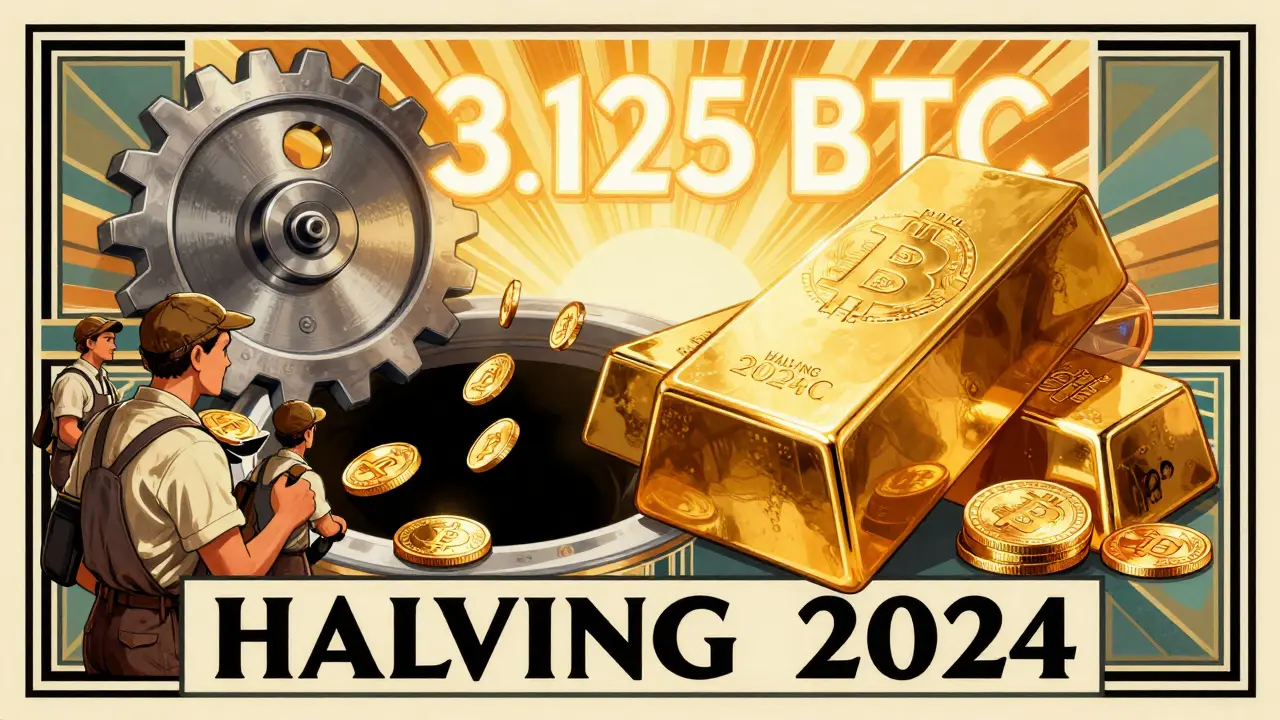
Bitcoin doesn’t work like any other asset. It doesn’t have a central bank printing more money. It doesn’t have companies issuing more shares. Its supply is locked in code - and every four years, it cuts itself in half. This isn’t a rumor. It’s not a prediction. It’s a hardcoded event that’s happened three times already and happened again in April 2024. The Halving Supply Shock Theory says this isn’t just a technical detail - it’s the core reason Bitcoin’s price moves the way it does.
What Exactly Happens During a Bitcoin Halving?
Every 210,000 blocks - roughly every four years - the reward miners earn for securing the Bitcoin network gets cut in half. It started at 50 BTC per block in 2009. Then it dropped to 25 in 2012, then 12.5 in 2016, then 6.25 in 2020. On April 19, 2024, it dropped again - to 3.125 BTC per block. That’s a 50% drop in new Bitcoin entering circulation overnight.
This isn’t a soft adjustment. It’s not a suggestion. It’s enforced by the Bitcoin protocol itself. The code doesn’t care about market sentiment, political pressure, or economic crises. It just runs. And every time it runs this code, it removes half the new supply.
Why does this matter? Because Bitcoin has a fixed maximum supply: 21 million coins. By 2023, nearly 19.7 million were already in circulation. That means less than 1.3 million remain to be mined - and each halving slows how fast they’re released. Post-2024, Bitcoin’s annual inflation rate dropped below 1.7%. Compare that to the U.S. dollar, which saw M2 money supply grow over 40% between 2020 and 2022. Bitcoin is designed to get scarcer over time. That’s the point.
The Supply Shock Mechanism
Think of supply and demand like a seesaw. If demand stays steady and supply suddenly drops, the price should rise. That’s basic economics. The Halving Supply Shock Theory says Bitcoin’s halving events are the most predictable supply shocks in history.
Before each halving, miners are producing a certain amount of new Bitcoin every day. After the halving? Half. That means less Bitcoin is being sold by miners to cover electricity and equipment costs. Less selling pressure. Meanwhile, demand doesn’t vanish - it often grows. More people hear about Bitcoin. More institutions get involved. More wallets are created.
Historical data backs this up. After the 2012 halving, Bitcoin went from $12 to over $1,100 in the next 12 months. After 2016, it rose from $650 to nearly $20,000. After 2020, it jumped from $8,800 to $69,000. Those aren’t coincidences. They’re patterns. Each time, the market had to absorb a 50% drop in new supply - and demand kept climbing.
Why It’s Not Always That Simple
But here’s the catch: the theory doesn’t always play out perfectly. The 2022 bear market, which followed the 2020 halving, saw Bitcoin drop 65% despite the supply cut. Why? Because macro forces overwhelmed it. The Federal Reserve raised interest rates. Crypto lending platforms collapsed. Investors pulled money out of riskier assets. The halving happened - but the world outside Bitcoin was in chaos.
Another problem: Bitcoin’s market cap has grown massively. In 2012, Bitcoin’s total value was under $1 billion. By 2024, it hit $1.2 trillion. A 50% drop in new supply doesn’t move the needle the same way it used to. Back then, halving removed 1,800 BTC per day. Now, it removes 450 BTC per day. To move the price, you need way more demand to absorb that reduced supply.
And then there’s the rise of institutional buyers. BlackRock, Fidelity, and others now control billions in Bitcoin through spot ETFs. Their buying decisions aren’t driven by halving hype. They’re driven by portfolio strategy, regulation, and macro trends. That means the old narrative - “buy before the halving” - doesn’t work the same way anymore.

Miners Are the Real Test
One of the most overlooked parts of the halving is what happens to miners. They’re the ones who produce new Bitcoin. When their reward drops by half, their revenue drops by half - but their costs don’t. Electricity, hardware, cooling, labor - all stay the same.
That’s why the days after a halving are brutal for small miners. If they’re using old ASICs or paying high electricity rates, they can’t survive. In 2024, many miners in China and Russia were already shut down before the halving even happened. In the U.S., miners with electricity costs above $0.05 per kWh struggled. Arcane Research estimated that 45% of small-scale operators would exit the network after the April 2024 cut.
But here’s the beauty of Bitcoin: the network adjusts. Every two weeks, the mining difficulty resets. If hash rate drops too much - meaning fewer miners are competing - the difficulty lowers. That lets the remaining miners keep producing blocks. It’s self-correcting. The network doesn’t break. It just gets leaner.
Is the Theory Still Valid in 2026?
By March 2026, we’re over a year past the 2024 halving. What happened? Bitcoin didn’t hit $100,000. It didn’t crash. It stabilized around $70,000-$80,000. So is the theory dead?
No. But it’s evolved.
The old model - “halving = price surge” - was based on a smaller, more speculative market. Now, Bitcoin is a global asset with institutional ownership, regulatory frameworks, and ETFs that move billions daily. The halving still creates a supply shock. But it’s no longer the only driver.
Think of it like this: the halving is the spark. But now, the fuel is institutional demand, macro policy, and global adoption. The spark still matters - but if the fuel isn’t there, the fire won’t catch.
Here’s what we know for sure: Bitcoin’s supply schedule is unchanged. The next halving is in 2028. The one after that in 2032. And each time, the new supply drops by half. That’s a guarantee. No central bank can change it. No government can override it. That’s why it’s still the most reliable scarcity mechanism in finance.

What Should You Watch For?
If you’re trying to understand Bitcoin’s price movements, don’t just look at the halving. Look at the bigger picture:
- Miner reserves: Are miners holding onto Bitcoin or selling it? Glassnode data showed miner reserves dropped 22% after the 2020 halving - a sign they weren’t selling. Watch for similar trends.
- ETF inflows: Since 2024, spot Bitcoin ETFs have brought in over $34 billion. That’s more than the entire market cap in 2016. This is now the biggest demand driver.
- Hash rate recovery: After a halving, the network hash rate usually dips - then rebounds as new, more efficient miners enter. A strong rebound signals long-term confidence.
- Transaction fees: As block rewards shrink, fees become more important. If fees rise above $5 per transaction, Bitcoin’s security model shifts from subsidy to fee-based - a major milestone.
The Halving Supply Shock Theory isn’t a magic bullet. But it’s still the foundation. Bitcoin was built on scarcity. And scarcity doesn’t disappear just because the world gets bigger. It just gets harder to move.
What Comes Next?
By 2036, Bitcoin’s block reward will fall below 0.01 BTC. At that point, transaction fees will need to cover 95% of miner revenue. That’s the real test. Can Bitcoin’s network stay secure without inflationary subsidies?
If it can - then the halving theory isn’t just about price. It’s about proving that a decentralized, algorithmic system can enforce scarcity better than any government or bank. And that’s worth more than any price prediction.
What is the Halving Supply Shock Theory?
The Halving Supply Shock Theory states that Bitcoin’s programmed reduction of block rewards by 50% every four years creates a supply shock that, under constant or growing demand, leads to upward price pressure. This mechanism was designed by Satoshi Nakamoto to mimic the scarcity of precious metals, making Bitcoin a deflationary asset over time.
How many times has Bitcoin halved so far?
Bitcoin has halved four times: November 28, 2012 (50 BTC to 25 BTC), July 9, 2016 (25 BTC to 12.5 BTC), May 11, 2020 (12.5 BTC to 6.25 BTC), and April 19, 2024 (6.25 BTC to 3.125 BTC). The next halving is expected in 2028.
Does the halving always cause Bitcoin to go up?
Not always. While historical data shows strong price increases after the first three halvings, the 2022 bear market followed the 2020 halving, with Bitcoin dropping 65%. This shows that macroeconomic factors - like rising interest rates or financial crises - can override the supply shock effect. The theory works best when demand is strong and external shocks are minimal.
Why do miners struggle after a halving?
Miners earn Bitcoin as a reward for securing the network. After a halving, their reward is cut in half - but their costs (electricity, hardware, cooling) stay the same. Miners with high operating costs or outdated equipment often shut down. This causes a temporary drop in network hash rate until difficulty adjusts and more efficient miners enter the market.
Is Bitcoin’s halving similar to gold mining?
Yes, in concept. Gold mining becomes harder and more expensive over time, so new supply grows slowly - about 0.7% annually in 2023. Bitcoin’s halving mimics this by reducing new supply at predictable intervals. Unlike gold, however, Bitcoin’s supply schedule is mathematically fixed and transparent, with no uncertainty about future issuance.
What role do Bitcoin ETFs play in the halving theory?
ETFs have become the dominant source of demand for Bitcoin since 2024. With over $34 billion in inflows by March 2024, institutional buying now outweighs retail speculation. This means price movements are less about halving hype and more about macroeconomic flows - changing how the supply shock interacts with market dynamics.



Jeffrey Dean
March 4, 2026 AT 10:43Julie Potter
March 5, 2026 AT 20:31Leah Dallaire
March 5, 2026 AT 21:00Basil Bacor
March 6, 2026 AT 02:16Emily Pegg
March 6, 2026 AT 03:44Ethan Grace
March 7, 2026 AT 08:05Jamie Hoyle
March 8, 2026 AT 22:07Brian T
March 10, 2026 AT 12:04Nash Tree Service
March 11, 2026 AT 13:54Ken Kemp
March 12, 2026 AT 16:28Jonathan Chretien
March 14, 2026 AT 06:53Bill Pommier
March 15, 2026 AT 15:45Olivia Parsons
March 16, 2026 AT 09:27Nick Greening
March 18, 2026 AT 08:10