
Imagine trying to catch a thief who never leaves fingerprints, pays in invisible cash, and operates across borders without a passport. That’s the nightmare scenario for regulators before blockchain analytics matured. Today, authorities aren’t just guessing; they are tracing every digital penny with surgical precision. Blockchain forensics is the investigative discipline that allows law enforcement and financial institutions to trace cryptocurrency transactions on public ledgers, linking anonymous wallet addresses to real-world identities and sanctioned entities. If you’re running a crypto business or holding significant assets, understanding how this works isn’t optional-it’s survival.
The Shift from Manual Hunting to Automated Tracing
Back in 2016, when investigators tackled the Helix case, they were doing it the hard way. Larry Dean Harmon ran a mixing service that laundered over $300 million from darknet markets. Investigators had to manually review hundreds of thousands of transactions to spot commission payment patterns. It was slow, painful, and prone to error. Harmon didn’t plead guilty until August 2021, and sentencing came only in November 2024. That lag time? Gone. Modern tools automate pattern recognition instantly.
Today’s platforms don’t just look at one chain. They track funds as they hop between Bitcoin, Ethereum, and newer networks like Solana. This cross-chain visibility is critical because criminals rarely stay on one blockchain. They bridge assets to confuse trackers. Advanced systems use algorithms like Personalized PageRank to map these hidden paths. For instance, recent academic methods like MPOCryptoML have improved detection accuracy by over 10% compared to older models. These tools identify complex laundering formations-like fan-in/fan-out or gather-scatter patterns-that human eyes might miss in a sea of data.
How Sanctions Detection Actually Works
Detecting sanctions evasion is different from general money laundering tracking. It requires knowing exactly who is banned and where their money goes. Organizations like TRM Labs a leading blockchain intelligence firm monitor specific wallets linked to sanctioned entities such as those in Iran, Russia, or North Korea. When a transaction touches a known high-risk address, the system flags it immediately.
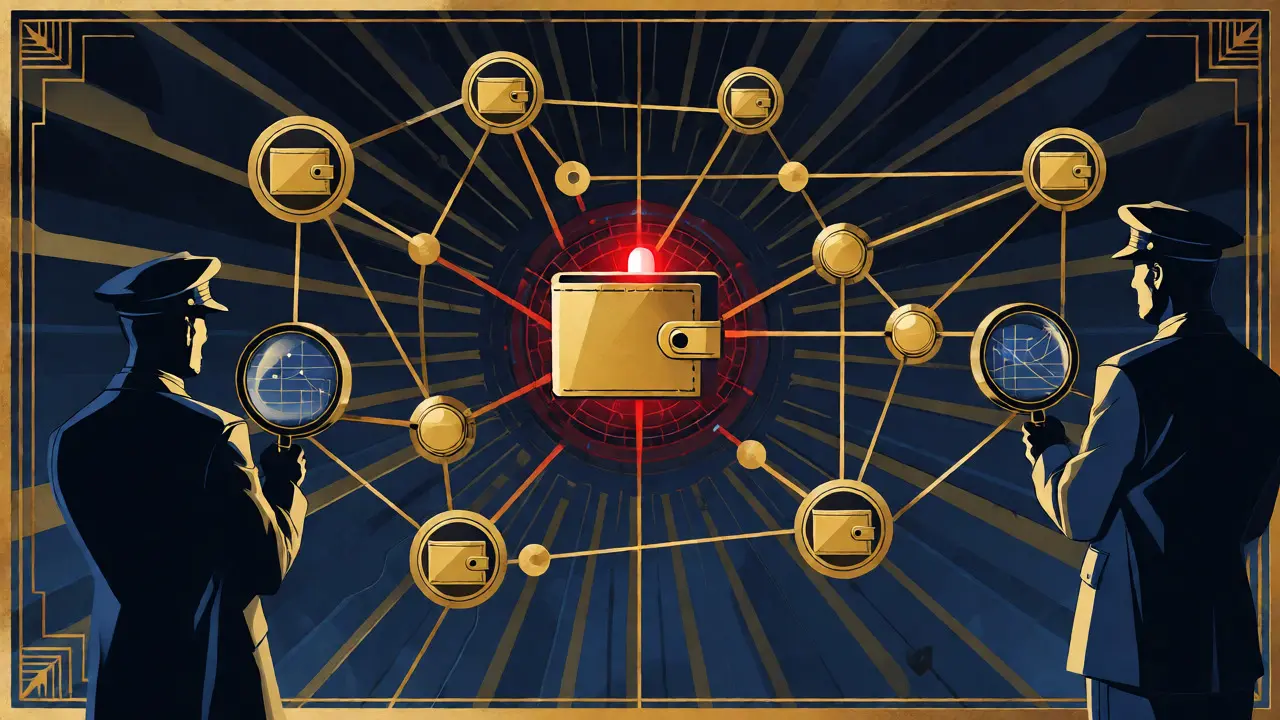
But it’s not just about direct hits. Sophisticated actors use intermediate wallets to obscure connections. Authorities now employ graph analysis to see two or three hops away. If Wallet A sends to Wallet B, which sends to a known sanctioned exchange, the risk propagates backward. This probabilistic scoring helps exchanges decide whether to freeze funds or file a Suspicious Activity Report (SAR). The goal is to stop the flow before it integrates into the traditional banking system.
The Toolkit: Who Are the Key Players?
You’ve probably heard of Elliptic. It’s one of the most battle-tested names in the space. Their platform visualizes fund flows through entire ecosystems, helping banks and exchanges like Bitget maintain compliance. But they aren’t alone. Chainalysis and TRM Labs offer similar capabilities, each with unique strengths in coverage and algorithmic depth.
| Provider | Primary Strength | Key Feature | Best For |
|---|---|---|---|
| Elliptic | Global Compliance | Cross-chain risk detection | Banks & Exchanges |
| Chainalysis | Law Enforcement | Reactor investigation tool | Police & Agencies |
| TRM Labs | Sanctions Focus | Real-time API monitoring | Fintech & Startups |
Choosing the right provider depends on your needs. Law enforcement often prefers Chainalysis for its deep historical database and court-admissible evidence trails. Financial institutions lean toward Elliptic or TRM Labs for automated, real-time screening that plugs directly into their transaction processing engines.
Beating Privacy Tools: Mixers and Obfuscation
Criminals love mixers. Services like Tornado Cash or Wasabi break the link between sender and receiver by pooling funds. This makes tracing difficult, but not impossible. Forensic analysts look for behavioral anomalies. Did a large amount enter a mixer and exit in equal-sized chunks shortly after? That’s a classic obfuscation tactic. Authorities also correlate off-chain data. If an undercover agent transfers BTC into a mixer and then receives a payout at a specific exchange, that timing gap becomes a clue.
Moreover, privacy coins themselves are under scrutiny. While Monero offers strong anonymity, its usage is declining in regulated jurisdictions because exchanges delist it to avoid compliance headaches. Regulators argue that if you can’t audit the source of funds, you can’t ensure they aren’t tied to terrorism financing or drug trafficking.

Why Your Business Needs This Now
If you operate a Virtual Asset Service Provider (VASP), you are legally required to know your customer. Ignorance is no longer a defense. Regulatory bodies monitor systemic risks by analyzing cross-border money laundering trends. If your platform processes payments from a wallet linked to a sanctioned entity, you could face massive fines. The Internet Watch Foundation, for example, uses these tools to disrupt child abuse content monetization via crypto, showing the scope extends beyond finance.
Implementing these solutions isn’t cheap or easy. It requires specialized teams trained in both traditional financial crime and blockchain tech. Companies spend months integrating APIs and tuning risk thresholds. False positives can frustrate users, while false negatives expose you to legal risk. That’s why many firms outsource this to providers who offer continuous updates as new laundering techniques emerge.
The Future: AI and Permanent Records
Here’s the kicker: blockchain records are permanent. Unlike bank statements that get archived or lost, every transaction ever made on Bitcoin remains visible forever. As more data accumulates, forensic power increases. Patterns that were ambiguous in 2020 become crystal clear in 2026. New protocols like the Internet Computer Protocol (ICP) are being integrated into these frameworks, allowing institutions to trade emerging assets confidently.
Expect AI to take over more of the heavy lifting. Machine learning models will predict potential sanctions evasion before it happens, based on historical behavior of similar wallet clusters. The cat-and-mouse game continues, but currently, the mouse has fewer places to hide.
Can authorities truly de-anonymize Bitcoin transactions?
Yes, though it’s challenging. While Bitcoin is pseudonymous, blockchain forensics combines on-chain data with off-chain information (like KYC data from exchanges) to attribute transactions to real individuals. High-value transactions or those involving known services are easier to trace than small, random peer-to-peer transfers.
What happens if my wallet interacts with a sanctioned address?
Your transaction may be flagged as high-risk. Depending on the severity and the policy of your exchange or bank, your funds could be frozen, or you might be asked to provide proof of origin. In severe cases, accounts may be closed to prevent regulatory penalties.
Are privacy coins like Monero safe from sanctions detection?
They are harder to trace due to built-in privacy features, but not immune. If a user converts Monero back to fiat or major cryptocurrencies like Bitcoin at a regulated exchange, the final step reveals identity. Additionally, behavioral analysis can sometimes infer patterns even within private chains.
How do mixers affect sanctions compliance?
Mixers complicate compliance by breaking the transaction trail. Many regulators view mixer usage itself as a red flag. Some jurisdictions have outright banned interactions with certain mixers (like Tornado Cash), requiring businesses to block any transactions associated with them regardless of the underlying intent.
Do I need expensive software to check my own transactions?
For personal use, free explorers provide basic visibility. However, for accurate risk scoring and sanctions checking, paid subscriptions to services like Chainalysis or TRM Labs are recommended. They provide context and risk scores that raw blockchain data cannot offer alone.