Russian Crypto Withdrawal Risk Calculator
Check Your Withdrawal Risk
Enter your withdrawal details to see if your transaction would trigger Russian bank restrictions based on Directive No. 74-P.
If you’ve ever tried to turn cryptocurrency into cash in Russia, you already know it’s not as simple as hitting a withdraw button. Since September 2025, Russian banks have been operating under a new, tightly controlled system that treats crypto-to-fiat withdrawals like potential fraud-until proven otherwise. It’s not about suspicion. It’s about systemic control.
What Happens When You Withdraw Crypto to Fiat in Russia?
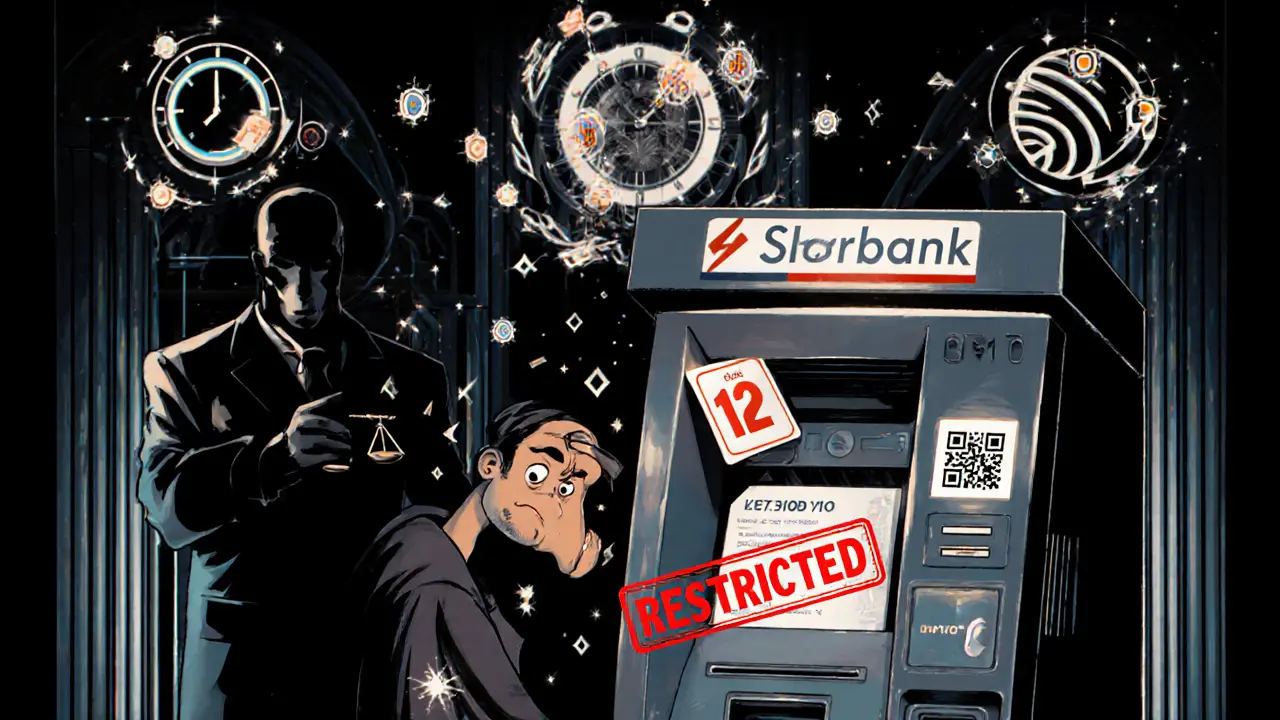
Let’s say you sold 0.5 BTC on Paxful and received 150,000 rubles in your Sberbank account. You go to an ATM to pull out 70,000 rubles in cash. Within minutes, your card gets blocked. You get an SMS: "Your withdrawal has been restricted due to suspicious activity. Daily limit: 50,000 rubles for the next 48 hours." That’s not a glitch. That’s policy. The Central Bank of Russia (CBR) rolled out Directive No. 74-P in August 2025, requiring all 347 licensed banks to monitor 12 specific transaction patterns tied to cryptocurrency activity. These aren’t random rules. They’re engineered to catch crypto users in real time. Here’s what triggers a freeze:- Withdrawals between 11 PM and 5 AM
- Amounts not divisible by 1,000 rubles (e.g., 65,000 instead of 64,000 or 66,000)
- Using ATMs more than 50 km from your registered address
- Scanning QR codes or using virtual cards instead of physical ones
- Receiving a large transfer (over 200,000 rubles) via Russia’s Faster Payments System, then withdrawing cash within 24 hours
- Getting 3+ messages from unknown numbers within 6 hours before withdrawal
- Device fingerprints suggesting malware or remote access
Why Is Russia Doing This?
The official reason? Fraud. In Q2 2025, Russian banks reported 273,100 scams totaling 6.3 billion rubles. The CBR says 89% of those cases involved cryptocurrency conversion at some point. That’s the number they use to justify the crackdown. But the real motive is deeper. Russia doesn’t want its citizens using crypto to bypass sanctions or move money out of the country. Crypto has become a key tool for cross-border payments-37.2% of all foreign currency withdrawals now come from crypto sources, according to Finance Minister Anton Siluanov’s October 2025 report. The government’s goal isn’t to eliminate crypto. It’s to control it. They’re creating a two-tier system:- Domestically: Crypto use is restricted, monitored, and punished.
- Internationally: Crypto is allowed-under strict supervision-for foreign trade settlements.
How Are Banks Enforcing These Rules?
All major banks-Sberbank, VTB, Tinkoff-have upgraded their systems. Sberbank alone hired 217 new analysts to monitor crypto-related transactions. Their compliance teams now work 24/7, reviewing flagged withdrawals that average 18.7 hours to process-up from 2.3 hours before September 2025. When a transaction triggers a red flag, the bank doesn’t just freeze your card. They send you an SMS within 15 minutes, then lock your withdrawal limit. You can still receive money. You can still pay bills. But you can’t take cash out beyond 50,000 rubles per day for two full days. To get your limit restored, you must prove the crypto came from a legitimate source. That means:- Notarized transaction history from the exchange
- Proof of identity linked to your wallet
- Documentation showing how you acquired the crypto (mining, employment, sale of goods)

What Are Users Really Experiencing?
On Russian forums like BitBoom and Reddit’s r/RussianCrypto, people are sharing horror stories:- A student in Kazan got his account frozen for 72 hours after cashing out 65,000 rubles from a Paxful trade. He had to show a notarized letter from the buyer proving the transaction was real.
- A freelancer in Novosibirsk lost 11 days of access to his funds after withdrawing 80,000 rubles. His bank demanded a 6-month bank statement showing consistent income-something he didn’t have because he got paid in crypto.
- Tinkoff Bank’s Trustpilot rating dropped from 4.3 stars in August 2025 to 2.1 in September. Seventy-eight percent of complaints mention crypto withdrawal blocks.
Are There Workarounds? Yes-but They’re Risky
Some users have found ways to adapt. Not legally. Just practically. One common tactic: using multiple bank accounts. Active traders now average 3.7 accounts across different banks. They stagger withdrawals-$600 here, $600 there-trying to avoid triggering cross-institutional monitoring algorithms. But this is dangerous. Banks now track activity across institutions. If you move money between Sberbank and VTB in a pattern that looks like layering, you could be flagged for money laundering. Another trick: building a “natural” transaction history. Legal expert Alexey Likhunov advises users to use their bank cards for regular spending-groceries, gas, subscriptions-for at least three months before attempting a crypto withdrawal. Transactions that look like a normal person’s behavior face 73% fewer restrictions. There’s also a black market emerging. Criminal intermediaries now charge 7-12% to “clear” crypto withdrawals for you. They use shell companies, fake invoices, and front accounts to make your cash withdrawal look “clean.” But if you get caught, the penalties could be severe.
What’s Coming Next?
The restrictions aren’t over. They’re just getting started. By December 1, 2025, banks will be required to verify the source of any crypto withdrawal over 100,000 rubles. That’s double the current limit. And legislation is already moving through the Duma to introduce criminal penalties for repeat violations. Under the proposed law:- First offense: fine up to 500,000 rubles
- Second offense: up to 2 years in prison
- Organized schemes (multiple accounts, multiple users): up to 10 years in prison
Is This Legal? Is This Fair?
The CBR argues these measures protect consumers and maintain financial stability. But critics say the opposite. Professor Ivan Zhdanov of the Moscow Financial and Industrial University says these rules push crypto underground, increasing risk, not reducing it. Rosfinmonitoring recorded a 22% spike in unregulated exchange activity after the rules took effect. And here’s the irony: while ordinary Russians are being locked out of their own money, banks are being allowed to trade crypto-up to 1% of their capital-under strict reserve rules. The state is creating a legal, controlled crypto market for big institutions while crushing the one used by regular people. It’s not about security. It’s about control.What Should You Do If You’re in Russia?
If you’re holding crypto and need to turn it into cash:- Don’t withdraw large amounts at once. Split them into smaller, regular transactions.
- Use the same bank card for everyday spending for at least 90 days before converting crypto.
- Avoid ATMs far from your registered address. Stick to branches you’ve used before.
- Keep records-even if the exchange doesn’t give them. Save screenshots, chat logs, wallet addresses.
- Never use unverified P2P sellers. Stick to known, documented contacts.
- Understand that your bank may treat you as a suspect until you prove otherwise.
Can Russian banks block my account if I withdraw crypto to fiat?
Yes. Russian banks can and do block accounts temporarily when crypto-to-fiat withdrawals trigger their monitoring system. The standard response is a 48-hour withdrawal limit of 50,000 rubles, followed by mandatory in-person verification. Accounts are not permanently closed unless fraud is proven, but repeated triggers can lead to permanent restrictions or legal action.
What is the daily withdrawal limit for crypto-related transactions in Russia?
The daily cash withdrawal limit for flagged crypto-related transactions is 50,000 rubles (approximately $600 USD). This limit applies for 48 hours after a transaction triggers one of 12 monitoring criteria set by the Central Bank of Russia. After the 48-hour window, the limit is lifted only after the bank completes verification of the transaction source.
Do I need to prove where my crypto came from to withdraw cash?
Yes. If your withdrawal is flagged, Russian banks require you to provide notarized documentation proving the origin of your cryptocurrency. This includes wallet addresses, transaction IDs, exchange records, and sometimes even proof of income or purchase receipts. Decentralized platforms like Bisq or LocalBitcoins do not provide this paperwork, making withdrawals from them extremely difficult.
Are there legal ways to convert crypto to rubles in Russia?
Yes, but only through regulated channels. The Central Bank of Russia allows licensed exchanges and payment processors to facilitate crypto-to-ruble conversions. These platforms must comply with strict KYC and AML rules. However, even these services are now subject to withdrawal limits and monitoring. For most individuals, the legal path is slow, paperwork-heavy, and restricted.
What happens if I try to withdraw more than 50,000 rubles after a crypto deposit?
If you attempt to withdraw more than 50,000 rubles in a single day after a crypto deposit, your transaction will be automatically blocked. You’ll receive an SMS notification within 15 minutes. To proceed, you must visit your bank branch with documentation proving the legitimacy of the crypto source. Without this, the restriction remains for the full 48-hour period, even if you only tried to withdraw once.
Is it illegal to hold cryptocurrency in Russia?
No, it is not illegal to hold cryptocurrency in Russia. You can buy, hold, and transfer crypto legally. The restrictions apply only to converting it into fiat currency and withdrawing cash. The government is focused on controlling the movement of money-not ownership of digital assets. However, future legislation may tighten this further.
Will Russia ban cryptocurrency entirely?
A full ban on holding crypto is unlikely, but a ban on private crypto-to-fiat conversion is highly probable. Experts predict Russia will fully prohibit unregulated cryptocurrency circulation within 6-8 months. The government is moving toward a state-controlled digital ruble and institutional crypto use for foreign trade, while eliminating personal access to crypto as a financial tool.



Kelly McSwiggan
November 14, 2025 AT 04:02So let me get this straight - you can’t withdraw cash unless your amount is divisible by 1,000? That’s not anti-fraud, that’s just *silly*. Next they’ll require you to wear a hat while using the ATM. 🤡
Cody Leach
November 14, 2025 AT 11:03They’re not trying to stop fraud. They’re trying to stop people from having any financial autonomy. This is control dressed up as security. The fact that banks are allowed to trade crypto themselves while crushing ordinary users? That’s the real story.
Byron Kelleher
November 15, 2025 AT 10:24Man, I feel for anyone trying to cash out crypto in Russia right now. It’s like the system was designed to make you feel guilty for just wanting to use your own money. But hey - if you’ve got a few months to build up a normal spending history, you might just squeak by. Stay patient, stay low-key.
Cherbey Gift
November 16, 2025 AT 10:51Imagine a world where your heartbeat gets flagged if it’s irregular - that’s what this is. They don’t trust your money, they don’t trust your choices, they don’t trust your life. And now they want to make you beg for permission to touch your own wealth? This isn’t regulation. This is spiritual theft.
Anthony Forsythe
November 17, 2025 AT 22:07There’s a quiet horror here that no one’s talking about - the erosion of dignity. You’re not just being restricted, you’re being *othered*. Treated like a criminal because you used technology to escape an economy that’s collapsing under its own weight. The state doesn’t want you to be free - it wants you to be predictable. And predictability is the new slavery.
Kandice Dondona
November 18, 2025 AT 08:24So sad 😔 but also so real. I’ve seen friends in Russia go through this - it’s not just about money, it’s about feeling like you’re under constant surveillance. Keep your records, keep your head down, and don’t give up. 💪❤️
Becky Shea Cafouros
November 18, 2025 AT 12:02The 50,000 ruble daily limit is arbitrary and inconsistent with global financial norms. While the intention may be to combat illicit activity, the collateral damage to legitimate users is severe and disproportionate.
Drew Monrad
November 19, 2025 AT 15:23Oh please. Russia’s not cracking down on crypto - they’re just jealous. The West has Bitcoin. The East has… the digital ruble? That’s not innovation, that’s a glorified spreadsheet. If they wanted real security, they’d stop treating citizens like toddlers with credit cards.
sandeep honey
November 20, 2025 AT 15:10What’s the point of crypto if you can’t spend it? This is just a way to force people into the state’s digital ruble. They want total control - no anonymity, no freedom, no escape. This is the future they’re building.
Mandy Hunt
November 21, 2025 AT 08:11They’re lying about fraud. This is all about tracking you. Every ATM visit, every transaction, every phone number - they’re building a database. And when the digital ruble launches? You won’t even know you’re trapped. They’ve been planning this for years
anthony silva
November 21, 2025 AT 09:05So you can’t withdraw 65k but you can withdraw 64k? That’s not a policy, that’s a joke. And the fact that banks are hiring 200+ analysts to watch people’s withdrawals? Someone’s got a big ego and zero real problems to solve
David Cameron
November 21, 2025 AT 21:16Control isn’t security. Control is fear dressed in compliance. The state doesn’t fear criminals - it fears people who don’t need its permission to live. Crypto is the quiet rebellion they can’t tolerate. So they turn banks into jailers.
Sara Lindsey
November 22, 2025 AT 11:08I know someone who used three different banks and spaced out withdrawals over weeks - finally got it through. It’s exhausting but doable. Just don’t panic, don’t rush, and keep receipts even if you think they’re useless. You never know when they’ll save you
Albert Melkonian
November 23, 2025 AT 12:03While the policy appears draconian, it is not without precedent in nations seeking to preserve monetary sovereignty. The central bank’s approach, though invasive, reflects a broader global trend toward financial traceability - especially in jurisdictions facing sanctions pressure. The challenge lies not in the intent, but in the implementation. A more nuanced tiered system, allowing for pre-verified users to bypass certain thresholds, could balance security with civil liberty. As a scholar of financial regulation, I urge policymakers to consider differential treatment based on transaction history and user verification status - not blanket suspicion.
alex piner
November 25, 2025 AT 02:27bro this is wild but honestly if you just chill and use the same card for groceries and gas for a few months it kinda works. i heard someone do it. no drama. just be boring. banks hate boring people 😅