You’ve probably felt it. You try to send a small amount of crypto, maybe $10 for a coffee or an NFT mint, and the network fee hits you with a slap-sometimes costing more than the transaction itself. Or worse, your transaction sits in the mempool for hours because the main chain is clogged. This isn’t just annoying; it’s a fundamental bottleneck that stops blockchain from being used by regular people. The problem? Blockchain scalability on Layer 1 networks like Bitcoin and Ethereum is limited by design. They prioritize security and decentralization over speed. That’s where Layer 2 comes in.
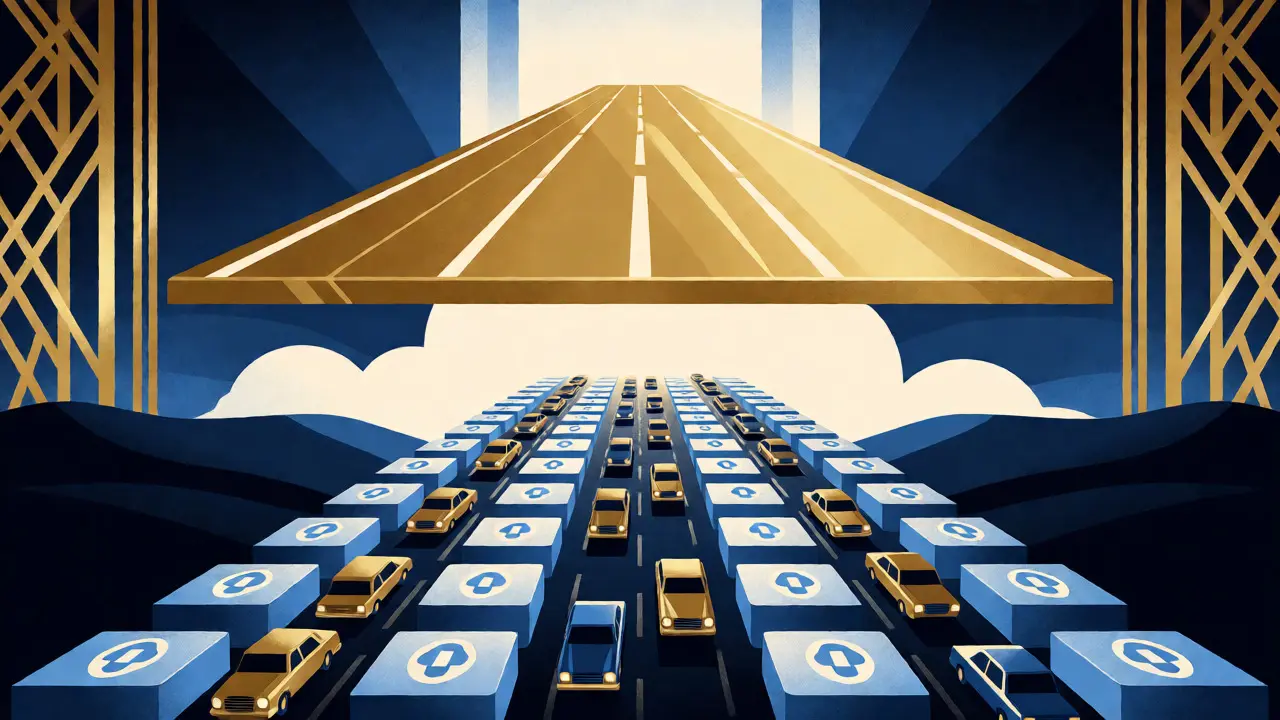
Think of Layer 2 (L2) not as a replacement for the main blockchain, but as a high-speed express lane built right next to the slow, secure highway. It handles the heavy lifting of transactions off-chain, then settles the final result back on the main chain. This approach doesn’t compromise the core security of the base layer. Instead, it unlocks massive throughput and near-zero fees, making daily crypto usage actually feasible. If you’re wondering how this magic works without breaking the system, let’s break down the mechanics, the types, and why this is the only realistic path to mass adoption.
The Core Problem: Why Layer 1 Can’t Handle Traffic
To understand the fix, you have to look at the flaw. Blockchains like Ethereum are designed so every node validates every transaction. This ensures no single entity can cheat, but it creates a massive drag on performance. Ethereum, for instance, historically processes around 15-30 transactions per second (TPS). Compare that to Visa’s 65,000 TPS, and the gap is obvious.
This limitation creates a supply-and-demand imbalance. Demand for block space spikes during market volatility or popular app launches, but the supply of processing power is fixed. When demand exceeds supply, gas fees skyrocket. Users compete to get their transactions included, bidding up prices. For developers building decentralized applications (DApps), this makes user experience terrible. For enterprises, it makes budgeting impossible. Layer 1 solutions, like increasing block size or sharding, require hard forks and consensus from the entire community-a slow, political process. Layer 2 sidesteps this by building on top of the existing infrastructure, requiring no changes to the base protocol.
How Layer 2 Actually Works: Off-Chain Processing
The secret sauce of L2 is moving computation off the main chain while keeping data availability on it. Here’s the basic flow:
- Transaction Initiation: Users submit transactions to the Layer 2 network, not directly to Layer 1.
- Off-Chain Execution: The L2 protocol processes these transactions in its own environment. This is fast and cheap because it doesn’t need global consensus for each step.
- Bundling: Many individual transactions are grouped into batches.
- Settlement: A compressed summary or cryptographic proof of these batches is submitted to the Layer 1 blockchain.
- Finality: The main chain records this summary, inheriting its security guarantees.
By batching hundreds or thousands of transactions into one L1 record, the cost per transaction drops dramatically. If one L1 transaction costs $10 and bundles 1,000 L2 transactions, each user pays roughly one cent. This economic model is what enables micro-transactions and gaming economies that were previously impossible.
The Main Types of Layer 2 Solutions
Not all L2s work the same way. There are three primary architectures, each with different trade-offs regarding speed, security, and complexity.
| Feature | Optimistic Rollups | ZK-Rollups | State Channels |
|---|---|---|---|
| How it works | Assumes transactions are valid unless challenged within a dispute window. | Uses zero-knowledge proofs to verify validity mathematically before posting. | Two parties open a channel, exchange many transactions privately, close with final balance. |
| Security Model | Inherits L1 security via fraud proofs. | Inherits L1 security via validity proofs. | Secure as long as both parties remain online; risk if one goes offline. |
| Withdrawal Time | Slow (typically 7 days due to challenge period). | Fast (minutes to hours, depending on proof generation). | Instant if cooperative; slower if unilateral exit needed. |
| Best For | General-purpose DeFi and dApps. | High-frequency trading and privacy-focused apps. | Direct payments between two known parties (e.g., Lightning Network). |
| Examples | Arbitrum, Optimism | zkSync, StarkNet, Polygon zkEVM | Lightning Network, Raiden Network |
Rollups: The Heavy Lifters
Rollups are currently the dominant narrative in Ethereum scaling. They execute transactions off-chain but post the raw transaction data to Layer 1. This ensures that anyone can reconstruct the state of the L2 if the operator fails. There are two flavors:
- Optimistic Rollups: As the name suggests, they assume everything is fine. If someone spots a fraudulent transaction, they can submit a "fraud proof" to the main chain to revert it. This creates a delay in withdrawals (often 7 days) because the network waits for potential challenges. Arbitrum and Optimism are the leading examples here.
- ZK-Rollups: These use advanced cryptography called zero-knowledge proofs. Before submitting data to L1, the prover generates a mathematical proof that the batch is valid. The L1 smart contract verifies this proof instantly. No waiting period for withdrawals means better UX. zkSync and StarkNet are key players.
State Channels: Private Highways
State channels are older tech, best exemplified by the Bitcoin Lightning Network. Imagine Alice and Bob want to trade repeatedly. Instead of hitting the blockchain each time, they lock funds in a multi-sig wallet on L1. Then, they sign off-chain updates to their balances. Only when they close the channel do they broadcast the final state to L1. This is incredibly fast and cheap but requires participants to stay online and monitor the channel. It’s perfect for micropayments but less flexible for complex smart contracts involving third parties.
Sidechains: Parallel Universes
Sidechains like Polygon PoS operate independently with their own consensus mechanisms. They are interoperable with the main chain but don’t inherit its security directly in the same robust way rollups do. If the sidechain validators collude, users could lose funds. However, they offer high customizability and speed. They are often considered "Layer 1.5" because they bridge the gap between full independence and strict dependency.

Real-World Impact: Fees and Speed
Let’s talk numbers. During peak congestion, sending a simple ERC-20 token transfer on Ethereum mainnet might cost $5 to $50. On Arbitrum or Optimism, that same transaction often costs under $0.01. The speed difference is equally stark. Ethereum blocks occur every ~12 seconds. L2 networks can finalize transactions in sub-second intervals.
This isn’t just theoretical. Decentralized exchanges (DEXs) like Uniswap now see significant volume on L2s. Gamers playing on-chain games prefer L2s because paying $10 to move a sword is absurd, but paying $0.005 is manageable. This shift has forced Layer 1 to evolve too, pushing Ethereum toward its own scaling upgrades (like Proto-Danksharding), which further reduce the cost of posting data for L2s.
Security Trade-Offs and Risks
No free lunch exists in crypto. While L2s inherit security from L1, they introduce new attack vectors.
- Centralization Risk: Many current L2 sequencers (the entities ordering transactions) are centralized. If a sequencer goes down or censors transactions, the network halts until it recovers. Decentralizing sequencers is a major roadmap goal.
- Data Availability: Rollups rely on L1 for data availability. If L1 becomes too expensive or congested, L2s suffer. Solutions like Celestia aim to provide dedicated data availability layers to mitigate this.
- Smart Contract Bugs: L2 protocols add complexity. Bugs in the bridge contracts (which move assets between L1 and L2) have led to hacks. Always check if a bridge is audited and battle-tested.
Despite these risks, the security model remains stronger than any centralized database because the ultimate source of truth is still the immutable, proof-of-work (or proof-of-stake) main chain.

Which Layer 2 Should You Use?
Your choice depends on your needs:
- For maximum security and general DeFi: Stick with established optimistic rollups like Arbitrum or Base. They have deep liquidity and mature tooling.
- For fast withdrawals and future-proofing: Look at ZK-rollups like zkSync Era or Linea. The tech is harder to build, but the end-game efficiency is superior.
- For simple Bitcoin payments: Use the Lightning Network. It’s specialized but unbeatable for BTC transfers.
- For low-cost experimentation: Sidechains like Polygon PoS offer great developer tools and low barriers to entry, though with slightly different security assumptions.
Frequently Asked Questions
Does using Layer 2 mean I lose my coins if the L2 network fails?
Generally, no. In rollup architectures, the transaction data is stored on the Layer 1 blockchain. If an L2 operator goes bankrupt or disappears, users can reconstruct the state of the network from the L1 data and withdraw their funds directly. This is why data availability is critical-it acts as a backup ledger.
Why do some Layer 2 withdrawals take 7 days?
This delay is specific to optimistic rollups. They operate on the assumption that transactions are valid. To prevent fraud, there is a "challenge period" (usually 7 days) where anyone can submit a proof that a transaction was invalid. Once this period passes without challenge, the withdrawal is finalized. ZK-rollups avoid this by proving validity upfront, allowing faster exits.
Are Layer 2 solutions compatible with all wallets?
Most major wallets like MetaMask, Rainbow, and Rabby support EVM-compatible Layer 2s automatically. You usually just need to add the network to your wallet settings. Non-EVM chains or Bitcoin-based L2s like Lightning may require specific wallets or plugins, such as Phoenix or Zap.
Do Layer 2 fees go to miners or validators?
Layer 2 fees primarily pay for the off-chain execution and the cost of posting data to Layer 1. A portion of the fee covers the L1 gas cost for the settlement transaction. The rest may go to the L2 sequencer or validator operators. Unlike L1, where fees burn ETH (in Ethereum's case), L2 fee models vary by protocol.
Is Layer 2 safer than Layer 1?
Layer 2 inherits the security of Layer 1, so it is generally considered very safe. However, it adds software complexity. The weakest link is often the bridge between L1 and L2 or the centralization of the sequencer. While cryptographically secure, operational risks exist. Over time, as sequencers decentralize and code matures, L2 security will match or exceed early-stage L1 implementations.


Harish Ramaiah
September 7, 2026 AT 22:00OMG!!! 😱😱😱 I literally CRIED reading this!! 🥺🥺 The fees were KILLING me... like, actually killing my soul?? 💀💀 It’s so unfair that we pay $50 just to move money?! 😭😭 But L2s are saving us!! 🙌🙌 Thank you for explaining it so clearly!! 🤩🤩 I’m switching to Arbitrum today!! No more pain!! 😍😍
Ritchie Grogg
September 8, 2026 AT 01:04Hey folks! 👋 Just wanted to say this is super helpful. I’ve been struggling with gas fees on mainnet and honestly felt pretty hopeless about using DeFi regularly. Seeing the breakdown of how rollups work really clicked for me. The analogy of the express lane next to the highway is perfect. I think a lot of people get confused by the tech jargon, but this makes it feel accessible. I’m definitely going to check out zkSync now that I understand the withdrawal times better. Thanks for sharing this!
Alexander James
September 9, 2026 AT 14:05This is exactly what needs to be shouted from the rooftops! For years, the crypto community has ignored the suffering of everyday users who are priced out of their own technology. We have built a system where speculation is rewarded while utility is punished by exorbitant costs. Layer 2 isn't just a technical upgrade; it is a moral imperative for financial inclusion. If we continue to prioritize decentralization at the expense of usability, we will remain a niche toy for the wealthy. This post rightly highlights that scalability is the bridge to mass adoption. We must demand these solutions.
Mary Burnett
September 10, 2026 AT 00:15Thank you for providing such a comprehensive overview. As someone who values clarity and precision in technical discussions, I appreciate the structured approach taken here. The distinction between optimistic and ZK-rollups is particularly well-articulated. It is important for users to understand the trade-offs regarding security and finality time before committing funds. I would also suggest looking into the current state of data availability layers, as they play a crucial role in the long-term viability of these networks. Your analysis is both thorough and balanced.
Stephen McElreavy
September 11, 2026 AT 06:32Greetings! 🌍 From a global perspective, seeing the democratization of access through Layer 2 protocols is truly inspiring. As we navigate the complexities of modular blockchains, it is vital to remember that interoperability remains our greatest challenge and opportunity. The use of zero-knowledge proofs represents a paradigm shift in cryptographic efficiency, allowing for verifiable computation without revealing underlying data. However, we must remain vigilant regarding the centralization vectors inherent in current sequencer architectures. Decentralized sequencing is the next frontier we must conquer to ensure true censorship resistance. Let us continue to educate ourselves on these nuanced mechanisms.
Indu Nair
September 13, 2026 AT 01:08LISTEN UP EVERYONE!! 📣 Stop complaining about fees and START USING L2s!! 🚀 The technology is HERE and it WORKS!! You are holding onto old ways because you are scared of change!! 😤 Embrace the future!! Mass adoption IS happening right now on Base and Arbitrum!! Don't let your fear stop your progress!! Get your wallet ready and jump in!! You can do this!! 💪💪💪
adam veikkanen
September 14, 2026 AT 18:20The comparison to Visa is misleading. Visa processes centralized transactions with chargebacks. Blockchain settlement is final. Comparing TPS directly ignores the cost of security guarantees. Furthermore, the article glosses over the user experience friction of bridging assets. Most retail users will not interact with L2s until bridging becomes invisible. Until then, adoption remains limited to power users.
Rishi Mehta
September 15, 2026 AT 03:56i cant believe we spent YEARS paying $50 fees for nothing lol its actually insane when u think about it we were basically donating to miners while getting nothing back its tragic really but hey at least l2s exist now so we dont have to suffer anymore thank god for that i guess
Saket Kulkarni
September 15, 2026 AT 05:20I find the philosophical underpinning of Layer 2 scaling quite fascinating. It suggests that scalability is not merely a technical hurdle but an evolutionary step in decentralized consensus. By separating execution from settlement, we create a hierarchy of trust that mirrors human societal structures. This allows for granular control over security assumptions based on the value of the transaction. It is a elegant solution to the trilemma.
Kathy Siew
September 16, 2026 AT 07:04oh wow another article telling me i need to learn 5 new things just to send money? cool cool. 🙄 sure, zkp's are great if you enjoy math homework every time you want to buy coffee. i'll stick to my centralized exchange tbh. less headache, fewer bridges to get hacked. good luck with all that 'scalability' though, hope it works out for the people who actually have time to care.
Brittany Ross
September 16, 2026 AT 11:46omg yes!! 🥰 finally someone explains why my fees were so high!! 😩 i was so stressed out trying to figure out which chain to use. 🤯 this helped so much!! 🙏✨ i'm gonna try arbitrum now!! fingers crossed!! 🤞💕
Maegan Rust
September 17, 2026 AT 19:16This is such a vibrant and necessary conversation! 🌈 It feels like we are witnessing the blooming of a digital ecosystem where accessibility is finally taking root. The variety of L2 options is like a garden with different flowers-some for speed, some for privacy, some for pure utility. It empowers us to choose the soil that fits our specific needs. I love seeing the community come together to nurture this growth. Let's keep watering this knowledge tree! 🌳💧
Jennifer Brosnan
September 19, 2026 AT 12:50It's cute that you think this solves everything. 🙄 Obviously, the big players are pushing L2s to offload congestion while keeping the premium L1 status for whales. It's a classic bait-and-switch. They know most normies won't understand the difference between a rollup and a sidechain, so they just throw buzzwords at them. Meanwhile, the real winners are the VCs funding these L2 projects. Wake up and smell the coffee. ☕🤡
Finlay Samms
September 21, 2026 AT 07:50Nice read mate! 👍 Always good to see a clear explanation without too much waffle. I've been dabbling with Optimism lately and the UX has improved massively since last year. Still, the bridging process can be a bit of a nightmare if you're not careful. :/ But yeah, definitely the way forward for most dApps. Cheers! 🍻
lea terrade
September 23, 2026 AT 06:03im curious about the environmental impact of running all these extra nodes for l2s does it really save energy or just shift the burden somewhere else idk seems complicated but im glad fees are lower at least thats a win i guess
Rachel Leet
September 24, 2026 AT 12:38Let's be honest, most people don't actually *need* blockchain for their daily transactions. They just want cheaper banks. L2s are essentially centralized databases with a fancy receipt mechanism. The 'trustlessness' argument falls apart when you realize you still have to trust the sequencer and the bridge contract. It's a compromise, not a revolution. But sure, if you like pretending you're decentralized while using a centralized API, go ahead.
Sophie Fitzgerald
September 25, 2026 AT 16:38Thanks for the info. I am still deciding which one to start with. Maybe Polygon?