
Have you ever wondered if there is a middle ground between the speed of centralized exchanges and the security of decentralized ones? That question has driven the evolution of crypto trading for years. Most traders are stuck choosing between handing over their private keys to a custodian or dealing with slow, expensive on-chain transactions. MOV Exchange is a decentralized cryptocurrency exchange that operates using a cross-chain protocol to facilitate on-chain transaction matching and settlement. It attempts to bridge this gap by offering a unique tri-product structure built on the Bytom value-exchange protocol.
In this review, we will break down how MOV Exchange works, why its three distinct trading products matter, and whether it still holds up in the crowded decentralized finance (DeFi) landscape of 2026. We’ll look at the mechanics behind SuperTx, MagnEx, and FlashSwap, analyze the fee structure, and compare it to giants like Uniswap. If you are looking for a non-custodial way to trade without sacrificing too much speed, this guide covers what you need to know.
What Is MOV Exchange?
At its core, MOV Exchange is not just a single trading interface; it is a suite of tools designed for different types of traders. Unlike traditional Automated Market Makers (AMMs) that rely solely on liquidity pools, MOV uses a hybrid approach. It sits firmly in the category of Decentralized Exchanges (DEX), which are platforms that allow peer-to-peer cryptocurrency trading without an intermediary. This means you never have to deposit funds into a company’s wallet. Your assets stay in your personal wallet until the exact moment of trade execution.
The platform was built on the foundation of the Bytom blockchain. Bytom introduced the concept of multi-asset smart contracts, allowing for complex financial operations across different tokens. MOV leverages this infrastructure to create a "cross-chain" experience. While many DEXs are confined to a single network like Ethereum or Binance Smart Chain, MOV’s architecture aims to facilitate smoother interactions between assets, reducing the friction often associated with moving value between different blockchains.
One critical distinction to make right away is avoiding confusion with other projects. There is a separate project called Movement Network (MOVE token), which launched its mainnet in late 2024. These are entirely different entities. MOV Exchange is specifically tied to the Bytom ecosystem and its specific cross-chain matching engine. Mixing them up can lead to significant errors when connecting wallets or researching tokenomics.
The Three Pillars: SuperTx, MagnEx, and FlashSwap
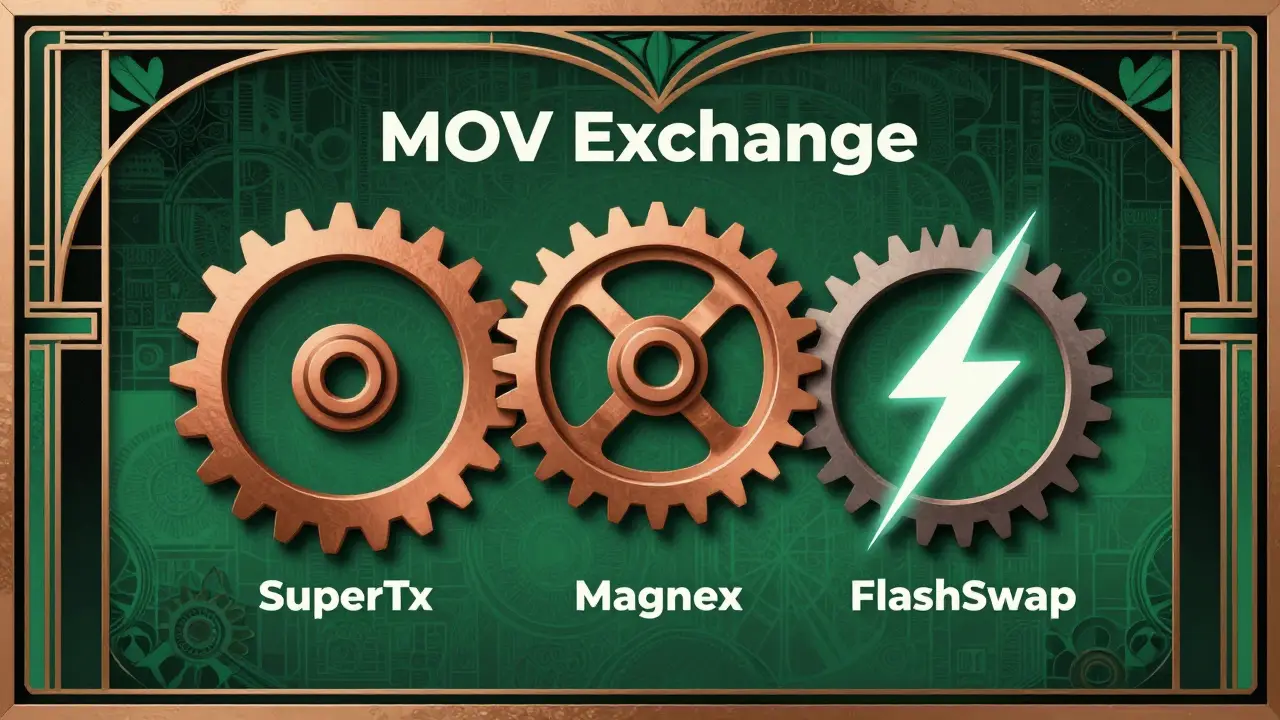
The most interesting aspect of MOV Exchange is its segmentation of trading strategies into three specialized products. This isn’t just marketing fluff; each product solves a specific problem in the DeFi space. Let’s look at how they work.
SuperTx: The Liquidity Powerhouse
SuperTx is described as a "superconducting exchange." In technical terms, it applies the Constant Function Market Maker (CFMM) model but optimizes it for stronger liquidity provision. For those unfamiliar, CFMM is the standard used by platforms like Uniswap V2, where a mathematical formula determines the price of assets based on the ratio of tokens in a pool.
SuperTx improves upon this by aiming to reduce slippage-the difference between the expected price of a trade and the executed price. High slippage kills profits, especially for larger trades. By providing deeper liquidity mechanisms, SuperTx allows traders to execute orders with lower fees and less price impact compared to traditional AMMs. If you are a liquidity provider, this product offers a more stable environment for earning yield without facing rapid impermanent loss during volatile market swings.
MagnEx: Contract-Based Trading
Next is MagnEx, or the "magnetic exchange." This component focuses on contract-based matching. Instead of swapping against a passive pool, MagnEx allows users to enter into specific on-chain asset transactions through predefined contracts. Think of this as a more structured way to trade, similar to how order books work in centralized exchanges, but executed via smart contracts.
This is particularly useful for traders who want specific entry and exit points rather than accepting whatever price the current pool offers. It brings a layer of precision to decentralized trading that is often missing in pure AMM models. However, because it relies on finding a counterparty or a matching contract, it may not be as instant as a simple swap.
FlashSwap: Speed Meets Security
Finally, we have FlashSwap, the "lightning exchange." This is where MOV tries to solve the biggest pain point of DeFi: speed. FlashSwap utilizes a hybrid model. The transaction matching happens off-chain using a fast transaction mode, which is crucial for high-frequency trading or reacting quickly to market news. Once the match is found, the final settlement is executed on-chain.
This two-step process ensures that you get the speed of a centralized order book while maintaining the security and transparency of on-chain settlement. You don’t have to trust a central server to hold your funds; the blockchain still validates the final transfer. This makes FlashSwap ideal for active traders who cannot afford to wait minutes for a block confirmation just to close a position.
| Product | Mechanism | Best For | Speed |
|---|---|---|---|
| SuperTx | Optimized CFMM | Liquidity Providers & Large Swaps | Standard On-Chain |
| MagnEx | Contract Matching | Precision Traders | Medium |
| FlashSwap | Hybrid Off/On-Chain | High-Frequency Trading | Fast |
Fees and Costs: What Will You Pay?
When evaluating any exchange, the fee structure is paramount. Centralized exchanges often hide costs in spreads or charge hefty withdrawal fees. MOV Exchange follows the decentralized ethos: no transfer fees, no withdrawal fees, and no account maintenance charges. The only cost you bear is the network gas fee required by the underlying blockchain (Bytom or bridged networks).
This is a significant advantage for users who trade frequently. On Ethereum, gas fees can sometimes exceed the profit of a small trade. Since MOV is built on Bytom, which generally has lower transaction costs than Ethereum Layer 1, your overhead remains minimal. However, keep in mind that if you are bridging assets from other chains, you may incur bridge fees. Always check the current state of the networks involved before executing large transfers.
There are also trading fees charged to liquidity providers and traders, typically ranging from 0.05% to 0.30% depending on the pool volatility. These fees are distributed to the liquidity providers, incentivizing them to keep the markets deep. Compared to centralized exchanges charging 0.1% plus withdrawal fees, MOV’s model is competitive, especially when you factor in the lack of custody risk.
Security and Non-Custodial Benefits
Security is the primary reason many users flock to decentralized exchanges. With MOV Exchange, you maintain direct control of your funds at all times. This eliminates counterparty risk-the danger that the exchange itself might go bankrupt, freeze your account, or suffer a catastrophic hack that drains user deposits. We’ve seen this happen repeatedly with major centralized platforms since 2022.
The platform uses a distributed server architecture across global locations. This reduces the risk of service downtime. If one node goes offline, others continue to operate. Furthermore, because the actual settlement happens on the blockchain, hackers cannot simply steal funds from a central database. They would need to compromise your personal private key, which is under your control, not MOV’s.
However, "non-custodial" does not mean "risk-free." You are responsible for securing your wallet. If you lose your seed phrase, no customer support team can recover your assets. Additionally, smart contract risks always exist. While MOV’s code has been operational since its inception, it is essential to ensure you are interacting with the official contract addresses. Phishing sites mimicking DEX interfaces are common, so always double-check URLs.
Liquidity Challenges and Limitations
No review is complete without addressing the downsides. The biggest hurdle for MOV Exchange, and indeed for most DEXs outside of the top tier (like Uniswap or PancakeSwap), is liquidity depth. While SuperTx aims to improve this, the overall volume on MOV is significantly lower than on major centralized exchanges.
Lower liquidity means higher slippage for large orders. If you try to sell $100,000 worth of a token on a thin pool, you might end up receiving significantly less value due to price impact. Institutional traders or whales may find MOV less suitable for massive positions compared to venues with deeper order books. For retail traders moving smaller amounts, however, this is rarely a dealbreaker.
Another limitation is the learning curve. Connecting a wallet, approving token allowances, and understanding gas dynamics requires more technical knowledge than signing up for an email-based account on a centralized platform. Newcomers to crypto may find the initial setup intimidating. There is no KYC (Know Your Customer) process, which preserves privacy but also means there is no recourse if you make a mistake, such as sending tokens to the wrong address.

How MOV Compares to Competitors
To understand MOV’s place in the market, we must compare it to established players. Uniswap dominates the Ethereum ecosystem with massive liquidity and a wide range of tokens. SushiSwap offers similar functionality with additional yield farming incentives. PancakeSwap provides low fees on the BNB Chain.
MOV distinguishes itself through its tri-product approach. Uniswap is primarily an AMM. MOV offers SuperTx (AMM), MagnEx (Order Book-like), and FlashSwap (Hybrid). This versatility allows MOV to cater to diverse strategies within a single ecosystem. Additionally, its roots in the Bytom network give it access to unique assets and cross-chain capabilities that Ethereum-only DEXs lack.
However, in terms of raw user base and brand recognition, MOV trails behind these giants. Community engagement and developer activity are vital for long-term survival in DeFi. Users should monitor social channels and GitHub repositories to gauge the health of the project. A stagnant community often signals a declining platform.
Getting Started with MOV Exchange
If you decide to try MOV Exchange, here is a straightforward path to get started:
- Set Up a Compatible Wallet: You will need a wallet that supports the Bytom network or the specific bridges used by MOV. Ensure your wallet software is up to date and your seed phrase is securely backed up offline.
- Acquire Assets: Purchase BYTM or other supported tokens from a centralized exchange if necessary, and withdraw them to your personal wallet. Alternatively, use a bridge to move assets from other chains.
- Connect to MOV: Visit the official MOV Exchange website. Connect your wallet using the provided interface. Never share your private key or seed phrase with any site.
- Choose Your Product: Decide whether you need the stability of SuperTx, the precision of MagnEx, or the speed of FlashSwap based on your trading goal.
- Execute Trade: Select the token pair, input the amount, and review the estimated output including slippage tolerance. Confirm the transaction in your wallet.
Always start with a small test transaction to familiarize yourself with the interface and confirm that the gas fees are acceptable. This practice helps avoid costly mistakes when you scale up your trading volume.
Final Thoughts on MOV Exchange
MOV Exchange represents a sophisticated attempt to diversify the decentralized trading experience. By offering three distinct products-SuperTx, MagnEx, and FlashSwap-it addresses various needs from liquidity provision to high-speed trading. Its non-custodial nature ensures that you remain the sole owner of your assets, protecting you from platform insolvency.
While it faces challenges related to liquidity depth and market awareness compared to industry leaders, its unique architecture on the Bytom protocol offers a viable alternative for traders seeking lower fees and enhanced privacy. Whether MOV is right for you depends on your trading style. If you prioritize speed and deep liquidity above all else, you might stick to the giants. But if you value decentralization, varied trading mechanisms, and lower operational costs, MOV Exchange deserves a spot in your toolkit.
Is MOV Exchange safe to use?
Yes, MOV Exchange is considered safe because it is non-custodial, meaning you retain control of your private keys and funds. However, safety also depends on your personal security practices, such as protecting your seed phrase and verifying contract addresses to avoid phishing scams.
What is the difference between MOV Exchange and Movement Network?
They are completely different projects. MOV Exchange is a decentralized trading platform built on the Bytom protocol. Movement Network is a separate blockchain project that launched its mainnet in 2024. Do not confuse their tokens or technologies.
Does MOV Exchange require KYC verification?
No, MOV Exchange does not require Know Your Customer (KYC) verification. As a decentralized platform, it allows anonymous trading. You only need a compatible crypto wallet to connect and trade.
Which wallets are compatible with MOV Exchange?
MOV Exchange is primarily compatible with wallets that support the Bytom network. You should check the official documentation for the latest list of supported hardware and software wallets, as compatibility can change with updates.
Why is liquidity lower on MOV compared to Uniswap?
Uniswap benefits from being the first major mover on Ethereum with a massive user base. MOV operates on the Bytom network with a more niche audience. Lower user adoption naturally results in less capital locked in pools, leading to lower liquidity.