Did you know that Cambodia didn't actually ban cryptocurrency? If you read the headlines from late 2024, it might have looked like a total shutdown. But the reality is much more complex-and arguably smarter. The National Bank of Cambodia (NBC) did not issue an outright prohibition on digital assets. Instead, they executed a precise regulatory pivot. They blocked unlicensed offshore exchanges while simultaneously building a legal framework for domestic, regulated crypto services.
This distinction matters. For traders, businesses, and investors in Southeast Asia, understanding this nuance is the difference between navigating a legal gray area and stepping into a fully compliant ecosystem. The NBC’s strategy isn’t about stopping innovation; it’s about controlling where that innovation happens. By channeling activity toward licensed local platforms, the central bank aims to protect consumers, fight cybercrime, and stabilize the Cambodian riel.
The Myth of the Total Ban
In November 2024, the Telecommunications Regulator of Cambodia (TRC) made a move that felt like a ban to many users. They blocked access to 16 major overseas cryptocurrency exchange websites. This list included giants like Binance and Coinbase, along with over 102 associated domains. At the time, Binance alone had roughly 200,000 registered users in Cambodia. That’s a significant chunk of the population suddenly cut off from their trading platforms.
Why did this happen? The official reason was simple: these platforms were operating without proper licenses or authorizations required by Cambodian law. The NBC had been warning about this since a joint statement in 2018, but enforcement lagged behind adoption. By 2024, Cambodia ranked as the 17th country globally in crypto adoption, with a domestic market valued at $7.9 million. The disconnect between high usage and zero regulation became unsustainable.
The block wasn’t just about control; it was about safety. Overseas exchanges offered lower fees and larger peer-to-peer networks, creating a regulatory arbitrage. Users could trade freely, but if something went wrong-fraud, hacking, or insolvency-they had no local recourse. The NBC wanted to end that vulnerability. However, calling this a "ban" is misleading. It was a blockade of *unregulated* channels, not the asset class itself.
Prakas B7-024-735 Prokor: The New Rules
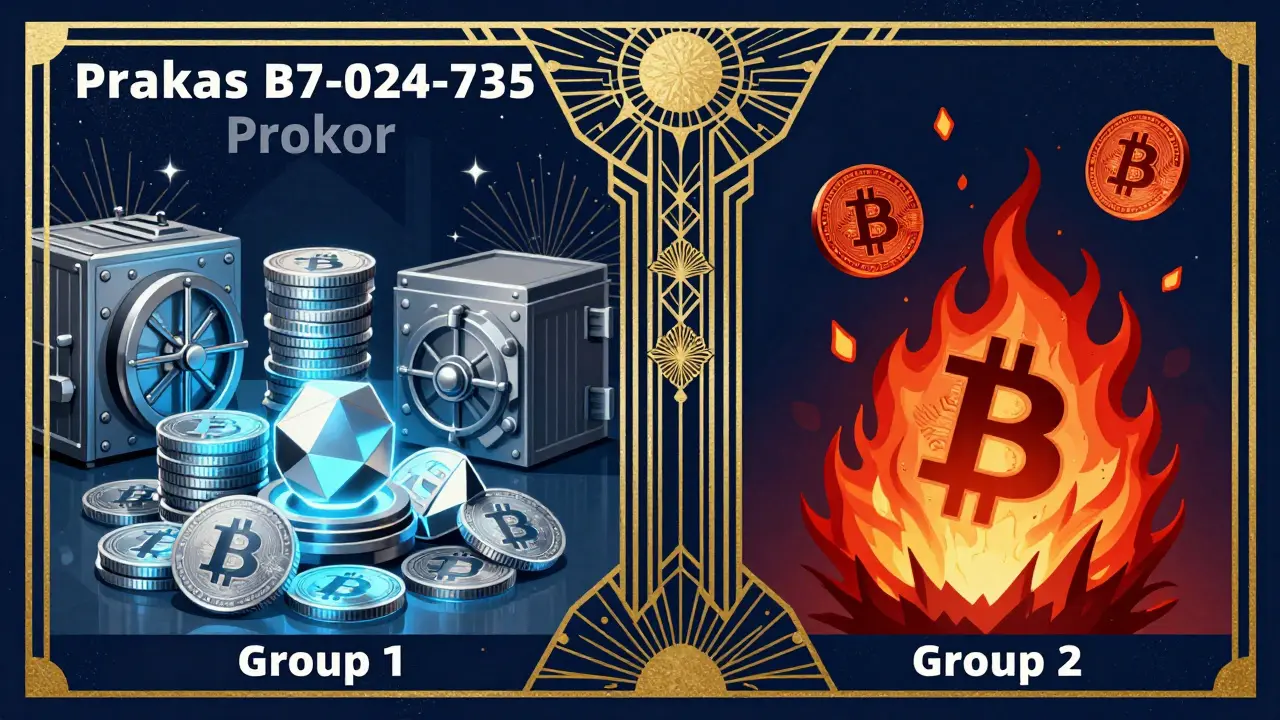
The real story unfolded in December 2024 with the issuance of Prakas B7-024-735 Prokor. Effective in early 2025, this regulation transformed Cambodia’s approach from informal prohibition to structured oversight. The document introduced a two-tier classification system for digital assets, mirroring frameworks used by global bodies like the Basel Committee.
Group 1 Assets: These include tokenized securities and approved stablecoins. These are considered lower-risk because they are backed by real-world value or regulated entities. Commercial banks under NBC supervision can invest in or hold these assets, subject to strict exposure limits designed to prevent systemic risk.
Group 2 Assets: This category covers "other crypto-assets," including Bitcoin and other unbacked cryptocurrencies. Regulators view these as higher-risk speculative instruments. Crucially, banks are explicitly prohibited from holding Group 2 assets on their own balance sheets.
This distinction is vital. It means that while your local bank can’t buy Bitcoin for its own treasury, it *can* offer services related to it. The regulation defines key terms like Crypto Asset Service Providers (CASPs), e-wallets, and tokenization, bringing clarity to a previously chaotic landscape. Legal analysts note that the text permits commercial banks to provide exchange on-ramping, custody solutions, and remittance conversion services for clients, provided they get prior NBC approval.
| Feature | Group 1 (Tokenized Securities/Stablecoins) | Group 2 (Bitcoin/Unbacked Cryptos) |
|---|---|---|
| Risk Profile | Lower (Backed/Regulated) | Higher (Speculative/Unbacked) |
| Bank Balance Sheet Holding | Permitted (with limits) | Prohibited |
| Client Services (Custody/Exchange) | Permitted (with approval) | Permitted (with approval) |
| Primary Use Case | Stability, Payments, Institutional | Investment, Store of Value |
Licensed Platforms: RGX and CNX
If offshore exchanges are blocked, where do Cambodians trade? The answer lies in the FinTech Regulatory Sandbox overseen by the NBC. As of 2025, only two domestic platforms have received authorization to operate legally: Royal Group Exchange (RGX) and Cambodian Network Exchange (CNX).
These platforms are the exceptions to the rule. They operate under direct regulatory scrutiny, meaning they must adhere to strict anti-money laundering (AML) standards, consumer protection protocols, and capital requirements. The government’s strategy is clear: steer users toward these supervised channels. By limiting the number of licensed players, regulators can monitor transactions more effectively than they could with hundreds of offshore apps.
For the average user, this shift requires adjustment. You can no longer simply download Binance and start trading. You must register with RGX or CNX, undergo identity verification, and comply with local reporting rules. While this adds friction, it offers security. If a dispute arises, there is a local authority-the NBC-that can intervene. With offshore exchanges, you were often on your own.
The Role of Project Bakong
You cannot understand Cambodia’s crypto policy without looking at Project Bakong. Launched in 2020, Bakong is both a Central Bank Digital Currency (CBDC) and a tokenized deposit system. It functions as a blockchain-based peer-to-peer payment platform where wallets link directly to bank accounts. By 2024, over 65% of the population used Bakong.
Bakong represents the NBC’s vision for financial inclusion. It allows instant transfers, reduces reliance on cash, and integrates with regional payment systems. The rise of private cryptocurrencies threatened to divert liquidity away from this national infrastructure. By regulating crypto, the NBC protects Bakong’s dominance in daily transactions. Stablecoins (Group 1 assets) may eventually complement Bakong, but speculative coins (Group 2) are kept at arm's length to preserve monetary stability.
This dual approach highlights a sophisticated balancing act. The NBC wants the efficiency of blockchain technology but rejects the volatility and opacity of unregulated markets. Bakong handles payments; licensed exchanges handle investment. Keeping these lanes separate prevents crypto chaos from disrupting the everyday economy.
Why the Strict Oversight?
The motivations behind these regulations go beyond mere control. Three primary drivers shaped the NBC’s decisions:
- State Oversight and Compliance: Offshore exchanges operated beyond Cambodian jurisdiction. Blocking them forced activity into the open, allowing authorities to track flows and enforce AML laws. This is critical for maintaining Cambodia’s standing with international financial bodies.
- Currency Stability: Cambodia faces dollarization pressures, where the US dollar dominates commerce. Unchecked crypto adoption could further erode the role of the Cambodian riel. By promoting Bakong and regulated stablecoins, the NBC supports the local currency.
- Cybercrime Combat: Cambodia has struggled with cybercrime, particularly fraud schemes linked to forced labor compounds. In October 2024, the U.S. Department of Justice indicted entities like Prince Group for running such operations. Cryptocurrencies were often used to launder proceeds. Tighter regulation helps disrupt these illicit networks.
These concerns are legitimate. The NBC isn’t trying to stifle progress; it’s trying to prevent exploitation. The ban on unlicensed platforms was a necessary step to clean up the environment before inviting formal participation.
What Comes Next?
As we move through 2026, the regulatory framework continues to mature. Additional rules governing specific approval procedures for CASPs are still pending publication. Banks are actively seeking NBC approval to offer crypto services, testing the boundaries of the new guidelines. Industry observers predict gradual expansion. If domestic platforms like RGX and CNX prove successful, the NBC may license more competitors.
However, challenges remain. VPN usage allows some users to bypass blocks on offshore exchanges. Enforcement against circumvention methods will be an ongoing battle. Moreover, the effectiveness of the model depends on whether local platforms can match the user experience and liquidity of global giants. If RGX and CNX fail to attract users, the black market will persist.
For now, Cambodia stands as a case study in controlled licensing. It avoids the extremes of total prohibition (like China’s earlier stance) and wild west deregulation (seen in some early adopters). Instead, it builds a walled garden where innovation thrives under watchful eyes. Whether this model becomes a blueprint for other Southeast Asian nations remains to be seen, but one thing is certain: the era of unregulated crypto in Cambodia is over.
Is cryptocurrency illegal in Cambodia?
No, cryptocurrency is not illegal. However, trading on unlicensed offshore exchanges like Binance and Coinbase is prohibited. Legal trading must occur through licensed domestic platforms such as Royal Group Exchange (RGX) and Cambodian Network Exchange (CNX).
Can I use Binance in Cambodia?
Officially, no. Access to Binance and other major overseas exchanges was blocked by the Telecommunications Regulator of Cambodia in November 2024 due to lack of local licensing. Using VPNs to access these sites violates regulatory intent and carries risks.
What is Prakas B7-024-735 Prokor?
It is the regulatory framework issued by the National Bank of Cambodia in December 2024, effective early 2025. It classifies digital assets into two groups, permits licensed banks to offer crypto services, and establishes rules for Crypto Asset Service Providers (CASPs).
Which crypto exchanges are legal in Cambodia?
As of 2025-2026, the only authorized platforms are Royal Group Exchange (RGX) and Cambodian Network Exchange (CNX). These operate under the NBC’s FinTech Regulatory Sandbox.
How does Project Bakong relate to crypto regulation?
Project Bakong is Cambodia’s state-backed digital payment system. The NBC regulates crypto to protect Bakong’s dominance in daily transactions and ensure monetary stability, preventing speculative cryptocurrencies from disrupting the local economy.