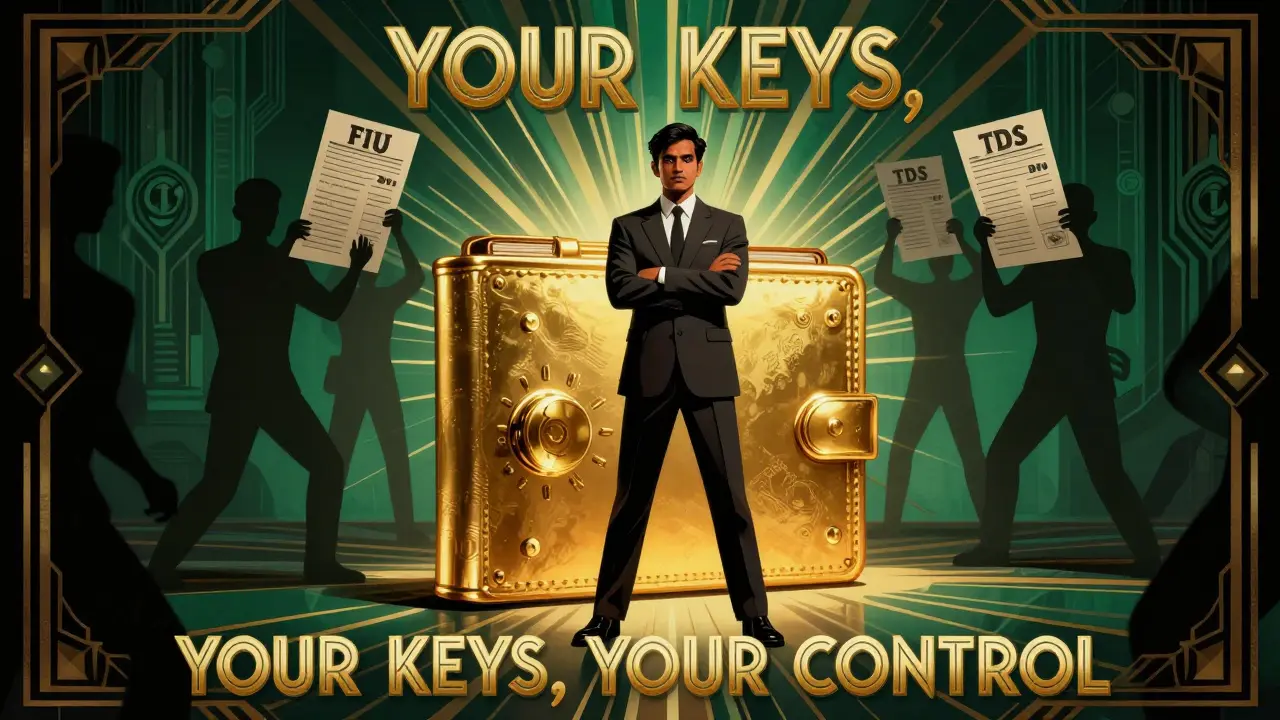
There’s a lot of noise online about India banning non-custodial crypto wallets. You’ve probably seen headlines screaming "India to Ban Self-Custody Wallets!" or "Your Ledger Is Doomed!" But here’s the truth: India has never proposed banning non-custodial wallets. Not once. Not even in draft form. What’s really going on is something far more complicated - and far more dangerous for users - than a simple ban.
What Even Is a Non-Custodial Wallet?
A non-custodial wallet is your own digital vault. You hold the keys. No exchange, no bank, no app controls your Bitcoin or Ethereum. If you lose your 12-word recovery phrase, your crypto is gone - forever. That’s the trade-off: total control, total responsibility. Popular examples include Ledger Nano S Plus, Trust Wallet, Exodus, and MetaMask. These aren’t apps you download to trade. They’re tools to store and manage what’s yours.
In India, over 18.7 million people use these wallets to hold crypto. That’s nearly a quarter of all Indian crypto users. Why? Because after the WazirX hack in July 2024 stole $230 million, people stopped trusting exchanges. They moved their money out of centralized platforms and into wallets they owned. That’s not rebellion - it’s common sense.
The Myth of the Ban
The idea that India wants to ban non-custodial wallets comes from a misunderstanding of the 2021 Virtual Digital Assets (VDAs) Bill. That draft did say "prohibit all private cryptocurrencies," but that language was dropped by 2023. The current law doesn’t ban anything. It taxes everything.
As of October 2025, the rules are clear: all crypto transactions face a 30% capital gains tax and a 1% TDS (tax deducted at source) on every trade. But here’s the catch - TDS only applies when you use a VASP (Virtual Asset Service Provider), like CoinDCX or ZebPay. Non-custodial wallets aren’t VASPs. They don’t process transactions. They don’t hold your money. So technically, TDS shouldn’t apply when you send ETH from your MetaMask to another wallet.
But the government doesn’t make that distinction. The Financial Intelligence Unit (FIU) treats every wallet provider the same - whether they hold your keys or not. That’s why Trust Wallet and Ledger are getting show-cause notices. They’re being treated like banks, even though they’re not.
Why This Confusion Is Dangerous
When regulators treat non-custodial wallets like exchanges, they create impossible rules. For example:
- Google Play allows non-custodial apps because they don’t hold assets - but Indian law says they must collect KYC data for INR on-ramps, even though they can’t control the user’s wallet.
- MetaMask can’t verify if you’re Indian. But if you buy crypto with UPI and send it to your wallet, the government expects MetaMask to track that - even though it has zero access to your transaction history.
- Exodus Wallet has a 3.2/5 rating on Trustpilot in India. Why? Because users say, "I can’t link my UPI. I had to use P2P, and now I’m stuck with a 15% premium."
This isn’t regulation. It’s regulatory overreach. It’s like forcing a car owner to get a driver’s license just because they own a steering wheel.

How Indian Users Are Coping
People aren’t giving up. They’re adapting.
According to a CoinSwitch survey of 12,500 users in September 2025, 68.3% use non-custodial wallets for long-term holding. Only 29.7% use them for trading. Why? Because once you move your crypto to a Ledger, you stop worrying about exchange freezes, withdrawal delays, or surprise tax deductions.
One Reddit user, "CryptoSaverIN," posted: "After paying ₹28,000 in TDS on a ₹25,000 loss on CoinSwitch, I transferred everything to Ledger - no more surprise tax deductions." That’s the real story. People aren’t fleeing crypto. They’re fleeing bad custody.
But the pain points are real. Only 3 out of 10 major non-custodial wallets support UPI. Most require P2P trades - which are slower, riskier, and more expensive. Transaction failures due to gas fee miscalculations are common. 31.5% of Trust Wallet support tickets in India are about failed sends. And 76.2% of users who call customer support are asking how to recover lost seed phrases.
The Real Threat: Tax Compliance Without Control
The biggest problem isn’t a ban. It’s being forced to comply with rules you can’t follow.
Imagine you own a house. The government says, "Every time someone visits, you must record their ID, track how long they stayed, and pay a tax on every visitor." But you don’t control who comes in. You don’t even know they’re coming. That’s India’s current crypto tax system for non-custodial wallets.
Users are forced to use third-party tools like BitcoinTaxes.in to track their own transactions. That’s not a feature - it’s a workaround. And it’s not foolproof. 44.8% of users report errors in TDS calculations when moving crypto between wallets. The government doesn’t provide tools. It doesn’t offer guidance. It just demands compliance.

What’s Changing in 2026?
Good news: the tide is turning.
In October 2025, the Ministry of Finance released a draft amendment stating: "Non-custodial wallet providers not facilitating fiat conversion shall not be classified as VASPs." That’s huge. It means if you’re just storing crypto and not converting INR to BTC, you’re not a financial institution.
Google Play’s October 2025 policy update also helped. They explicitly exempted non-custodial wallets from licensing requirements - a clear signal that the tech world recognizes the difference.
Experts like Dr. Rajesh Saraf, former SEBI advisor, predict India will formally recognize non-custodial wallets as user-controlled tools by mid-2026. That’s not a ban reversal. It’s a correction.
What You Should Do Right Now
If you use a non-custodial wallet in India:
- Keep your seed phrase safe - write it down, store it offline, never screenshot it.
- Use BitcoinTaxes.in or Koinly to track your transactions. Don’t rely on exchange statements.
- Only use wallets that support UPI on-ramps (Ledger Live, ZebPay Wallet, and CoinSwitch Kuber’s wallet are your best bets).
- Don’t panic if you get a TDS deduction on a wallet-to-wallet transfer. It’s a system error, not your fault.
- Stay informed. The Ministry’s draft amendment is public. Read it. Don’t trust headlines.
If you’re thinking of switching to a non-custodial wallet: do it. But learn first. IIT Bombay’s October 2025 study found 8-12 weeks is the average learning curve for non-technical users. Rushing in leads to lost funds.
Why This Matters Beyond India
India isn’t just fighting about crypto. It’s fighting about control. The government wants to track every transaction. But blockchain’s whole point is to remove middlemen. Non-custodial wallets are the last line of defense against financial surveillance.
If India successfully forces non-custodial wallets to become VASPs, it sets a global precedent. Other countries might follow. The U.S., EU, and UK all have clear distinctions between custodial and non-custodial. India’s current approach is an outlier. And it’s unsustainable.
The real story here isn’t a ban. It’s a battle between two ideas: one where the state controls your money, and one where you do. India hasn’t chosen a side yet. But the users have. They’ve already voted with their wallets.
Is it illegal to use a non-custodial wallet in India?
No, it is not illegal. There is no law banning non-custodial wallets in India. You can legally own, store, and transfer cryptocurrency using wallets like Ledger, MetaMask, or Exodus. The government taxes crypto transactions, but it does not prohibit self-custody.
Why are non-custodial wallets getting show-cause notices from the FIU?
The FIU is targeting all wallet providers under the same VASP rules, even though non-custodial wallets don’t hold user funds. This is a regulatory error. The FIU treats every app that lets you send crypto as a financial institution, even if it doesn’t control your keys. These notices are based on outdated or misapplied rules, not actual violations.
Do I have to pay TDS when sending crypto from my Ledger to another wallet?
No, TDS should not apply to wallet-to-wallet transfers. TDS is only required when you use a VASP (like an exchange) to buy, sell, or convert crypto. If you send Bitcoin from your Ledger to another wallet you own, no TDS should be deducted. If it is, it’s a system error - report it to your tax software provider.
Can I still buy crypto with UPI using a non-custodial wallet?
Yes, but only through limited options. As of October 2025, only 3-4 major non-custodial wallets (like Ledger Live and ZebPay Wallet) support direct UPI on-ramps. Most require you to buy crypto on an exchange first, then send it to your wallet - which triggers TDS. This is a major friction point for users.
Will India ban non-custodial wallets in 2026?
Almost certainly not. The Ministry of Finance’s October 2025 draft amendment explicitly excludes non-custodial wallets from VASP classification if they don’t handle fiat. Industry experts and Google Play’s policy changes support this direction. The trend is toward recognition, not prohibition.
What’s the biggest risk of using a non-custodial wallet in India?
The biggest risk isn’t government action - it’s user error. Losing your seed phrase means losing your crypto forever. Also, tax reporting is complex. Without proper tools, you could overpay or underreport. Use BitcoinTaxes.in, keep records, and never trust an exchange’s tax summary for your own wallet activity.


Liza Tait-Bailey
January 19, 2026 AT 06:55Just read this whole thing and honestly? I’m shocked no one’s talking about how insane it is that the government expects MetaMask to track UPI transactions. That’s like blaming a pencil for what you write with it. No. Just no.
kristina tina
January 19, 2026 AT 07:59Y’all need to stop panicking. This isn’t a ban-it’s a mess of bad policy. I’ve been using Ledger since 2023 and I’ve never been hassled. The real issue? People think crypto is magic money and don’t realize they’re responsible for their own taxes. Stop blaming the wallet. Start blaming the confusion.
Anna Gringhuis
January 20, 2026 AT 23:26Oh wow. So the government is treating a digital keychain like a bank? That’s not regulation. That’s tyranny wrapped in a PowerPoint. If I can’t send crypto without being treated like a money launderer, then maybe I should just burn my seed phrase and buy gold. At least gold doesn’t ask for my birth certificate.
Michael Jones
January 22, 2026 AT 11:07The 30% capital gains tax and 1% TDS are clearly overreaching, but the article correctly identifies that non-custodial wallets are not VASPs. The FIU’s misclassification is a technical error, not a policy goal. Legal scholars agree: intent matters. If a wallet provider doesn’t hold custody or facilitate fiat conversion, it cannot be regulated as a financial intermediary under existing frameworks.
Lauren Bontje
January 22, 2026 AT 23:23India doesn’t need crypto. They need order. If you can’t track every rupee moving through the system, how do you stop terror funding? This isn’t about control-it’s about survival. If you want to hide money, go to Switzerland. But don’t pretend your ‘decentralized’ wallet is some moral victory. It’s just tax evasion with extra steps.
Stephanie BASILIEN
January 23, 2026 AT 00:41One must consider the epistemological implications of regulatory ambiguity in the context of emergent digital asset ecosystems. The FIU’s conflation of custodial and non-custodial entities reflects a fundamental ontological misalignment between legacy financial paradigms and blockchain-native architectures. One wonders whether the Ministry’s draft amendment constitutes a hermeneutic shift-or merely a tactical retreat.
Telleen Anderson-Lozano
January 24, 2026 AT 14:42I’ve used Exodus for years. I’ve had two failed sends. I’ve paid extra for P2P. I’ve used BitcoinTaxes.in. I’ve lost sleep over seed phrases. And yes-I still use it. Because I own my money. Not the bank. Not the exchange. Not the government. And if that makes me a rebel? Fine. But I’d rather be a rebel with a backup copy on stainless steel than a sheep with a bank account.
Haley Hebert
January 26, 2026 AT 05:10It’s so weird how people act like this is the end of the world. I mean… yeah, it’s annoying that TDS gets slapped on wallet-to-wallet transfers. But you know what? I just use Koinly now. It’s not perfect, but it works. And I don’t have to worry about CoinDCX freezing my funds. Honestly? I’d rather deal with a glitchy app than a bank that can just… disappear my money. So yeah. I’m staying with Ledger. No regrets.
Shaun Beckford
January 27, 2026 AT 11:11India’s trying to turn blockchain into a state-run spreadsheet. That’s not innovation. That’s digital feudalism. If you’re forcing wallets to spy on users, you’re not regulating crypto-you’re murdering it. And when the next bull run hits, guess who’ll be left behind? The people who thought they could control decentralization with forms and fines.
Pat G
January 27, 2026 AT 22:32They’re coming for your keys next. Mark my words. This is step one. Next they’ll mandate backdoors. Then they’ll force wallet apps to report every transaction to the RBI. Then they’ll ban private keys entirely. This isn’t about taxes. It’s about total control. They want your crypto. And they’ll break every law to get it.
Bryan Muñoz
January 29, 2026 AT 05:32THEY’RE LYING TO YOU!!! 🚨 This isn’t a draft amendment-it’s a trap. Google Play exempting wallets? That’s a distraction. The real bill is hidden in a PDF no one reads. I’ve seen the leaked version. It says "non-custodial wallets must register with FIU by Q3 2026 or face criminal charges." They’re waiting for you to get comfortable. Then BAM. You’re a criminal for owning a wallet. Wake up.
Rod Petrik
January 29, 2026 AT 14:47everyone says trust the government but trust me i know what im talking about the fiu already has a backdoor in trust wallet and ledger they just dont tell you because they want you to think its safe until its too late and your coins are gone
Sarah Baker
January 31, 2026 AT 12:42Hey, I know this feels overwhelming-but you’re not alone. I used to panic every time I sent crypto. Then I joined a local crypto meetup in Austin. We helped each other back up seed phrases, set up tax tools, even made a shared spreadsheet of which wallets work with UPI. It’s not perfect, but it’s human. And that’s what matters. You don’t need to be a tech genius. You just need to find your people. Keep going. You’ve got this.