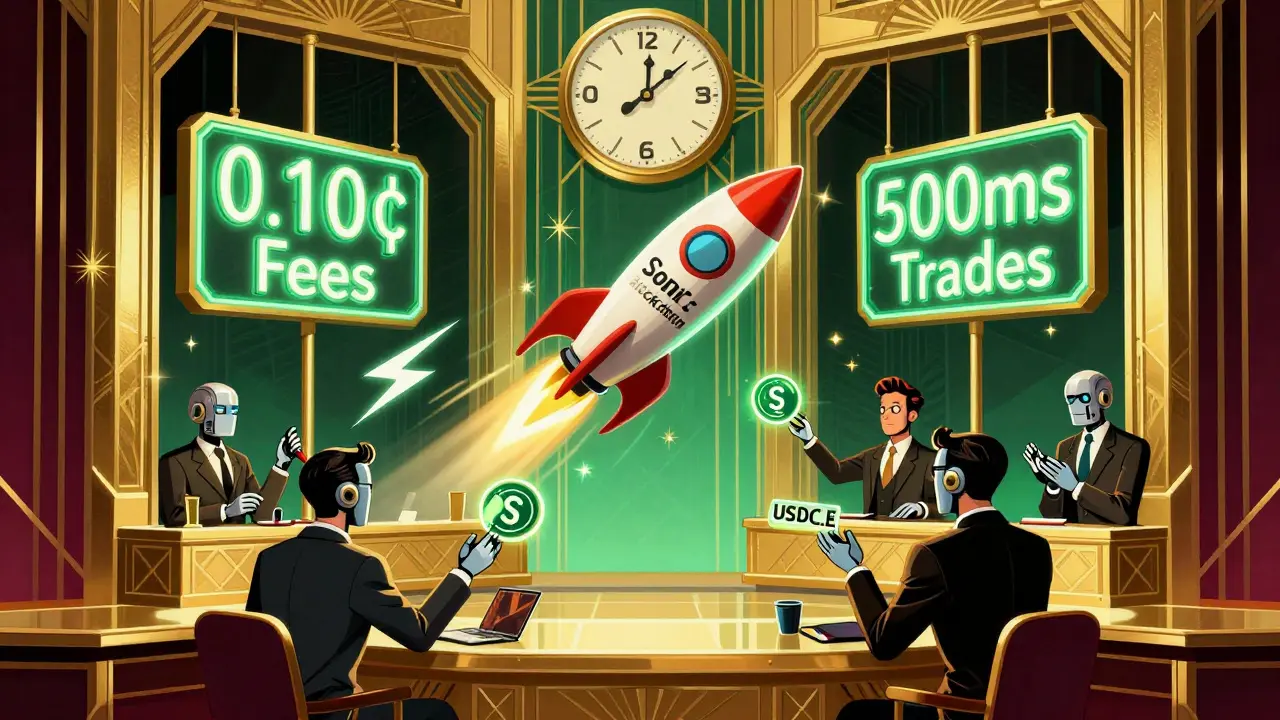
Shadow Exchange v2 isn’t just another crypto exchange. It’s a hyper-specialized trading platform built for one thing: blazing-fast, low-cost trades on the Sonic blockchain. If you’re trading tokens native to Sonic, it’s one of the fastest and cheapest ways to do it. But if you’re looking for a broad selection of coins or cross-chain swaps, you’ll quickly hit its limits.
What Makes Shadow Exchange v2 Different?
Most decentralized exchanges (DEXs) like Uniswap or PancakeSwap work like open markets where anyone can trade any token. Shadow Exchange v2 is the opposite. It’s a narrow lane, built only for Sonic’s ecosystem. Launched in 2024, it’s designed to take full advantage of Sonic’s ultra-fast blockchain - with block times under a second and instant transaction finality. That’s not a marketing claim. It’s measurable. Users report trades settling in under 500 milliseconds, something you’d struggle to find on Ethereum-based DEXs. Its secret sauce? A modified version of the x(3,3) incentive model. Unlike older DEXs that use ve(3,3), where users lock tokens for years just to earn voting power (and often forget about them), Shadow Exchange lets you unlock rewards faster and more flexibly. This keeps active traders engaged and prevents voting power from getting stuck in the hands of inactive users. It’s a smarter way to keep liquidity flowing.Performance Numbers That Matter
As of Q2 2024, Shadow Exchange v2 was processing nearly $30 million in daily trading volume - the highest on the Sonic network. The most traded pair? USDC.E/WS, accounting for over 34% of all volume. That tells you who’s using it: traders moving stablecoins and Sonic’s native token, S, with minimal friction. Fees are where it really shines. Compared to Ethereum DEXs, users pay about 95% less in transaction costs. That’s not theoretical - it’s based on real gas fee comparisons from g-ever.org. On Ethereum, a simple swap can cost $5-$15. On Shadow Exchange, it’s often under $0.10. For frequent traders, that adds up fast. The average bid-ask spread is 0.781%, which is 23% tighter than the typical DEX spread of 1.01%. That means you get better prices when you buy or sell. It’s not perfect - spreads widen during volatility - but it’s consistently better than most competitors.What You Can and Can’t Trade
Shadow Exchange v2 supports 38 tokens and 87 trading pairs. That’s tiny compared to Uniswap’s 8,000+ or PancakeSwap’s 1,200+. You won’t find Bitcoin, Ethereum, Solana, or even popular memecoins like Dogecoin here. It’s built for Sonic-native assets: S, stS, xSHADOW, USDC.E, and a handful of other tokens that run on Sonic’s chain. That’s not a bug - it’s a feature. By limiting the scope, the platform optimizes for speed and liquidity depth within its niche. But if you want to trade across chains or access a wide variety of altcoins, you’ll need another platform. Shadow Exchange v2 is not a one-stop shop. It’s a precision tool.How to Use It
Getting started is straightforward if you’re familiar with Web3 wallets. You need a wallet that supports the Sonic blockchain - MetaMask is the most common choice, but you’ll need to manually add Sonic’s network details. Once connected, you can swap tokens, add liquidity, or stake your LP tokens to earn xSHADOW rewards. The interface is clean and responsive. No lag. No freezing. That’s because the backend is built for speed. But the learning curve comes in understanding concentrated liquidity. Unlike older DEXs where you just deposit equal amounts of two tokens and let the system handle everything, Shadow Exchange lets you choose specific price ranges for your liquidity. If you pick too narrow a range, your funds might get pulled out of the market if prices move. Too wide, and your returns drop. Most users report figuring it out in 15-20 minutes using community guides. Official documentation is sparse. You’ll learn more from YouTube tutorials and Discord threads than from the website itself.
Pros and Cons
- Pros: Sub-second trade finality, fees 95% lower than Ethereum, tight spreads, active community of yield farmers, optimized for Sonic ecosystem, no margin trading (reduces risk), dynamic fees that adapt to market conditions.
- Cons: Only 38 tokens supported, no cross-chain swaps, no mobile app, minimal official documentation, support response times can be slow, account lockouts possible after multiple failed login attempts, no institutional tools or API access.
Who Is This For?
Shadow Exchange v2 is perfect for:- Yield farmers who want to stake LP tokens on Sonic and earn xSHADOW rewards
- Traders who swap S, stS, and USDC.E frequently and hate paying high fees
- Users already deep into the Sonic ecosystem and looking for the fastest trading layer
- People who want to trade Bitcoin or Ethereum on a DEX
- Beginners who don’t understand concentrated liquidity or DeFi mechanics
- Investors looking for long-term growth through token appreciation - Shadow Exchange doesn’t issue tokens with utility beyond trading and staking
Is It Safe?
There’s no central authority. No KYC. No customer support team you can call. You’re responsible for your own funds. The platform is built on open-source code, and audits have been conducted by third parties, but public reports are limited. The team is anonymous and incorporated in Panama - a common setup for DEXs, but one that raises questions about accountability. Cashbackforex.com flagged potential review manipulation, warning that fake reviews are common in this space. That doesn’t mean Shadow Exchange is a scam - it just means you should trust data more than testimonials. Look at on-chain metrics: trading volume, liquidity depth, and wallet activity. Those are real. Reviews are not.
Current Status: Maintenance Mode
Since Q1 2025, development has slowed. The team isn’t adding new features. Instead, they’re focused on stability. That’s a good sign. Many crypto projects rush to launch features and then collapse under their own weight. Shadow Exchange v2 seems to be doing the opposite: locking in gains and making sure the platform doesn’t break. The roadmap now centers on deeper integration with Sonic’s ecosystem - especially leveraging Sonic’s upcoming airdrop program. If Sonic’s user base grows, Shadow Exchange will grow with it. If Sonic stalls, Shadow Exchange will too.The Bigger Picture
Shadow Exchange v2 is a microcosm of a larger trend: the rise of specialized DEXs. Instead of trying to be everything to everyone, these platforms focus on one chain, one use case, one advantage. It’s like choosing a race car over an SUV. You sacrifice versatility for performance. Messari’s analysis gives it a 65% chance of being acquired or merged within three years if Sonic doesn’t grow beyond its current 1.2% share of DeFi TVL. That’s the risk. But if Sonic becomes a major Layer 1 - competing with Solana or Arbitrum - Shadow Exchange could be its crown jewel.Final Verdict
Shadow Exchange v2 is the best DEX on the Sonic blockchain. Period. If you’re trading within that ecosystem, it’s unbeatable in speed and cost. The fees are dirt cheap, the trades are instant, and the rewards for providing liquidity are well-designed. But if you’re looking for a general-purpose crypto exchange, keep looking. It’s too narrow. Too focused. Too dependent on one chain. Use it if you’re a Sonic native. Avoid it if you’re not.Is Shadow Exchange v2 safe to use?
Shadow Exchange v2 is a decentralized exchange with no central authority, so you control your own funds. It’s built on open-source code and has undergone third-party audits, but public audit reports are limited. There’s no KYC, no customer support hotline, and the team is anonymous. Safety depends on your own diligence: use trusted wallets, double-check contract addresses, and avoid sharing private keys. Don’t rely on reviews - check on-chain data like trading volume and liquidity pools instead.
Can I trade Bitcoin or Ethereum on Shadow Exchange v2?
No. Shadow Exchange v2 only supports tokens native to the Sonic blockchain. That includes S, stS, xSHADOW, and USDC.E. Bitcoin, Ethereum, Solana, and other major coins are not available. If you need to trade those, you’ll need a different exchange like Uniswap, PancakeSwap, or a centralized platform like Binance.
How do I add liquidity to Shadow Exchange v2?
First, connect your Web3 wallet (like MetaMask) to the Sonic network. Then, select a trading pair (e.g., S/USDC.E) and choose a price range for your liquidity. You can pick a wide range for lower returns but less risk, or a narrow range for higher yields but more exposure to price swings. After depositing your tokens, you’ll receive LP tokens. Stake those LP tokens to earn xSHADOW rewards. Community guides recommend keeping half your rewards as xSHADOW and using the other half to buy more S or stS tokens for compounding.
Why are fees so low on Shadow Exchange v2?
Shadow Exchange runs on the Sonic blockchain, which has much lower transaction costs than Ethereum. Sonic’s architecture allows for faster blocks and less congestion, so gas fees are minimal. Shadow Exchange further reduces costs by optimizing its smart contracts and using a dynamic fee model that adjusts based on market conditions - not fixed percentages. As a result, users pay about 95% less than they would on Ethereum-based DEXs.
Is Shadow Exchange v2 better than Uniswap?
It depends on what you need. If you want to trade a wide variety of tokens across multiple chains, Uniswap is far superior - it supports over 8,000 tokens. But if you’re only trading Sonic-native assets, Shadow Exchange v2 is faster, cheaper, and more efficient. Uniswap has higher fees and slower confirmation times on Ethereum. Shadow Exchange wins on speed and cost within its niche, but loses on variety and cross-chain support.
Does Shadow Exchange v2 have a mobile app?
No. Shadow Exchange v2 is a web-based platform only. You access it through your browser using a Web3 wallet like MetaMask. There is no official mobile app, and third-party apps claiming to support it are not verified. Always use the official website to avoid phishing scams.
What happens if Sonic blockchain fails?
If Sonic loses adoption or stops functioning, Shadow Exchange v2 will likely become unusable. Its entire value is tied to Sonic’s success. It doesn’t support other blockchains. Without Sonic, there’s no liquidity, no trading pairs, and no reason to use it. That’s the biggest risk - it’s a single-chain platform. Its future depends entirely on whether Sonic grows beyond its current 1.2% share of the DeFi market.
Can I earn passive income on Shadow Exchange v2?
Yes. You can earn passive income by providing liquidity to trading pairs and staking your LP tokens to earn xSHADOW rewards. Many users report annual percentage yields (APYs) between 15% and 45%, depending on the pair and market conditions. However, these yields are not guaranteed and can drop if liquidity increases or trading volume falls. Always research the tokenomics before depositing funds.