Supply Chain Traceability Savings Calculator
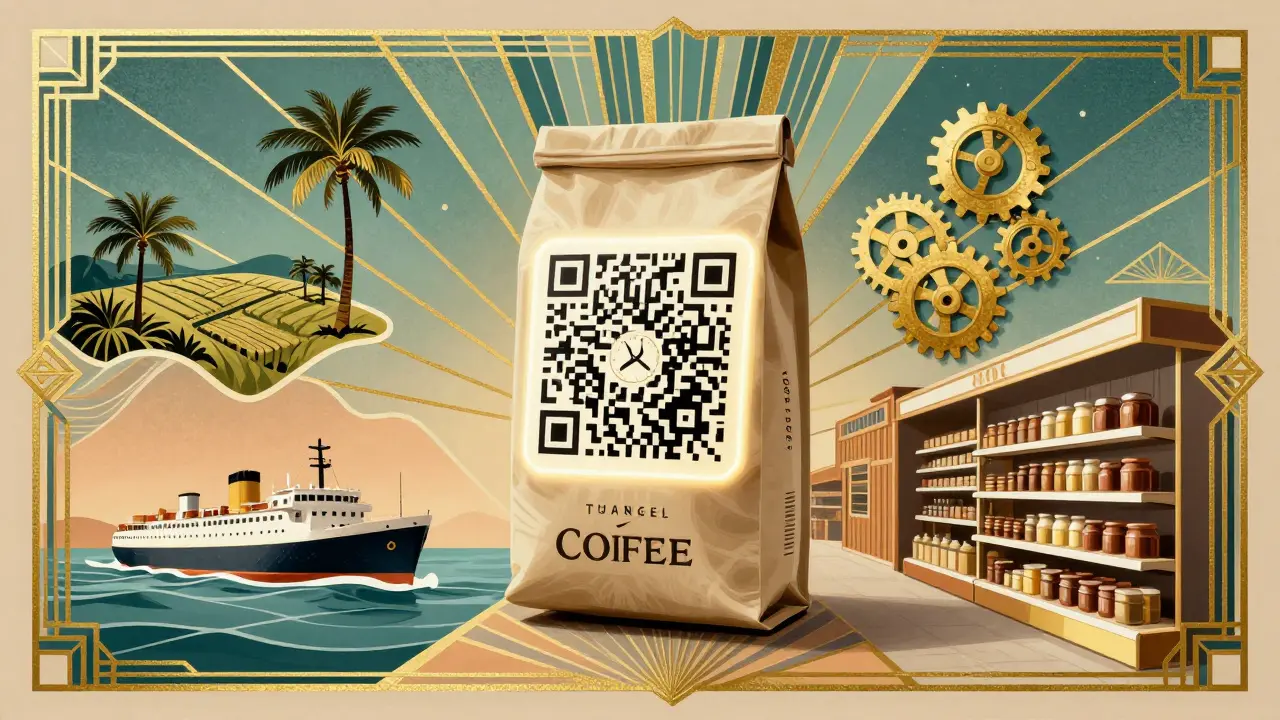
Imagine you buy a bag of coffee. You scan a QR code on the label, and instantly see where the beans were grown, who harvested them, which ship carried them across the ocean, and how long they sat in storage before reaching your local store. No guesswork. No paperwork. Just proof. That’s not science fiction-it’s what blockchain is doing in supply chains today.
Why Supply Chains Need Blockchain
Traditional supply chains are messy. Paper invoices, disconnected systems, manual updates, and hidden delays make it hard to know where things really are-or if they’re even real. A single product might pass through 20+ companies before reaching you. Each one keeps its own records. If something goes wrong-a spoiled batch of medicine, a contaminated food product-you spend weeks tracing it back. Blockchain fixes that by creating one shared, unchangeable record that everyone in the chain can see. It’s not about cryptocurrency. It’s about trust. Every time a product changes hands, a new block is added to the chain. That block includes who handled it, when, where, and under what conditions. Once recorded, it can’t be deleted or altered. No one can cheat the system. And because it’s digital, updates happen in real time.Food Safety: Cutting Recall Time from Months to Seconds
When contaminated food hits the market, speed saves lives. In 2018, an E. coli outbreak linked to romaine lettuce took weeks to trace. The CDC had to interview hundreds of patients, call dozens of distributors, and sift through piles of paper records. By the time they found the source, thousands were sick. With blockchain, Walmart cut that time to under two seconds. They started requiring suppliers to log every step of the lettuce’s journey-from farm to shelf-on a blockchain system. If a problem pops up, they don’t need to guess. They just pull up the digital trail. Which farm? Which truck? Which warehouse? All visible. No delays. No guesswork. The same system is used by Carrefour in Europe and Nestlé globally. For perishable goods, it’s not just about safety-it’s about waste. If a shipment of strawberries sits too long in a warm warehouse, the system alerts everyone. The product can be rerouted, discounted, or discarded before it spoils. That’s not just efficiency. That’s money saved.Pharma and Vaccines: Keeping Cold Chains Intact
Some medicines need to stay frozen. The Moderna and Pfizer COVID-19 vaccines required storage at -70°C. One degree too warm, and the dose could fail. Tracking that across continents, planes, and warehouses was a nightmare. Moderna used blockchain to tie sensor data directly to each vial. Temperature, humidity, shock levels-all recorded on the blockchain in real time. If a truck’s cooling system failed, the system flagged it immediately. Everyone in the chain-distributors, hospitals, pharmacies-knew exactly which vials were at risk. No need to throw out entire batches. Just the ones that slipped. This isn’t just for vaccines. It’s for insulin, antibiotics, cancer drugs-anything that needs precise conditions. Regulatory agencies like the FDA now encourage blockchain use because it reduces fraud and ensures authenticity. Counterfeit drugs kill over 1 million people a year. Blockchain makes it nearly impossible to fake a product’s history.
Diamonds, Cars, and Oil: Tracking High-Value Goods
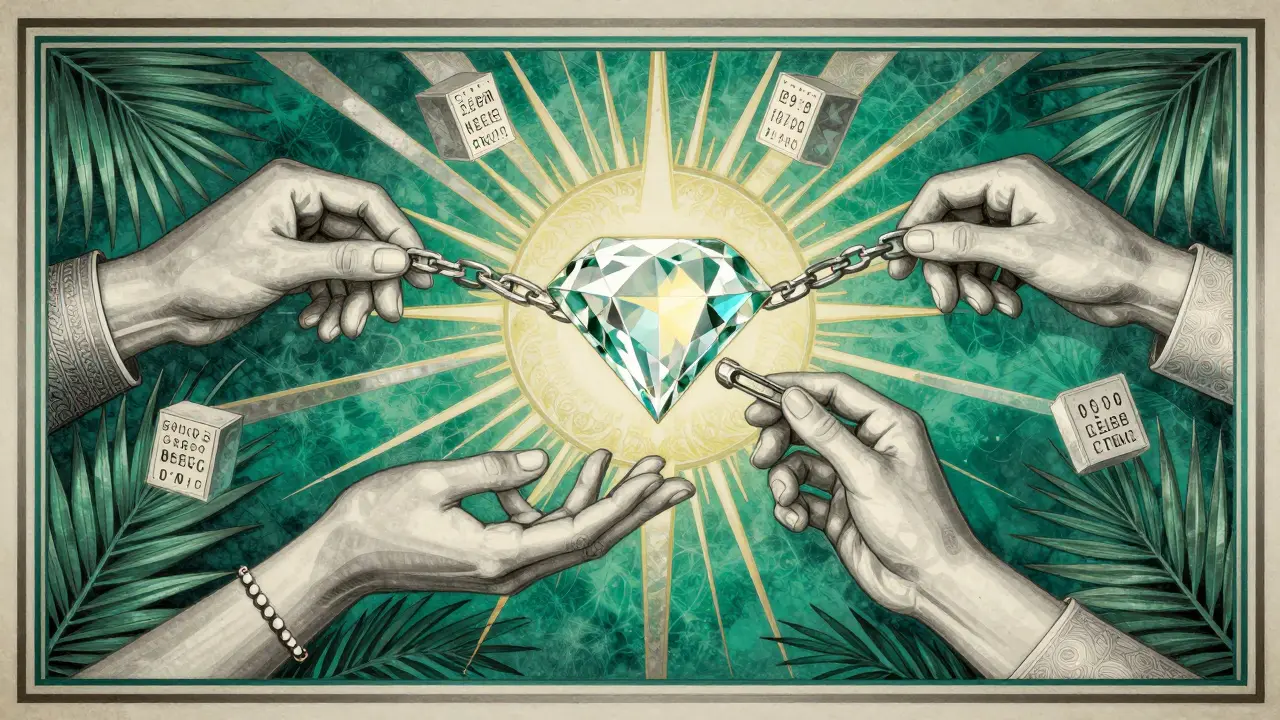
Not all supply chains are about food or medicine. Some are about trust in luxury or critical materials. De Beers, the world’s biggest diamond company, built a blockchain system called Tracr to track every diamond from mine to jewelry store. Before, there was no way to prove a diamond wasn’t a “blood diamond.” Now, each stone gets a digital ID. You can see its origin, who cut it, where it was polished, and who sold it. Customers scan the code and see the full journey. That kind of transparency builds trust-and justifies higher prices. Ford uses blockchain to track cobalt for its electric car batteries. Cobalt is often mined in dangerous conditions in the Democratic Republic of Congo. By recording every step-from mine to battery pack-Ford can prove it’s not using child labor or unethical sources. That matters to regulators and consumers alike. Abu Dhabi National Oil Company (ADNOC) tracks oil from the wellhead to the gas pump. Each barrel’s journey is logged: extraction, refining, shipping, customs, delivery. This cuts fraud, simplifies payments, and helps with carbon reporting. If a customer wants to know the carbon footprint of the fuel they bought, they can see it on the blockchain.How Smart Contracts Automate the Chain
Blockchain doesn’t just record data-it acts on it. That’s where smart contracts come in. A smart contract is code that runs automatically when conditions are met. For example:- If a shipment of seafood arrives at a port with a temperature above 4°C, the contract automatically flags it as spoiled and notifies the supplier.
- If a payment is due when goods are received, the system releases funds instantly-no invoice, no delay.
- If a container is delayed beyond 72 hours, the contract triggers a penalty payment to the buyer.
Who’s Using It? Real Companies, Real Results
You don’t have to take our word for it. Here’s what’s already working:- Maersk & IBM (TradeLens): Reduced shipping documentation time by 40%. Cut container idle time by 20%.
- FedEx: Joined the Blockchain in Transport Alliance to resolve customer disputes faster. Now, proof of delivery is immutable.
- John West (tuna supplier): Customers scan a code on the can and see the exact fishing boat, location, and date the tuna was caught.
- Walmart: Reduced food traceability time from 7 days to under 2 seconds.
What You Need to Get Started
You don’t need to build your own blockchain. Most companies use existing platforms:- IBM Blockchain: Used by Maersk, Walmart, and Pfizer. Good for large enterprises.
- Oracle Blockchain Platform: Used by Tracifier and food processors. Strong with ERP systems.
- Microsoft Azure Blockchain: Integrates with Microsoft 365 and Dynamics 365. Good for businesses already in the Microsoft ecosystem.
- Sensors for real-time data (temperature, location, shock)
- Integration with your existing inventory or ERP system
- Partners who agree to join the network
- Staff trained to manage the system
What’s Next? AI, Tokenization, and Decentralized Finance
Blockchain is just the foundation. The next wave combines it with other tech:- AI + Blockchain: Predict delays before they happen. Spot patterns in supplier performance.
- Tokenization: Turn physical goods into digital assets. A pallet of coffee beans becomes a token you can trade, use as collateral, or sell to a buyer halfway across the world.
- Decentralized finance (DeFi): Small suppliers can get loans based on their blockchain records. No bank approval needed. Just proof of delivery history.
Is Blockchain Right for Your Business?
Ask yourself:- Do you have 5+ partners in your supply chain?
- Do you struggle with delays, fraud, or recalls?
- Do customers ask where your products come from?
- Are you losing money on wasted inventory or slow payments?
How does blockchain improve supply chain transparency?
Blockchain creates a single, shared digital ledger where every transaction-like a product moving from supplier to warehouse to store-is recorded permanently and in real time. Unlike traditional systems where each company keeps its own records, blockchain gives everyone in the chain access to the same verified data. This eliminates hidden delays, reduces fraud, and lets you trace a product’s entire journey with a single scan.
Can blockchain prevent counterfeit products?
Yes. Every product gets a unique digital identity tied to its physical journey. If someone tries to sell a fake medicine or diamond, the blockchain shows the real history-where it was made, who handled it, and whether it passed quality checks. Counterfeiters can’t replicate that record. Companies like De Beers and Moderna use this to prove authenticity and protect consumers.
Is blockchain expensive to implement?
It depends. Setting up a basic traceability system with a platform like Oracle or IBM can cost $50,000-$200,000 upfront, depending on complexity. But many companies see a return in under a year. Tracifier helped food processors cut costs by 40% by automating paperwork and reducing waste. Walmart saved millions by slashing food recall times from weeks to seconds. The real cost is not using it-lost sales, recalls, and damaged trust.
Do all suppliers need to use blockchain?
Not all at once, but the more partners join, the more value you get. Start with your top 3-5 suppliers. Once they’re on the system, you can show results-faster payments, fewer delays, better compliance-and convince others to join. Blockchain’s power comes from network effects. One company using it does little. A whole network using it changes how business works.
How is blockchain different from a regular database?
A regular database can be edited or deleted by anyone with access. Blockchain can’t. Once data is added, it’s permanent and cryptographically linked to everything before it. No single company owns it-it’s shared. This makes it tamper-proof. You don’t need to trust the other party. You just trust the code.
What industries benefit most from blockchain in supply chains?
Food, pharmaceuticals, luxury goods, automotive, and energy. These industries face strict regulations, high risks of fraud, or dangerous consequences from errors. Food recalls, counterfeit drugs, blood diamonds, and unethical mining all have real-world harm. Blockchain gives them the tools to prove integrity and compliance. But any business with a complex, multi-partner supply chain can benefit.
Can blockchain help with sustainability reporting?
Absolutely. Blockchain can track carbon emissions at every stage-from raw material extraction to shipping. Ford uses it to prove cobalt in its batteries isn’t mined with child labor. Oil companies track emissions from well to pump. Consumers and regulators demand this data. Blockchain makes it verifiable, not just claimed.
Are there any downsides to using blockchain in supply chains?
Yes. It’s not a magic fix. It requires buy-in from all partners, integration with existing systems, and investment in sensors and training. It won’t help if data entry is sloppy. Also, blockchain doesn’t fix bad suppliers-it just makes their actions visible. If a supplier ships spoiled goods, you’ll know faster, but you still have to fire them. The technology exposes problems-it doesn’t solve them alone.
What’s the difference between blockchain and RFID tracking?
RFID tags track location and movement but don’t record who did what or why. They’re like a GPS ping. Blockchain records the full history: who scanned it, when, under what conditions, and what happened next. RFID tells you a box moved. Blockchain tells you why it moved, if it was damaged, and whether payment was triggered. RFID is a sensor. Blockchain is the complete, tamper-proof story.
Will blockchain replace supply chain managers?
No. It replaces paperwork, delays, and guesswork-not human judgment. Managers still need to interpret data, negotiate with suppliers, and make strategic decisions. Blockchain gives them better information faster. Think of it like a dashboard in your car. It doesn’t drive for you. It just shows you what’s happening so you can drive better.
Steven Ellis
December 12, 2025 AT 08:07Blockchain in supply chains is one of those rare tech upgrades that actually delivers on the hype. It’s not just about traceability-it’s about rebuilding trust in a world where consumers are starving for authenticity. I’ve seen food distributors cut waste by 30% just by knowing exactly when a shipment started to deviate from optimal conditions. No more guessing. No more blame games. Just data.
The real magic? It turns opaque systems into transparent ones without needing to overhaul everything overnight. Start with one high-risk product line-say, premium coffee or insulin-and let the ROI speak for itself. Once suppliers see how much time and money they save, they’ll beg to join.
And let’s not forget the sustainability angle. Carbon footprints aren’t just marketing fluff anymore. With blockchain, you can prove your emissions data isn’t made up. That’s powerful.
It’s not perfect, but it’s the best tool we’ve got right now to fix supply chains that were built for the 20th century in a 21st-century world.
Claire Zapanta
December 14, 2025 AT 03:59Oh sure, let’s hand over our entire global supply chain to some blockchain tech bros in Silicon Valley who think ‘immutable ledger’ means ‘no accountability.’
Who’s auditing the auditors? Who owns the nodes? And why is every single ‘transparent’ supply chain still controlled by IBM or Microsoft? This isn’t decentralization-it’s corporate surveillance with extra steps.
Next they’ll be scanning your toothpaste to track your dental habits. Wake up. This isn’t progress. It’s control dressed up as innovation.
Ian Norton
December 14, 2025 AT 15:59Let’s cut through the noise. The ROI on blockchain in supply chains is real-but only for Fortune 500 companies with $10M+ budgets. Small suppliers? They’re forced to adopt it without compensation, then get penalized if their sensors glitch. The ‘network effect’ is just a euphemism for coercion.
Walmart’s 2-second traceability? Great. But how many farms went bankrupt trying to afford the IoT sensors? The tech doesn’t fix inequality-it automates it.
And don’t get me started on smart contracts. They’re legal landmines. One line of bad code and a $200K shipment gets auto-rejected. No appeal. No human review. Just code.
Sue Gallaher
December 15, 2025 AT 21:52Blockchain is just another way for big corporations to make us all pay for their laziness. Why should a small farmer in Iowa have to buy expensive sensors just because Walmart doesn’t want to hire more people to check paper logs?
And who the hell cares if my coffee came from Colombia or Vietnam? I just want it to taste good and not cost $12 a bag.
This isn’t innovation. It’s corporate theater. They want us to think they’re ethical while they keep squeezing margins. Wake up people.
Jeremy Eugene
December 15, 2025 AT 21:52The elegance of blockchain in supply chains lies in its ability to reduce friction without requiring centralized authority. It’s a protocol, not a product. The value emerges from interoperability, not proprietary control.
What’s often overlooked is that this technology enables new forms of contractual trust between parties with no prior relationship. That’s revolutionary in global trade, where legal systems vary wildly.
Implementation challenges are real, but they’re not insurmountable. The question isn’t whether blockchain works-it’s whether we’re willing to invest in the infrastructure to make it work for everyone, not just the biggest players.
Nicholas Ethan
December 16, 2025 AT 06:16Walmart claims 2 second traceability but never publishes the false positive rate. How many legitimate shipments are flagged as contaminated? How many suppliers are wrongly penalized? Where’s the audit trail for the audit trail?
Also: blockchain doesn’t prevent fraud. It just makes it more expensive to commit. The bad actors adapt. They still corrupt data at the source. Sensors can be tampered with. People still lie.
This isn’t a solution. It’s a complexity multiplier with a shiny UI.
Kathy Wood
December 17, 2025 AT 01:34THIS IS A SCAM. A DIGITAL SCAM. THEY’RE USING BLOCKCHAIN TO TRICK YOU INTO THINKING YOUR COFFEE IS ETHICAL WHILE THEY STILL PAY FARMERS 30 CENTS A POUND!
THEY’RE NOT FIXING THE SYSTEM. THEY’RE JUST PUTTING A PRETTY LAYER ON TOP OF THE SAME EXPLOITATION.
YOU THINK YOU’RE SUPPORTING FAIR TRADE? YOU’RE JUST BUYING A DIGITAL TATTOO THAT SAYS ‘I’M A GOOD PERSON.’
THE REAL VICTIMS? THE FARMERS. THE REAL VILLAINS? THE TECH COMPANIES PROFITING FROM THEIR SUFFERING.
STOP BEING A SHEEP. STOP SCANNING QR CODES. STOP BUYING INTO THIS LIE.
Hari Sarasan
December 18, 2025 AT 06:31From an operational architecture standpoint, the integration of blockchain with IoT-enabled sensor networks creates a non-repudiable data plane that fundamentally reconfigures the trust topology of multi-tiered logistics ecosystems.
The cryptographic anchoring of provenance metadata enables atomic settlement protocols that eliminate reconciliation latency, thereby reducing working capital requirements by up to 47% in pilot deployments.
However, the governance model remains a critical bottleneck. Permissioned ledgers, while scalable, reintroduce centralized control vectors that undermine the decentralized ethos-thus creating a paradox of trust architecture.
Moreover, the computational overhead of SHA-256 hashing across 20+ entities introduces marginal latency that, when aggregated across millions of transactions, becomes non-trivial in high-throughput environments.
And let’s not ignore the human factor: legacy ERP systems are not designed for real-time blockchain ingestion. The friction between legacy and distributed ledgers remains the primary adoption barrier.
Tokenization of physical assets, while theoretically elegant, introduces regulatory arbitrage risks under MiCA and SEC frameworks. This isn’t just a tech problem-it’s a legal, economic, and sociotechnical convergence point.
The future belongs to hybrid architectures where blockchain serves as an immutable audit trail-not a transaction engine.
John Sebastian
December 18, 2025 AT 16:49I’ve worked in logistics for 20 years. I’ve seen every ‘revolution’ come and go. RFID. EDI. Cloud ERP. Blockchain? It’s the same thing with more buzzwords.
It doesn’t fix broken relationships between suppliers and buyers. It doesn’t pay farmers more. It doesn’t make trucks arrive on time.
It just gives you a fancy dashboard to watch the same old problems play out.
I’m not against tech. I’m against pretending tech fixes culture.
Jessica Eacker
December 20, 2025 AT 04:20One of the most beautiful things about blockchain in supply chains is how it empowers the little guys. Imagine a small coffee cooperative in Ethiopia-no bank account, no fancy software-but they can still prove their beans were grown sustainably and get paid instantly when the shipment lands.
This isn’t just about efficiency. It’s about dignity.
Start small. Start with one partner. Let the data speak. The rest will follow. You don’t need to boil the ocean. Just add one drop at a time.
Ike McMahon
December 22, 2025 AT 01:42Blockchain isn’t about the tech. It’s about the story. People want to know where their stuff comes from. They want to believe in what they buy.
That’s why John West’s tuna cans with the scanable journey? They sell for 20% more. Not because the tuna’s better. Because the story is better.
Trust is the new currency. And blockchain? It’s the wallet.
JoAnne Geigner
December 23, 2025 AT 23:06I’ve been thinking a lot about how blockchain mirrors the way human memory works-each event is linked to what came before, and once it’s recorded, it becomes part of a larger narrative that can’t be erased.
That’s profound, isn’t it? We’re not just tracking coffee beans-we’re preserving dignity, accountability, and truth across borders and time.
Maybe this is the first time technology has been used not to control, but to honor.
It’s not perfect. But it’s a start. And sometimes, that’s enough.
Anselmo Buffet
December 24, 2025 AT 02:25Honestly? I didn’t think I’d care about blockchain. But after seeing how it helped a friend’s family farm get paid faster and avoid fake buyers? I’m sold.
It’s not flashy. It’s not magic. But it works.
Just don’t overcomplicate it. Keep it simple. Let the tech do the boring stuff so people can focus on what matters.
Patricia Whitaker
December 25, 2025 AT 17:50Wow. Another tech bro article pretending blockchain is the answer to everything. Did you even talk to a single person who works in a warehouse? Or a truck driver? Or a farmer?
This isn’t innovation. It’s delusion wrapped in a whitepaper.
Joey Cacace
December 26, 2025 AT 02:55Just wanted to say thank you for writing this. As someone who works in pharma logistics, I’ve seen firsthand how blockchain saved lives during the vaccine rollout. No more guessing which vials were compromised.
It’s not perfect-but it’s the most honest system we’ve ever had.
Keep pushing this. We need more of this kind of clarity.
Taylor Fallon
December 27, 2025 AT 16:09so like… blockchain is basically like a digital journal that everyone can read but no one can erase? 😍
and you can trade your coffee beans as tokens?? like nfts but for actual stuff??
imagine a farmer in kenya getting a loan just because their shipment history is on the blockchain… that’s wild.
also… why do all the examples have big companies? where’s the small biz love?? 😔
also also… can i use this to prove my cat’s food is ethically sourced? 🐱
Sarah Luttrell
December 29, 2025 AT 11:17Oh look, another Silicon Valley fairy tale where the rich get richer by making the poor buy sensors.
Let me guess-IBM’s blockchain platform is ‘open’ but only if you sign a 47-page NDA?
And of course, the ‘transparent’ diamond? Still mined by children. The blockchain just makes the lie prettier.
How quaint. You think a QR code fixes colonialism?
PRECIOUS EGWABOR
December 31, 2025 AT 10:40Blockchain? More like block-chain-er. They’re chaining us to corporate platforms under the guise of transparency.
Real transparency would be paying farmers a living wage. Not scanning a code on your coffee bag.
Kathleen Sudborough
January 2, 2026 AT 07:09What I love most is how this tech doesn’t demand perfection-it just demands honesty.
It won’t magically fix broken systems. But it won’t let you hide when they’re broken either.
That’s not tech. That’s accountability.
And honestly? That’s more than most industries deserve.