
If you're running a crypto business or just trading digital assets in the U.S., you're not dealing with one set of rules-you're dealing with 50. As of 2026, there's no single federal law that clears up how crypto should be handled across the country. That means every state has its own playbook. Some are open for business. Others feel like a minefield. And if you don't know which is which, you could be breaking the law without even realizing it.
Why State Rules Matter More Than Federal Ones Right Now
The federal government has been slow to act. Even after the GENIUS Act passed in September 2025, it didn't wipe out state laws-it just set a baseline. That means if your state has stricter rules, you still have to follow them. And if your state is more lenient, you might get away with things that would get you shut down in New York.
Here’s the reality: 47 states have passed some kind of crypto regulation. That’s not a suggestion. It’s the law. And the differences between them aren’t small. They affect where you can open a business, how much you pay in fees, how long it takes to get approved, and even whether your customers can use your service at all.
New York’s BitLicense: The Hardest License in the Country
New York’s BitLicense is the most famous-and the most feared. Created in 2015 by the Department of Financial Services (NYDFS), it was the first major state-level crypto license. But it’s not a license you apply for lightly. You need:
- $5,000 in application fees
- At least $2 million in net capital
- A detailed business plan, cybersecurity plan, and anti-money laundering program
- 80% of your crypto held in NYDFS-approved cold storage
- Biometric access controls for all digital wallets
And the wait? On average, 14.3 months. Since 2015, only 37 companies have gotten a BitLicense out of over 100 applications. That’s a 37% approval rate-and most of those are big players like Coinbase and Kraken, who spent millions just to get through the door.
Small businesses? Forget it. Many shut down or moved. One exchange owner in Brooklyn told me he spent $187,000 on compliance over two years and made zero revenue. He moved to Wyoming. Within 18 months, his volume tripled.
Wyoming: The Crypto-Friendly State
Wyoming doesn’t just welcome crypto-it built its entire financial system around it. In 2018, it created Special Purpose Depository Institutions (SPDIs), the first state-chartered banks allowed to hold crypto assets and offer full FDIC insurance. That’s huge. It means a crypto company in Wyoming can do everything a regular bank does: take deposits, issue loans, and hold digital assets-all under state supervision.
There are now 12 crypto banks in Wyoming, including Kraken Bank and Avanti Financial Group. Together, they processed $12.7 billion in crypto transactions in 2024. And the state doesn’t charge income tax, capital gains tax, or sales tax on crypto. That’s why over 63% of new crypto banking jobs since 2020 have gone to Wyoming.
The catch? You need $25 million in minimum capital and FDIC insurance. That’s not for small startups. But for firms ready to scale, Wyoming is the easiest place to operate.

California: The Middle Ground
California took a different route. Instead of licensing, they went with registration. If your company does more than $500,000 in crypto transactions per year, you have to register with the Department of Financial Protection and Innovation (DFPI). No $2 million capital requirement. No biometric locks. No 14-month wait.
As of Q3 2025, 142 companies were registered in California. That’s more than any other state besides Texas. The process takes 45 to 60 days. And while the state has started cracking down-17 enforcement actions since 2023-it’s still far more accessible than New York.
Users notice the difference too. According to DFPI’s 2024 report, crypto-related disputes in California are resolved in 38% less time than in New York. That’s not just faster-it’s better customer service.
Texas, Louisiana, and the Rest: A Patchwork of Rules
Texas doesn’t require a license at all. Just a basic cybersecurity plan under Finance Code Chapter 152. No bonding. No capital minimum. No application fee. If you’re a small crypto merchant or a peer-to-peer trader, Texas is one of the friendliest states.
Louisiana? They set a $35,000 annual activity threshold. If you do less than that, you don’t need to register. Above it? You need a license from the Office of Financial Institutions. It’s a smart way to protect consumers without crushing small operators.
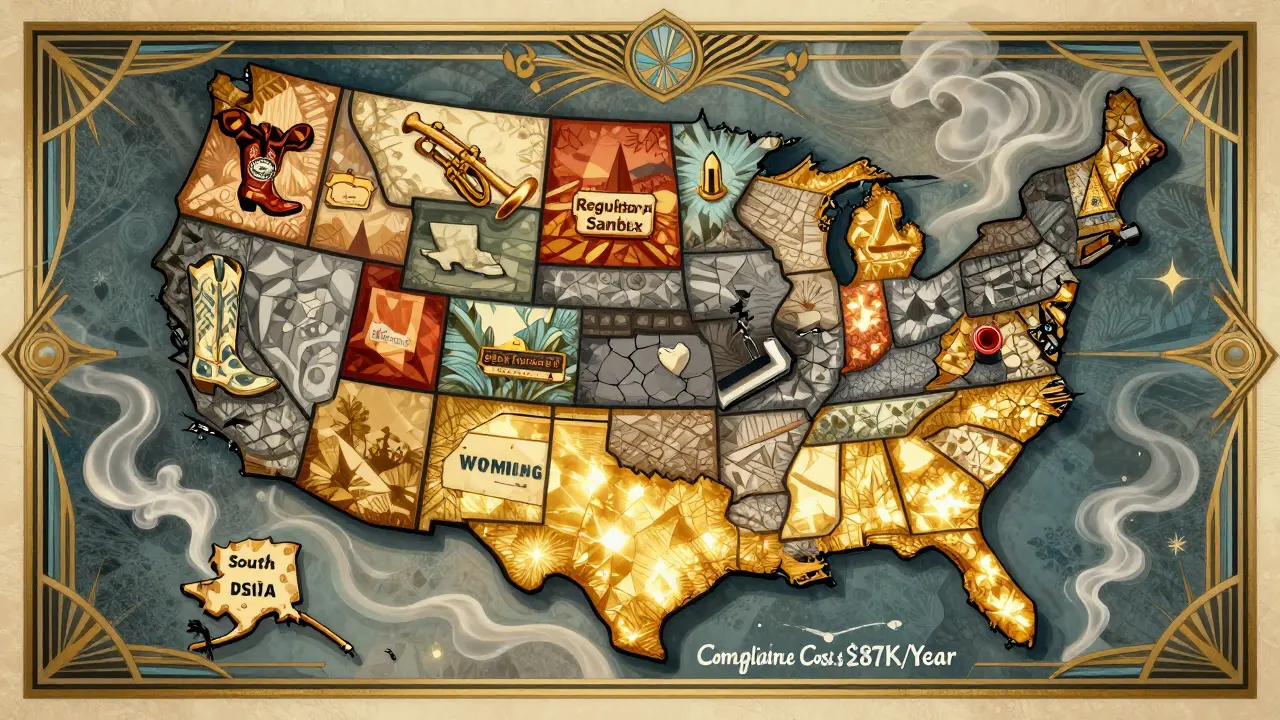
But here’s the problem: 28 states require bonding, and the amounts vary wildly. Texas: $25,000. New York: $500,000. Arizona lets you apply for a regulatory sandbox-basically a test zone where you can try new products without full licensing. That’s helped Arizona’s crypto startups grow 34% faster than in states without sandboxes.
And then there are the states that still haven’t figured it out. Massachusetts and Connecticut have no clear rules, but they’re aggressively going after crypto scams. In Massachusetts alone, $2.1 billion was recovered from crypto fraud between 2020 and 2025. That’s not regulation-that’s reaction. And it scares off legitimate businesses.
What This Means for You
If you’re a user: Where you live affects what exchanges you can use. Some platforms won’t let New Yorkers trade certain tokens. Others won’t let Massachusetts residents open accounts at all. Check your exchange’s terms before signing up.
If you’re a business owner: Don’t assume your license in one state works everywhere. You might need to register in five or six states just to serve your customers. The average multi-state crypto firm spends $287,000 a year just on compliance costs. That’s not marketing. That’s legal overhead.
And if you’re thinking about starting a crypto company? Location matters more than code. Wyoming, South Dakota, and Tennessee are attracting 78% of new crypto banking jobs. New York, Massachusetts, and Connecticut are losing talent. You’re not just choosing a state-you’re choosing your future.
The Big Picture: What’s Coming Next
The GENIUS Act of 2025 gave the federal government more power over stablecoins and custody rules. But 22 states are already suing, saying it violates the 10th Amendment. That means the legal fight isn’t over. It’s just beginning.
Some experts think federal law will eventually override state rules. Others say states will keep their power, and we’ll end up with a federal-state partnership. Either way, the patchwork isn’t going away anytime soon.
For now, your best move is simple: Know your state’s rules. Don’t assume federal law protects you. Don’t assume your neighbor’s rules apply to you. And don’t wait until you get fined to learn the difference between a license and a registration.
The crypto world moves fast. But the rules? They’re still stuck in 2025. And if you’re not keeping up, you’re already behind.



Heather Crane
January 24, 2026 AT 14:59Catherine Hays
January 25, 2026 AT 08:10Nathan Drake
January 26, 2026 AT 09:04HARSHA NAVALKAR
January 26, 2026 AT 16:36Kevin Pivko
January 27, 2026 AT 16:03MICHELLE REICHARD
January 28, 2026 AT 07:17tim ang
January 29, 2026 AT 13:41Julene Soria Marqués
January 30, 2026 AT 10:36Bonnie Sands
January 31, 2026 AT 08:05katie gibson
February 1, 2026 AT 03:16Ashok Sharma
February 2, 2026 AT 06:25Margaret Roberts
February 2, 2026 AT 20:12