Imagine a world where your driving skills on a virtual track could earn you real money. That was the promise of Howl City, a project that tried to blend high-speed racing with blockchain technology. But if you are looking at the coin today, specifically the HWL token, you might be scratching your head. The numbers don’t look like what they used to promise. So, what exactly is this coin, and why does it matter right now?
Let’s cut through the noise. Howl City started as an ambitious metaverse platform focused on racing games. It wanted to give players a chance to compete, build communities, and earn rewards through its native cryptocurrency. However, the reality of the crypto market in 2026 is harsh for small-cap projects. Understanding HWL requires looking past the initial hype and examining the actual data: the supply, the price history, and the severe liquidity issues that define its current state.
The Core Concept: Racing Meets Blockchain
At its heart, Howl City is a blockchain-based gaming platform designed to offer a metaverse experience centered around racing games and virtual world exploration. The idea wasn’t entirely new, but the execution aimed to combine two popular trends: competitive gaming and play-to-earn mechanics. Players were supposed to jump into realistic races, compete against others globally, and earn digital assets that could be traded or used within the ecosystem.
The development team behind the project remained anonymous, which is common in early-stage crypto ventures but also adds a layer of risk. Their vision included more than just racing. The roadmap promised a full metaverse expansion, including virtual real estate trading, social hubs, and additional game modes. This multi-phase approach meant that Phase One would focus purely on the racing aspect to build a user base before rolling out broader features.
- Play-to-Earn Mechanics: Users could potentially earn tokens by winning competitions or completing specific in-game challenges.
- Cross-Platform Access: The architecture was designed to allow access from multiple devices, ensuring consistent gameplay regardless of hardware.
- Virtual Economy: Assets earned in the game were meant to be tokenized, allowing players to trade them on external marketplaces.
This model relied heavily on user adoption. Without enough people playing, the economy collapses. And here lies the biggest challenge for Howl City: it never reached the critical mass needed to sustain such an ecosystem.
Tokenomics: Supply, Demand, and Reality
To understand any crypto coin, you have to look at its tokenomics-the economic structure of the token. For HWL, the numbers tell a story of extreme scarcity in circulation versus massive total potential supply. This discrepancy often leads to volatility and confusion among investors.
The technical specifications show a total token supply of 540,000,000 HWL. However, the circulating supply has historically been reported much lower, around 11,250,000 HWL. When only a tiny fraction of the total supply is available for trading, price movements can be erratic. Even a small amount of buying or selling can cause wild swings because there isn’t enough depth in the market to absorb those trades smoothly.
| Attribute | Value / Detail |
|---|---|
| Total Supply | 540,000,000 HWL |
| Circulating Supply | ~11,250,000 HWL (Self-reported) |
| Blockchain Network | Binance Smart Chain (BSC) |
| Token Standard | BEP-20 |
| All-Time High Price | $0.23 USD |
The token operates on the Binance Smart Chain, which allows for low transaction fees and fast processing times. This makes it compatible with wallets like MetaMask and decentralized exchanges such as PancakeSwap. Being on BSC was a strategic choice to reduce barriers for entry, but it didn’t solve the fundamental issue of demand.
Market Performance: From Hype to Negligible Value
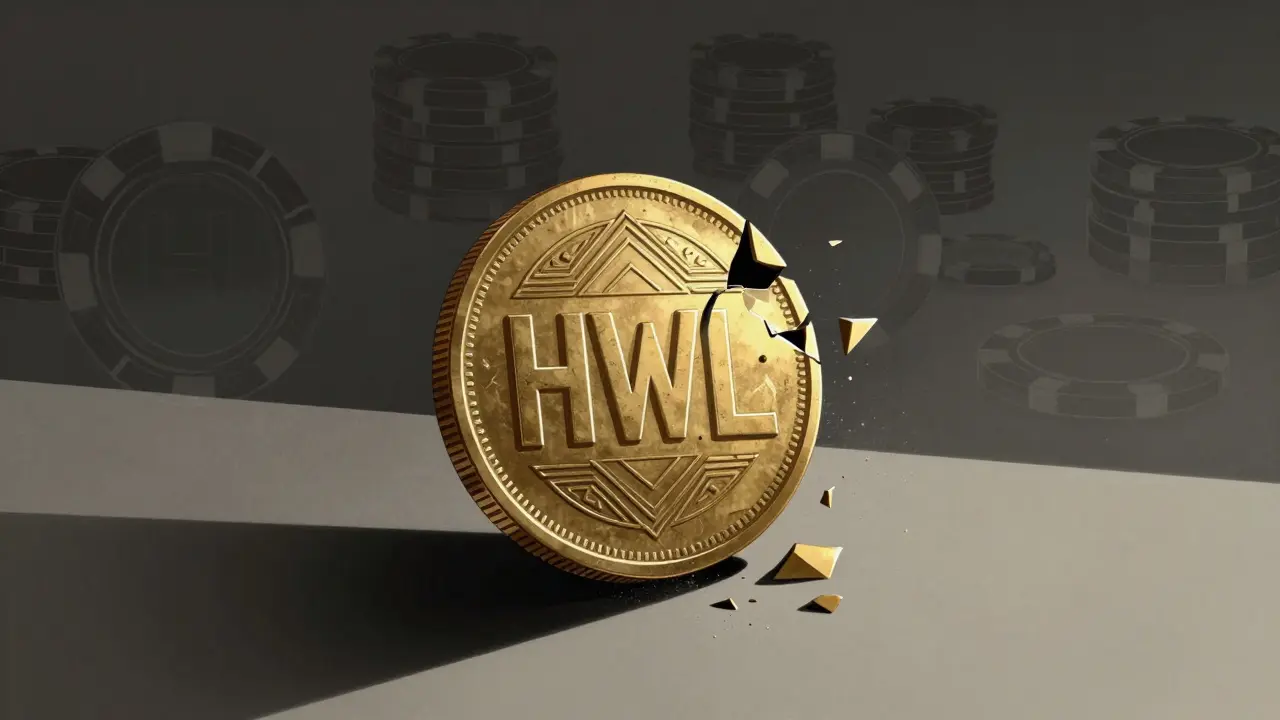
If you bought HWL at its peak, you are likely holding a bag that has lost nearly all its value. The token reached an all-time high of $0.23 during the earlier phases of the metaverse boom. That sounds decent until you compare it to where it sits today. By late 2023 and continuing into 2026, the price had collapsed to approximately $0.000033 USD. That represents a decline of over 99.9% from its highest point.
Why did this happen? Several factors contributed to this steep drop:
- Lack of Liquidity: With a market capitalization hovering around $365-$400, there is almost no money moving in and out of the token. You can’t sell even a modest amount without crashing the price further.
- Low Trading Volume: Daily trading volumes often dip below $300. In the crypto world, volume indicates interest. Zero volume means zero interest.
- Competition: Established giants like Axie Infinity, The Sandbox, and Decentraland absorbed most of the investor attention and funding. Howl City couldn’t compete for resources or users.
For context, major gaming tokens have market caps in the hundreds of millions or billions. Howl City’s micro-cap status places it outside the realm of serious investment for most institutional or even retail traders. It exists in a shadow corner of the market where discovery is rare and exit strategies are nearly impossible.
Where Can You Trade HWL?
Finding a place to buy or sell HWL is part of the difficulty. Unlike Bitcoin or Ethereum, which are listed on every major exchange, Howl City relies almost exclusively on decentralized platforms. The primary venue for trading is PancakeSwap, specifically version 2 on the Binance Smart Chain.
Trading on PancakeSwap requires you to connect a Web3 wallet, such as Trust Wallet or MetaMask, and hold some BNB (Binance Coin) to pay for gas fees. The trading pair is typically HWL/BUSD. Because the liquidity pool is so shallow, slippage becomes a major problem. Slippage is the difference between the expected price of a trade and the price at which the trade is executed. On a thin book like HWL’s, trying to sell $10 worth of tokens might result in getting back only $2 due to the lack of buyers at higher prices.
This creates a trap for holders. They own tokens that technically have a price, but they cannot convert them to cash without accepting massive losses. This illiquidity is perhaps the most significant risk associated with the HWL token today.

Risks and Challenges for Investors
Investing in micro-cap cryptocurrencies like Howl City carries extreme risks. It is not just about the price going down; it’s about the structural viability of the project itself. Here are the key red flags to consider:
- Anonymous Team: Without public faces attached to the project, accountability is limited. If the developers decide to abandon the project, there is no one to hold responsible.
- Minimal Community Engagement: Social media metrics show negligible activity. Reddit discussions are virtually nonexistent, and Discord servers lack meaningful conversation. A dead community usually signals a dead project.
- Development Stagnation: There is little evidence of active development updates or new feature releases since the initial launch phase. The roadmap promises remain unfulfilled.
- Regulatory Uncertainty: As a play-to-earn token, HWL may face scrutiny under securities laws in various jurisdictions, especially if it fails to demonstrate utility beyond speculation.
Experts note that projects with market caps below $1 million have a roughly 95% chance of being abandoned within 18 months based on historical data from previous crypto cycles. Howl City fits this profile perfectly. While the broader metaverse sector is projected to grow, reaching over $10 billion by 2027, Howl City is unlikely to capture any meaningful share of that growth given its current constraints.
Is There Any Future for Howl City?
Can a project like this make a comeback? Technically, yes. Cryptocurrency markets are known for sudden spikes driven by memes or viral trends. However, relying on luck is not a strategy. For Howl City to recover, it would need several things to change simultaneously:
- New Funding: Significant capital injection to improve marketing and development.
- User Adoption: A surge in active players actually using the racing platform.
- Exchange Listings: Getting listed on a centralized exchange to increase visibility and liquidity.
Without these elements, the token remains speculative at best and risky at worst. The gap between Howl City and established competitors is too wide to bridge without substantial resources. Investors should view HWL not as an investment opportunity, but as a case study in how quickly small-cap crypto projects can lose relevance.
What is the current price of Howl City (HWL)?
As of recent data, the price of HWL hovers around $0.000033 USD. However, due to extremely low liquidity, this price can fluctuate wildly with minimal trading activity. Always check live charts on PancakeSwap for the most up-to-date rates.
Is Howl City a good investment in 2026?
Generally, no. With a market cap under $400 and near-zero trading volume, HWL poses extreme risk. Most experts advise against investing in micro-cap tokens with no active development or community engagement due to the high likelihood of total loss.
How do I buy HWL tokens?
You can attempt to buy HWL on PancakeSwap (v2) using the Binance Smart Chain. You will need a BEP-20 compatible wallet like MetaMask, along with BNB for transaction fees. Be aware of high slippage and low liquidity risks.
What happened to the Howl City metaverse?
The project launched initially as a racing game but failed to gain traction. Plans for expanding into a full metaverse with real estate and social features appear stalled due to lack of funding and user adoption. Development updates have become sparse.
Who created Howl City?
The development team behind Howl City remains anonymous. This is common in early crypto projects but increases risk for investors as there is no public accountability or verifiable track record for the founders.