Hypr (HYPR) isn’t another meme coin or a copy of Bitcoin. It’s a niche cryptocurrency built for one specific job: helping game developers add blockchain features without needing a PhD in cryptography. If you’ve ever wondered how some games let players truly own their skins, weapons, or characters on-chain - and how that’s even possible without making the code impossibly complex - Hypr is trying to solve that exact problem.
What Hypr (HYPR) actually does
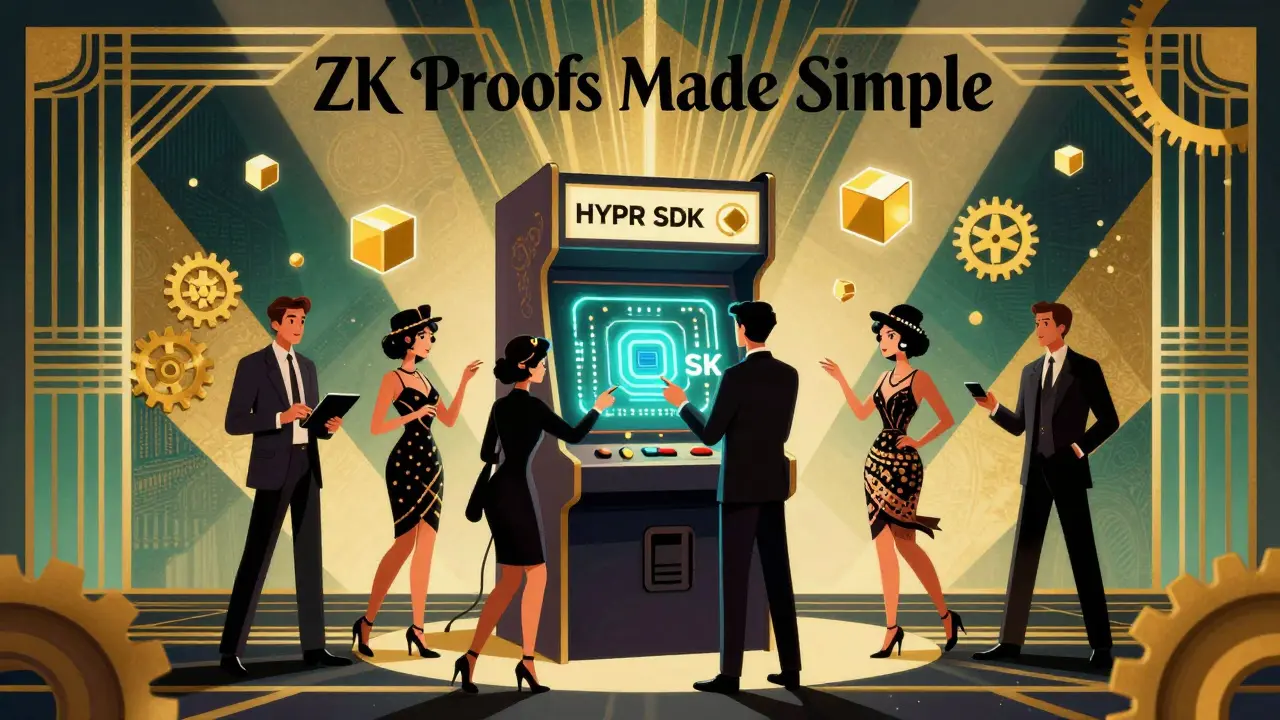
Hypr Network is a Layer 2 solution running on top of Ethereum. That means it doesn’t replace Ethereum - it works alongside it to make things faster and cheaper. But unlike other Layer 2s like Polygon or Arbitrum that focus on general transactions, Hypr is laser-focused on gaming. Its main tool? Plug-and-play software development kits (SDKs) that let game makers add zero-knowledge (ZK) proofs into their games without writing a single line of complex crypto code.
Zero-knowledge proofs sound scary, but they’re basically a way to prove something is true without revealing the details. For games, that means proving a player earned a rare item fairly - without exposing their private wallet or game data. Most developers avoid ZK tech because it’s hard. Hypr says: don’t worry, we’ve already built it. Just drop in our SDK, and it works.
The HYPR token: what it’s for
The HYPR token is the fuel inside this system. It’s not used for buying in-game items directly. Instead, it powers access to Hypr’s tools, pays for verification services, and likely rewards developers who build on the platform. Think of it like a subscription license - but instead of paying monthly, you pay in HYPR tokens to unlock features.
There are exactly 100 million HYPR tokens ever created. As of late 2023, about 71.8 million were in circulation. That leaves nearly 28 million tokens still unissued - probably reserved for future team incentives, ecosystem growth, or partnerships. The token launched with no major exchange listings at first, but by November 2023, it was trading on a few smaller platforms like CoinMarketCap and CoinGecko.
Price and market reality
Don’t get fooled by hype. As of November 2023, HYPR traded around $0.002 USD. That’s two-tenths of a cent. On some platforms, you might see a spike up to $0.09 - but those numbers are likely outdated, misreported, or from fake trading pairs. CoinMarketCap and CoinGecko, the two most trusted crypto data sources, showed wildly different 24-hour volume numbers: $6,700 vs. $4,400. That’s not normal. It signals low liquidity and possibly thin trading.
At that price, Hypr’s market cap was around $145,000 - barely enough to buy a decent used car. For comparison, Immutable X (IMX), another gaming-focused token, trades at over $100 million in market cap with daily volumes over $10 million. Hypr’s daily volume was under $7,000. That’s less than 0.07% of what IMX moves. If you wanted to buy or sell a large amount of HYPR, you’d likely crash the price.

Who’s using it? No one, yet
This is the biggest red flag. If Hypr is so great at making ZK tech easy, why aren’t game studios using it?
There are no public case studies. No announcements from indie devs or studios saying, “We built our game on Hypr.” No GitHub commits showing active development. No Reddit threads discussing integrations. No developer forums. Even the official Twitter account @hypr_network has minimal engagement.
That’s unusual. Most crypto projects with real tech - even small ones - have at least a few developers sharing tutorials or bug reports. Hypr has none. CoinMarketCap even labels its page as a “preview,” meaning they don’t consider it fully verified. That’s rare for a token that’s been live for over a year.
How does it compare to other gaming blockchains?
Hypr isn’t alone. There are other projects trying to do the same thing:
- Immutable X (IMX): Used by big games like Guild of Guardians. High volume, strong developer support, and real users.
- Polygon zkEVM: A general-purpose ZK Layer 2, but many games use it because it’s reliable and well-documented.
- Ronin (Axie Infinity): Built for one game, but that game had millions of players.
Hypr’s advantage? It’s the only one focused purely on making ZK proofs accessible to devs with zero crypto background. But advantage doesn’t mean adoption. If you’re a game studio, would you risk building on a platform with no track record, no user base, and no proof it works in the real world? Probably not.
Is Hypr worth paying attention to?
Technically, the idea is solid. Blockchain gaming needs better tools. ZK tech is the future of privacy and security in games. If Hypr can deliver on its promise - and get even one well-known indie game to use it - everything could change.
But right now? It’s a concept on paper. No real usage. No developer testimonials. No partnerships. No traction. The token’s price is so low not because it’s undervalued - but because no one cares enough to buy it.
If you’re a developer looking to build a blockchain game, skip HYPR for now. Try Immutable X or Polygon zkEVM. They’re proven. They have docs. They have communities. You can find help when you get stuck.
If you’re an investor? Be extremely cautious. Low market cap + low volume + zero real-world proof = high risk. This isn’t a speculative gamble like Dogecoin. This is a bet on a team that hasn’t shown they can deliver.
The bottom line
Hypr (HYPR) is a crypto coin built for a real problem - simplifying zero-knowledge tech for game developers. But having a good idea doesn’t mean you’ve built a working product. Right now, HYPR exists mostly in whitepapers and price charts. There’s no evidence it’s being used by anyone. The market doesn’t believe in it. The developers aren’t talking about it. The community is silent.
It’s not dead. But it’s not alive either. It’s waiting. For a game studio to take a chance. For a developer to share a success story. For someone to prove this isn’t just another crypto experiment.
Until then, HYPR is a theory - not a tool. And theories don’t move markets.