
When you hear the term open source crypto coin, it might sound like a fancy tech buzzword. But it’s not marketing fluff-it’s the actual foundation of how most cryptocurrencies work. If you’ve ever wondered why Bitcoin or Ethereum can’t be shut down by a single company, or why anyone trusts a digital currency they can’t see or touch, the answer lies in open source code. This isn’t just about software-it’s about trust, control, and who really owns the system behind your money.
What Does "Open Source" Actually Mean for Crypto?
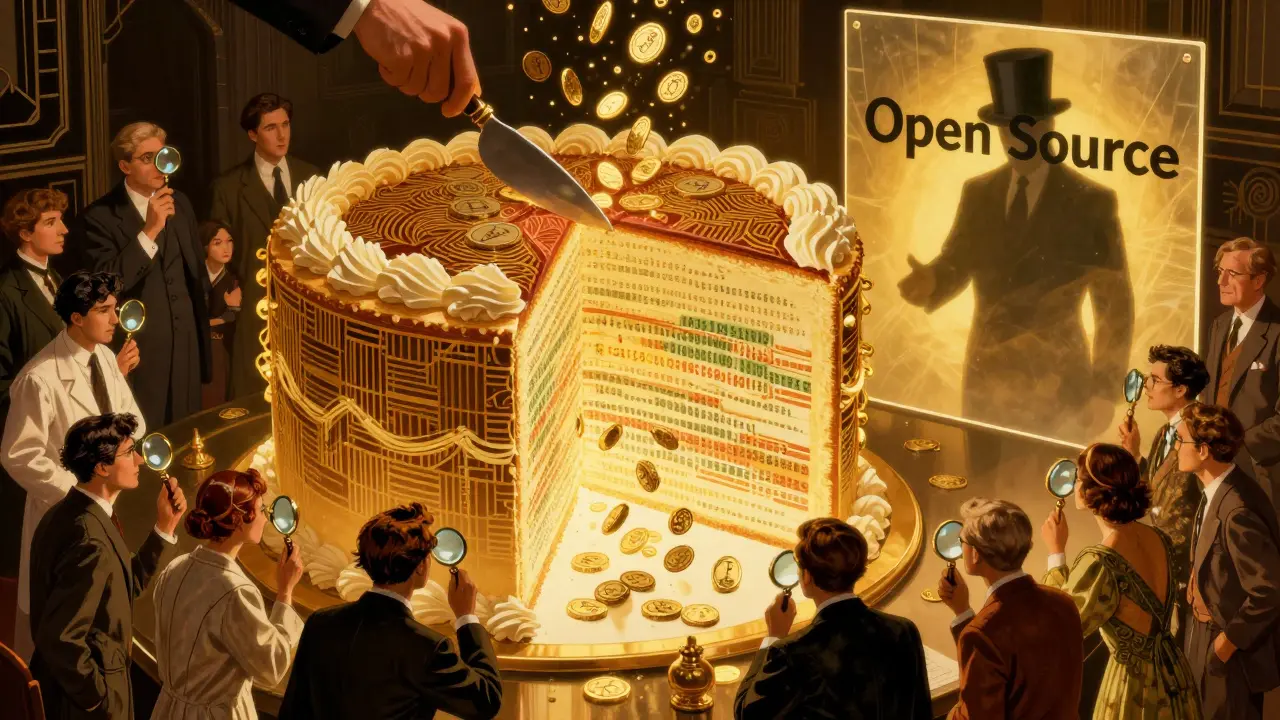
Open source means the code that runs a cryptocurrency is publicly available. Not hidden behind a corporate firewall. Not locked in a vault. Not owned by a CEO or a venture capital firm. Anyone can download it, read it, change it, or build on it. This isn’t some niche developer thing-it’s the core reason Bitcoin exists.Think of it like a recipe for a cake. If a bakery says, "Our chocolate cake is the best," but won’t let you see the ingredients or steps, you have to trust them. But if they post the full recipe online-every measurement, every step, every substitution-you can check it yourself. You can even make your own version. That’s open source. In crypto, the "cake" is the blockchain, and the "recipe" is the code that makes transactions happen, coins get created, and networks stay secure.
Bitcoin’s original code, released in 2009, was open source from day one. And it wasn’t just a one-time release-it was designed to be improved by anyone. Today, over 15,000 code changes have been made by more than 450 different developers, none of whom work for a single company. No one owns Bitcoin. No one controls it. It runs because thousands of people around the world run the same open code on their computers.
How Open Source Crypto Works
Every cryptocurrency that’s truly decentralized relies on three key parts: the blockchain, the consensus rules, and the client software. All three are open source.- The blockchain is a public ledger. Every transaction ever made on Bitcoin or Ethereum is stored permanently and visible to anyone. You can look up any address and see every coin it ever received or sent.
- The consensus rules are the math and logic that decide what counts as a valid transaction. For example, Bitcoin only allows 21 million coins to ever exist. That rule is coded into the software, not enforced by a bank or government.
- The client software is the program that lets your computer connect to the network. It’s called a "node." Anyone can download Bitcoin Core, Ethereum’s Geth, or Litecoin’s client-and run it. No permission needed. No signup. No fee.
This system works because every node checks every transaction against the same open rules. If someone tries to cheat-say, by sending the same coin twice-the network rejects it. No central authority steps in. The code does.
Why Open Source Matters More Than You Think
Most people think crypto is about making money. But the real innovation isn’t the price charts. It’s the fact that you don’t need a bank to move money. And that’s only possible because the code is open.Here’s why that’s huge:
- Transparency - You can look at the code and see exactly how coins are created, how fees are calculated, and whether there’s a hidden backdoor. Closed-source systems? You’re trusting someone else’s word.
- Security - When thousands of developers worldwide are reviewing the code, bugs get caught fast. Bitcoin’s code has been under constant scrutiny for over 15 years. It’s been attacked, tested, and broken-and still works.
- No single point of failure - If one company runs a system, and they get hacked or go bankrupt, the whole thing collapses. Open source crypto has no company. No HQ. No CEO. It runs on tens of thousands of computers spread across the globe.
- Freedom to fork - If a group of developers thinks Bitcoin’s transaction speed is too slow, they can copy the code, change it, and launch a new coin. That’s how Bitcoin Cash, Litecoin, and dozens of others were born. No lawsuit. No permission. Just code.
This isn’t theoretical. In 2025, over 70% of the top 50 cryptocurrencies by market cap were built on open source code. Ethereum, Solana, Cardano, Dogecoin-all of them started with publicly available code. Even the most "private" coins like Monero or Zcash are open source. Their privacy features are built into the code, so anyone can verify they actually work.
Open Source vs. Closed Source Crypto
Not all crypto is created equal. Some projects claim to be decentralized but use closed-source code. That’s a red flag.Here’s the difference:
| Feature | Open Source Crypto | Closed Source Crypto |
|---|---|---|
| Code Access | Publicly available on GitHub or similar | Hidden, only insiders can see it |
| Security Audits | Anyone can audit the code | Only paid auditors get access |
| Updates | Community-driven, transparent proposals | Decided by a small team or company |
| Ownership | No single entity controls it | Often owned by a startup or VC firm |
| Trust Required | Trust the code, not the company | Trust the company |
If a crypto project says it’s "decentralized" but won’t show you the code, treat it like a black-box investment. You’re betting on a team, not a system. Open source crypto lets you bet on the system itself.
Real Examples You Can Explore
You don’t have to take anyone’s word for it. You can check this stuff yourself.- Bitcoin Core - The official Bitcoin software. You can download it, compile it, and run your own Bitcoin node. The code is on GitHub. Every change since 2009 is visible. You can even see who wrote each line.
- Ethereum - The code for Ethereum’s core protocol is open on GitHub. Developers from over 80 countries have contributed. You can read the exact rules for how smart contracts work.
- Monero - A privacy coin that uses advanced cryptography. Its entire codebase is open, and independent researchers have verified that its privacy features actually work as claimed.
These aren’t just "projects." They’re public infrastructure. Like Wikipedia, but for money. Anyone can edit it. Anyone can use it. No one owns it.
What This Means for You
If you’re holding crypto, you should care about this. Because if the code isn’t open, you have no way to know if your coins are safe. If the project shuts down, or if the team disappears, or if they secretly add a backdoor-you’re out of luck.But if it’s open source? You can verify everything yourself. You can run your own node. You can see the transaction history. You can even fork it if you think it’s broken.
This is the real power of open source crypto. It turns users from passive consumers into active participants. You’re not just holding a coin. You’re part of a global network that runs on transparent, community-built code.
Myths About Open Source Crypto
There are a few misunderstandings that keep popping up:- "Open source means it’s not secure." - False. The more eyes on the code, the fewer bugs survive. Linux, Apache, and OpenSSL are all open source and power the internet.
- "Anyone can steal the code and copy it." - True. But that’s the point. Copying the code doesn’t copy the network. Bitcoin’s value isn’t in the code-it’s in the millions of people running it.
- "Open source projects are chaotic and unmanaged." - Some are. But the biggest ones-Bitcoin, Ethereum, Litecoin-have clear governance. Proposals are discussed publicly. Changes are reviewed. Votes happen in code, not boardrooms.
How to Check if a Crypto Is Truly Open Source
Before you invest, ask these three questions:- Is the code on GitHub or a similar public repository?
- Are there recent commits from multiple developers (not just one person)?
- Can you download and run the software yourself without needing permission?
If the answer to any of these is "no," it’s not open source. And if it’s not open source, it’s not truly decentralized.
Is Bitcoin open source?
Yes. Bitcoin’s core software, called Bitcoin Core, is fully open source. The code is hosted on GitHub, licensed under the MIT license, and has been modified by over 450 developers since 2009. Anyone can download, review, or contribute to it.
Can I make my own crypto coin using open source code?
Yes. Many coins started as forks of Bitcoin or Ethereum. You can copy the code, change a few parameters-like total supply or block time-and launch your own blockchain. But unless people actually use it, it has no value. The code is just the starting point.
Does open source mean crypto is free to use?
The software is free to download and use. But using the network usually costs a small fee-called a transaction fee-to pay miners or validators. This isn’t a "price" set by a company; it’s determined by supply and demand on the network.
Are all cryptocurrencies open source?
No. Some projects, especially newer ones or those backed by venture capital, keep their code private. These are often called "permissioned blockchains" and are not truly decentralized. Always check the code before trusting a crypto project.
Why does open source matter for security?
Because bugs and backdoors are found faster when thousands of people are looking. Closed-source systems rely on a small team to catch mistakes. Open source relies on the entire world. Bitcoin has gone 15 years without a critical flaw in its core code-partly because it’s been reviewed more than any other software in history.
Open source crypto isn’t about technology alone. It’s about power. Who controls the system? Who gets to change the rules? Open source says: everyone. And that’s why it’s the most important innovation in money since the printing press.

Melissa Ritz
March 4, 2026 AT 10:16Look, I get it. Open source sounds cool, but let’s be real-most of these projects are just glorified GitHub repositories with 3 contributors who ghosted after the ICO. I’ve read the Bitcoin code. It’s a mess. Comments are outdated, variable names are cryptic, and half the functions are legacy spaghetti from 2012. If this is the pinnacle of transparency, I’ll stick with my bank.
Also, who the hell reviews 15,000 commits? Nobody. It’s theater. The real power is still in the wallets and exchanges. The code? Just a pretty facade.
James Burke
March 5, 2026 AT 13:03Actually, the beauty of open source isn’t that it’s perfect-it’s that anyone can fix it. I run a Bitcoin node on an old Raspberry Pi. No fancy gear. Just code I downloaded and trusted because I could see every line. That’s power. No middleman. No ‘trust us’ vibes. You verify. You participate. It’s not magic, it’s math-and math doesn’t lie.
Also, if you’re scared of open code, you’re scared of transparency. And that’s not a crypto problem. That’s a you problem.
jonathan swift
March 6, 2026 AT 17:06OPEN SOURCE? LOL. You think they didn’t backdoor it? 🤔
Bitcoin’s code? Yeah, it’s public. But who wrote the first version? Satoshi. And where is he now? Gone. Poof. Like the CIA dropped a ghost into the blockchain and walked away. And now we’re all running code written by a ghost who might’ve been a NSA project. 🤫
And don’t get me started on Ethereum. They ‘forked’ it after The DAO. Who decided that? A handful of devs in a Slack room. That’s not decentralized. That’s a secret society with GitHub access. 👁️
Datta Yadav
March 6, 2026 AT 19:41Let me break this down for you folks who think open source = democracy. The entire crypto ecosystem is a rigged game where the same 20 developers, mostly from Silicon Valley, control 80% of the meaningful commits. Bitcoin Core? Dominated by a handful of core maintainers who gatekeep every PR. Ethereum? Same thing. They call it decentralized, but if you’re not a white male dev with a GitHub profile and a Y Combinator connection, your PR gets ignored. It’s not open. It’s exclusive. And don’t give me that ‘anyone can contribute’ BS-try submitting a patch when your name sounds like ‘Datta Yadav’ and see how fast it gets labeled ‘non-standard’ or ‘unmaintainable.’
Open source is the new corporate veil. Same power. Different label. The code is free. The access? Not so much.
Lydia Meier
March 8, 2026 AT 16:37While the premise of open-source cryptography is theoretically sound, one must consider the empirical evidence regarding long-term maintainability and security audit efficacy. The assertion that increased visibility equates to enhanced security is not universally validated. In fact, studies conducted by the Open Source Security Foundation (2023) indicate that critical vulnerabilities in high-profile open-source projects persist for an average of 147 days prior to remediation. Furthermore, the absence of formal governance structures introduces systemic fragility. One must therefore question whether the romanticized notion of decentralized code is, in practice, a liability rather than an asset.
jay baravkar
March 10, 2026 AT 00:48Bro, this is the coolest thing ever. Imagine being part of a network where YOU control the rules, not some CEO in a suit. I started running a node last year. It’s just sitting there in my closet, humming like a fridge. And every time a transaction goes through? I feel like I’m part of something bigger. Like I’m helping build the future.
And yeah, it’s not perfect. But it’s ours. No one’s taking it away. Not the government. Not the banks. Not even the devs. That’s freedom. And it’s real. Go run a node. It’s free. It’s easy. You’ll thank yourself later. 💪
Ian Thomas
March 11, 2026 AT 14:12Open source? Sure. But let’s not pretend this is some Enlightenment-era public square. It’s a digital town hall where everyone’s yelling, no one’s listening, and the mayor is a bot.
The real question isn’t whether the code is open-it’s whether anyone with actual power cares. The miners? The validators? The whale wallets? They’re not reading GitHub. They’re optimizing profit. The code is a mirror. It reflects the values of those who use it. And right now? The values are: speed, scale, and selfishness.
So yes, it’s open. But is it free? Or just… visible?
Rachel Rowland
March 12, 2026 AT 02:44I love how people treat open source like it’s some kind of miracle cure. It’s not. It’s a tool. A really powerful one. But tools don’t fix bad intentions. You can have open code and still have rug pulls, insider dumps, and dev wallets that hold 30% of the supply. The code doesn’t stop greed. People do.
So yeah, check the code. Run the node. But don’t stop there. Look at the wallets. Look at the team. Look at who’s cashing out. Open source gives you the keys. But you still have to drive. And you better know where you’re going.
Bonnie Jenkins-Hodges
March 12, 2026 AT 11:37Open source? In AMERICA? Please. This is just another way for the left to undermine national security. You think we should let China, Russia, and Iran read our financial code? That’s not freedom. That’s treason. Bitcoin doesn’t belong to the world. It belongs to the free world. And if you’re handing over the keys to our money to strangers on the internet, you’re not a pioneer-you’re a traitor. 🇺🇸
Also, why are we letting non-Americans vote on our blockchain? Who elected them?
Cerissa Kimball
March 12, 2026 AT 19:57Open source crypto is foundational to modern financial integrity yet often misunderstood. While transparency is indeed a virtue, the absence of formal accountability mechanisms introduces significant risk. Many open-source projects lack dedicated security teams, legal oversight, or insurance frameworks. Furthermore, the MIT license, commonly used, provides zero liability protection. Users assume responsibility for all consequences, including loss due to exploits, which are inevitable in complex systems. The notion that community review ensures safety is statistically unsupported. In practice, audits are sporadic and underfunded. This is not innovation-it’s institutional negligence with a GitHub badge.
Basil Bacor
March 13, 2026 AT 11:09open source? more like open to abuse. anyone can copy the code and make a scam coin. look at all the doge clones. and who’s checking it? some guy in his basement with 3 monitors? nah. the whole thing’s a joke. i’ve seen code that’s got typos in the consensus logic. and they call it secure? lol. we’re all just playing pretend while the real power’s still in the banks. #notallcrypto
Emily Pegg
March 14, 2026 AT 03:12Can we just admit that open source is just a way for tech bros to feel morally superior? I’ve seen devs who won’t touch a closed-source project but will happily fund a coin that’s been abandoned for 2 years because ‘the code is public.’
It’s not about the code. It’s about identity. You don’t care about security. You care about being the person who says ‘I ran a node.’
And then you sell your BTC at $70k like a total chump. 😔
Ethan Grace
March 15, 2026 AT 05:55What if the real revolution isn’t the code-but the silence around it? We talk about transparency, but we never ask who chose to make it public. Who decided the code should be free? Was it the people? Or was it the same people who always decide what’s ‘free’? The blockchain doesn’t change power. It just makes it quieter. And quieter is harder to see. Harder to fight. Harder to understand.
Maybe open source isn’t liberation. Maybe it’s just camouflage.
Jamie Hoyle
March 15, 2026 AT 17:31Open source? Yeah, right. The only reason Bitcoin’s code is public is because Satoshi didn’t know how to copyright it. And now we’re all playing pretend that this is some noble experiment. Meanwhile, the top 0.1% of wallets hold 40% of all BTC. The code doesn’t prevent concentration. It enables it. The ‘decentralized’ network is just a distributed Ponzi with better PR.
And don’t even get me started on Ethereum’s gas fees. ‘Open source’ doesn’t mean fair. It just means you can see the scam from all angles. That’s not freedom. That’s a spectator sport.
Jeffrey Dean
March 16, 2026 AT 11:55You’re all missing the point. The code isn’t the revolution. The revolution is the psychological shift. For the first time in human history, people are building systems without asking permission. Without a boss. Without a license. Without a board meeting.
That’s terrifying. That’s beautiful. That’s the real innovation-not the math, not the nodes, not the forks. It’s the quiet rebellion of millions saying: ‘I don’t need you to tell me what’s valid. I’ll verify it myself.’
And that? That changes everything. Even if you don’t run a node. Even if you don’t understand the code. You’re still part of it. Because you chose to believe in something that doesn’t need you to believe in it.
Brian T
March 18, 2026 AT 11:06Open source crypto? Yeah, sure. But why does it always come with this weird cult of personality? Like if you don’t run a node, you’re not ‘real.’ Like if you use Coinbase, you’re a sheep.
Here’s the truth: most people don’t care about the code. They care about the price. And that’s fine. You don’t need to understand how a car engine works to drive it. So stop shaming people for using wallets. The code is there if you want it. But not everyone has to be a sysadmin to use money.
Just… chill.
Nash Tree Service
March 20, 2026 AT 01:02The notion that open source inherently enhances security is a fallacy rooted in naive idealism. Empirical data demonstrates that the majority of open-source vulnerabilities remain unpatched for extended periods due to insufficient funding and volunteer burnout. Furthermore, the absence of contractual liability exposes users to unquantifiable risk. The blockchain, while transparent, is not immutable in its governance. Proposals are influenced by concentrated capital, not distributed consensus. The myth of decentralized control is maintained by rhetorical flourish, not operational reality. One cannot optimize for trust through transparency alone-trust requires accountability, and accountability requires structure. This is not a revolution. It is a regression masked as innovation.
Jane Darrah
March 21, 2026 AT 03:32I just want to say… I cried when I first ran my own node. Not because I understood the code. But because I realized I didn’t need anyone’s permission to be part of this. No bank. No app store. No ‘approval.’ Just me, my laptop, and this thing called Bitcoin Core that I downloaded like it was a free screensaver.
And then I saw a transaction go through. From someone in Nigeria. To someone in Chile. And there was no middleman. No fee. No delay. Just… math. And trust.
That’s when I got it. This isn’t about money. It’s about dignity. The dignity to participate without asking.
I’m not a dev. I’m not a coder. I’m just someone who finally felt like I belonged.
Denise Folituu
March 22, 2026 AT 17:23Open source? Please. The entire crypto world is built on a lie. The code is public, sure. But the real control? It’s in the wallets. The mining pools. The exchanges. The venture capital firms that quietly fund the ‘community’ projects. You think they want you to run a node? No. They want you to buy tokens and trust them. The open code is just a distraction. A shiny object while they quietly move the pieces.
It’s not decentralized. It’s just… distributed deception.
And we’re all playing along because it feels like freedom. But freedom without power is just… a very expensive illusion.