You’ve heard the name Algebra. Maybe it popped up on a Twitter feed, a Discord server, or a crypto influencer’s latest post. The promise is usually big: low fees, high liquidity, and access to new tokens before they hit the major centralized exchanges like Coinbase or Binance. But here is the hard truth about platforms with names that sound mathematical or institutional-they are often wrappers for something much more complex, and sometimes, much riskier.
In 2026, the landscape of cryptocurrency trading has shifted dramatically. We moved past the era of trusting every whitepaper blindly after the massive hacks of 2024 and 2025. You need to know exactly what you are connecting your wallet to. This review cuts through the hype to answer the real question: Is Algebra a legitimate tool for traders, or is it a risky interface you should avoid?
What Exactly Is Algebra?
First, let’s clear up a common confusion. When people search for "Algebra crypto exchange," they might be looking for two very different things. There is no major, publicly traded centralized exchange (CEX) named Algebra that holds your funds in custody. Instead, Algebra is primarily known as a Decentralized Exchange (DEX) aggregator and launchpad infrastructure.
Think of it this way: If Uniswap is a single grocery store, Algebra is a service that checks prices at ten different grocery stores and sends you to the cheapest one. It operates on-chain, meaning it doesn’t hold your money. It interacts with smart contracts on networks like Ethereum, BNB Chain, Solana, and others. Its main product allows users to trade tokens by finding the best execution path across multiple liquidity pools simultaneously.
This distinction is critical. Because Algebra is a DeFi protocol, not a company with a headquarters and customer support team, the rules of engagement change completely. You are not signing up for an account. You are connecting a digital wallet, such as MetaMask or Phantom, and approving transactions directly on the blockchain.
The Core Technology: How It Works
To understand if Algebra is right for you, you have to understand how it moves your money. The platform uses an algorithmic routing engine. Here is the step-by-step process when you click "Swap" on their interface:
- Connection: You connect your Web3 wallet. No email, no phone number, no KYC (Know Your Customer) verification.
- Quote Generation: Algebra scans dozens of underlying DEXs (like Uniswap, PancakeSwap, Raydium) to find the best price for your token pair.
- Splitting Orders: If you want to swap $10,000 worth of ETH for USDC, Algebra might split that order into three smaller trades across different pools to minimize slippage (the difference between the expected price and the executed price).
- Execution: The transaction is signed by your wallet and sent to the blockchain. Once confirmed, the tokens appear in your wallet.
The value proposition here is efficiency. On a standard DEX, large trades can move the market against you, costing you extra money. Algebra’s router tries to prevent this. For active traders, this technology can save significant amounts in fees and slippage. However, this convenience comes with technical risks that average users often overlook.
Security Audit: Is Your Money Safe?
This is the most important section. In the world of DeFi, "safe" does not mean "insured." Unlike a bank account protected by FDIC insurance, or even some centralized exchanges that offer limited compensation programs, DeFi protocols operate on a "code is law" basis. If there is a bug in the code, your funds can vanish instantly, and there is no customer support line to call.
So, how does Algebra stack up? As of mid-2026, Algebra has undergone audits from reputable firms, but audits are not guarantees. They are snapshots in time. A contract can be audited today and hacked tomorrow if a new vulnerability is discovered or if the team introduces un-audited changes.
| Feature | Centralized Exchange (e.g., Coinbase) | Decentralized Platform (e.g., Algebra) |
|---|---|---|
| Custody | Exchange holds your keys | You hold your keys (Non-custodial) |
| KYC Required | Yes (ID, Selfie) | No |
| Hack Risk | Platform-wide hack affects all users | Smart contract exploit affects specific users |
| Recovery Option | Support ticket / Potential reimbursement | None. Transactions are irreversible. |
| Regulatory Oversight | High (SEC, FCA, etc.) | Low to None |
The biggest risk with Algebra isn't necessarily the platform itself being malicious; it's the ecosystem around it. Scammers often create fake versions of popular sites. Always double-check the URL. The official site is typically algebra.finance or similar, but phishers will use algebra-exchange.com or algebra.io. One wrong click can drain your wallet.
Furthermore, because Algebra integrates with many other protocols, it inherits their risks. If a liquidity pool it routes through is compromised, your trade could execute incorrectly. This is known as composability risk. You are only as safe as the weakest link in the chain of protocols you interact with.
Fees and Costs: What Will It Cost You?
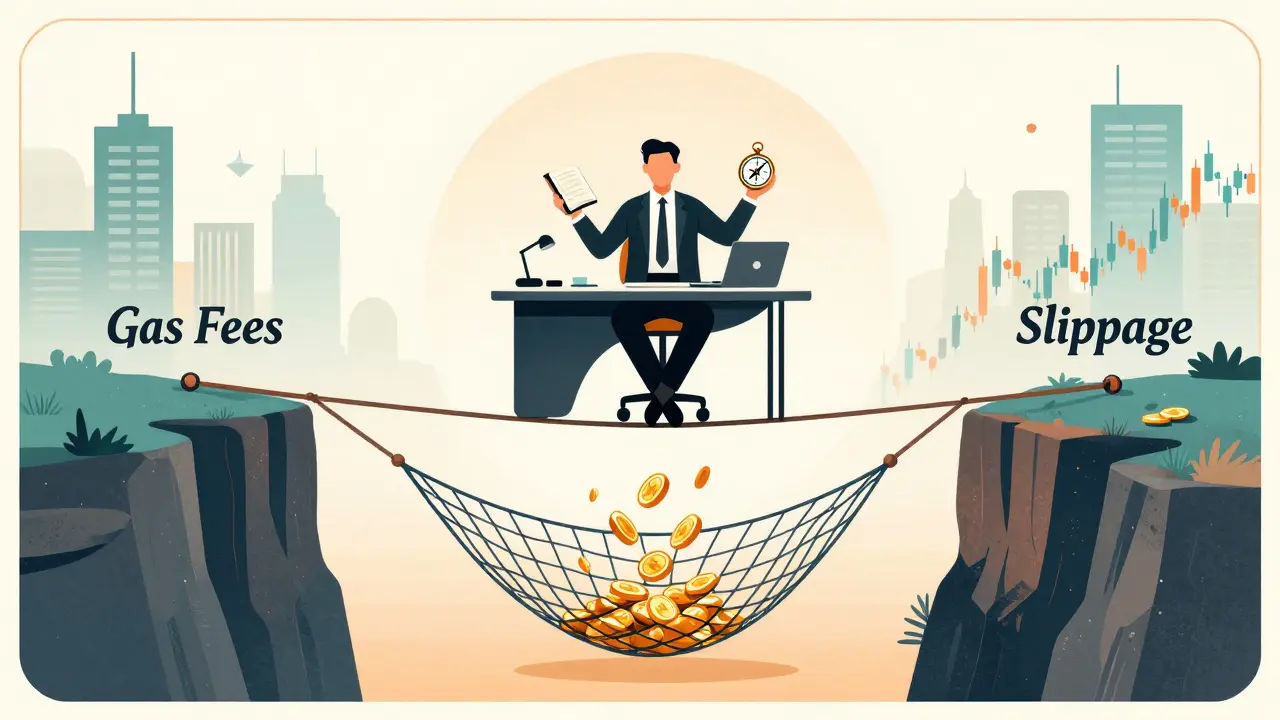
One of the main reasons traders flock to aggregators like Algebra is cost savings. But "low fees" is a relative term in crypto. Let’s break down where your money goes when you trade on Algebra.
- Gas Fees: These are network fees paid to miners or validators to process your transaction. On Ethereum, this can range from $5 to $50+ depending on congestion. On cheaper chains like Solana or BNB Chain, it might be less than $0.01. Algebra does not control these fees; the blockchain does.
- Trading Fees: Most DEXs charge a small percentage per trade (usually 0.05% to 0.3%). Algebra may charge a tiny premium for its routing service, often around 0.05%, which is generally lower than the slippage you would pay trading manually on a single pool.
- Slippage Tolerance: You set this in your wallet settings. If you set it too low, your trade fails, and you still pay gas. If you set it too high, you might get a worse price. Algebra’s interface helps optimize this, but you must remain vigilant.
For small trades under $100, the gas fees on Ethereum-based networks might outweigh any savings from better routing. In these cases, using a Layer 2 solution like Arbitrum or Optimism, or a native chain like Solana, is essential for profitability. Algebra supports multi-chain trading, so choosing the right network is part of your strategy.
User Experience: Is It Easy to Use?
If you are used to clicking "Buy" on an app like Robinhood or Coinbase, Algebra will feel foreign. There is no "Forgot Password" button. There is no deposit address generated for you. You are interacting directly with the blockchain.
The interface is clean and modern, designed to reduce cognitive load. It shows you the best route clearly, highlighting potential savings compared to other options. However, the learning curve is steep for beginners. You need to understand concepts like:
- Approvals: Before you can swap a token, you must approve the Algebra contract to spend it. This is a separate transaction that costs gas.
- Network Switching: You must ensure your wallet is connected to the same network as the token you want to trade.
- Wallet Signatures: Every action requires a signature. You will see pop-ups asking you to sign messages. Never sign a message unless you initiated the action.
For experienced DeFi users, the experience is smooth and efficient. For newcomers, it can be intimidating and prone to expensive errors. If you accidentally send ERC-20 tokens to an ERC-20 address on the wrong chain, those funds are gone forever.
Regulatory Status and Compliance
As of 2026, regulatory pressure on DeFi platforms has increased globally. Governments are trying to identify who controls these protocols. Algebra operates as a decentralized autonomous organization (DAO) or a foundation, depending on its current structure. This means there is no central entity easily identifiable for regulators to sanction.
This lack of regulation is a double-edged sword. On one hand, it means censorship resistance. No government can freeze your assets on Algebra. On the other hand, it means zero consumer protection. If the protocol rug-pulls (developers abandon the project and take the funds), you have no legal recourse. Always verify the transparency of the team. Does Algebra publish regular updates? Are the smart contracts open-source? Can anyone audit them? Transparency is your best shield in the absence of regulation.
Alternatives to Consider
Is Algebra the only option? No. The aggregator space is competitive. Depending on your needs, you might prefer other tools:
- 1inch: A veteran in the aggregation space, known for robust security and wide token support.
- Matcha: Built by the 0x team, offering a very user-friendly interface for swapping.
- Jupiter: The dominant aggregator on the Solana network, ideal for high-speed, low-cost trading.
- Uniswap Interface: While primarily a DEX, its interface also offers basic aggregation features and is the gold standard for trustlessness.
Comparing these platforms regularly is wise. Sometimes one aggregator has better liquidity for a specific obscure token than another. Don’t become loyal to one tool; stay loyal to the best price and security track record.
Final Verdict: Should You Use Algebra?
Algebra is a powerful tool for intermediate to advanced crypto traders who understand the risks of DeFi. It offers genuine value through optimized routing and reduced slippage. However, it is not suitable for beginners who are not comfortable managing private keys, understanding gas fees, and verifying contract addresses.
If you decide to use Algebra, follow these strict safety rules:
- Use a Burner Wallet: Never connect your main wallet holding your life savings to a DeFi interface. Create a separate wallet with only the funds you intend to trade.
- Verify the URL: Bookmark the official site and never click links from social media.
- Revoke Permissions: After trading, use tools like Revoke.cash to remove approval permissions from the Algebra contract if you are done using it.
- Start Small: Test the platform with a small amount first to ensure you understand the workflow.
In the volatile world of 2026 crypto markets, tools like Algebra provide efficiency, but they demand responsibility. The power is yours, but so is the risk. Trade wisely.
Is Algebra a centralized or decentralized exchange?
Algebra is a decentralized exchange (DEX) aggregator. It does not hold your funds. Instead, it connects your wallet to various liquidity pools on the blockchain to execute trades.
Do I need to complete KYC to use Algebra?
No. Since Algebra is a non-custodial DeFi protocol, there is no account creation process. You simply connect your Web3 wallet, so no identity verification (KYC) is required.
What happens if my trade fails on Algebra?
If a trade fails due to slippage or network issues, your tokens remain in your wallet. However, you will still lose the gas fee paid to the blockchain for processing the failed transaction attempt.
Is Algebra available in the United States?
DeFi protocols like Algebra are generally accessible worldwide, including the US, as they do not have centralized servers blocking IP addresses. However, users must comply with local tax laws and regulations regarding crypto trading.
How does Algebra make money?
Algebra typically generates revenue through a small service fee on each trade, often taken from the spread or as a tiny percentage added to the transaction. This incentivizes the development and maintenance of the routing algorithms.
Mark Corpuz
June 8, 2026 AT 10:21The distinction between a CEX and a DEX aggregator is often glossed over in these kinds of reviews, but it is absolutely critical for anyone looking to preserve their capital. Most retail traders do not understand that connecting a wallet to an unverified contract is fundamentally different from depositing funds into a regulated entity. The lack of KYC is a feature, not a bug, for privacy advocates, but it removes the safety net of identity verification that allows for fraud recovery in traditional finance.
Sylvia Mossman
June 10, 2026 AT 10:08Stop pretending this is safe just because it has audits. Audits are useless if the devs have admin keys they never renounce. I’ve seen too many 'audited' protocols rug pull within weeks of launch. Algebra is just another wrapper trying to look legit while the real money is being made by insiders dumping tokens on unsuspecting normies who think 'low fees' means 'no risk'.
Kelly Tenney
June 10, 2026 AT 14:58I really appreciate how this post breaks down the technical aspects without being overly condescending. It’s so important for us to understand that we are taking on more responsibility when we use DeFi tools like Algebra. I always tell my friends to start small and use a burner wallet, exactly as suggested here. It feels empowering to know we can trade without intermediaries, but only if we respect the risks involved.
Steven Jacobowitz
June 11, 2026 AT 11:21You guys are missing the point about slippage tolerance. If you don’t set it right, you get rekt. I lost half my ETH swap once because I didn’t adjust the tolerance during high volatility. Algebra’s router is decent but it’s not magic. You need to understand the underlying liquidity pools or you’re just gambling. Also, gas fees on Ethereum mainnet are still a joke compared to L2s. Why would anyone use this on mainnet for small trades?
Yogendra Dwivedi
June 11, 2026 AT 19:42This is a very comprehensive overview. I find the comparison table particularly useful for visualizing the differences in custody and regulatory oversight. It highlights why many users in emerging markets prefer non-custodial solutions despite the learning curve. The emphasis on using Layer 2 networks for smaller transactions is also sound advice that many beginners overlook.
Alexis Abster
June 12, 2026 AT 09:50Oh my gosh, the part about signing messages scared me! 😱 I almost clicked a link last week that looked like Algebra but wasn’t. Thank goodness I double-checked the URL. It’s wild how easy it is to lose everything with one wrong click. I’m definitely sticking to my Coinbase account for now because at least I can call support if something goes wrong. This stuff is too intense for my nerves!
Lee Paige
June 13, 2026 AT 11:35They want you to trust code written by anonymous entities while simultaneously pushing centralized control through regulatory backdoors. The SEC is already circling these aggregators. By using Algebra, you are participating in a shadow banking system that operates outside the law. Eventually, they will freeze the smart contracts or ban the RPC nodes. Wake up before your assets become frozen digital dust.
Caitlin Donahue
June 13, 2026 AT 21:37i mean its pretty cool that u dont need to give ur id to trade. but yeah the whole gas fee thing is annoying af. i tried swapping some tokens on arbitrum and it was way cheaper than eth mainnet. good tip about the burner wallet tho. dont wanna risk my main stash on some new protocol lol
Karthikeyan S
June 14, 2026 AT 16:10Look at all these sheep following the herd 🐑🐑🐑. You think you're smart using a 'decentralized' tool but you're just feeding the whales. The admins of Algebra probably have backdoors in the routing algorithm to front-run large orders. Don't believe me? Check the transaction history yourself. You're all doomed to be exploited by the elite class who built this system 💀💀💀
Dinesh Pattigilli
June 16, 2026 AT 08:20Typical reddit take. Only plebs worry about security audits. Real degens know that the alpha is in the early access tokens, not the stablecoin swaps. Algebra is fine if you know what you're doing, which clearly most of you don't. Stop crying about hacks and learn to code your own contracts. If you can't handle the risk, stay away from crypto entirely.
Madhu Menon
June 16, 2026 AT 10:40In the grand scheme of financial evolution, tools like Algebra represent a transitional phase. We are moving from trust-based systems to verification-based systems. The discomfort felt by users accustomed to centralized exchanges is merely the growing pain of decentralization. One must embrace the chaos to find the order within the blockchain's immutable ledger. 🧘♂️
Narendra Kulkarni
June 17, 2026 AT 07:40Nice writeup mate. I've been using 1inch for years but might give Algebra a shot on Solana since the fees are so low there. Just gonna keep my funds in a separate wallet like you said. Safety first yeah? Thanks for sharing this info.
verna kennedy
June 18, 2026 AT 05:53If you cannot afford to lose the money you put into this, you have no business being here. This is not investing; it is speculation wrapped in technical jargon. The article tries to soften the blow by calling it a 'tool,' but let's be clear: it is a casino where the house changes the rules via governance votes. Proceed with extreme caution or leave.
Caralee Robertson
June 18, 2026 AT 14:45I'm still confused about the whole approval process. Do I have to approve every single token I want to swap? That sounds like a lot of extra steps and gas fees. Maybe I'll stick to Jupiter for Solana stuff since it seems simpler. But thanks for explaining the difference between CEX and DEX, that helped a bit!
Greg Lewis
June 19, 2026 AT 23:04why does everyone care about privacy when the government owns the internet anyway? you think hiding behind a wallet address makes you invisible? they track your IP your device fingerprint everything. algebra is just another data harvesting point disguised as freedom. stop dreaming about decentralization it doesn't exist
JEVON HALL
June 21, 2026 AT 21:58Hey folks 👋 Just wanted to add that if you're using Algebra on Ethereum, make sure you switch to Arbitrum or Optimism if possible. The gas savings are massive. Also, always check Revoke.cash after you're done trading to remove unnecessary approvals. It’s a small step that saves a lot of headaches later. Happy trading! 🚀💰
Dr Lynea LaVoy
June 23, 2026 AT 04:50It is crucial to emphasize the importance of verifying the official URL before connecting any wallet. Phishing sites are becoming increasingly sophisticated, mimicking the design of legitimate platforms like Algebra with near-perfect accuracy. Users should bookmark the official site directly from a trusted source and avoid clicking links from social media or email newsletters. Additionally, utilizing hardware wallets for significant holdings adds an essential layer of security against remote exploits.