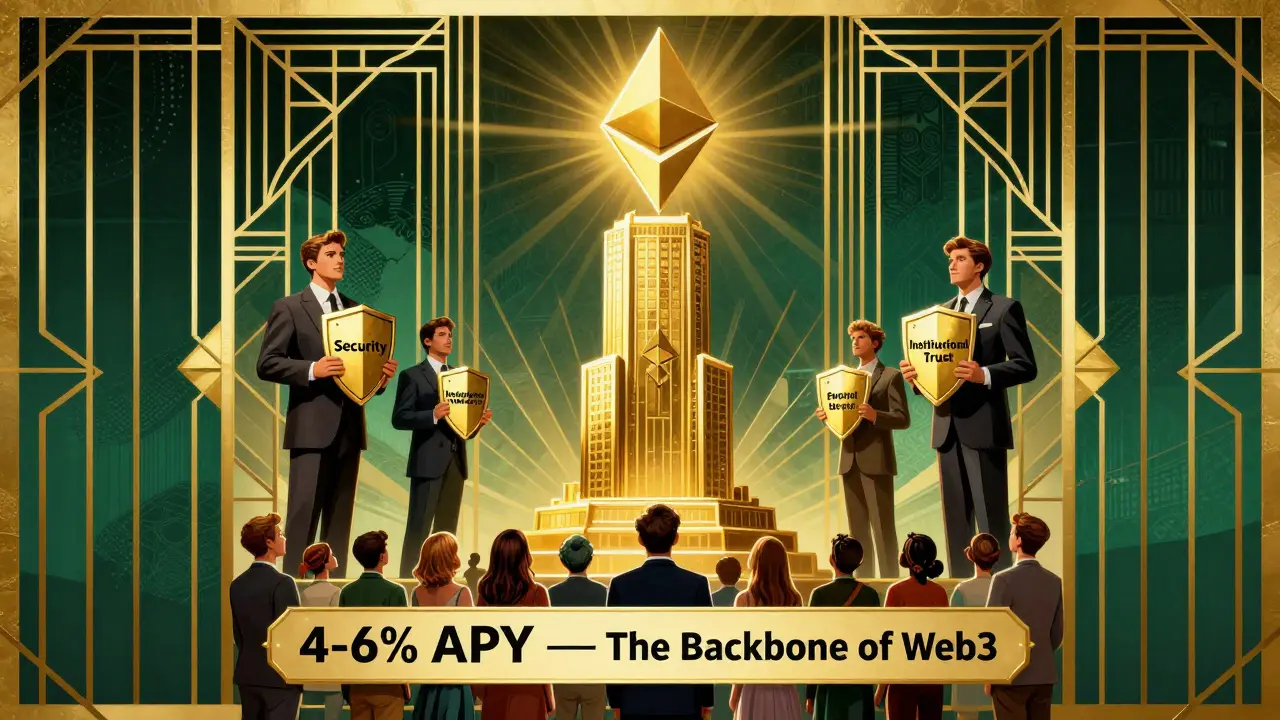
Staking isn’t just a way to earn passive income anymore-it’s become a core part of how blockchains stay secure and grow. By locking up your crypto, you help validate transactions and get rewarded for it. But not all staking options are created equal. In 2025, the landscape has shifted. Some coins offer jaw-dropping yields, but come with big risks. Others give modest returns but are backed by massive networks and institutional trust. If you’re looking to stake in 2025, you need to look beyond the headline APY. You need to ask: Is this network secure? Can I actually get my money out? Is the reward real, or just inflated by tokenomics?
Ethereum: The Safe Bet With Institutional Backing
Ethereum is still the gold standard for staking. After its Merge in 2022, it switched from energy-hungry mining to Proof-of-Stake, cutting its energy use by 99.95%. Today, over $65 billion is locked in Ethereum staking, secured by more than 1.2 million validators. That’s not just a number-it’s a firewall against attacks. Even if one validator goes down, the network keeps running.
The APY for Ethereum staking is between 4% and 6% in 2025. That might seem low compared to others, but here’s why it matters: Ethereum’s market cap is projected at $466.69 billion. That’s more than the next four staking coins combined. It’s the backbone of DeFi, NFTs, and smart contracts. If you stake Ethereum, you’re not just earning rewards-you’re betting on the most used blockchain in the world.
There are two ways to stake Ethereum. The full way requires 32 ETH (about $124,000 at current prices) and dedicated hardware. Most people use liquid staking providers like Lido or Coinbase. These platforms let you stake with as little as 0.01 ETH and give you a token (like stETH) that represents your stake. You can trade it, use it in DeFi, or earn more yield while your ETH is locked. Withdrawals still take 24-36 hours, but Ethereum’s Dencun upgrade in early 2025 will make this faster and cheaper.
Solana: The Speed Demon With High Rewards
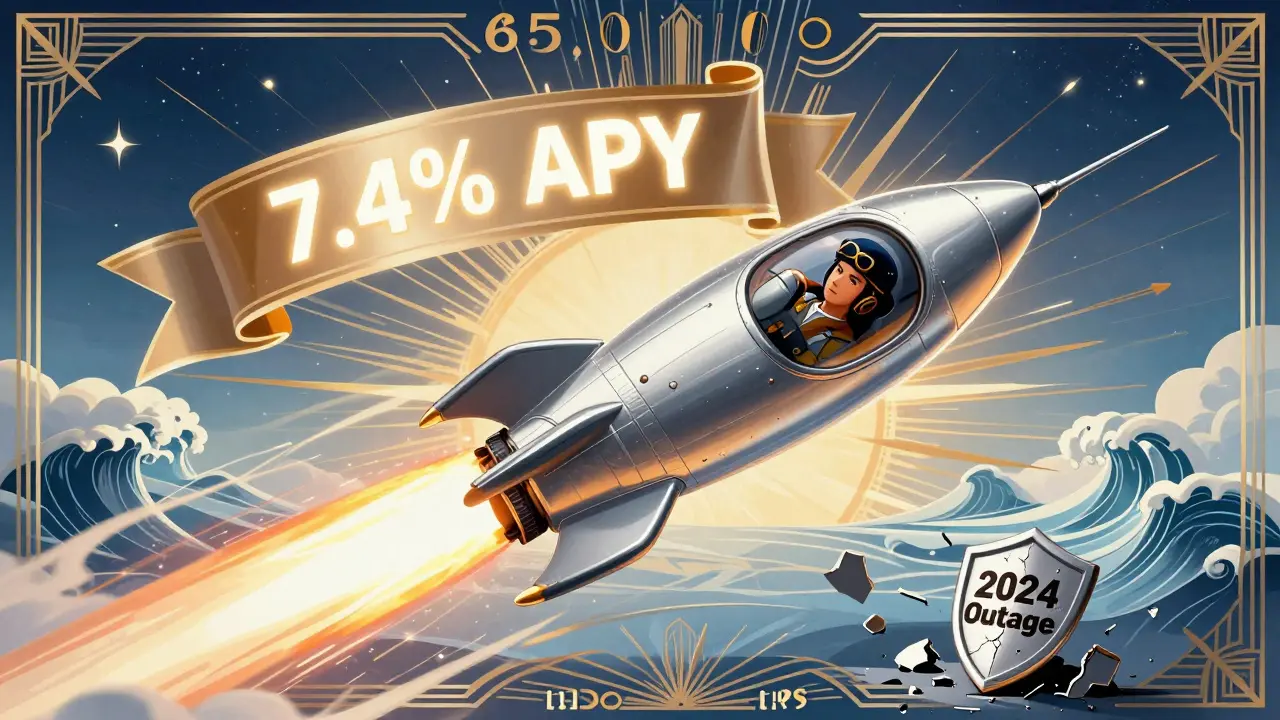
If Ethereum is the fortress, Solana is the rocket. It handles 65,000 transactions per second-over 2,000 times faster than Ethereum. Its network runs on a hybrid consensus model called Proof-of-History, which keeps things lightning-fast without sacrificing security. By 2025, Solana’s staking APY is projected at 6-7%, with some validators offering up to 7.4% after accounting for inflation.
What makes Solana stand out? Accessibility. You can stake any amount of SOL using the Phantom wallet in under five minutes. No minimum. No technical setup. Just click, confirm, and start earning. Over 70% of all SOL is staked, which means the network is heavily secured by its own users. In 2023, Solana’s market cap jumped 500%. That kind of growth doesn’t happen without strong fundamentals.
But there’s a catch. Solana has had outages. In late 2024, a 6-hour network halt froze staking rewards for $2.3 billion in staked assets. The Solana Foundation is fixing this with Firedancer, a new validator client launching in Q1 2025. It’s designed to handle 1 million transactions per second and prevent future crashes. If it works, Solana could become the most reliable high-speed blockchain. For now, it’s a high-reward, high-stakes play.
BNB: The Highest Real Reward Rate
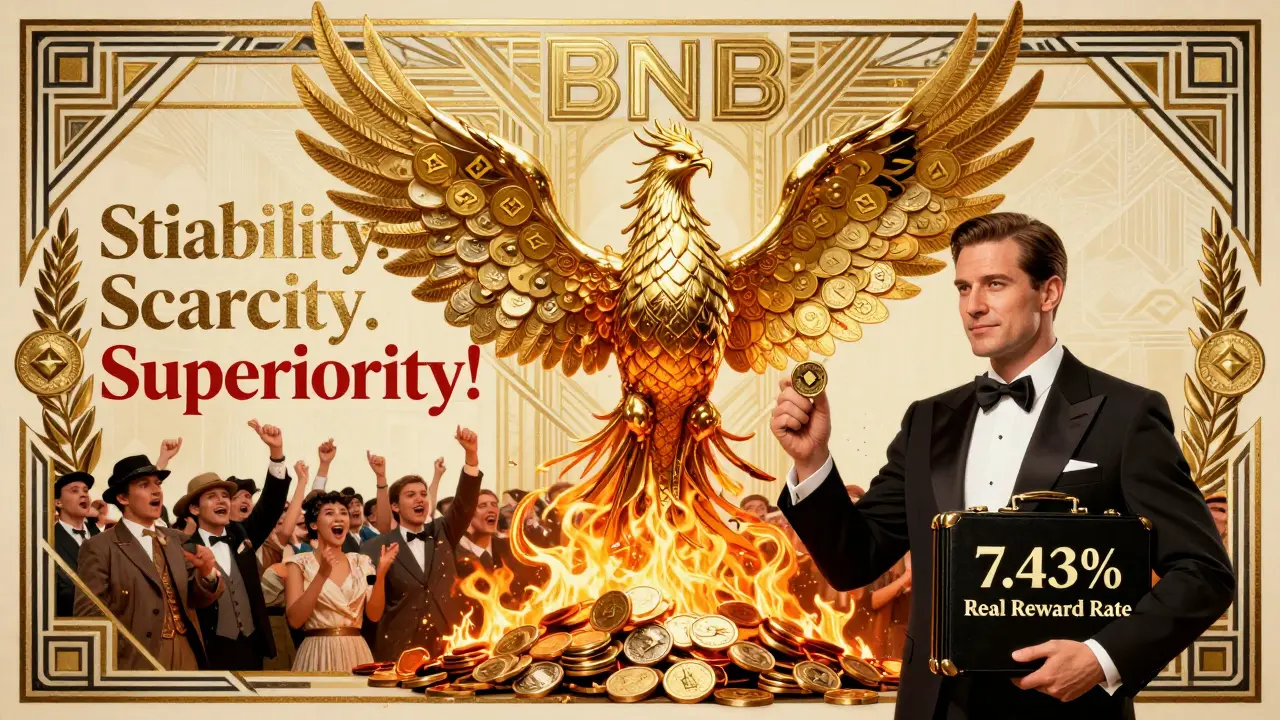
Many people chase high APYs, but they forget to check the real reward rate. That’s the actual return after inflation, token burns, and network fees. According to CoinLedger’s 2024 report, BNB has the highest real reward rate at 7.43%. That beats Solana’s nominal 7% and Ethereum’s 5%. Why? Because Binance actively burns BNB every quarter, reducing supply and increasing scarcity.
Staking BNB is simple. You can do it directly on Binance with a 7.8% APY and same-day withdrawals. Or use a non-custodial wallet like Trust Wallet for slightly lower yields but full control. BNB’s ecosystem is massive-it powers Binance Smart Chain, which hosts thousands of DeFi apps, NFTs, and games. Even if the price doesn’t move, the burn mechanism keeps the value stable.
Unlike some high-yield coins, BNB isn’t a lottery ticket. Binance is the world’s largest crypto exchange. Its financial strength backs BNB’s utility. In 2025, BNB’s market cap is projected at $149.89 billion. That’s third only to Ethereum and Bitcoin. It’s not flashy, but it’s solid.
Tron: High Yield, High Risk
Tron offers 20% APY. That’s tempting. But here’s the truth: Tron’s network is centralized. Only 27 super representatives validate transactions, and they’re elected by a small group of large holders. That’s not decentralization-it’s a club. The TRON Foundation admits this. It’s efficient, but it’s not as secure as Ethereum or Solana.
Staking Tron is easy. You only need 10 TRX (less than $1) to get started. Rewards come daily. But remember: Tron’s APY dropped from 25% in 2023 to 20% in 2024. Why? Because as more people staked, the rewards got split thinner. If you’re chasing yield, this is a treadmill. You earn more today, but tomorrow, the rate drops again. And if Tron’s centralized structure ever gets targeted by regulators, your staked funds could be frozen.
Tron’s ecosystem is growing-especially in Asia. It’s popular for gaming and content platforms. But if you’re looking for long-term safety, this isn’t the coin.
Polkadot: For the Technical Crowd
Polkadot offers 10-12% APY, one of the highest among major coins. But here’s the catch: you have to nominate validators. You can’t just click a button. You need to choose 16 validators for optimal rewards, and if one gets slashed (punished for misbehavior), you lose part of your stake. It’s not beginner-friendly.
Polkadot’s real strength is interoperability. It connects different blockchains so they can talk to each other. That’s huge for the future of Web3. If you believe cross-chain apps will dominate in 2025, Polkadot is a smart bet. Its network processes transactions in under 6 seconds and has a strong research team behind it.
But it’s not for everyone. The learning curve is steep. You need to understand bonding, nominations, and slashing. If you’re not technical, stick with something simpler. For those who are, Polkadot offers one of the best risk-adjusted yields in the market.
MoonBull: The Wildcard
95% APY? Sounds too good to be true. It is. MoonBull ($MOBU) isn’t a blockchain validator. It’s a token that gives rewards based on trading volume, liquidity pools, and token burns. That means if trading stops, your rewards vanish. There’s no network security behind it-just math.
Analytics Insight called it a “high-risk, high-reward outlier.” That’s polite. In reality, it’s a speculative asset. You could make 10x in a month. Or lose it all if the hype dies. It’s not staking. It’s gambling with a fancy name. Avoid unless you’re comfortable treating it like a lottery ticket.
Cardano: The Academic Choice
Cardano has peer-reviewed research, a slow but steady development process, and a 4-5% APY. It’s safe. But it’s also slow. Fewer than 100 DeFi apps run on Cardano. Most users still use Ethereum or Solana for DeFi. That means less demand for staking rewards.
Cardano’s team is brilliant. But progress is cautious. If you believe in long-term, research-driven development, Cardano is worth holding. But if you want growth, it’s not the best pick for 2025.
What to Avoid
- Coins with APY over 20% without clear validation mechanisms
- Projects with fewer than 100 validators-they’re too centralized
- Staking on exchanges without withdrawal options-you lose control
- Coins with no clear roadmap for 2025-if they don’t plan ahead, they won’t survive
How to Start Staking in 2025
- Choose your goal: Safety? Yield? Liquidity? Ethereum for safety, Solana for yield, BNB for balance.
- Use trusted platforms: Coinbase, Phantom, or Polkadot.js for non-custodial staking. Avoid unknown wallets.
- Check real APY: Don’t trust headline numbers. Look at inflation-adjusted returns (like CoinLedger’s data).
- Start small: Test with $100 before locking up $10,000.
- Keep an eye on upgrades: Ethereum’s Dencun, Solana’s Firedancer-these changes can boost rewards or fix bugs.
Final Thoughts
There’s no single “best” cryptocurrency for staking in 2025. It depends on what you want. If you want safety, go with Ethereum. If you want speed and decent yield, Solana is your best bet. BNB gives you the highest real return. Tron is tempting but risky. Polkadot is for experts. MoonBull? Skip it.
The staking market is worth $35.7 billion and growing. But with growth comes complexity. Don’t chase the highest APY. Chase the most sustainable, secure, and transparent system. That’s where the real value is.
Can I stake Ethereum with less than 32 ETH?
Yes. You can stake any amount using liquid staking services like Lido, Coinbase, or Kraken. These platforms pool your ETH with others and issue you a token (like stETH) that represents your share. You earn the same 4-6% APY without needing 32 ETH.
Is staking crypto safe?
It’s safer than holding, but not risk-free. The main risks are network outages, slashing (if you stake on Polkadot or similar), and regulatory action. Centralized exchanges like Binance or Coinbase reduce risk by handling security for you. Non-custodial staking (using your own wallet) gives you more control but requires you to manage your keys.
Why does Solana’s APY vary so much?
Solana’s APY changes based on how much SOL is staked across the network. When more people stake, rewards get split thinner. Validators also set their own fees-some take 1%, others 5%. That’s why APY can range from 2% to 7%. Use tools like SolanaFM or Phantom to see real-time rates from different validators.
Do I pay taxes on staking rewards?
Yes. In the U.S., staking rewards are taxed as ordinary income when you receive them. The IRS treats them like interest or wages. Keep records of when you earned rewards and their USD value at that time. Platforms like Koinly or CoinLedger can help track this.
What happens if a staking platform shuts down?
If you stake through a custodial platform (like Binance or Coinbase), your funds are usually protected-those companies hold your coins securely and pay rewards. But if a non-custodial wallet or validator goes offline, you might lose access temporarily. Always use well-established platforms with 99%+ uptime and strong reputations. Never stake on a service you can’t verify.
Next Steps
If you’re new to staking, start with Ethereum on Coinbase. It’s simple, safe, and widely trusted. Once you’re comfortable, try staking 10% of your portfolio in Solana through Phantom wallet. Watch how the network behaves during price swings and outages. Then, if you want higher yield, add BNB. Avoid chasing yields above 10% unless you fully understand the risks. The best staking strategy isn’t about the highest return-it’s about consistency, security, and staying in the game long-term.


Sahithi Reddy
March 18, 2026 AT 18:48Henrique Lyma
March 20, 2026 AT 17:27Ernestine La Baronne Orange
March 21, 2026 AT 20:31George Hutchings
March 22, 2026 AT 09:07Steph Andrews
March 23, 2026 AT 01:02Zachary N
March 24, 2026 AT 06:40john peter
March 24, 2026 AT 16:26Marc Morgan
March 25, 2026 AT 06:36Anastasia Thyroff
March 26, 2026 AT 05:01Ricky Fairlamb
March 27, 2026 AT 05:27Tony Weaver
March 27, 2026 AT 07:48Lauren J. Walter
March 28, 2026 AT 23:57Tobias Wriedt
March 30, 2026 AT 05:18Manali Sovani
March 31, 2026 AT 04:42Taylor Holloman.
March 31, 2026 AT 08:08Bryan Roth
March 31, 2026 AT 22:50sai nikhil
April 2, 2026 AT 06:06Kira Dreamland
April 2, 2026 AT 15:21shreya gupta
April 4, 2026 AT 11:39Derek Lynch
April 5, 2026 AT 08:57