Imagine a world where you don't have to create a new account and password every time you sign up for a service. No more "Forgot Password" emails, no more filling out the same KYC forms for every bank account, and no more worrying about a single company leaking your entire social security number because their central database got hacked. This isn't a futuristic dream; it's what blockchain identity authentication is making possible by shifting control of personal data from giant corporations back to the individuals. By using a distributed ledger, we can finally move away from the fragile, centralized systems that have defined the internet since its inception.
The Core Shift: From Centralized to Self-Sovereign Identity
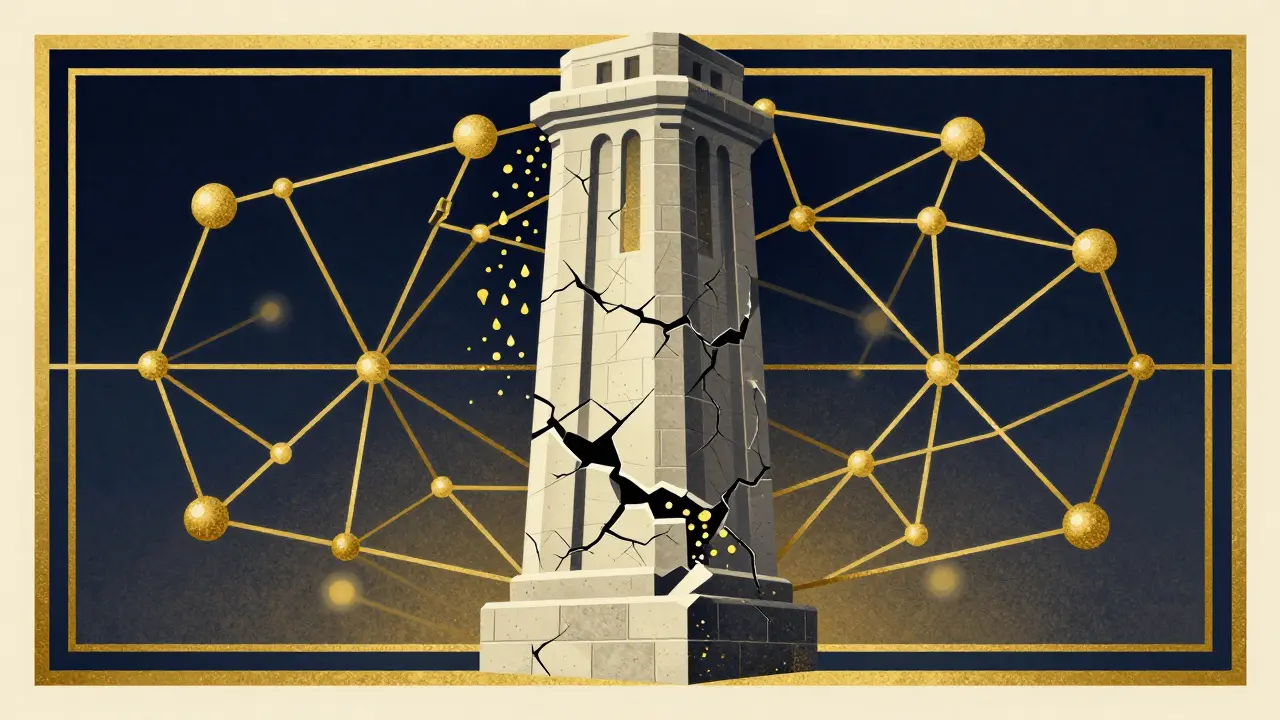
For decades, we've relied on a "hub-and-spoke" model. You give your data to a central authority-like a government or a tech giant-and they vouch for you. The problem? That hub is a massive target. When the 2017 Equifax breach hit, 147 million people had their data exposed because it was stored in one place. Blockchain changes the game by introducing Self-Sovereign Identity (SSI). This is a model where you own your identity and decide exactly who sees what.
Instead of a company owning your profile, you hold your credentials in a digital wallet. When a service needs to verify your age or address, you don't send them a copy of your passport. Instead, you provide a cryptographic proof that says, "Yes, I am over 21," without ever revealing your actual birth date. This is made possible through Zero-Knowledge Proofs, a method that allows one party to prove to another that a statement is true without revealing any information beyond the validity of the statement itself.
How It Actually Works Under the Hood
To understand the benefits, we need to look at the tech. Most modern systems rely on Decentralized Identifiers (DIDs), which are a W3C standard. Think of a DID as a URL for your identity that you control, rather than one assigned to you by a company like Google or Facebook.
- Issuance: A trusted entity (like a university or government) signs a digital credential and sends it to your wallet.
- Storage: The credential stays with you, not on the blockchain. Only a cryptographic hash (a digital fingerprint) is stored on the ledger to prove the document is authentic.
- Verification: When you need to prove something, you share a "presentation" of that credential. The verifier checks the blockchain to see if the issuer's signature is valid.
This process is incredibly fast. In optimized systems, 98% of these verifications happen in under two seconds. Compare that to traditional KYC (Know Your Customer) checks, which can drag on for 24 to 72 hours of manual paperwork and emailing PDFs back and forth.
Key Benefits for Users and Businesses
The most immediate win is the death of the password. By using asymmetric key pairs-a private key you keep and a public key the world sees-you can sign into services without ever typing a password. This eliminates phishing attacks because there is no password for a hacker to steal.
| Feature | Traditional Systems (Centralized) | Blockchain Systems (Decentralized) |
|---|---|---|
| Data Control | Owned by the service provider | Owned by the individual (SSI) |
| Security Risk | Single point of failure (Honey pots) | Distributed risk across nodes |
| Verification Speed | Slow (Hours to Days for KYC) | Near-instant (Seconds) |
| User Experience | Multiple accounts and passwords | One unified digital wallet |
| Cost | High manual verification costs | Up to 65% lower verification costs |
For businesses, the benefit is a massive reduction in liability. If you don't store a customer's raw social security number because you only store a blockchain-verified "proof" of it, you have much less to worry about when it comes to GDPR or CCPA compliance. You aren't holding the data; you're just verifying that the data is correct.
Real-World Successes and Failures
We've seen this work in the wild. Switzerland's SwissCovid digital ID system is a great example. By allowing citizens to access health services without a central government database tracking every move, they hit a 92% user satisfaction rate. People liked the privacy and the speed.
On the flip side, it's not all smooth sailing. One major European bank tried to roll out a blockchain ID system in 2023, but 40% of users quit during the onboarding process. Why? Because it was too complicated. If the user has to manage complex cryptographic keys without a friendly interface, they'll go back to using a password, even if it's less secure.
This highlights the "recovery problem." In a traditional system, you click "forgot password" and an admin resets it. In a pure decentralized system, if you lose your private key, you lose your identity. To fix this, companies like 1Kosmos have developed multi-factor recovery systems so users aren't locked out of their own lives.

Industry Adoption and the Road to 2027
The momentum is shifting from "experiment" to "standard." The EU's eIDAS 2.0 regulation, effective in 2026, officially recognizes blockchain-based identities as legally valid. This is a huge catalyst. When the law says a digital blockchain credential is as good as a plastic ID card, enterprises will stop hesitating.
Financial services are leading the charge, with about 42% of current implementations. Imagine applying for a mortgage. Instead of sending ten different PDF bank statements, you grant the lender temporary access to a verifiable credential of your income. J.P. Morgan has noted that this could turn a process that takes days into one that takes hours.
Looking ahead, Gartner predicts that by 2027, 30% of all consumer digital identities will be blockchain-based. We are also seeing the rise of Hyperledger Indy and Microsoft Entra Verified ID, which are providing the plumbing needed for this to scale globally.
Is blockchain identity safer than a password?
Yes, because it removes the "honey pot" effect. Traditional passwords are stored in central databases; if that database is hacked, everyone is compromised. Blockchain uses private keys and cryptographic proofs, meaning there is no central list of passwords to steal.
What happens if I lose my digital wallet or private key?
This is the biggest challenge for beginners. In early systems, losing your key meant losing your identity. However, modern enterprise solutions now use "social recovery" or multi-factor recovery systems that allow you to regain access through trusted contacts or secondary biometric verification.
Does the blockchain store my personal data?
No. This is a common misconception. Your actual data (name, address, etc.) stays in your encrypted digital wallet. Only a cryptographic hash or a digital signature is stored on the blockchain. This ensures privacy while still allowing a third party to verify that the data hasn't been tampered with.
How long does it take to set up a blockchain identity?
For a tech-savvy user, setting up a wallet and understanding the basics takes about 2-3 hours. For non-technical users, it may take 8-10 hours of guidance to feel comfortable managing keys and requesting credentials from issuers.
Which industries are using this the most right now?
Financial services are the biggest adopters (42%), followed by healthcare (28%) and government sectors (20%). These industries benefit most from the speed and security of automated KYC and credential verification.
Next Steps for Implementation
If you're a business owner looking to move toward decentralized identity, start by auditing your current IAM (Identity and Access Management) system. You don't have to rip everything out. Most modern blockchain identity tools offer API gateways that allow you to integrate verifiable credentials into your existing login flow.
For individual users, the best way to start is by exploring W3C-compliant wallets. Look for tools that support DIDs and verifiable credentials. Start small-perhaps with a professional certification or a membership card-and get used to the feeling of "pushing" your data to a verifier rather than "uploading" it to a server.