Iran Bitcoin Mining Electricity Calculator
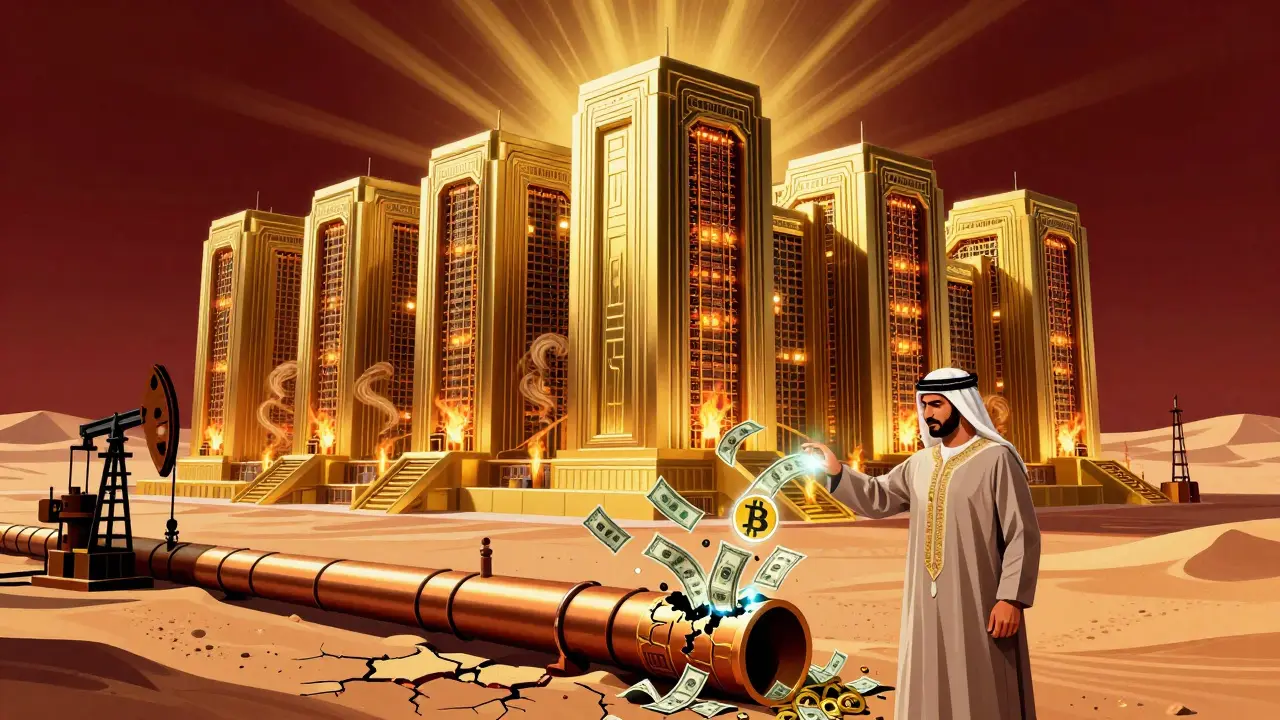
Iran's Bitcoin mining consumes about 4.5-5 terawatt-hours (TWh) of electricity annually—equivalent to the energy from 10 million barrels of oil. This electricity could power millions of households, but instead, it's diverted to mining operations.
This calculator shows the energy trade-off between Bitcoin mining and household electricity use in Iran.
By 2025, Iran is mining Bitcoin at a scale no other sanctioned nation has matched-not because it’s the cheapest place to mine, but because it’s the only one turning mining into a national survival tactic.
When the U.S. pulled out of the Iran nuclear deal in 2018, the country lost access to the global banking system. Wire transfers froze. Oil sales got harder to settle. Foreign currency vanished. In response, Iran didn’t just look for loopholes-it built a parallel financial engine. And that engine runs on Bitcoin.
Today, Iran accounts for about 4.5% of all Bitcoin mining worldwide. That’s more than Russia, more than Kazakhstan, and more than most countries with far better infrastructure. But here’s the twist: Iran isn’t mining Bitcoin to get rich. It’s mining it to stay alive.
How Bitcoin Replaced the Dollar
Before sanctions, Iran sold oil and got paid in dollars. Those dollars went into banks in Europe or Asia. Now, those banks won’t touch Iranian money. So Iran stopped asking for dollars. Instead, it started asking for Bitcoin.
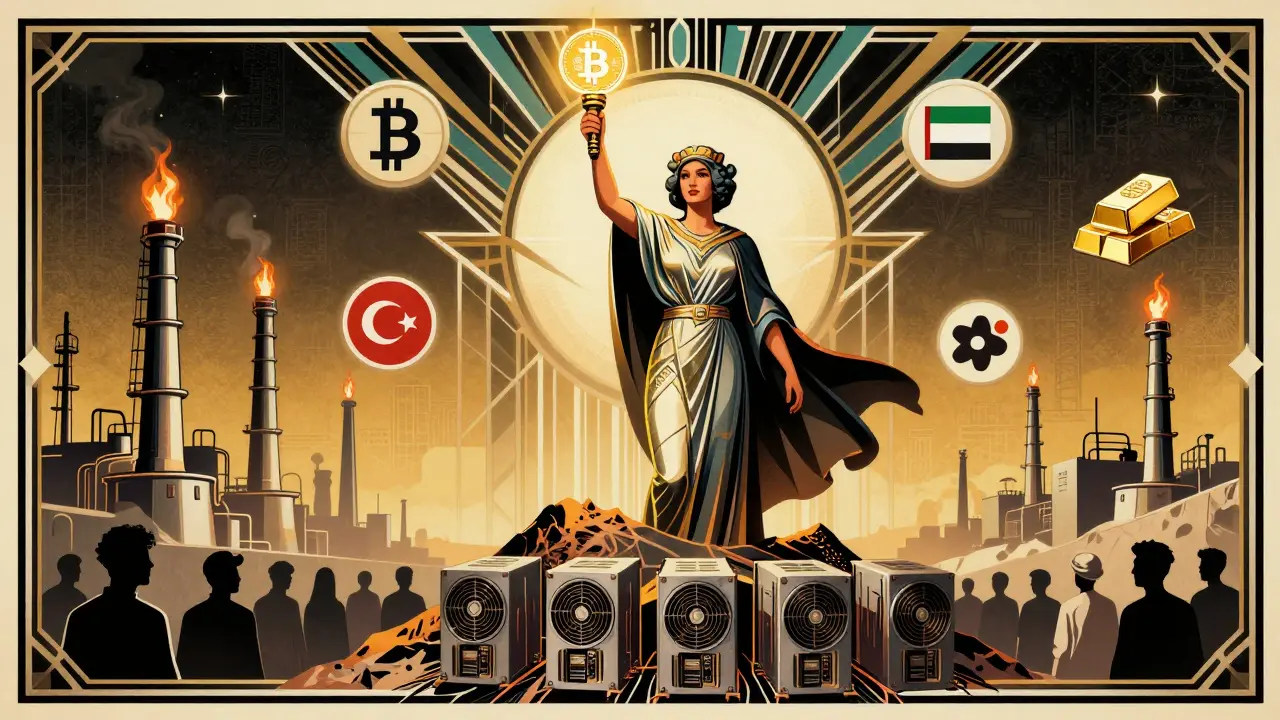
Here’s how it works: Iranian mining farms use cheap electricity-often subsidized or outright free-to run thousands of ASIC miners. The Bitcoin they produce gets sent to wallets controlled by state-linked entities. From there, it’s swapped for other cryptocurrencies, then moved through exchanges in the UAE, Turkey, or Hong Kong, and finally converted into euros, yuan, or even gold. The end result? Iran buys medicine, food, and machinery without touching a single Western bank.
In 2024 alone, over $4.18 billion in cryptocurrency flowed out of Iran. That’s a 70% jump from the year before. And it’s not just random citizens mining. The Islamic Revolutionary Guard Corps (IRGC) runs some of the largest operations. One 175-megawatt mining farm in Rafsanjan, run by IRGC-linked firms and Chinese investors, uses enough electricity to power a small country. And they don’t pay for it.
Why Iran’s Mining Is Different
Other sanctioned countries tried crypto. Venezuela launched the Petro. North Korea hacked exchanges. Both failed.
Iran did something smarter. Instead of inventing its own coin, it used Bitcoin-the most trusted, decentralized, and globally accepted digital asset. It didn’t try to replace the dollar. It bypassed it.
Unlike Venezuela’s failed state coin, Bitcoin doesn’t need trust. It doesn’t need a central authority. It just needs internet and electricity. Iran has both. And it has something even more valuable: political will.
The Iranian government didn’t just allow mining-it formalized it. By 2022, it had issued over 10,000 mining licenses. It set up a legal framework for crypto payments for imports. It allowed 90 domestic exchanges to operate. It turned mining from a gray-market hustle into a state-backed industry.
And it didn’t stop there. Iran signed crypto cooperation deals with Russia and has been negotiating similar agreements with Austria, Switzerland, and even South Africa. These aren’t just trade deals-they’re financial backdoors.
The Infrastructure Behind the Mines
Iran’s mining isn’t happening in basements or garages. It’s industrial. Massive. And tightly controlled.
Most of the big farms sit in special economic zones, military bases, or inside facilities owned by powerful religious foundations like Astan Quds Razavi. These places get priority access to electricity, often at near-zero cost. Some miners don’t even get billed. Their power is a political perk.
The hardware? Mostly Chinese-made ASIC miners-BItmain, MicroBT, and Canaan units smuggled in through Turkey and the UAE. Sanctions make buying new gear hard, so miners rely on used equipment, refurbished units, and underground supply chains. The miners run 24/7, optimized for maximum hash rate, not efficiency.
Power comes mostly from natural gas, which Iran has in abundance. It’s cheaper than coal, cleaner than diesel, and easier to pipe to remote mining zones. One estimate says the electricity used by Iranian miners equals the energy from 10 million barrels of oil per year. That’s about 4% of Iran’s total oil exports in 2020-except now, it’s being turned into Bitcoin instead of cash.

The Hidden Costs
There’s a dark side to this strategy.
Iran’s power grid is crumbling. Cities like Tehran and Mashhad suffer daily blackouts. Hospitals run on generators. Schools shut down in winter because there’s not enough electricity for heating.
Meanwhile, mining farms keep running. In some areas, residential users get cut off while mining operations get priority. Critics say this isn’t just inefficient-it’s immoral. Ordinary Iranians pay higher prices for food and medicine, while the regime uses their electricity to buy weapons and fund militias abroad.
And it’s not just energy. Internet bandwidth is stretched thin. Mining pools need constant connectivity. When the government throttles internet access during protests, miners are among the first to lose service. Some use satellite links or private fiber networks. Others bribe telecom officials. It’s a constant game of cat and mouse.
How the World Is Responding
Western governments aren’t blind to this. The U.S. Treasury, FinCEN, and Europol have flagged Iranian-linked crypto flows since 2022. In June 2025, FinCEN issued a public advisory naming specific Iranian shell companies and exchanges used to launder crypto.
Exchanges like Binance and KuCoin have been warned. Some have blocked Iranian IPs. Others ignore it. The problem? Bitcoin is decentralized. You can’t shut down a mining farm without shutting down the whole network. And even if you ban one wallet, the Iranians just create ten more.
Blockchain analytics firms like Chainalysis and Elliptic track Iranian Bitcoin movements. They’ve mapped out how coins move from Iranian farms to “teapot” refineries in Beijing, to UAE free zones, then into TRON-based stablecoins before hitting global markets. It’s a well-oiled machine.
But here’s the catch: most users don’t know if the Bitcoin they hold was mined in Iran. And that’s the point. Bitcoin’s fungibility-the idea that one coin is the same as another-is now being weaponized. A dollar bill from a drug dealer is still a dollar. A Bitcoin from an Iranian mine is still a Bitcoin.
Is This Strategy Working?
Yes. But not perfectly.
Iran hasn’t replaced oil exports with Bitcoin. Oil still makes up the bulk of its foreign income. But Bitcoin has become its safety net. When sanctions tighten, Bitcoin mining ramps up. When oil prices drop, Bitcoin fills the gap.
It’s also buying time. With Bitcoin, Iran can import critical medical equipment, spare parts for power plants, and even components for its missile program. Without it, the economy would have collapsed years ago.
But there are limits. Bitcoin’s price swings make it risky. A $10 million Bitcoin payment could be worth $8 million tomorrow. The regime doesn’t hold Bitcoin long. It converts quickly.
And the world is catching up. More exchanges are implementing KYC checks. More banks are refusing to process crypto-related transactions. And new blockchain tracing tools are getting better at spotting Iranian-linked wallets.
What Comes Next?
Iran isn’t slowing down. In 2025, new mining farms opened in Bushehr and Khuzestan, using surplus gas power and solar installations. The government plans to increase mining capacity by 50% over the next two years.
It’s also exploring decentralized finance (DeFi) platforms and stablecoins pegged to gold or Chinese yuan. The goal? To create a full crypto economy-inside Iran, outside the reach of the dollar.
But the biggest threat isn’t sanctions. It’s energy. If Iran’s power grid collapses under the strain, mining stops. If international pressure cuts off hardware imports, mining slows. If Bitcoin’s price crashes, the whole model becomes less profitable.
For now, though, it’s working. Iran has turned a financial blockade into a technological advantage. It’s not the first country to try crypto to survive sanctions. But it’s the only one that turned it into a system.
And that’s why the rest of the world is watching-not because Iran is a Bitcoin superpower. But because it proved that even under the heaviest sanctions, a determined state can build its own financial world.
Is Bitcoin mining legal in Iran?
Yes, but only under strict government control. Iran legalized cryptocurrency mining in 2020 and now requires all miners to obtain licenses from the Ministry of Energy and register with the Central Bank. Private citizens can mine, but large-scale operations are dominated by state-linked entities like the IRGC and religious foundations. Unlicensed mining is banned and can lead to equipment seizure.
How much electricity does Iran use for Bitcoin mining?
Iran’s Bitcoin mining consumes an estimated 4.5 to 5 terawatt-hours of electricity annually-equivalent to the output of 10 million barrels of crude oil. This represents about 4% of Iran’s total oil export energy value in 2020. The power is mostly drawn from natural gas plants and subsidized grids, with mining farms often receiving electricity at near-zero cost.
Does Iran use Bitcoin to pay for imports?
Yes. Since 2020, Iran has officially allowed cryptocurrency payments for imports. In August 2021, it completed its first $10 million import order using Bitcoin, buying medical equipment from a Turkish supplier. Since then, hundreds of such transactions have occurred, primarily through licensed domestic exchanges that convert crypto into foreign currency for importers.
Why hasn’t the U.S. shut down Iran’s Bitcoin mining?
Because Bitcoin is decentralized. You can’t block a mining farm without shutting down the entire network. While the U.S. has sanctioned specific Iranian mining entities and exchanges, the miners themselves are spread across thousands of locations. Even if one farm is taken offline, others replace it. Plus, Bitcoin transactions are anonymous by design, making it nearly impossible to track every coin’s origin without invasive surveillance.
Are Iranian miners using stolen hardware?
No, not officially. Iranian miners mostly use smuggled or second-hand ASIC miners from China, Turkey, and the UAE. While sanctions make new equipment hard to import, there’s no evidence of large-scale theft. Instead, Iran relies on gray-market suppliers, informal networks, and state-backed procurement channels to acquire mining hardware. Some miners even modify older models to extend their lifespan.
Could other sanctioned countries copy Iran’s model?
Possibly, but it’s not easy. Iran succeeded because it had three things most sanctioned nations lack: massive energy reserves, a centralized government willing to break rules, and years to build the infrastructure. Countries like Venezuela and North Korea tried and failed because they relied on unstable state coins or criminal activity. Iran’s model works because it uses Bitcoin’s global legitimacy-not a homegrown alternative.