Think about the last time you posted something on Instagram, Twitter, or Facebook. Did you ever wonder who really owns that post? Who decides if it stays up? Who gets paid when your content goes viral? On traditional platforms, the answer is simple: the platform. But on blockchain-based social networks, the answer flips entirely - you do.
Who Owns Your Data?
On Facebook, Instagram, or X (formerly Twitter), your profile, posts, followers, likes, and even your private messages belong to the company. They store it on their servers. They decide when to delete your account - no warning, no appeal. They sell your attention to advertisers. And you? You get nothing but a fleeting dopamine hit. Blockchain social media changes that. Platforms like Lens Protocol, Farcaster, and Mastodon don’t store your data on their servers. Instead, your profile is tied to a blockchain wallet. Think of it like a digital ID you control with a private key. If you want to switch from one app to another - say, from Warpcast (Farcaster’s main client) to another Farcaster app - your profile, followers, and posts come with you. No re-following. No losing content. No platform locking you out. This isn’t theoretical. In 2025, Lens Protocol’s NFT-based profiles were ported across 120+ apps by users. That’s real ownership. Traditional platforms? Your account is a lease. Cancel it, and everything vanishes.How Creators Get Paid
On YouTube or TikTok, creators earn pennies from ads - if they’re lucky. Most need brand deals just to break even. On blockchain platforms, money flows directly from fans to creators. Take Diamond App. Every user can create their own “creator coin.” Fans buy it. Its value rises as more people engage with the creator’s content. If you post something popular, your coin spikes. You cash out. No middleman. No 30% cut. No algorithm deciding if you’re “worthy.” Steemit and Hive Blog reward users with cryptocurrency for posting, commenting, and upvoting. Top users on Steemit earned $100-$500 a month in 2024 just for writing and engaging. That’s real income - not ad revenue shares. Compare that to Instagram. A creator with 100,000 followers might get $500 for a sponsored post. On Farcaster, a creator with 5,000 followers could earn $1,000+ a month through token tips, NFT sales, and paid replies - all without needing a brand deal.Content Moderation: Who Decides What You See?
On Twitter, you might wake up to find your post gone - no explanation. Or your account shadowbanned. Why? Because an algorithm or a moderator in a remote office decided it violated their rules. Often, those rules change overnight. Blockchain platforms handle moderation differently. Mastodon, for example, runs on hundreds of independent servers. Each server sets its own rules. One might ban hate speech. Another might allow political rants. You choose which server to join. No one forces you into a single feed. Farcaster and Lens Protocol use token-weighted voting. If 60% of users with active tokens vote to remove a post, it gets hidden. No corporate HQ. No opaque policy. Just community-driven decisions. Traditional platforms moderate at scale - 5 billion posts a day. They can’t be fair. Blockchain platforms moderate at human scale. Smaller, but more transparent.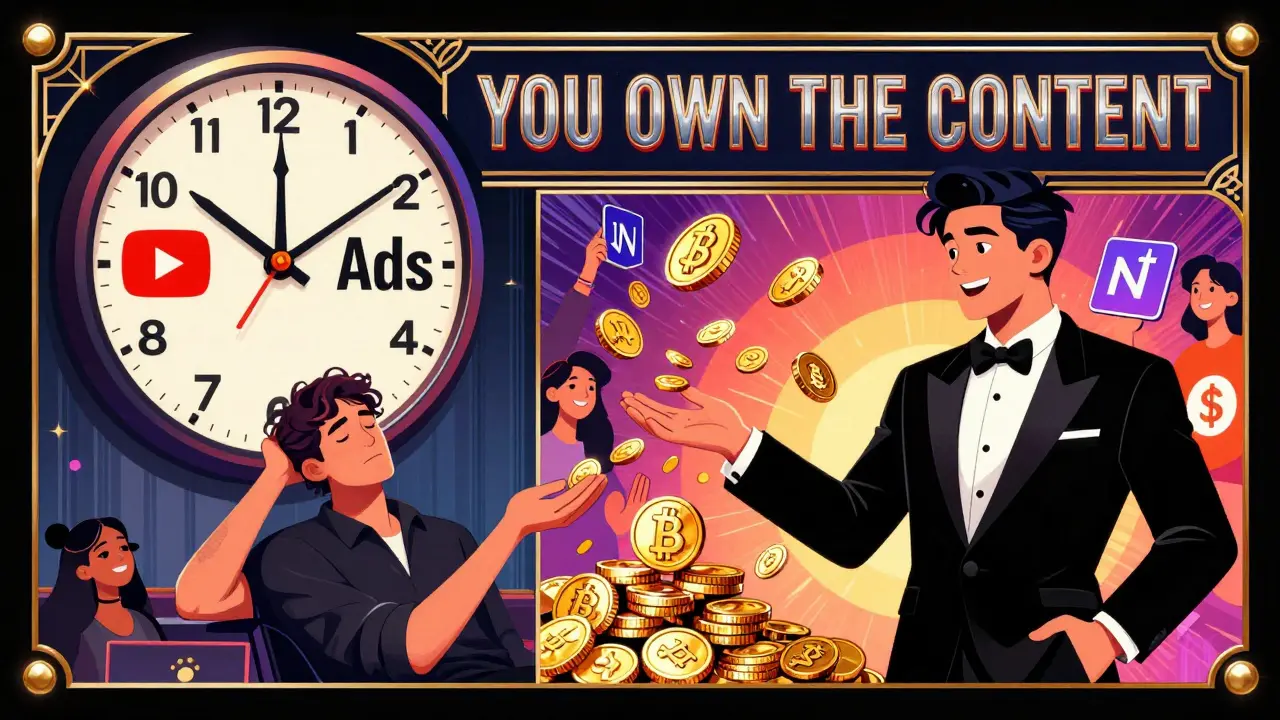
Why Most People Still Use Facebook
Let’s be honest: blockchain social media is clunky. To join Lens Protocol, you need a Polygon wallet. You need ETH to pay gas fees. You need to understand NFTs. The setup takes 15-30 minutes. Most people won’t do it. Traditional platforms? Sign up with your email. Tap “Next.” Done. In 90 seconds, you’re scrolling. Performance matters too. Posting a video on Instagram takes a second. On some blockchain platforms, it can take 30 seconds - or longer - because every action gets recorded on a blockchain. Transactions cost money. Networks get slow. Users get frustrated. That’s why Mastodon, with 15 million users, is the biggest blockchain-style platform - and even that’s just 0.5% of Facebook’s 3.2 billion. Most people don’t want to learn crypto. They just want to share memes.The Real Trade-Off
You can’t have it all. Traditional platforms give you speed, simplicity, and scale. They’re built for billions. But they control everything. Your data. Your voice. Your income. Blockchain platforms give you freedom. Ownership. Direct rewards. But they demand effort. Understanding. Patience. The choice isn’t about which is “better.” It’s about what you value. If you’re a creator tired of begging for brand deals - blockchain might be your lifeline. If you’re a privacy-minded user sick of being tracked - decentralized networks are your refuge. If you just want to post a cat video and get 100 likes? Stick with Instagram.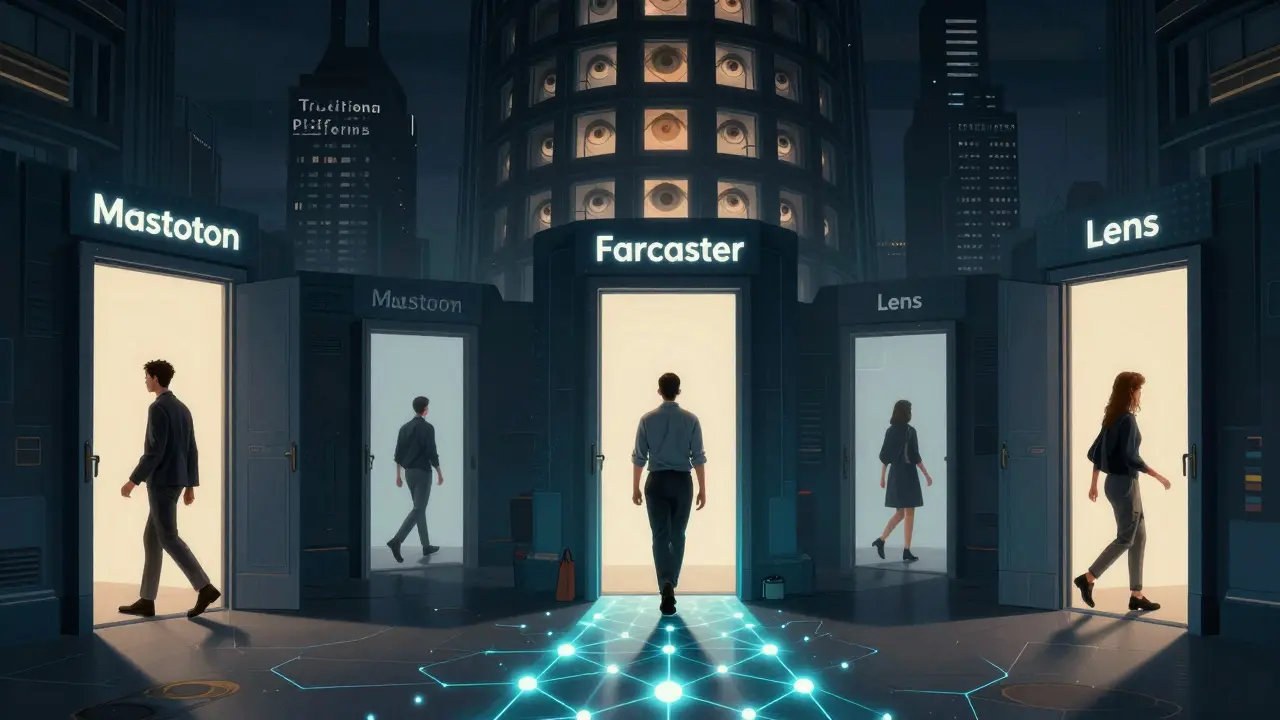
What’s Changing in 2026?
The tide is turning - slowly. Farcaster introduced gasless interactions in late 2025. Now, users can like, comment, and repost without paying fees. That’s huge. Lens Protocol now lets you sign in with Google or Apple ID - no wallet needed at first. The barrier is dropping. Bluesky, built on the AT Protocol (not blockchain, but decentralized), hit 13 million users in 2025 by mimicking Twitter’s interface while keeping data distributed. It’s proof: you don’t need crypto to be decentralized. Big tech is watching. Meta tried to launch a crypto social network with Libra in 2019. They scrapped it. But now, they’re quietly testing blockchain-backed profile systems. Why? Because users are asking for control. In 2026, we’re seeing the first real hybrid models: familiar apps, with blockchain underneath. Imagine posting a meme on Instagram - but your profile is stored on a blockchain, and you earn crypto for every share. That’s the future.Is This Just a Niche?
Yes. Right now. But niches grow. Reddit started with 200 users. Twitter began as a side project. Blockchain social media is still in its early days - like smartphones in 2007. The users who are here now? They’re not casual. They’re builders. Creators. Privacy advocates. They’re the ones pushing the tech forward. And as wallets get easier, as fees disappear, as apps feel like Instagram - more people will try it. You don’t need to switch tomorrow. But if you’ve ever felt like social media is working against you - it’s worth exploring. There’s a new kind of social network out there. One where you’re not the product. You’re the owner.Can I use blockchain social media without cryptocurrency?
Yes - but only partially. Platforms like Farcaster and Lens Protocol now let you sign up with email or social logins (Google, Apple) to start posting. But to tip creators, claim rewards, or fully control your profile, you’ll eventually need a wallet. The trend is toward making wallets invisible - like signing into a website with your phone - so you won’t need to understand crypto to use it.
Are blockchain social platforms safer than Facebook or Twitter?
It depends. Blockchain platforms don’t store your data centrally, so hackers can’t breach one server to steal millions of profiles. But if you lose your private key, you lose your account - permanently. There’s no “forgot password?” button. That’s a trade-off. Traditional platforms are vulnerable to breaches, but they offer account recovery. Blockchain gives you control - but also responsibility.
Which blockchain social media platform is best for creators?
For direct monetization, Farcaster and Lens Protocol lead. Farcaster lets you charge for replies and tips in ETH or USDC. Lens Protocol lets you mint NFTs of your posts and sell them directly. Diamond App is ideal if you want to build a personal token that fans can buy and trade. Steemit and Hive are good for writers who earn through upvotes. The best choice depends on your content type and audience.
Do blockchain social media platforms have ads?
No - not the kind you see on Facebook or YouTube. Most blockchain platforms are ad-free by design. Revenue comes from users paying for premium features (like paid usernames on Farcaster) or from creator tokens. Some platforms may introduce token-based advertising in the future, but it would be user-controlled - you’d choose to see ads in exchange for crypto rewards, not be tracked without consent.
Can I move my followers from Instagram to a blockchain platform?
Not directly. Your Instagram followers don’t transfer. But you can invite them. Many creators use their Instagram bio to link to their Farcaster or Lens profile. Over time, if your content is compelling, followers will follow you where you’re truly in control - and get rewarded for it.
jack carr
March 6, 2026 AT 13:25Honestly? I tried Farcaster last month. Thought I’d dive in - signed up with Google, no wallet needed at first. Posted a meme. Got 12 likes. Felt weirdly… free. Like I wasn’t being sold to. Then I tried to tip someone $0.50 in ETH and realized I had to learn what a gas fee even is. I gave up. But I still check it once a week. It’s like a quiet corner of the internet where people actually talk. I miss that.
Eva Gupta
March 7, 2026 AT 05:48I’m from India, and honestly, this resonates so much. On Instagram, my small art page got shadowbanned for ‘inappropriate content’ - it was a watercolor of a tree. Meanwhile, on Lens, I posted the same thing, got 3 tips in MATIC, and someone in Poland bought a print. No gatekeepers. No ads. Just people who like what I make. It’s not perfect - the UI is clunky - but it feels human. I’m not just content. I’m a creator.
Drago Fila
March 8, 2026 AT 18:02If you’re a creator, this isn’t a trend - it’s survival. I used to beg for brand deals on Instagram. Now I post on Farcaster. People tip me in USDC. I bought my first laptop with crypto earnings. No middleman. No ‘you’re not viral enough.’ The tech is rough, yeah. But the freedom? Worth every minute of learning. Don’t write it off because it’s hard. Write it off because you don’t care. And if you care? Start small. One post. One tip. One step.
Nancy Jewer
March 8, 2026 AT 21:17From a protocol standpoint, the AT Protocol (Bluesky) and Lens/Farcaster represent two distinct paradigms: federated identity vs. blockchain-native sovereignty. The former prioritizes interoperability and UX continuity; the latter prioritizes composability and asset ownership. The convergence is inevitable - we’re seeing early signs in walletless onboarding and gasless transactions. This isn’t crypto evangelism - it’s infrastructure evolution. The user doesn’t need to understand the stack. They just need to feel control. And that’s what’s being delivered.
Julie Potter
March 9, 2026 AT 03:34Oh please. You all sound like crypto bros who think NFTs are a lifestyle. I posted a photo on Instagram. Got 200 likes. Got paid $50 by a brand. On Farcaster? I’d have to pay $3 in gas to post it, wait 45 seconds for it to confirm, then hope someone tips me $0.12 in ETH that I can’t even cash out without KYC. You’re not ‘owning your data’ - you’re owning a headache. The only thing decentralized here is your common sense.
Nash Tree Service
March 9, 2026 AT 18:03While the premise of user sovereignty is theoretically compelling, one must critically assess the operational viability of such systems. The latency inherent in blockchain consensus mechanisms renders real-time interaction impractical for mass adoption. Furthermore, the economic model presupposes a level of financial literacy and risk tolerance that is not representative of the global user base. The notion that ‘you’re not the product’ ignores the fact that time, attention, and behavioral data remain valuable commodities - merely repackaged under a different ledger. The transition from centralized to decentralized paradigms does not inherently resolve power asymmetries; it merely redistributes them.
Christina Young
March 11, 2026 AT 17:15Blockchain social media isn’t the future. It’s a niche for people who think ‘decentralized’ sounds cool but don’t understand how servers work. Mastodon has 15 million users? That’s 0.5% of Facebook. And you think that’s progress? You’re not building the future. You’re just yelling into an echo chamber while everyone else is watching TikTok.
Olivia Parsons
March 12, 2026 AT 04:19I’ve been using Bluesky for a year. No wallet. No crypto. Just a clean feed, no ads, and I can choose which servers to follow. It’s not perfect, but it’s better than being tracked everywhere. I didn’t need to learn blockchain. I just needed to want control. If you’re curious, try it. It’s free. No risk. Just a different way to be online.
Steven Lefebvre
March 12, 2026 AT 19:36What’s wild is how fast this is changing. Last year, you needed a wallet just to comment. Now? Farcaster lets you sign in with Apple. Lens lets you log in with Google. The crypto stuff is still there underneath - but you don’t have to touch it. It’s like using a credit card without knowing how the banking system works. The future isn’t about forcing people into wallets. It’s about making wallets invisible. And that’s happening.
nalini jeyapalan
March 14, 2026 AT 02:36Bluesky is decentralized? It’s not blockchain. AT Protocol isn’t even crypto. You’re conflating decentralization with blockchain. Big difference. One is architecture. The other is currency. Stop using them interchangeably. The real innovation is in protocol design - not in NFTs or tokens. Focus on the infrastructure, not the hype.
Denise Folituu
March 15, 2026 AT 06:18I used to post on Instagram. Now I post on Farcaster. My followers are fewer. But they’re real. One guy from Japan tipped me $20 because I wrote about my mom’s cancer. No brand. No ad. Just a human saying ‘thank you.’ I cried. That’s not a feature. That’s a revolution. And yeah, it’s messy. But I’d rather be messy and free than polished and owned.
Bill Pommier
March 17, 2026 AT 03:42The entire argument rests on a fundamental misapprehension: that ownership equates to empowerment. In reality, blockchain platforms transfer control from corporate entities to technical gatekeepers - developers, token holders, and protocol maintainers - who operate with equal opacity, if not greater ideological rigidity. The removal of centralized moderation does not yield democratic governance; it yields fragmented, inconsistent, and often exclusionary norms. The ‘ownership’ narrative is a neoliberal fantasy - one that burdens users with technical responsibility while obscuring the new hierarchies that emerge. This is not liberation. It is privatization of the public square.