
It is easy to get the wrong idea about cryptocurrency in India. You might hear it is banned. Or you might hear it is completely free. The truth is much messier, but also more specific. As of May 2026, buying, selling, and holding crypto is perfectly legal in India. However, the government treats these assets as high-risk investments rather than money. They are not legal tender. You cannot use Bitcoin to pay your electricity bill or buy groceries in a way that is protected by consumer law. Instead, they fall under a strict regulatory umbrella known as Virtual Digital Assets (VDAs).
This guide cuts through the noise. We will look at exactly what you can do, what you cannot do, and how the heavy tax burden affects your wallet. We will also cover the new rules from the Securities and Exchange Board of India (SEBI) that changed the game in 2025.
The History: From Total Ban to Cautious Acceptance
To understand where things stand today, you have to look at the rollercoaster ride of the last few years. For a long time, the Reserve Bank of India (RBI) was openly hostile to crypto. In April 2018, the RBI issued a circular prohibiting all banks and financial institutions from dealing with virtual currencies. This effectively killed the market. Exchanges couldn't process fiat deposits or withdrawals. Users were locked out.
Then came the turning point. In March 2020, the Supreme Court of India struck down the RBI's ban in the landmark case Internet and Mobile Association of India v Reserve Bank of India. The court ruled that the RBI could not restrict citizens' right to choose their profession. Banking access was restored overnight. Since then, the number of Indian crypto users has exploded, reaching over 107 million people by late 2025. But while the ban was lifted, the trust was never fully rebuilt. The government chose a path of "regulation through taxation" rather than open embrace.
What Is Legal? What Is Not?
Let's be clear about the boundaries. Here is what is allowed and what is not:
- Allowed: Buying, selling, trading, and holding cryptocurrencies like Bitcoin, Ethereum, and stablecoins on registered exchanges.
- Allowed: Using crypto for peer-to-peer transfers if both parties agree (though this carries tax implications).
- Not Allowed: Using crypto as legal tender. A shopkeeper is not legally required to accept Bitcoin for goods. If they do, it is treated as a barter transaction, not a standard sale.
- Restricted: Unregistered platforms. Any exchange operating without registration with the Financial Intelligence Unit-India (FIU-IND) is illegal.
The key term here is Virtual Digital Asset (VDA). This is the official legal classification used in Indian tax laws. It covers cryptocurrencies, NFTs, and other blockchain-based tokens. By defining them as assets, the government ensures they are taxed like property or capital gains, not like currency.
The Tax Burden: Why Trading Costs So Much
If there is one thing every Indian crypto trader knows, it is the pain of taxes. India has some of the highest crypto tax rates in the world. This is by design. The government wants to discourage speculative trading while capturing revenue from those who still participate.
Here is the breakdown of what you owe:
- 30% Flat Tax on Gains: Regardless of whether you held the asset for a week or ten years, you pay 30% tax on any profit. There are no deductions for expenses, except the cost of acquisition. This means if you bought Bitcoin for $10,000 and sold it for $15,000, you pay 30% on the $5,000 gain. You cannot deduct trading fees, internet costs, or hardware wallet prices.
- 1% TDS (Tax Deducted at Source): When you sell crypto, the exchange deducts 1% of the transaction value before giving you the money. This applies even if you made no profit. For high-frequency traders, this can eat up capital quickly.
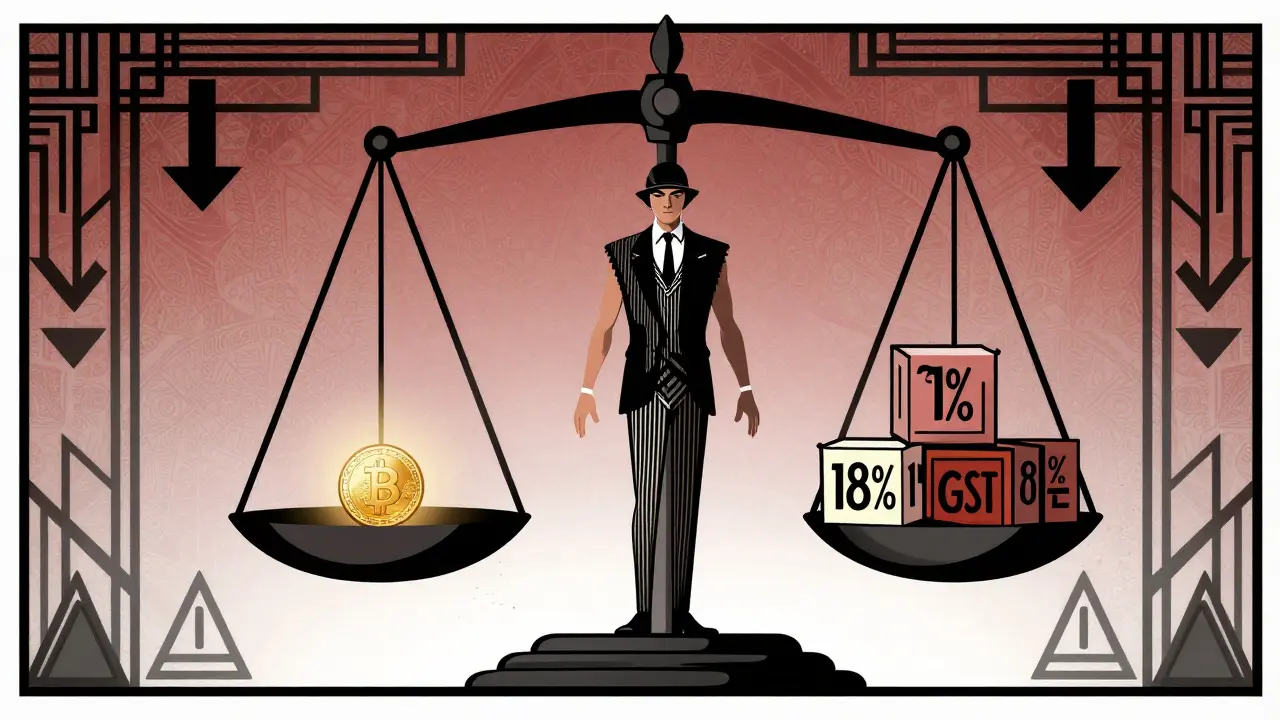
- 18% GST: In July 2025, major exchanges began applying an 18% Goods and Services Tax on trading activities, including spot trades, derivatives, and staking rewards. This stacks on top of the income tax.
When you combine the 30% income tax, the 1% TDS, and the 18% GST, the effective tax rate on certain transactions can exceed 49%. This makes India one of the most expensive places in the world to trade crypto actively. Most retail investors in India now prefer long-term holding strategies to minimize taxable events.
| Country | Crypto Capital Gains Tax | TDS / Withholding | GST/VAT on Trading |
|---|---|---|---|
| India | 30% (Flat) | 1% on turnover | 18% |
| United States | Up to 20% (varies by income/hold period) | N/A | N/A |
| United Kingdom | Up to 20% (Capital Gains Tax) | N/A | N/A |
| El Salvador | 0% (Legal Tender) | N/A | N/A |
New Regulators: SEBI Steps In
For years, the RBI handled monetary policy, and the Ministry of Finance handled taxes. But starting April 1, 2025, a new player entered the arena: the Securities and Exchange Board of India (SEBI).
SEBI now oversees crypto tokens that resemble securities. This means if a token offers voting rights, dividends, or promises returns based on the efforts of a third party, it falls under SEBI's jurisdiction, not just the general VDA framework. This creates a two-tier system:
- Commodity-like Tokens: Bitcoin and Ethereum are generally viewed as digital commodities. They follow the VDA tax rules and FIU-IND compliance.
- Security-like Tokens: Many altcoins, especially those launched via Initial Coin Offerings (ICOs) or Security Token Offerings (STOs), are now scrutinized by SEBI. These projects face stricter disclosure requirements, similar to traditional stock listings.
This move aims to protect investors from fraud and pump-and-dump schemes. However, it adds complexity for exchanges, which must now classify every token they list correctly.
Compliance for Exchanges: The FIU-IND Rule
You cannot just sign up on any global exchange anymore. Since March 2023, all Virtual Digital Asset Service Providers (VDASPs) serving Indian users must register with the Financial Intelligence Unit-India (FIU-IND). This includes exchanges, wallet providers, and payment gateways.
The requirements are strict:
- KYC/AML Protocols: Exchanges must verify user identities thoroughly.
- Transaction Monitoring: Systems must flag suspicious activities and report them to authorities.
- Data Retention: Transaction records must be kept for specified periods.
This rule forced many international giants to either invest heavily in compliance infrastructure or block Indian IP addresses entirely. If you are using an unregistered platform, you are taking a significant risk. Your funds may not be protected, and the platform could be shut down without warning.

The Future: Digital Rupee vs. Private Crypto
While private crypto faces heavy taxes, the government is pushing its own digital currency: the Digital Rupee (e₹). Issued by the RBI, this Central Bank Digital Currency (CBDC) is legal tender. It works instantly, has zero transaction fees for consumers, and is backed by the state.
The strategy seems clear. The government wants to promote the Digital Rupee for daily payments and commerce. Meanwhile, private cryptocurrencies are relegated to the role of speculative investment assets. The upcoming discussion paper expected later in 2026 may clarify rules for Decentralized Finance (DeFi) and staking, but the core stance is unlikely to change: private crypto is legal, but it is not money.
Practical Tips for Indian Crypto Users
If you are navigating this landscape, here is how to stay safe and compliant:
- Stick to Registered Exchanges: Only use platforms listed on the FIU-IND registry. This ensures your KYC data is secure and the platform operates within Indian law.
- Keep Meticulous Records: Because you cannot deduct expenses, your cost basis is critical. Use accounting software to track every purchase, sale, and transfer. You will need this for your annual tax return.
- Consider Long-Term Holding: Given the 30% tax and 18% GST, frequent trading is financially inefficient. Many Indians are shifting to a "buy and hold" strategy for major assets like Bitcoin and Ethereum.
- Watch for SEBI Updates: If you invest in smaller altcoins or DeFi tokens, check if SEBI has classified them as securities. Ignoring this could lead to future penalties.
- Explore the Digital Rupee: For everyday transactions, consider using the e₹ wallet. It integrates with UPI and offers the speed of crypto without the tax complexity.
Is cryptocurrency banned in India in 2026?
No, cryptocurrency is not banned. It is legal to buy, sell, and hold crypto assets. However, they are not recognized as legal tender, meaning you cannot force anyone to accept them as payment for debts or goods.
How much tax do I pay on crypto profits in India?
You pay a flat 30% tax on capital gains. Additionally, there is a 1% TDS deducted at the source of the transaction, and an 18% GST applies to trading services. No expenses can be deducted from your gains except the cost of acquisition.
Can I use Bitcoin to pay for groceries?
Technically, yes, if the seller agrees. However, it is not legal tender. The transaction will be treated as a barter deal for tax purposes, triggering capital gains tax for the seller and potentially complex reporting for you.
Which exchanges are legal in India?
Only exchanges registered with the Financial Intelligence Unit-India (FIU-IND) are legal. Major domestic players like CoinDCX, WazirX, and ZebPay are registered. International exchanges must also comply with FIU-IND rules to serve Indian users legally.
What is the difference between VDA and Crypto?
In India, "Virtual Digital Asset" (VDA) is the legal term used in tax laws to describe cryptocurrencies, NFTs, and other blockchain tokens. "Crypto" is the common slang. Legally, they refer to the same underlying assets, but VDA is the term you will see on tax forms and government documents.
Does SEBI regulate all cryptocurrencies?
No. SEBI regulates tokens that exhibit characteristics of securities, such as offering voting rights or dividends. Most major cryptocurrencies like Bitcoin and Ethereum are treated as digital commodities under the broader VDA framework, overseen by the Ministry of Finance and FIU-IND.