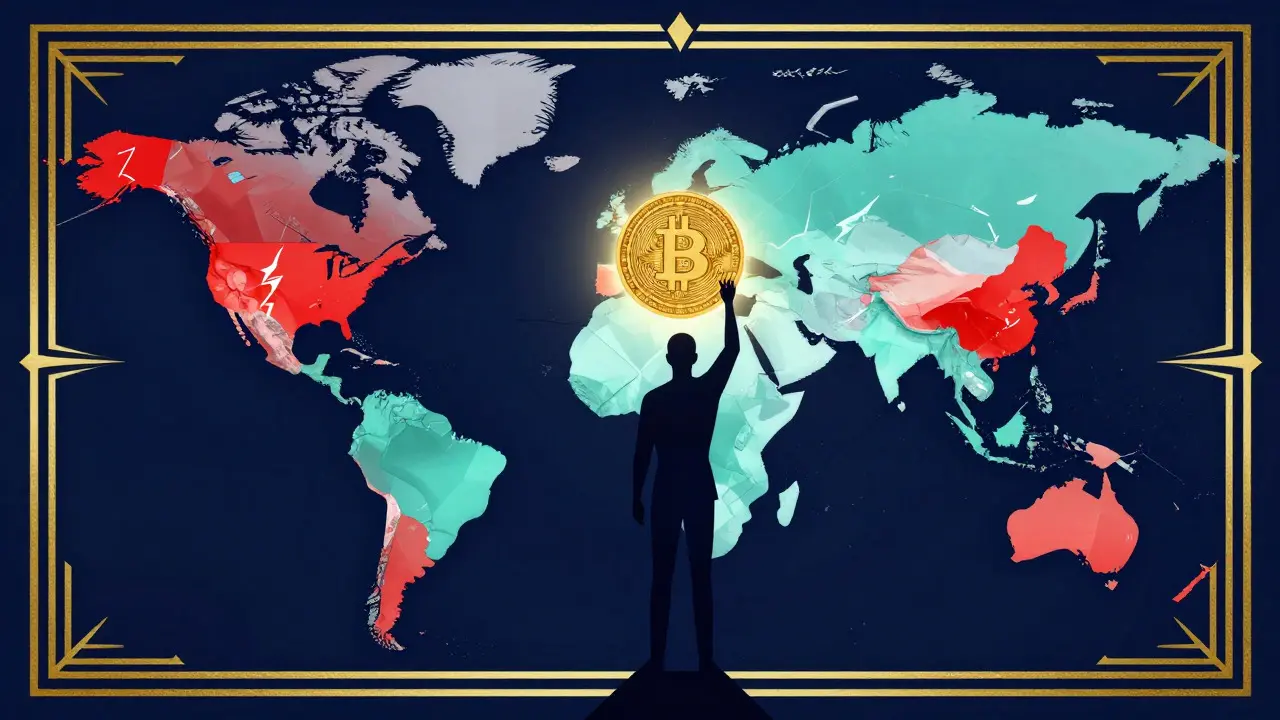
Imagine holding a wallet full of assets that are perfectly legal in your neighbor's country but considered a criminal offense in yours. For millions of people using digital assets, this isn't a hypothetical scenario; it's the daily reality of navigating a fragmented global legal landscape. As we move through 2026, the question is no longer just about price volatility or technical upgrades. It is about where you live and how aggressively local authorities hunt down ordinary users rather than just institutional bad actors.
The gap between jurisdictions has widened significantly. While some nations have embraced blockchain technology with clear regulatory frameworks, others have doubled down on prohibition, treating simple possession as a crime. This article breaks down the current enforcement climate, identifying exactly which countries pose the highest risk for individual crypto holders and what those risks actually look like in practice.
The High-Risk Zone: Total Bans and Active Prosecution
At one end of the spectrum lies a group of countries where Cryptocurrency Enforcement is synonymous with total prohibition. These jurisdictions don't just regulate; they outlaw. If you hold, trade, or mine digital assets here, you are technically breaking the law, and the state is actively looking for violators.
China remains the most prominent example. Since banning exchanges and Initial Coin Offerings (ICOs) back in 2017, the government has maintained a comprehensive crackdown. In 2024 and 2025, enforcement extended beyond just trading to include mining operations and even peer-to-peer transactions. The Chinese approach is systematic. Authorities use surveillance tools to track illicit flows, making it one of the least friendly environments for any crypto activity. The risk here isn't just a fine; it can involve criminal charges for violating financial regulations.
Following China are Algeria and Bolivia. Both nations have implemented complete bans on the use, holding, and trading of cryptocurrencies. In Algeria, all crypto-related activities are declared illegal with strict penalties. Bolivia’s Central Bank cited concerns over financial stability and money laundering as reasons for the prohibition. In these places, the legal system treats crypto holdings similarly to other unregistered financial instruments, leading to active prosecution under existing financial crime statutes.
Bangladesh rounds out this high-risk tier. The country strictly prohibits crypto use, classifying it as illegal under anti-money laundering laws. Authorities have issued explicit warnings that involvement in crypto transactions can lead to fines or jail time. Unlike countries that simply ignore crypto, Bangladesh actively enforces these bans, creating a hostile environment for anyone holding digital assets.
The Middle Ground: Heavy Taxation and Regulatory Friction
Not every restrictive country goes so far as to ban crypto entirely. Some use taxation and bureaucratic hurdles as their primary enforcement tools. This creates a "de facto" restriction where ownership is legal, but the cost of compliance makes participation difficult for average users.
India is the prime example of this strategy. Rather than criminalizing possession, India imposes a 30% flat tax on all crypto gains and a 1% Tax Deducted at Source (TDS) on every transaction. This structure means that if you sell a coin for a profit, you pay 30%. If you swap one coin for another, you might trigger a taxable event. While the Supreme Court overturned the banking ban in 2020, the heavy tax burden acts as a significant deterrent. For many traders, the administrative headache and financial loss make holding crypto less attractive, effectively reducing user numbers without needing police raids.
In contrast, countries like Ecuador take a cautious stance. The Central Bank does not recognize crypto as legal tender, and payments are discouraged. However, there is no outright ban. Instead, the government launched its own state-backed digital currency, the Sistema de Dinero Electrónico. This represents regulatory discouragement rather than active prosecution. You won't be arrested for holding Bitcoin in Ecuador, but you likely won't find many merchants accepting it either.
Western Jurisdictions: Targeting Whales, Not Retailers
In major Western economies, the enforcement narrative is different. The focus is rarely on the individual user buying a small amount of Ethereum. Instead, authorities target large-scale criminal enterprises, money launderers, and non-compliant institutions.
The United States has adopted a selective approach. Recent actions, such as the Office of Foreign Assets Control (OFAC) sanctioning the Russia-based exchange Cryptex in September 2024, show serious commitment to dismantling illicit networks. Cryptex processed over $5.88 billion in transactions linked to fraud and ransomware. The U.S. State Department even offered a $10 million reward for information leading to the arrest of its operator. However, for the average American user, the risk remains low. The administration's stance in recent years has leaned toward crypto-friendliness, reducing regulatory pressure on individuals while keeping a sharp eye on institutional compliance.
Europe is moving in a similar direction but with more centralized oversight. The launch of the Anti-Money Laundering Authority (AMLA) in July 2025 marked a significant shift. Scaling from 30 to over 400 employees by 2028, AMLA aims to create a unified supervisory framework. Under the Fifth Anti-Money Laundering Directive (AMLD5), exchanges and custodians must implement strict customer due diligence. This increases the chance of fund recovery for victims of fraud but also means tighter monitoring of who is doing business within the EU. For users, this translates to better protection against scams, provided they stick to regulated platforms.

Asia-Pacific: Compliance Over Punishment
Across the Asia-Pacific region, the trend is heavily skewed toward building robust regulatory frameworks rather than punishing users. The goal is to legitimize the industry, not crush it.
Singapore operates under the Payment Services Act, managed by the Monetary Authority of Singapore (MAS). The focus here is on issuer liability and reserve backing. For instance, new stablecoin rules require issuers to hold full reserves with regulated institutions. If an exchange fails, users have clearer recourse. There is little appetite for prosecuting retail investors for simply holding assets. The environment is business-friendly, emphasizing transparency and operational safety.
South Korea took a similar step with the "Act on Protection of Virtual Asset Users" (VAUPA), which took effect in mid-2024. This law requires exchanges to segregate client assets, maintain insurance, and report suspicious activity. The Financial Services Commission noted that exchanges enhanced their compliance systems well before the law passed. For users, this means higher security standards. The risk of prosecution for normal usage is minimal; the risk lies mainly in dealing with unregulated offshore platforms that fail to meet these new standards.
Brazil also passed a national crypto law in 2023, with the Central Bank dividing implementation into phases. Like its neighbors, Brazil is focused on defining roles and responsibilities rather than imposing criminal penalties on users. The draft rules emphasize clarity for both institutions and consumers, signaling a long-term commitment to integration into the mainstream financial system.
Risk Assessment: Where Do You Stand?
To help you gauge your personal exposure, consider the following breakdown of enforcement styles. The table below summarizes the key differences between high-risk, moderate-risk, and low-risk jurisdictions based on data from 2024 and 2025.
| Region/Country | Enforcement Style | User Risk Level | Key Mechanism |
|---|---|---|---|
| China, Algeria, Bolivia, Bangladesh | Total Prohibition | High | Criminal prosecution, asset seizure, active policing |
| India | Heavy Taxation | Moderate | 30% gain tax, 1% TDS, complex reporting |
| USA, Europe | Selective/Institutional | Low (for retail) | Targeting money launderers, strict exchange oversight (AMLA/OFAC) |
| Singapore, South Korea, Brazil | Regulatory Framework | Low | Compliance requirements, asset segregation, consumer protection |
It is crucial to understand that "prosecution" doesn't always mean going to prison. In many jurisdictions, the primary tool is financial penalty. In India, for example, the "punishment" is the loss of 30% of your gains. In China, it can be imprisonment. In Singapore, it is likely just a requirement to file accurate tax returns. Knowing which bucket your country falls into helps you decide whether to stay onshore, use privacy-preserving tools (where legal), or simply avoid the space altogether.

Global Cooperation and the Future of Tracking
One factor that changes the calculus for everyone is international cooperation. In 2024, sanctioned jurisdictions received $15.8 billion in cryptocurrency, accounting for roughly 39% of all illicit crypto transactions. This concentration of illicit flow makes it easier for authorities to target specific hubs. Operations like "Operation Endgame," a coordinated effort between U.S. and European authorities, resulted in the seizure of domains and €7 million in funds linked to payment processors funneling money to criminal networks.
As blockchain tracking tools improve, the ability to trace funds across borders grows stronger. This benefits honest users because it increases the likelihood of recovering stolen funds. However, it also means that hiding assets in offshore wallets offers less protection than it did five years ago. The era of total anonymity is fading, replaced by a system of transparent compliance. For the average user, this is generally a positive development, provided they remain within the bounds of their local laws.
Frequently Asked Questions
Is it illegal to hold crypto in China?
Technically, yes. Since the 2017 ban on exchanges and ICOs, domestic trading is prohibited. While casual holding has sometimes been overlooked, enforcement has tightened to include mining and P2P trades. The risk of prosecution exists, especially if amounts are significant or if you are involved in organized schemes.
What is the difference between a crypto ban and heavy taxation?
A ban makes the activity illegal, potentially leading to criminal charges and asset seizure. Heavy taxation, like in India, keeps the activity legal but imposes a high financial cost (e.g., 30% tax on gains). The former carries legal risk; the latter carries economic risk.
Does the US prosecute individual crypto users?
Rarely. US enforcement typically targets major criminal enterprises, money launderers, and non-compliant exchanges. Individual users who comply with tax laws face minimal prosecution risk. The focus is on systemic issues like sanctions evasion and fraud.
How does the EU's AMLA affect crypto users?
The Anti-Money Laundering Authority (AMLA) strengthens oversight of exchanges and custodians. For users, this means stricter Know Your Customer (KYC) checks and better protection against fraudulent projects. It reduces the risk of falling victim to scams but increases the level of identity verification required.
Which countries are the safest for crypto users in 2026?
Countries with established regulatory frameworks like Singapore, South Korea, and Portugal are considered safe. They focus on compliance and consumer protection rather than prosecution. Portugal, in particular, has positioned itself as one of Europe's most crypto-friendly nations with minimal prosecution risk for legitimate users.


Melissa G
August 17, 2026 AT 16:10The fragmentation of legal sovereignty in the digital age presents a profound paradox. We speak of borderless assets, yet our rights remain tethered to the soil beneath our feet. This dichotomy forces us to reconsider what it means to be a citizen in a decentralized world.
Marco Maldonado
August 19, 2026 AT 14:43Stop crying about China and look at home! The US government is just waiting for the right excuse to tax you into oblivion. Its not illegal here but its practically a crime if you dont pay up like a good patriot. Wake up people!
Calliope Clio
August 20, 2026 AT 15:08Omg this article is so dry 🥱📉
Who actually reads this stuff? I mean, sure, maybe if you are a lawyer or something boring like that. But for the rest of us who just want to buy a cool NFT, its all just noise. The real story is how much we lose in fees anyway. 😂💸
Abigail Sparks
August 21, 2026 AT 11:46You need to stop hiding under your rocks! If you live in a high-risk zone, move or use privacy tools legally. Do not wait until the cops knock on your door. Action beats anxiety every single time. Get out there and take control of your financial destiny now!
OLIVER CHRISTIAN
August 21, 2026 AT 11:57Great breakdown. For those in the EU, keep an eye on AMLA. It’s not just red tape; it’s building a safety net. If you stick to regulated exchanges, you’re actually safer than before. Let’s stay informed and compliant.
Kelsey Anne
August 22, 2026 AT 08:58Moral hazard is rampant. People in banned countries deserve their fate for ignoring the law. No excuses. Law is law. End of story.
Jade Brown
August 23, 2026 AT 22:41Let’s dissect the macroeconomic implications here. The convergence of regulatory arbitrage and jurisdictional friction creates a complex derivative risk profile for the average holder. You’re essentially betting on the stability of local legislative bodies while holding volatile assets. It’s a precarious equilibrium that only the most sophisticated traders can navigate without getting burned by compliance costs or sudden policy shifts. The alpha isn’t in the coin; it’s in the legal loophole. Don’t sleep on the geopolitical beta.
Nikki keller
August 25, 2026 AT 02:00It’s interesting how the definition of 'user' changes depending on the lens. Are we consumers, investors, or criminals? Perhaps we are simply citizens trying to protect our purchasing power. The tone of enforcement often reflects the political climate more than the actual risk to the individual. Let’s try to see the human element behind these regulations.
miranda gamboa
August 26, 2026 AT 08:45Exciting times! 🚀
For anyone in APAC, the compliance frameworks are actually a huge win for long-term holders. Segregated assets and insurance requirements mean less fear of exchange collapse. Let’s focus on the positives of regulation rather than just the restrictions. The infrastructure is getting stronger! 💪📈
Kiran Jayaram
August 27, 2026 AT 17:39typical western bias in this article they ignore how india actually protects its currency from foreign speculation
the 30% tax is genius because it kills the speculative bubble before it hurts the rupee
stop listening to these crypto bros who want to destroy national economies for profit
Uday N M
August 29, 2026 AT 09:46India's approach is correct. Stability first.
Claudio Perrone
August 29, 2026 AT 19:05what a mess
i live in ireland and half the time i dont even know if my bank will let me buy eth
the whole thing feels like a big game of russian roulette with your own money
who knows what the next law will be tomorrow
just scary honestly
Hicham Mounir
August 30, 2026 AT 01:24It really is overwhelming, isn't it?
I feel your frustration. The uncertainty can be paralyzing. But remember, you are not alone in this journey. Many of us are navigating these same waters. Let’s support each other through the confusion. Your feelings are valid and shared by many in the community. Take a deep breath. We figure it out together.
Daniel Brown
August 31, 2026 AT 15:29You mentioned the US targets whales. What about the small fish? Does OFAC really care if I hold $50 worth of altcoins? Or is it just the big players who get the heat? Seems like a double standard to me. Why should the little guy worry about sanctions evasion when he can barely afford gas fees?