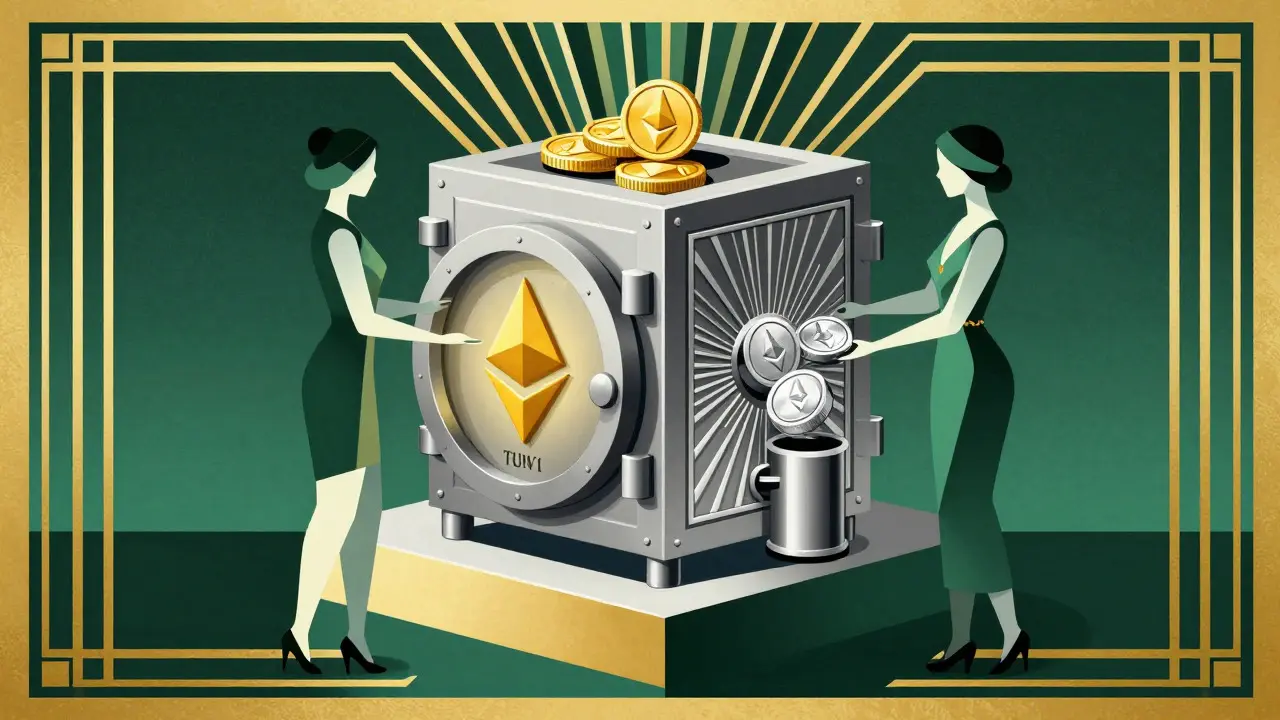
Imagine trying to buy a rare collectible card, but there’s no shop owner. Instead, you walk into a room full of boxes. Each box contains a specific mix of cards and cash. To get the card you want, you don’t negotiate with a person; you simply put in more cash than the box currently holds, and the math automatically adjusts the price for everyone else. This is exactly how Uniswap V1 was the first decentralized exchange protocol that introduced the Automated Market Maker (AMM) model to the crypto world in November 2018 worked. It wasn’t just an app; it was a proof-of-concept that proved complex financial trading could happen on-chain without a middleman.
If you are looking at Uniswap today, you are likely using V3 or V4. But understanding V1 is crucial because it laid the groundwork for everything we see in decentralized finance (DeFi) now. It stripped away the traditional order books used by centralized exchanges like Binance or Coinbase and replaced them with liquidity pools. Let’s break down what made this version revolutionary, where it failed, and why its legacy still dictates how we trade tokens today.
The Core Innovation: Automated Market Makers (AMMs)
Before Uniswap V1, if you wanted to swap Token A for Token B on a blockchain, you needed a counterparty. You had to find someone who actually owned Token A and wanted Token B. If no one was there to match your trade, your order sat unfilled. This created a massive bottleneck for liquidity, especially for smaller or newer tokens.
Uniswap V1 solved this by introducing the Automated Market Maker (AMM) is a system that uses mathematical formulas rather than order books to determine asset prices and facilitate trades between users. Here is the simple logic behind it:
- Liquidity Pools: Users deposited pairs of assets (like ETH and DAI) into smart contracts.
- Pricing Formula: The price was determined by the constant product formula ($x * y = k$). If you bought more of one token, its price went up relative to the other, maintaining the balance.
- No Counterparty Needed: You were always trading against the pool, not another person.
This meant trading was available 24/7, globally, and permissionlessly. No KYC (Know Your Customer) checks, no account creation, and no bank links. Just connect your wallet, and you were ready to go.
Technical Architecture and Limitations
While the concept was brilliant, the execution in V1 had significant constraints. Understanding these limitations helps explain why later versions (V2 and V3) became necessary.
| Feature | V1 Specification | Impact on User Experience |
|---|---|---|
| Supported Chains | Ethereum Only | High gas fees during network congestion; slow transaction speeds. |
| Token Support | ERC-20 Tokens + ETH | Could not trade non-Ethereum assets directly. |
| Trading Fee | 0.3% per swap | Standardized fee structure, paid to liquidity providers. |
| Routing | ETH-Centric | All trades had to route through ETH, causing inefficiency for non-ETH pairs. |
| Security | Insecure Price Oracle | Vulnerable to manipulation and reentrancy attacks. |
The most glaring issue was the ETH-centric routing. If you wanted to swap Token A for Token B, the protocol would force you to swap Token A for ETH, and then ETH for Token B. This double-hop increased slippage and cost more in gas fees. Additionally, the price oracle-the mechanism that tells the contract what the current market price is-was not decentralized. Malicious actors could manipulate the price feed, leading to unfair trades.
User Experience: Simple but Raw
Let’s talk about what it felt like to use Uniswap V1. The interface was incredibly minimalistic. There was no fancy dashboard, no real-time charts, and no portfolio tracker. You saw a search bar and two input fields. It was raw code exposed to the user.
Pros of the UX:
- Speed of Onboarding: You could start trading in under two minutes. No email verification, no ID upload. Just MetaMask connection.
- Simplicity: The single menu design reduced cognitive load. You knew exactly what you were doing: swapping tokens.
- Global Access: Anyone with an internet connection and some ETH could participate, regardless of their country’s banking regulations.
Cons of the UX:
- No Charts: Traders had to open a separate window on CoinGecko or Etherscan to check price trends before swapping.
- Gas Fee Shock: The UI didn’t always clearly predict the total cost including Ethereum gas fees. During high network activity, a $10 swap could cost $50 in gas.
- Error Handling: If a transaction failed, you still lost the gas fee. V1 did not optimize for failed transactions, making mistakes expensive.
Security and Risks in V1
Security was the biggest concern for early adopters. Uniswap V1 was built on experimental technology. While the core smart contracts were audited, the ecosystem around them was wild west.
One major vulnerability was Reentrancy Attacks are a type of exploit where a malicious contract repeatedly calls a function before the previous execution completes, draining funds from the pool. Non-standard tokens that didn’t follow the strict ERC-20 rules could trick the Uniswap contract into thinking they had sent funds when they hadn’t. This led to several exploits in the early days where liquidity providers lost money.
Furthermore, customer support was non-existent. If you messed up a transaction, there was no help desk. You relied on community forums and Twitter. This lack of safety net was a barrier for mainstream adoption but aligned with the "be your own bank" ethos of crypto purists.
The Evolution: From V1 to V3
Uniswap V1 was never meant to be the final product. It was a stepping stone. The lessons learned from V1 directly shaped its successors.
- Uniswap V2 (May 2020): Addressed the ETH-centric routing by allowing direct ERC-20 to ERC-20 swaps. It also introduced a better price oracle and fixed the gas efficiency issues for failed transactions.
- Uniswap V3 (May 2021): Introduced Concentrated Liquidity is a feature that allows liquidity providers to allocate capital within specific price ranges, increasing capital efficiency and reducing slippage. This allowed traders to provide liquidity only where they expected the price to stay, drastically improving returns for providers and depth for traders.
Today, Uniswap operates across multiple chains including Polygon, Arbitrum, Optimism, and Celo. But V1 remains the spiritual ancestor of all these innovations.

Who Was Uniswap V1 For?
If you were a casual investor, V1 was risky due to the complexity of managing private keys and gas fees. However, for DeFi enthusiasts, developers, and early adopters, it was a goldmine. It allowed them to:
- Trade newly launched tokens immediately after deployment.
- Provide liquidity and earn the 0.3% trading fees.
- Experiment with yield farming strategies before they became mainstream.
It wasn’t for everyone, but it was essential for the growth of the decentralized economy.
Final Thoughts on the Legacy
Uniswap V1 may seem primitive compared to modern interfaces, but its impact cannot be overstated. It proved that trustless, automated trading was viable. It shifted the paradigm from centralized control to community-driven liquidity. While it had flaws-high fees, security risks, and poor UX-it paved the way for the multi-billion dollar DeFi industry we have today. When you swap tokens on any DEX now, you are standing on the shoulders of Uniswap V1.
Is Uniswap V1 still active today?
Technically, the V1 smart contracts are still deployed on the Ethereum blockchain, but almost no one uses them. Most liquidity has migrated to V2 and V3 due to better efficiency, lower costs, and improved features. Using V1 today would result in higher slippage and unnecessary gas fees.
What is the main difference between Uniswap V1 and V3?
The key difference is liquidity management. V1 required liquidity to be spread across all possible prices, which was inefficient. V3 introduces concentrated liquidity, allowing providers to focus their capital in specific price ranges. This leads to deeper liquidity for traders and higher potential returns for providers.
Why were gas fees so high on Uniswap V1?
Uniswap V1 operated solely on the Ethereum mainnet. During periods of high network congestion, users competed to pay higher gas fees to get their transactions processed quickly. Since V1 lacked optimizations for failed transactions, even errors cost the full gas price, adding to the expense.
Did Uniswap V1 require KYC verification?
No, Uniswap V1 was completely permissionless. Users only needed an Ethereum-compatible wallet (like MetaMask) to connect and trade. There were no identity checks, phone verifications, or email sign-ups required.
How did Uniswap V1 handle price discovery?
V1 used the constant product formula ($x * y = k$) to determine prices based on the ratio of assets in the liquidity pool. However, its price oracle was not decentralized, making it vulnerable to manipulation by large trades or external data feeds.
Lance Jantz
July 30, 2026 AT 21:53Oh, the sweet, naive innocence of 2018! We were all just little lambs wandering into the slaughterhouse of smart contracts, thinking we were pioneers. Uniswap V1 wasn't just code; it was a philosophical statement about the death of the middleman, wrapped in a UI that looked like it was designed by a blind monk using only ASCII art. The constant product formula, $x * y = k$, is essentially the mathematical embodiment of entropy-order decaying into chaos as you trade. It’s beautiful, really. A digital ouroboros eating its own tail. Most people see a swap button; I see the existential dread of liquidity providers watching their impermanent loss bloom like a poisonous flower. It changed crypto forever? No, it revealed that humans are still incapable of trusting math more than they trust a guy named Chad who promises 100x returns on Telegram.
Don Fizy
July 31, 2026 AT 16:28Great breakdown! :) It's wild to look back at how simple it was. Just connect wallet and go. No KYC, no fuss. That permissionless aspect is what really made it special for early adopters. Keep learning!
Phil Babb
August 2, 2026 AT 08:52You missed the real point!! The gas fees were astronomical!!! Everyone knows this!!! But hey, at least we had fun burning ETH while trying to buy a meme coin worth less than a penny!!! Wake up sheeple!!!
Dominic Greco
August 2, 2026 AT 15:45They want you to believe it was 'innovative' 🤡 but let’s be real, the centralized exchanges were already manipulating prices before V1 even launched. The whole AMM model is just a way to hide the slippage so you don’t notice you’re getting ripped off by the whales 🐋. Trust nothing. The oracle manipulation wasn’t a bug; it was a feature designed to keep us poor. 👀💸
Sean Rowland
August 3, 2026 AT 04:35Actually, your characterization of the 'ETH-centric routing' as merely 'inefficient' is profoundly reductive. It was a fundamental architectural necessity given the nascent state of ERC-20 standards at the time. To suggest otherwise ignores the intricate dance of gas optimization versus security that defined that era. Furthermore, calling the UX 'raw' is an understatement bordering on insult; it was utilitarianism stripped to its barest bone, devoid of the consumerist bloat that plagues modern dApps. You clearly haven’t suffered through a failed transaction where you lost 50 dollars in gas for a swap that reverted due to a rounding error. Try that. Then come back and tell me it was 'simple.'
Sus Sawyer
August 3, 2026 AT 07:34Hey Sean, chill out dude. Not everyone remembers every single gas spike from 2018 lol. The point is it opened the doors for regular folks to trade without asking permission. That’s huge. Sure, the UX was rough, like driving a car with no steering wheel, but it got us moving. And yeah, those failed txs hurt my wallet bad 😅 but we learned. Now we have better tools. Progress!
Aryan MISHRA
August 4, 2026 AT 13:03V1 was inefficient. Gas was high. Slippage was terrible. Move on. V3 is superior. Concentrated liquidity is the only metric that matters now. Stop romanticizing the past.
Ryan Robinson
August 5, 2026 AT 21:21i mean... it was kinda cool tho. i remember my first swap on v1. felt like magic even though i lost money. the ui was ugly af but it worked. dont hate on the classics guys.
Earl Kott65
August 7, 2026 AT 07:23Oh wow, 'magic'? 🙄 You mean 'expensive mistake waiting to happen'. But sure, Ryan, let’s pretend that paying $50 in gas to swap $10 worth of SHIB was a spiritual journey. 🚀🌕 Classic DeFi bro energy. Love it.
Ethan Yuwono
August 7, 2026 AT 13:06it is interesting how we view history. v1 was flawed but necessary. like the first airplane. it crashed often. but it flew. we should appreciate the attempt rather than just mocking the crashes.
Jack Delasquez
August 8, 2026 AT 13:31yea man totally. also did u know u could provide liquidity too? i tried that once. thought i was gonna get rich quick. instead i got impermanent loss. lol. life is funny like that. anywyas good post.
Harman Singh
August 10, 2026 AT 10:56why r u all so happy? nobody won. everyone lost money to gas or devs. ur wallets r empty. cry about it. i lost 2 eth on a bad token. thanks uniswap. thanks.
Qolbina Islami
August 10, 2026 AT 20:22This article is biased!!! American tech giants always steal ideas from elsewhere!!! Uniswap is just a copy of older concepts!!! Support local blockchain initiatives!!! Don’t let Silicon Valley control your future!!! USA!!!