
Crypto Tax Calculator for India
Calculate Your Crypto Tax Liability
- Taxable Gain: ₹0
- Tax (30%): ₹0
- Health & Education Cess (4%): ₹0
- Total Tax Liability: ₹0
- TDS (1%): ₹0
- GST on Exchange Fees: ₹0
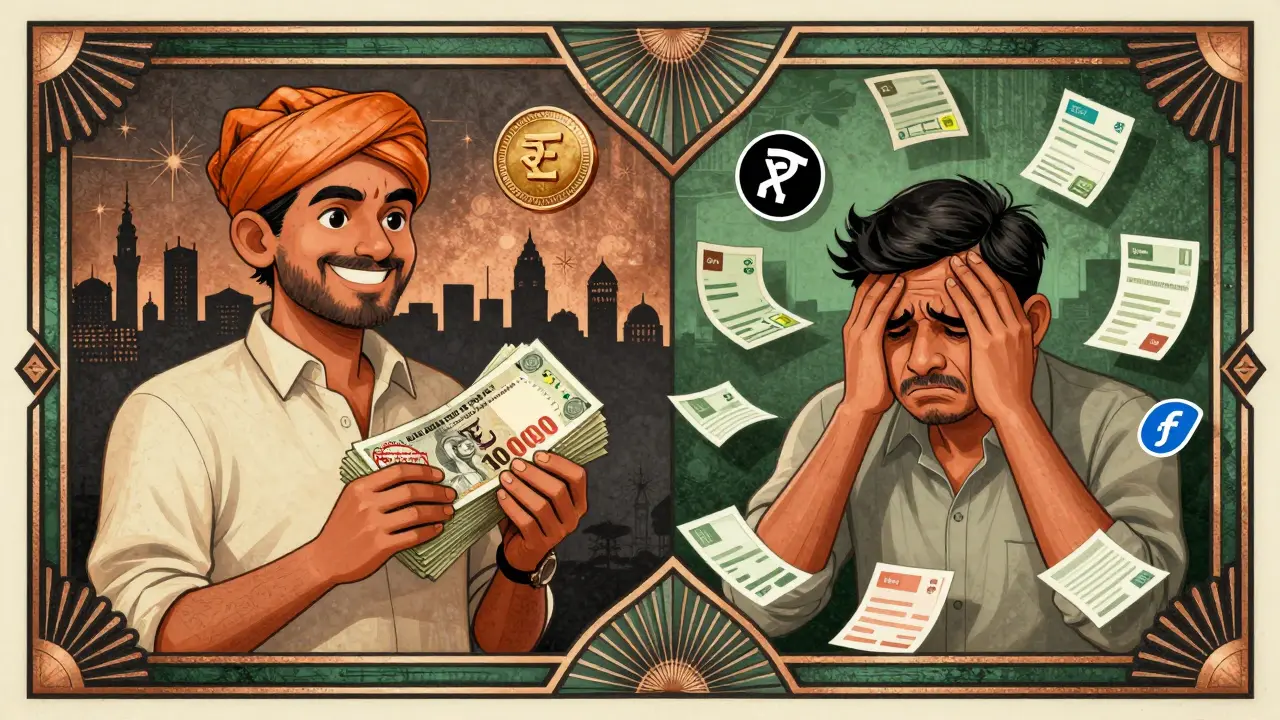
If you’re trading Bitcoin, Ethereum, or NFTs in India, you’re not just dealing with price swings-you’re dealing with one of the strictest crypto tax systems in the world. Since April 2022, the Indian government has treated all cryptocurrencies as Virtual Digital Assets (VDAs), and the rules are not just complex-they’re harsh. There’s no long-term vs. short-term distinction. No deductions for trading fees. No indexation to adjust for inflation. Just a flat 30% tax on every profit, plus a 1% TDS that gets pulled out of every transaction. And now, starting July 2025, even the fees you pay to exchanges are taxed at 18% GST.
How Crypto Gains Are Taxed in India
Every time you sell, trade, or spend cryptocurrency, you trigger a taxable event. The tax is calculated as: Sale value minus purchase cost. That’s it. You can’t deduct anything else-not exchange fees, not wallet costs, not even the cost of buying the crypto with a credit card that charged you interest.
Let’s say you bought 0.1 BTC for ₹3,00,000 in January 2024 and sold it in March 2025 for ₹5,00,000. Your gain is ₹2,00,000. You owe 30% of that: ₹60,000. Add the 4% health and education cess, and it jumps to ₹62,400. That’s more than 31% of your profit gone before you even touch your wallet.
And here’s the kicker: if you got crypto for free-through staking rewards, airdrops, or mining-the government treats that as income. You pay tax on the fair market value in INR at the moment you received it, at your regular income tax slab rate. So if you earned 0.5 ETH worth ₹2,50,000 as staking rewards and you’re in the 30% tax bracket, you owe ₹75,000 right then and there.
The 1% TDS That’s Eating Into Your Profits
Since July 1, 2022, every crypto transaction over ₹10,000 (₹50,000 for specified persons like high-income earners) triggers a 1% Tax Deducted at Source (TDS). This isn’t a separate tax-it’s an advance payment toward your final tax liability. But here’s the problem: exchanges deduct it upfront, and many users don’t realize they can claim it back when filing returns.
Imagine you sell ₹2,00,000 worth of Solana. The exchange deducts ₹2,000 as TDS. You think you’ve paid ₹2,000 in tax. But if your actual capital gains tax is ₹60,000, that ₹2,000 just reduces what you owe. If your gains were only ₹1,500, you still paid ₹2,000 in TDS-and now you have to wait for a refund. Many users don’t claim this credit properly, losing money they’re owed.
According to a KoinX report from February 2025, 57.2% of Indian crypto traders struggled to reconcile TDS credits with their income tax returns. The Income Tax Department’s AIS (Annual Information Statement) pulls data from exchanges, but mismatches happen. One user on Reddit reported losing ₹18,000 because their exchange reported a different purchase price than what they had recorded.
Now, Even Exchange Fees Are Taxed
Starting July 7, 2025, every fee you pay to a crypto exchange-whether it’s for trading, withdrawing, depositing, or staking-is subject to 18% GST. This change, confirmed by the Central Board of Indirect Taxes and Customs (CBIC), reclassifies crypto platforms as “Online Service Providers” under GST law. That means even if your exchange doesn’t have a physical office in India, they must register for GST and charge you the tax.
For example, if you pay ₹500 to trade on WazirX, you now pay ₹90 extra in GST. If you withdraw ₹1 lakh, you pay ₹18,000 in GST on the withdrawal fee. This wasn’t the case before. The industry estimates this will raise operational costs for exchanges by 15-20%, and those costs are being passed on to users through higher fees.
Some platforms have started absorbing part of the cost. Others have raised minimum withdrawal limits to reduce the number of small, fee-heavy transactions. Either way, it’s another layer of friction for retail investors.
What’s Not Taxed? (And What’s Still a Gray Area)
Gift cards, vouchers, and loyalty points aren’t considered VDAs, so those are fine. But everything else-Bitcoin, Ethereum, Dogecoin, Polygon, NFTs, even tokens from DeFi protocols-is covered.
Here’s where things get messy: DeFi transactions. If you swap tokens on Uniswap through a wallet, there’s no exchange pulling TDS. You’re on your own to track and report. The same goes for liquidity provision, yield farming, or staking on non-KYC platforms. The Income Tax Department’s FAQs from May 2023 don’t fully cover these. TaxGuru legal expert Pallavi Patel points out that most taxpayers have no idea how to value these complex transactions. One user on CryptoTaxIndia’s Telegram group reported accidentally paying tax on a token swap that was actually a loss-because they didn’t know how to calculate cost basis across multiple wallets.
Hard forks and airdrops are taxed as income at fair market value on receipt. But what if you didn’t receive the asset until months later? What if the token dropped in value? The rules don’t allow for losses to offset gains. You pay tax on the value at receipt, even if the asset later becomes worthless.
How It Compares to the Rest of the World
India’s 30% flat tax on crypto gains is among the highest globally. The U.S. taxes crypto gains as capital gains-0% to 20% for long-term holdings (over one year), up to 37% for short-term. Portugal taxes crypto gains at 0% for non-professional traders. Singapore doesn’t tax capital gains at all. Even Germany allows tax-free crypto sales after one year.
India’s system is unique in combining a 30% capital gains tax with a 1% TDS. No other major economy does both. The Blockchain and Crypto Assets Council (BACC) says this double layer is stifling innovation. Retail traders are leaving. According to a Binance Research and IIM Bangalore study, retail participation dropped from 82% of all trades in 2021 to just 57% in 2024. Institutional players, who can afford tax advisors and compliance teams, are taking over.
But there’s a flip side: clarity. Before 2022, there was no official rule. Some paid tax. Some didn’t. Now, at least everyone knows the rules-even if they’re harsh. As one institutional investor on Reddit put it: “High taxes? Yes. But at least I know what I owe.”

What You Need to Do to Stay Compliant
Keeping up isn’t optional. The Income Tax Department now receives real-time data from all registered exchanges. If you don’t report, you’ll get a notice. Here’s what you need:
- Complete transaction history: Every buy, sell, trade, gift, and reward. Timestamps and INR values at time of transaction.
- Accurate cost basis: Track every purchase batch. If you bought BTC in three different transactions, you can’t just average them-you must use FIFO (first-in, first-out) unless you specify otherwise.
- TDS certificates: Download them from your exchange. You’ll need them to claim credit.
- Wallet addresses: If you moved crypto between wallets or to DeFi, keep records. The tax department can trace on-chain activity.
Most people spend 8-12 hours a quarter doing this manually. Tools like KoinX, CoinTracker, and CryptoTaxIndia have cut that to 2-3 hours. They auto-import exchange data, calculate gains/losses, and generate reports for ITR filing. But they’re not perfect. Discrepancies between exchange records and AIS data affected 32.7% of filers in 2023-24, according to ClearTax.
The Bigger Picture: e-Rupee and the Future
India isn’t banning crypto. It’s taxing it into submission. The government’s message is clear: “You can do it, but at your own risk and cost,” as Commerce Minister Piyush Goyal said in 2023.
Behind the scenes, the Reserve Bank of India is rolling out the e-Rupee-a digital currency backed by the central bank. The e-Rupee will operate under traditional banking rules: no anonymity, no volatility, no tax on capital gains (because it’s not an investment-it’s money).
Industry analysts at Bernstein predict India’s crypto market will stabilize at ₹2.8-3.2 trillion in annual trading volume by 2027, down from ₹8.7 trillion in 2021. But institutional volume will make up the difference. Retail traders? They’re being priced out.
The Joint Committee on Virtual Digital Assets, formed in November 2024, is expected to recommend changes by March 2026. Rumors suggest possible adjustments to TDS thresholds or DeFi clarity. But don’t expect the 30% rate to drop. The government sees taxation as its main tool-not prohibition, not promotion. Just control.
Final Reality Check
If you’re a small investor in India, crypto is no longer a get-rich-quick play. It’s a high-cost, high-compliance activity. A 31.2% tax on every profit, plus GST on fees, plus TDS headaches, means you need strong conviction to stay in. Many have already left. Others are holding long-term, betting the rules will change-or that the value will rise enough to justify the tax.
Don’t guess. Don’t hope. Track everything. Use software. File on time. And understand: this isn’t a temporary phase. This is India’s crypto tax reality-and it’s here to stay.
Is crypto trading legal in India?
Yes, crypto trading is legal in India. The government hasn’t banned it. But it’s heavily taxed. Since April 2022, all cryptocurrency transactions are regulated under the Virtual Digital Assets (VDA) framework, and you must pay tax on gains, fees, and rewards.
Do I pay tax if I lose money on crypto?
No. India does not allow crypto losses to offset gains. Even if you sold Bitcoin at a loss, you can’t use that loss to reduce your tax bill on other crypto profits. Each transaction is taxed individually. You pay tax on every profit, regardless of overall losses.
What happens if I don’t report my crypto gains?
The Income Tax Department receives transaction data directly from exchanges through the Annual Information Statement (AIS). If you don’t report gains, you’ll likely receive a notice demanding tax payment, interest, and penalties. In severe cases, this can lead to legal action under the Income Tax Act.
Do I pay GST on buying or selling crypto?
No, GST does not apply to the buying or selling of cryptocurrency itself. But since July 2025, GST at 18% applies to all service fees charged by crypto exchanges-like trading fees, withdrawal fees, and staking service charges. You pay GST on the platform’s fees, not on the crypto value.
How do I calculate my crypto tax if I use multiple wallets?
You must track every purchase and sale across all wallets. Use tax software like KoinX or CoinTracker that supports multi-wallet imports. You need the exact timestamp and INR value for each transaction. The tax department uses FIFO (first-in, first-out) by default unless you specify otherwise. Without accurate records, you risk overpaying or underreporting.
Are NFTs taxed the same as Bitcoin?
Yes. NFTs are classified as Virtual Digital Assets (VDAs) under Indian tax law. Every sale, trade, or transfer of an NFT triggers a taxable event. You pay 30% tax on gains, 1% TDS on transactions over ₹10,000, and 18% GST on any platform fees you pay to sell or mint the NFT.
Can I claim a refund if TDS is more than my actual tax?
Yes. TDS is an advance payment. If you paid more TDS than your actual tax liability (for example, if your gains were low or you had no profit), you can claim the excess as a refund when you file your income tax return. You must include your TDS certificates (Form 26AS) and accurately report your crypto gains in Schedule CG of ITR-2.
Do I pay tax on crypto received as a gift?
Yes. If you receive crypto as a gift from someone who is not a relative (as defined under income tax law), the fair market value of the crypto at the time of receipt is treated as income and taxed at your slab rate. If the giver is a relative, no tax is due on receipt, but you’ll pay tax when you later sell it.



Chevy Guy
December 15, 2025 AT 01:02no wonder they banned cash transactions last year
theyre not taxing crypto
theyre punishing freedom
and you guys are still trading like it's 2021
Kelsey Stephens
December 16, 2025 AT 19:58Sue Bumgarner
December 17, 2025 AT 11:02Kayla Murphy
December 18, 2025 AT 13:53Florence Maail
December 19, 2025 AT 22:58and you're still trusting exchanges to report right? lol
they'll screw you over and you'll be the one paying the penalty
Abby Daguindal
December 21, 2025 AT 13:58SeTSUnA Kevin
December 22, 2025 AT 08:43Madhavi Shyam
December 22, 2025 AT 20:24Mark Cook
December 23, 2025 AT 17:47Bradley Cassidy
December 23, 2025 AT 18:08then i used cointracker and it auto-pulled my 12 wallets and even flagged a lost tx from 2023
life saver. dont be a hero. use the tool
Shruti Sinha
December 25, 2025 AT 16:45Sean Kerr
December 27, 2025 AT 04:58Rebecca Kotnik
December 27, 2025 AT 09:08Elvis Lam
December 28, 2025 AT 18:27Jonny Cena
December 30, 2025 AT 07:38