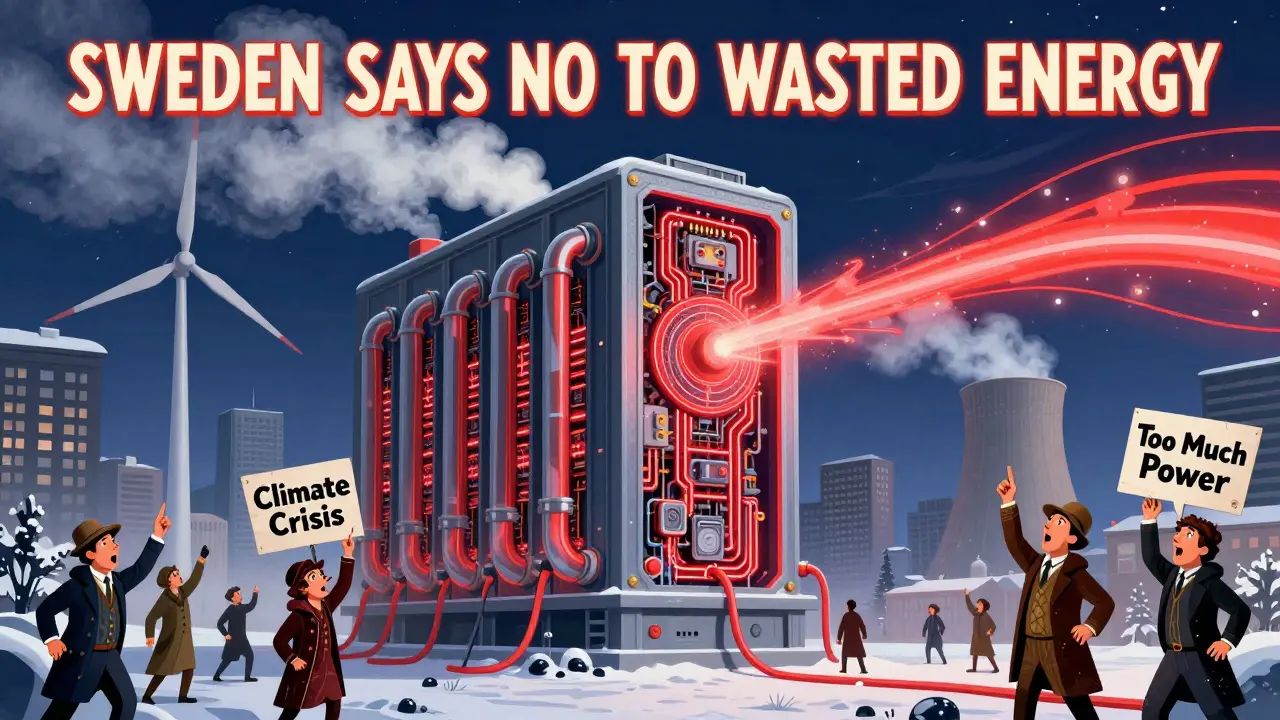
Sweden isn’t banning cryptocurrency outright-but it’s making it harder than ever to mine it. While Bitcoin and other proof-of-work coins still technically operate in the country, the regulatory environment has shifted dramatically since 2022. The reason? Energy use. Not just any energy use-massive, unsustainable amounts of electricity that directly conflict with Sweden’s climate goals.
Why Sweden Cares More Than Other Countries
Most countries look at the energy source when judging crypto mining. If a mine in Texas runs on wind or solar, it’s often seen as green. Sweden doesn’t care about the source. It cares about the total amount of electricity pulled from the grid. Even if 100% of that power comes from hydropower or nuclear, the act of using it for mining still counts as a climate risk. In 2022, Bitcoin mining in Sweden jumped from under 0.3 TWh per year to nearly 1 TWh in just four months. That’s the same amount of electricity used by 200,000 Swedish homes. For a country that gets 84% of its power from renewable or nuclear sources, that spike wasn’t just a blip-it was a red flag. The Swedish Financial Supervisory Authority (FI) and the Financial Stability Council (FSC) warned that crypto mining was undermining national carbon neutrality targets. Erik Thedéen, head of FI, called it a direct contradiction to Sweden’s climate commitments. The numbers don’t lie. Globally, Bitcoin mining uses about 143 TWh per year-more than entire countries like Norway and Sweden. Each Bitcoin transaction consumes 707 kWh of electricity. A single Visa transaction? 0.0023 kWh. That’s over 300,000 times more energy.How Sweden’s Rules Changed
Sweden didn’t just issue a warning. It rewrote the rules. In January 2025, the Crypto-Asset Environmental Transparency Act went into effect. Any mining operation larger than 0.5 megawatts must now publish real-time data on energy consumption and source. No hiding. No guessing. The public, regulators, and even local municipalities can see exactly how much power is being used-and where it’s coming from. Municipalities added their own layers. Boden capped new mining facilities at 5 MW. Kiruna demanded 90% renewable energy verification. Banks, under pressure from FI, started cutting off services to mining companies-even those using clean energy. One miner in Norrbotten County lost his banking access in January 2025 despite running entirely on hydroelectric power. No explanation. Just a letter saying services were terminated. The registration process for crypto businesses now takes 4 to 6 months. In Portugal, it’s 6 weeks. In Sweden, you need an Environmental Impact Assessment, quarterly sustainability reports, AML compliance, and detailed projections of future energy use-all under the Swedish Environmental Code.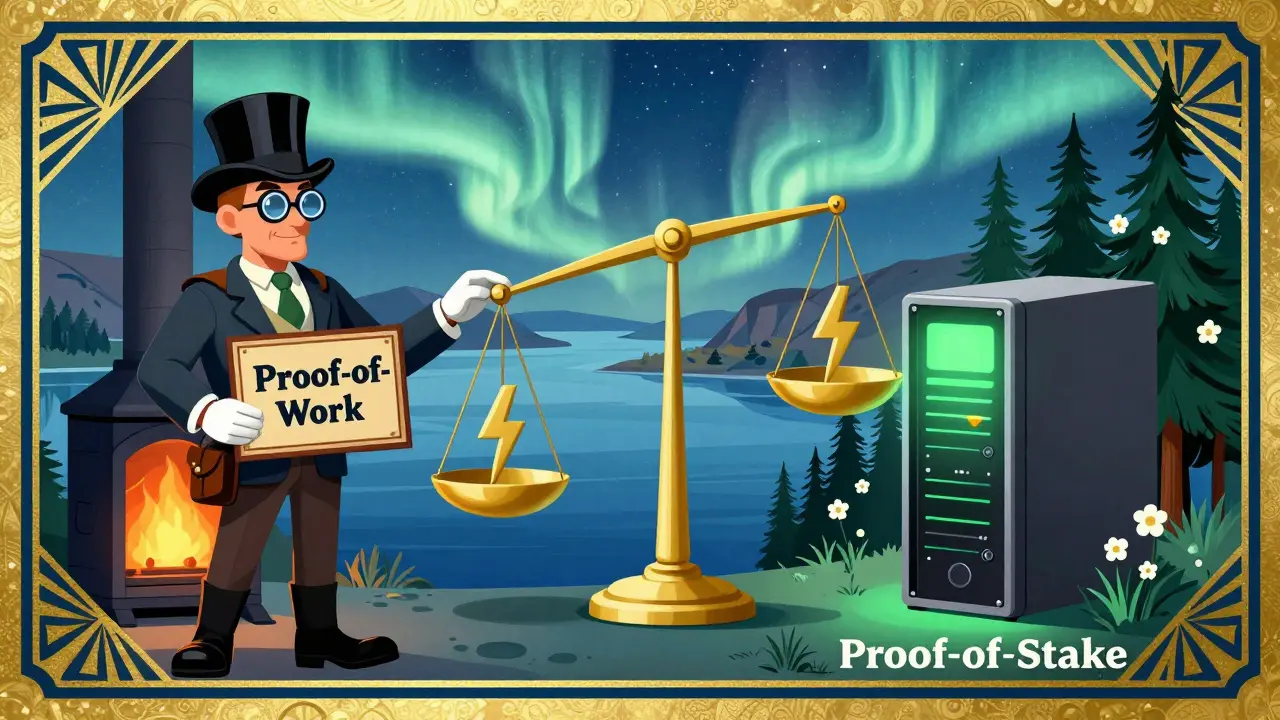
The Pushback: Is This Fair?
Not everyone agrees. Dr. Per Jansson from KTH Royal Institute of Technology argues that crypto mining can actually help stabilize the grid. His research shows mining farms in Boden can reduce power draw by 90% in under 15 minutes when the grid is under stress. That kind of flexibility is rare in industrial energy use. Mining rigs can turn off faster than factories or even electric vehicle chargers. The Swedish Blockchain Association says banning mining misses the point. They argue that regulating financial products-like exchanges and wallets-is enough. Why punish the technology when the real issue is energy policy? Christin Lindholm, CEO of the association, wrote in the Financial Times: “We don’t ban cars because they burn fuel. We build better roads and cleaner engines.” The European Commission agreed-with limits. The MiCA regulation, adopted across the EU, requires crypto projects to disclose their environmental impact in white papers. But it stopped short of banning proof-of-work. Sweden pushed for a ban. The EU said no.What’s Happening to Mining Companies?
The result? A mass exodus. A 2024 survey of 47 Swedish mining companies showed 68% plan to move operations out of Sweden by 2026. Norway is the top destination-42% of companies are relocating there. Germany and the U.S. follow. Norway has no mining restrictions, cheap renewable energy, and a welcoming attitude. It now hosts 1.5% of global Bitcoin mining. But not everyone is leaving. Twenty-two percent are switching to proof-of-stake. One Stockholm startup, EcoChain, cut its energy use by 99.95% after switching from proof-of-work to proof-of-stake. It still makes money-from transaction fees, not mining rewards. The Swedish Energy Agency is helping. It’s poured 150 million SEK ($13.8 million USD) into projects that turn mining waste heat into district heating. A pilot in Luleå recovers 65% of the heat generated by mining rigs and uses it to warm homes. That’s innovation-using a problem to solve another.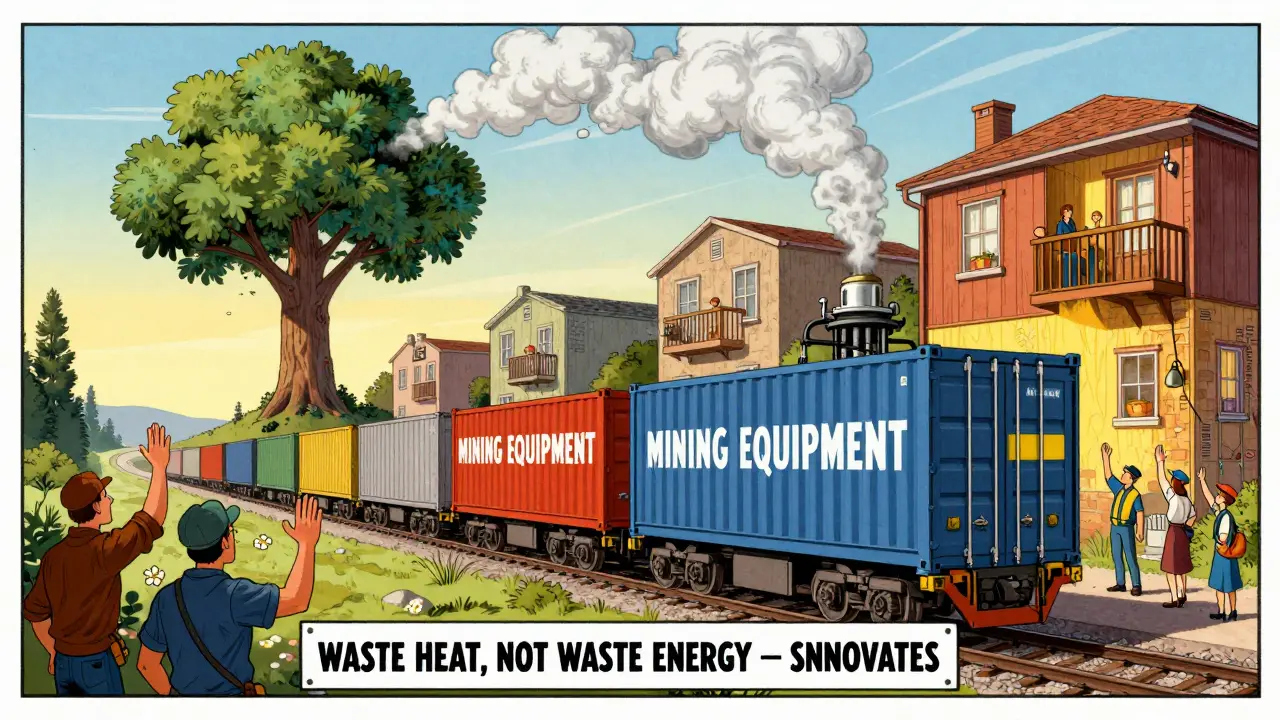
What This Means for Sweden’s Crypto Future
Sweden’s crypto mining sector has shrunk by 40% since 2022. Its share of the Nordic crypto market dropped from 38% to 27%. Meanwhile, Norway’s share rose to 34%. But Sweden isn’t giving up on blockchain. Stockholm still hosts 37% of all Nordic blockchain startups-just not the energy-hungry kind. Companies building supply chain trackers, identity verification tools, and enterprise ledgers are thriving. Kista Science City alone has 120 blockchain firms. The European Central Bank is watching. In 2024, it allocated €1.2 billion to research low-energy consensus mechanisms. Sweden’s pressure helped make that happen. By 2025, mining energy use in Sweden is projected to drop below 0.8 TWh per year. That’s still more than some small nations use-but it’s down from its peak. The shift isn’t just about regulation. It’s about market forces. Miners who can’t adapt are leaving. Those who innovate are staying.The Bigger Picture
Sweden’s story isn’t just about crypto. It’s about how countries balance technology, environment, and economic growth. Other nations might allow mining because they have cheap power or lax rules. Sweden chose to say: “We won’t trade our climate goals for a few mining rigs.” It’s not a perfect system. Some miners feel punished unfairly. Others see it as a necessary step. But one thing is clear: if you want to mine Bitcoin in Sweden, you’ll need more than hardware. You’ll need transparency, adaptability, and a willingness to change-or move.Sweden didn’t kill crypto. It just made sure it doesn’t cost the planet.
Is Bitcoin mining illegal in Sweden?
No, Bitcoin mining is not illegal in Sweden as of 2025. However, it’s heavily regulated. Any mining operation over 0.5 megawatts must publicly report real-time energy use and source. Banks are discouraged from serving miners, and local municipalities impose additional restrictions on new facilities. The legal framework favors transparency and environmental accountability over outright prohibition.
Why does Sweden care more about crypto energy use than other countries?
Sweden focuses on total energy consumption, not the source. Even if a mine uses 100% renewable power, the sheer volume of electricity it pulls from the grid still strains national infrastructure and conflicts with climate targets. Countries like the U.S. or Norway often accept mining because they prioritize energy source (e.g., wind, hydro) over total usage. Sweden’s approach is stricter because it measures impact by absolute demand, not sustainability of supply.
What’s the difference between proof-of-work and proof-of-stake?
Proof-of-work (used by Bitcoin) requires miners to solve complex math problems using powerful computers, consuming massive amounts of electricity. Proof-of-stake (used by Ethereum since 2022) selects validators based on how much cryptocurrency they hold and are willing to “stake” as collateral. It uses 99.95% less energy. Switching from proof-of-work to proof-of-stake can reduce a crypto operation’s energy use from thousands of kWh per day to just a few.
Can I still start a crypto mining business in Sweden?
It’s extremely difficult. You must register with the Swedish Financial Supervisory Authority, complete an Environmental Impact Assessment, submit quarterly energy reports, and comply with local municipal caps on power usage. Banks are unlikely to support you, and the approval process takes 4-6 months-twice as long as in most EU countries. Most new miners are choosing Norway, Germany, or the U.S. instead.
What’s happening to Swedish crypto exchanges?
They’re struggling. Trustpilot ratings for Swedish crypto exchanges dropped from 4.2 in 2022 to 2.8 in early 2025. Users report longer KYC checks, sudden withdrawal limits, and closed accounts. Many exchanges have scaled back operations or shifted focus to non-mining blockchain services like enterprise ledgers and digital identity tools to stay compliant and viable.
Is Sweden planning to ban crypto mining completely?
No. Sweden abandoned its push for an EU-wide ban in late 2024. Instead, it’s focusing on market-based tools like carbon pricing for energy-intensive crypto operations and requiring full transparency. The goal is no longer to eliminate mining, but to make it accountable. By 2027, Sweden’s approach may resemble Switzerland’s-technology-neutral, outcome-focused, but still environmentally strict.
How is Sweden using mining waste heat?
The Swedish government is funding pilot projects to capture heat from mining rigs and feed it into district heating systems. A project in Luleå recovered 65% of the waste heat and used it to warm homes and public buildings. This turns a climate liability into a public benefit, helping offset the energy cost of mining while supporting Sweden’s goal of carbon-neutral heating.
Why did Bitcoin mining surge in Sweden after China’s 2021 ban?
When China banned cryptocurrency mining in 2021, hundreds of large-scale mining operations relocated to countries with cheap, reliable power. Sweden became a top destination because of its stable grid, cold climate (which naturally cools hardware), and abundant hydroelectric and nuclear power. Between April and August 2022, mining energy use in Sweden tripled, jumping from under 0.3 TWh to nearly 1 TWh annually.


Rachel McDonald
December 18, 2025 AT 16:32So Sweden’s just punishing innovation because they’re scared of change? 😒 Like, sure, mining uses power-but so does every damn factory, data center, and EV charger. Why pick on crypto? It’s not like they’re burning coal. They’re using surplus hydro! This feels like green virtue signaling with a side of tech-phobia.
Vijay n
December 19, 2025 AT 20:00Sweden is controlled by globalist elites who want to kill decentralization because they cant tax it or track it blockchain is the future and this is just the beginning of the new world order they want to control every coin every transaction every breath you take
Alison Fenske
December 20, 2025 AT 03:56I get why Sweden is doing this but honestly it makes me sad. I mean imagine being this proud of your clean energy and then seeing it get gobbled up by machines that dont even make anything real. Like yeah its tech but its not building schools or hospitals. Its just spinning wheels. I wish they could find a middle ground but I think they just needed to draw a line in the sand
Grace Simmons
December 21, 2025 AT 09:33Sweden's actions are not only justified but exemplary. The United States continues to treat energy consumption as an externality rather than a strategic imperative. This is not anti-tech-it is pro-civilization. If your industry cannot operate within the ecological boundaries of a nation committed to sustainability, then it does not belong there.
Collin Crawford
December 22, 2025 AT 09:38You're all missing the point. The real issue is that Sweden's grid is over 80% nuclear and hydro. That means mining isn't increasing carbon emissions-it's just increasing demand. But demand itself is the problem because it forces the grid to maintain capacity for peak loads. Even if the energy is clean, the infrastructure cost isn't. This isn't about climate-it's about load management disguised as environmentalism.
Jayakanth Kesan
December 24, 2025 AT 01:50Interesting approach. I live in India where we struggle to keep lights on in some cities. But I get it-if you have clean power and a clear goal, why waste it on something that could be done more efficiently elsewhere? Maybe Sweden is just ahead of the curve. Respect.
Aaron Heaps
December 25, 2025 AT 11:31They didn't ban mining. They just made it impossible. Classic bureaucratic sabotage. And now everyone's leaving for Norway. Guess what? Norway's grid is 98% hydro. So Sweden's move didn't save energy-it just exported the problem. Brilliant.
Tristan Bertles
December 25, 2025 AT 14:13There’s hope in the waste heat projects. Turning a problem into a solution? That’s the kind of innovation we need. Not bans. Not fear. Just smart engineering. The fact that Luleå is heating homes with mining rigs? That’s not surrender-that’s adaptation. Keep going.
Megan O'Brien
December 27, 2025 AT 10:15Proof-of-work is a legacy consensus mechanism with zero marginal utility in the post-2022 blockchain landscape. The energy inefficiency is non-optimal from a systems theory standpoint and fundamentally misaligned with ESG paradigms. It’s not even worth debating.
Earlene Dollie
December 28, 2025 AT 12:50They’re killing the soul of crypto… the wild, free, rebellious spirit… it’s not just about energy it’s about freedom… and now they’re turning it into a corporate compliance form with quarterly reports and bank denials… I’m crying
Dusty Rogers
December 29, 2025 AT 05:32Swedish miners who switched to proof-of-stake? That’s the real win. No drama. No shouting. Just smart people adapting. The tech didn’t die-it evolved. And that’s how progress actually works.
Kevin Karpiak
December 30, 2025 AT 02:37Sweden thinks it’s better than everyone else. Meanwhile, the U.S. is building nuclear-powered mining farms in Texas. We don’t apologize for energy. We use it. And we don’t let bureaucrats tell us what to do with our hardware.
Amit Kumar
December 30, 2025 AT 17:01As someone from India where we still struggle to get 24/7 power, I find this fascinating. Sweden doesn't have an energy crisis-but it chose to treat mining like a crisis anyway. That’s discipline. That’s vision. We don’t have the luxury to be this selective. But maybe we should learn from it. Not every innovation deserves to be fed. Some need to be redirected.