TON Transaction Cost Calculator
Calculate TON Transaction Costs
See how much it costs to send TON transactions compared to Ethereum and Solana.
Transaction Cost Breakdown
Comparison to Other Blockchains
Toncoin (TON) isn’t just another cryptocurrency. It’s the native token of The Open Network (TON), a blockchain built to work inside Telegram - the messaging app used by over 900 million people worldwide. You don’t need to be a tech expert to use it. If you can send a photo on Telegram, you can send TON. That’s the whole point.
How Toncoin Got Started
Toncoin wasn’t born in a garage startup. It started in 2017 inside Telegram, the encrypted messaging app founded by Pavel Durov. The team wanted to build a blockchain fast enough to handle payments, apps, and data storage for billions of users - not just thousands. They called it the Telegram Open Network, and the token was originally named Grams.
But in 2020, the U.S. Securities and Exchange Commission shut down Telegram’s token sale, calling Grams an unregistered security. Telegram walked away. Instead of dying, the project was picked up by the community. Developers, miners, and early adopters kept building. Today, it’s run by the TON Foundation, a nonprofit based in Switzerland. The name changed to The Open Network. The token became Toncoin. And the vision stayed the same: make crypto as easy as texting.
How Toncoin Actually Works
Toncoin runs on a blockchain that’s designed for speed. Most blockchains, like Bitcoin or even Ethereum, process a few dozen transactions per second. TON claims it can handle up to 100,000 transactions per second. That’s not a guess - it’s built into the architecture using something called dynamic sharding.
Think of sharding like splitting a busy highway into dozens of parallel lanes. When traffic spikes, the system automatically creates more lanes. When traffic drops, it merges them back. This lets TON scale without slowing down or getting expensive. Transaction fees? Around $0.0001. That’s less than a penny per transaction - even for sending 100 payments at once.
The network uses Proof-of-Stake (PoS), which means people lock up (or “stake”) TON to help secure the network. In return, they earn rewards. Right now, staking gives you about 7.2% annual returns. To become a validator, you need at least 1,000 TON - roughly $4,500 as of late 2025. But regular users can stake as little as 0.1 TON through wallet apps.
Why Toncoin Is Different
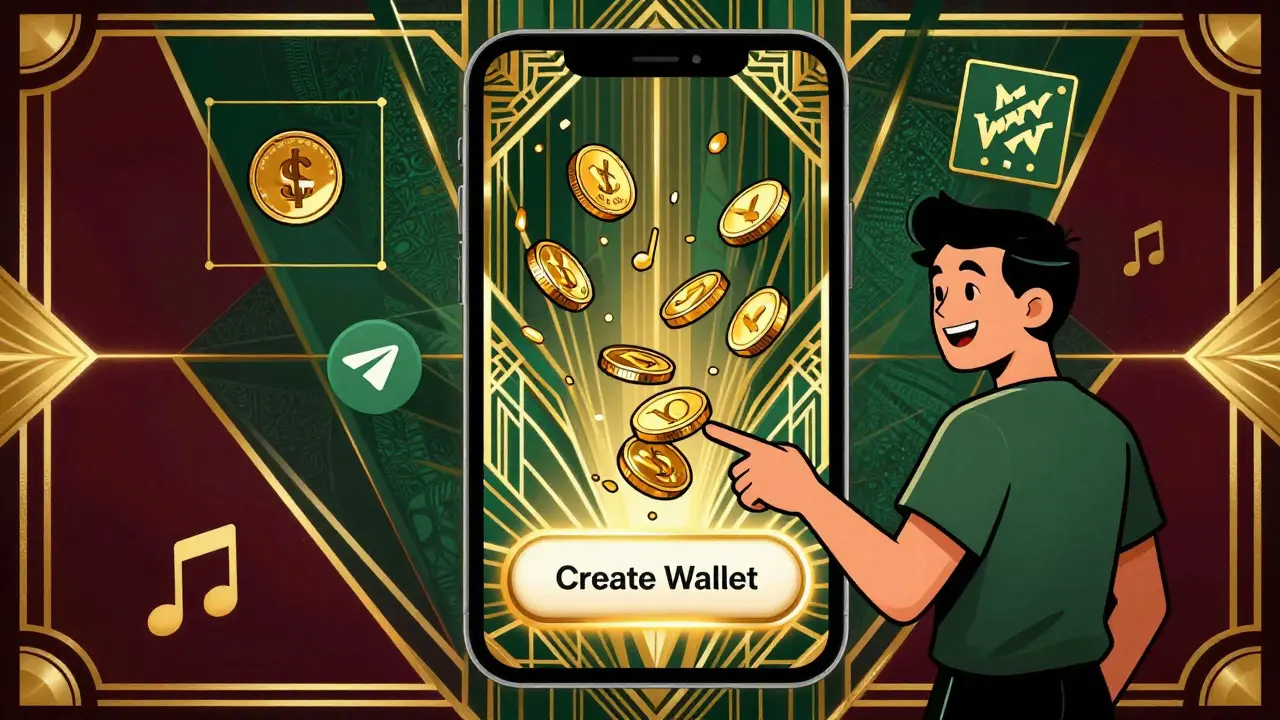
Most crypto projects fight for attention. TON doesn’t have to. It’s already inside Telegram - the 5th most downloaded app on Earth. You don’t need to download a separate wallet. Just open Telegram, search for @wallet, and tap “Create Wallet.” In under 30 seconds, you have a crypto wallet linked to your phone number. No seed phrases. No private keys to copy-paste. Just tap to send TON to anyone in your contacts.
That’s the killer feature. You can pay a friend for coffee, tip a content creator, or buy an NFT - all without leaving the app. Over 5 million TON payments happen every day inside Telegram. That’s more daily crypto transactions than most blockchains see in a week.
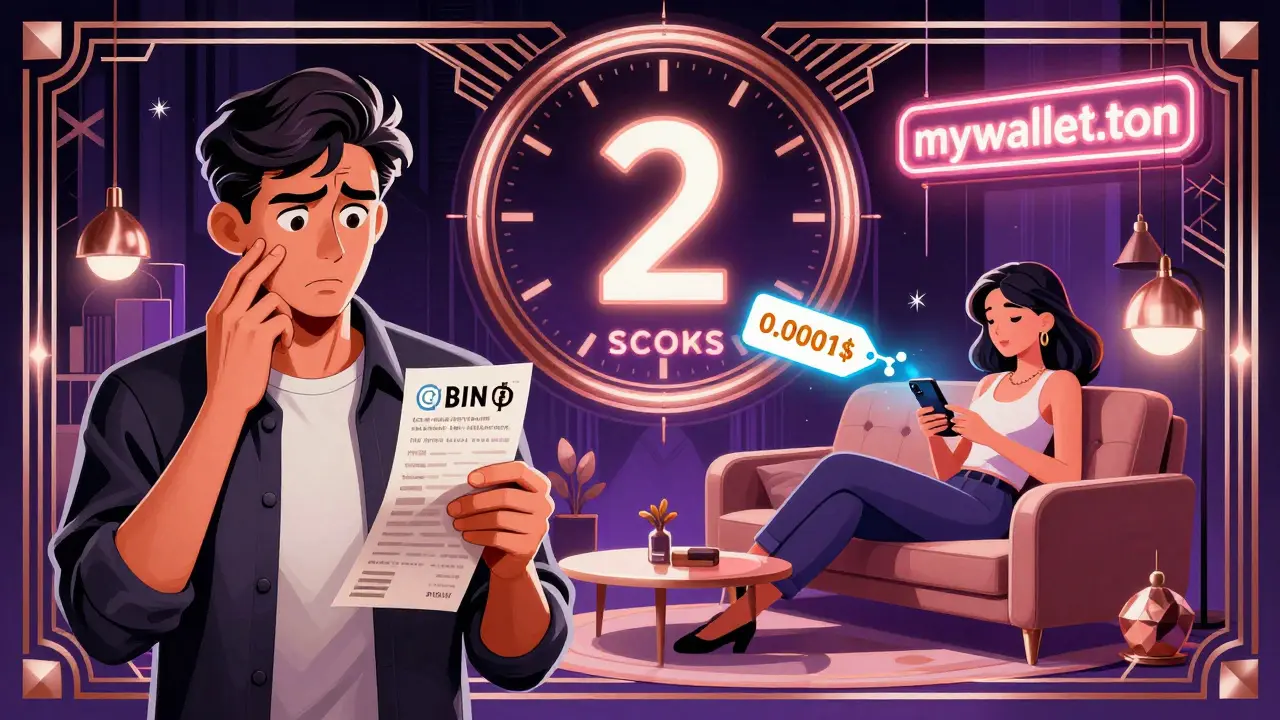
TON also has its own domain system: TON DNS. Instead of sending crypto to a long string like 0x9f8d...a2c1, you send it to mywallet.ton. It’s like having a crypto email address. You can even buy a custom domain for 10 TON per year - cheaper than most domain registrars.
What You Can Do With Toncoin
Toncoin isn’t just for sending money. It’s the fuel for the whole ecosystem:
- Payments: Send TON to friends, pay for goods, tip creators - all within Telegram.
- Staking: Earn rewards by locking up TON to help secure the network.
- Smart Contracts: Developers build apps (DeFi, games, tools) using FunC or Tact, TON’s native languages. Over 1,250 projects are live.
- Decentralized Storage: Store files on TON Storage, paid for in TON. No central server. No censorship.
- TON Proxy: Browse the web anonymously through a decentralized proxy network.
- Gaming & NFTs: Play games where you own your items. Buy digital art with TON.
There’s even a TON Pay system coming in late 2026 that will let small businesses accept crypto payments directly inside Telegram - no merchant account needed.
Toncoin vs. Other Cryptocurrencies
How does TON stack up against Ethereum, Solana, or Bitcoin?
| Feature | Toncoin (TON) | Ethereum | Solana |
|---|---|---|---|
| Transactions per second | Up to 100,000 | 15-30 | 2,000-4,000 |
| Average fee | $0.0001 | $1.20 | $0.00025 |
| Consensus | Proof-of-Stake | Proof-of-Stake | Proof-of-History + PoS |
| DeFi TVL (Total Value Locked) | $1.2 billion | $220 billion | $15 billion |
| Integration with messaging app | Yes (Telegram, 900M+ users) | No | No |
| Developer tools maturity | 3.1/5 | 4.9/5 | 4.5/5 |
TON wins on speed and ease of use. It loses on ecosystem depth. Ethereum has thousands of DeFi apps, lending platforms, and DAOs. TON is still catching up. But TON’s advantage isn’t technical - it’s behavioral. It doesn’t need to convince people to use crypto. It just needs them to open Telegram.
Who Uses Toncoin?
Most TON users aren’t crypto traders. They’re regular people - students, parents, shop owners - who just want to send money fast and cheap. About 65% of TON users are new to crypto. The average user is under 35. Over 78% of users are under 35, and 62% live in Asia - especially Russia, Vietnam, and Indonesia.
On Reddit, users say things like: “I sent TON to my cousin in Manila while we were chatting. He got it in 2 seconds. No fees. No app. Just tap.” That’s the norm, not the exception.
Even older users are adopting it. One 65-year-old woman in Brazil told a TON survey team: “I didn’t understand crypto until my grandson showed me how to send TON through Telegram. Now I use it to pay my hairdresser.”
Is Toncoin Safe?
Security is a double-edged sword with TON. On one hand, the blockchain itself is robust. It’s been running since 2021 with no major hacks. The network has over 100 validators spread across the globe.
But the biggest risk isn’t the blockchain - it’s Telegram. If Telegram decides to remove wallet integration tomorrow, TON’s growth could stall. That’s why critics say TON is too centralized. The TON Foundation says it’s independent, but Telegram still controls the app where most users interact with TON.
Also, because wallets are so easy to set up, many users don’t back up their seed phrases. If you lose your phone and didn’t write down your recovery phrase, your TON is gone. There’s no customer service. No reset button. No “I forgot my password.”
Where to Buy Toncoin
You can buy TON on most major exchanges: Binance, OKX, Bybit, KuCoin, and Coinbase. But the easiest way? Use the @wallet bot inside Telegram. Just tap “Buy TON,” link your card, and you’re done. No KYC, no identity checks - unless your country requires it by law.
As of October 2025, TON’s market cap is around $12.8 billion, making it the 12th largest cryptocurrency. Daily trading volume averages $1.2 billion. The total supply is 5 billion TON, with about 2.8 billion in circulation.
What’s Next for Toncoin?
The roadmap is aggressive:
- Shardification 2.0 (2025): Now supports 1,024 dynamic shards - more than enough for global scale.
- TON Staking v3.0 (2025): Minimum staking dropped from 5,000 to 1,000 TON. More people can earn rewards.
- TON Spaces (Q1 2026): A decentralized social feed - like Twitter, but owned by users.
- TON Pay (Q3 2026): Merchants accept TON directly in Telegram. No apps. No QR codes.
If these launch on time, TON could become the first blockchain to truly reach mass adoption - not through hype, but through everyday use.
Final Thoughts
Toncoin isn’t trying to beat Ethereum at DeFi. It’s trying to beat Venmo at payments. It’s not competing with Bitcoin as digital gold. It’s competing with SMS.
If you’re looking for a crypto with real, daily usage - not just speculation - TON is one of the few that delivers. You don’t need to understand blockchain to use it. You just need a phone and a Telegram account.
It’s not perfect. The ecosystem is still young. Developer tools are improving but lag behind Ethereum. But if you want to see what crypto looks like when it’s actually used by regular people - not just traders - then TON is the clearest example today.
Is Toncoin the same as Telegram crypto?
Yes. Toncoin (TON) is the native cryptocurrency of The Open Network, which started as the Telegram Open Network. Even though Telegram officially left the project in 2020, TON is still deeply tied to Telegram’s app. You can send, receive, and store TON directly inside Telegram - that’s why people still call it “Telegram crypto.”
Can I mine Toncoin?
No. Toncoin uses Proof-of-Stake, not Proof-of-Work. You can’t mine it like Bitcoin. Instead, you can stake TON to earn rewards. To become a validator, you need at least 1,000 TON. Regular users can stake smaller amounts through wallet apps like Tonkeeper or Tonkeeper Wallet.
How do I get started with Toncoin?
Open Telegram. Search for @wallet. Tap “Create Wallet.” That’s it. You’ll get a wallet address and a 12-word recovery phrase. Write it down. Then you can buy TON with a credit card inside the app or receive it from someone else. No setup. No technical steps. It’s designed to be this simple.
Is Toncoin a good investment?
There’s no guaranteed return. Toncoin’s value is tied to how many people use it. Right now, it’s growing fast because of Telegram’s user base - 900 million people. If even 10% of them start using TON regularly, demand could spike. But if Telegram changes its stance, adoption could slow. Treat it like a high-risk, high-potential bet on mass adoption, not a safe store of value.
Can I use Toncoin in the U.S.?
Yes. You can buy, hold, and send TON in the U.S. through exchanges like Coinbase and Binance. You can also use the @wallet bot in Telegram. However, some U.S.-based exchanges may restrict TON trading due to regulatory uncertainty. Always check your exchange’s policies before buying.
What’s the difference between TON and TON Coin?
None. TON is the name of the blockchain network. Toncoin (or TON coin) is the token that powers it. People say “TON” to refer to both, just like people say “Bitcoin” for both the network and the currency. They’re interchangeable in casual use.

Bhoomika Agarwal
December 4, 2025 AT 01:38Rod Filoteo
December 4, 2025 AT 18:44Mark Stoehr
December 5, 2025 AT 11:52Shari Heglin
December 7, 2025 AT 02:45Andrew Brady
December 7, 2025 AT 12:08Nelia Mcquiston
December 7, 2025 AT 13:36Marsha Enright
December 8, 2025 AT 04:30Layla Hu
December 8, 2025 AT 22:46Katherine Alva
December 8, 2025 AT 23:16Vidyut Arcot
December 10, 2025 AT 17:12Sharmishtha Sohoni
December 12, 2025 AT 05:27alex bolduin
December 12, 2025 AT 07:13Mohamed Haybe
December 13, 2025 AT 01:37Greer Dauphin
December 14, 2025 AT 11:11Marsha Enright
December 14, 2025 AT 13:09Catherine Williams
December 16, 2025 AT 06:08ashi chopra
December 16, 2025 AT 06:23