
When the State Bank of Pakistan banned banks from handling cryptocurrency transactions in 2018, most people assumed crypto would die out in the country. Instead, it exploded. By 2025, Pakistan was trading over $300 billion in crypto annually-more than most developed nations. And none of it happened through banks. Not a single rupee moved through the formal financial system. This isn’t a glitch. It’s a workaround built by millions of ordinary people who refused to wait for permission to use money differently.
How Did Pakistan Bypass the Ban?
Pakistan’s crypto market didn’t grow because of government support. It grew because people had no other choice. The rupee had lost nearly 60% of its value against the dollar since 2018. Inflation hit 38% in 2024. Savings evaporated. People needed something stable. Bitcoin, Ethereum, and especially USDT (Tether) became lifelines. Without bank accounts to move money, traders turned to mobile wallets. Easypaisa and JazzCash-two apps used by over 80 million Pakistanis for everyday payments-became the bridge between rupees and crypto. You’d send rupees to a local trader via Easypaisa. They’d send you USDT on the blockchain. No bank involved. No paperwork. No approval needed. This peer-to-peer system isn’t new. But in Pakistan, it scaled faster than anywhere else. Platforms like Paxful, LocalBitcoins, and local apps like CryptoPak and BitClave became hubs. Traders built trust networks. Reviews, ratings, and verified accounts replaced banks as the gatekeepers of safety.Who’s Actually Trading?
It’s not just tech elites. It’s students, freelancers, shopkeepers, and factory workers. A 2025 survey by CoinLaw found 18.2 million verified crypto users. But when you include people who trade through informal networks or use crypto for remittances without registering, the number jumps to over 40 million-nearly 20% of the population. The biggest driver? Freelancers. Pakistan has one of the largest remote work forces in Asia. A graphic designer in Lahore gets paid $500 a month in USD from a client in California. Without crypto, they’d wait weeks for a wire transfer, pay 10% in fees, and risk the bank rejecting it. With USDT, they get paid in minutes, convert to rupees via Easypaisa, and keep 95% of the value. Young people under 30 make up 70% of crypto users. They’re the ones who grew up with smartphones, saw their parents lose savings to inflation, and didn’t trust the system. They didn’t need a degree in finance to understand Bitcoin. They just needed to know: “Will this hold value tomorrow?”Why Bitcoin and USDT Dominate
You won’t find many people in Pakistan trading Solana or Dogecoin. The top three assets are clear:- Bitcoin (BTC) - Seen as digital gold. People buy it to hold long-term, especially when the rupee is crashing.
- USDT (Tether) - The real workhorse. Used for daily trading, remittances, and hedging. It’s pegged to the dollar, so it doesn’t swing wildly. Traders use it as a bridge between rupees and other cryptos.
- Ethereum (ETH) - Used by developers and those involved in DeFi. Less common among regular users, but growing fast in urban centers.
The Energy Angle: Why Pakistan Is Mining Bitcoin
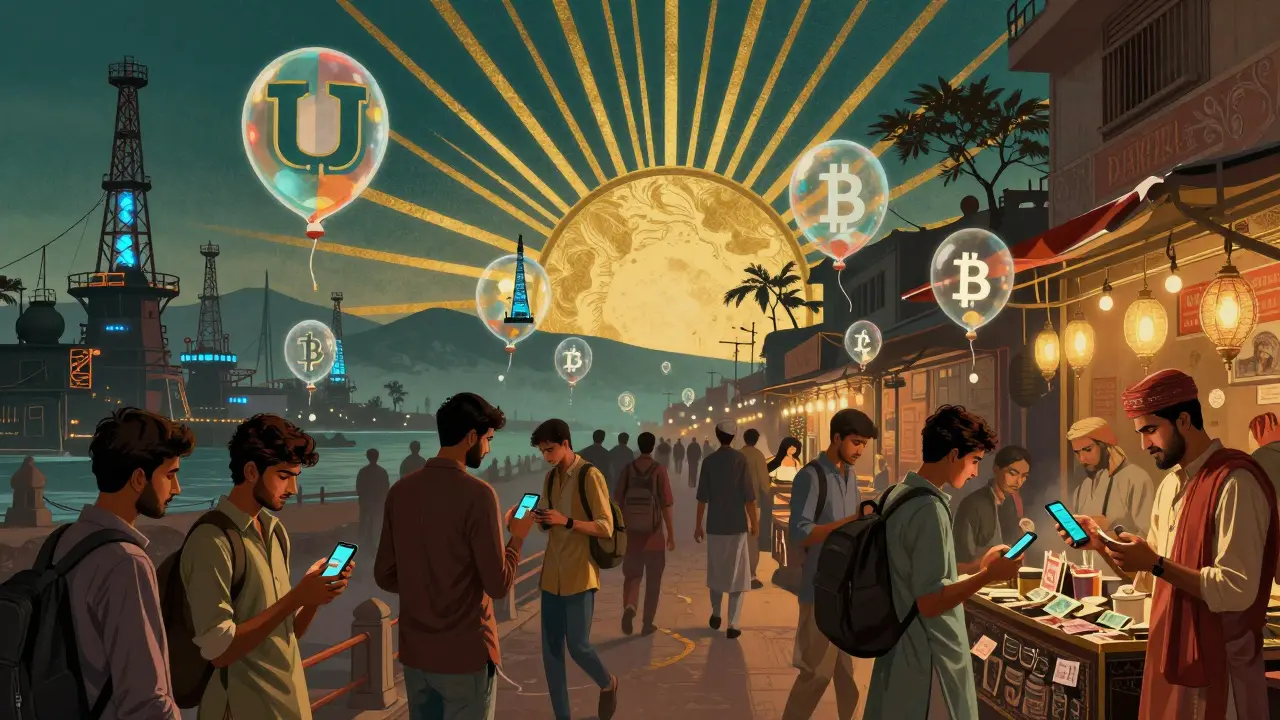
Here’s something most international reports miss: Pakistan is quietly becoming a Bitcoin mining hub. In 2024, the government allocated 2,000 megawatts of surplus electricity-mostly from underused hydropower plants-to crypto mining operations. Not because they love Bitcoin. Because they needed to use the power. Pakistan has chronic energy shortages, but also massive unused capacity in rural areas. Mining rigs run 24/7, using cheap, off-peak power. Some operations are small-garage setups with five ASICs. Others are industrial-scale farms near dams in Khyber Pakhtunkhwa and Punjab. The government doesn’t regulate these mines. But they don’t shut them down either. That’s a quiet form of approval. Mining isn’t about making money from block rewards. It’s about converting electricity into a portable, exportable asset. A miner in Sialkot can sell their Bitcoin for USDT, then cash out via JazzCash. No one needs to know where the power came from.Why the $300 Billion Number Is Controversial
Yes, $300 billion in annual trading volume is real. But it’s not like Wall Street trading. Most of it is peer-to-peer, with the same coins changing hands multiple times a day. One person buys USDT, sells it to someone else for rupees, who then buys Bitcoin, sells it for USDT again. Each trade counts as volume. That’s why experts say the number is inflated. It’s not $300 billion in new money flowing in. It’s $300 billion in turnover. Think of it like a local market where the same apples are sold 10 times a day. The total sales volume is high, but the actual value added is much lower. Still, even if you cut it in half-$150 billion-it’s still more than the entire crypto market of Canada or Australia. The scale is undeniable.
What’s Next? The Push for Regulation
The government can’t ignore this anymore. In late 2024, Pakistan’s Securities and Exchange Commission started drafting rules for virtual asset service providers. The goal? Bring crypto into the light-not ban it. Talks are underway to license local exchanges, require KYC for large transactions, and tax crypto gains. But there’s resistance. Many traders fear regulation will mean banks get involved again-and banks have a history of freezing accounts without warning. Some experts suggest Pakistan could create a national Bitcoin reserve, using mined coins as collateral for loans or foreign reserves. Others say the country should launch its own digital rupee, but allow it to be traded against crypto. Neither idea is official yet. But the direction is clear: Pakistan won’t stop crypto. It’s trying to control it.What This Means for the Rest of the World
Pakistan’s crypto story isn’t about speculation. It’s about necessity. When a country’s currency fails, when banks won’t serve you, and when remittances cost too much-people find a way. Crypto isn’t the goal. Financial freedom is. Other countries with unstable currencies-Argentina, Nigeria, Turkey-are watching closely. They see Pakistan’s mobile wallet system, its mining infrastructure, its underground banking network. They’re asking: “Can we do this too?” The answer is yes. But it won’t come from regulators. It’ll come from people. From students using Easypaisa. From freelancers sending USDT to their families. From miners running rigs on cheap hydropower. This isn’t a financial revolution. It’s a quiet, daily act of resistance.What You Should Know Before Getting Involved
If you’re thinking about trading crypto in Pakistan-or any country with restrictions-here’s what actually matters:- Use USDT for daily trading. It’s the most stable and widely accepted.
- Stick to platforms with verified traders. Look for 5+ star ratings and long histories.
- Never store large amounts on exchanges. Use a hardware wallet or a secure offline wallet.
- Track your taxes. Even if the government isn’t enforcing them now, they will.
- Understand the risks. Crypto prices swing. Scams are common. Don’t invest more than you can lose.
Is crypto legal in Pakistan?
Crypto isn’t officially banned in Pakistan, but it’s also not officially legal. The State Bank of Pakistan prohibited banks from dealing with crypto in 2018, but there’s no law that makes owning or trading crypto a crime. The government is now working on regulations, but as of 2025, trading continues through peer-to-peer platforms and mobile wallets without interference.
How do Pakistanis buy crypto without banks?
Most people use mobile payment apps like Easypaisa and JazzCash. You send rupees to a verified crypto seller, and they send you Bitcoin or USDT on the blockchain. It’s fast, low-cost, and doesn’t involve banks at all. Many traders use local platforms like CryptoPak or BitClave that connect buyers and sellers directly.
Why is USDT so popular in Pakistan?
USDT is pegged to the U.S. dollar, so it holds its value even when the Pakistani rupee crashes. It’s used for daily trading, sending money abroad, and storing value. Over 65% of all crypto trades in Pakistan involve USDT because it’s stable, widely accepted, and easy to convert back to rupees via mobile wallets.
Is Bitcoin mining happening in Pakistan?
Yes. The government allocated 2,000 megawatts of surplus electricity for Bitcoin mining operations in 2024, mostly in rural areas with underused hydropower. While not officially regulated, mining is tolerated because it uses energy that would otherwise go to waste. Many small-scale miners run rigs in garages or farms, selling their Bitcoin for USDT via local platforms.
Will Pakistan ever ban crypto again?
It’s unlikely. With over 40 million users and $300 billion in annual trading volume, a ban would cause massive economic disruption. Instead, the government is moving toward regulation-trying to bring crypto into the formal system without killing its grassroots growth. The goal is to tax it, license exchanges, and protect users-not shut it down.
Can I send crypto from Pakistan to other countries?
Yes. Crypto is one of the easiest ways to send money internationally from Pakistan. Many freelancers and overseas workers use Bitcoin or USDT to send earnings to family members abroad. Recipients can cash out via local exchanges or peer-to-peer platforms in their country. It’s faster and cheaper than Western Union or bank wires.
Are crypto earnings taxed in Pakistan?
As of 2025, there’s no formal crypto tax law in Pakistan. However, the Federal Board of Revenue is drafting rules that may require reporting crypto gains as income. Many traders are keeping records just in case. If regulation comes, taxes will likely be applied to capital gains from selling crypto for rupees or foreign currency.

greg greg
January 13, 2026 AT 04:12It's wild how Pakistan turned a financial blockade into a decentralized revolution. The fact that they're using mobile wallets like Easypaisa and JazzCash as de facto banking infrastructure is genius. No banks? No problem. People just built their own system from the ground up using tools they already had. This isn't just crypto adoption-it's financial autonomy in real time. And the scale? Over 40 million people participating without any central authority? That's not a niche trend. That's a new economic model emerging under pressure. The world keeps talking about CBDCs and regulated crypto, but Pakistan already solved the problem by ignoring the regulators entirely. They didn't wait for permission. They just did it.
Tiffani Frey
January 14, 2026 AT 13:35This is one of the most compelling case studies in financial resilience I've ever seen. The USDT dominance makes perfect sense-when your currency is collapsing, you need a stable anchor. But what's even more impressive is how trust was built without banks: ratings, reviews, verified accounts. It's like a decentralized version of eBay, but for survival. And the mining angle? Brilliant. Using surplus hydropower to convert electricity into portable wealth? That's not just clever-it's sustainable innovation born of necessity. The government's quiet tolerance speaks louder than any policy document could.
Tre Smith
January 15, 2026 AT 17:10Let’s be honest: $300 billion in trading volume is meaningless noise. It’s just the same coins bouncing between wallets. You can’t call that economic activity-it’s circular trading with inflated metrics. And don’t get me started on the mining claims. 2,000 megawatts? That’s a massive energy subsidy disguised as tolerance. Pakistan’s government isn’t being smart-they’re just too incompetent to shut it down. Also, calling this ‘financial freedom’ is laughable. This is desperation dressed up as innovation. Real economies don’t rely on peer-to-peer chaos.
Ritu Singh
January 16, 2026 AT 15:08Did you know the US has been watching this closely? They're terrified. This is the first time a nation has successfully bypassed the dollar system without using gold or physical commodities. USDT isn't just a stablecoin-it's a digital parallel currency. And the mining? It's not about electricity. It's about data sovereignty. The Chinese are involved. The Russians are involved. Pakistan is building a new financial firewall. The banks don't control it. The Fed doesn't control it. And that's why they're rushing to regulate now. They know what's coming.
kris serafin
January 18, 2026 AT 05:28USDT for daily use? Absolutely. But don’t forget-this only works because of the mobile money infrastructure. In most countries, you’d need a bank to even link your wallet. Here, Easypaisa does it all. It’s like the internet of money. Also, if you’re trading crypto in Pakistan, use a Ledger. Seriously. I’ve seen too many people lose everything to fake sellers on Telegram. Don’t be that guy.
Jordan Leon
January 19, 2026 AT 01:30There’s something deeply human about this story. It’s not about technology. It’s about dignity. When your savings vanish, when your government fails you, when the system locks you out-you don’t wait for a law to change. You find a way. You trade rupees for USDT through a guy at the tea stall. You mine Bitcoin in your garage because the power’s cheap and the future is uncertain. This isn’t finance. It’s survival. And it’s beautiful in its simplicity.
Rahul Sharma
January 19, 2026 AT 12:38Important to note: Easypaisa and JazzCash are regulated by State Bank of Pakistan, even if they don't directly handle crypto. So technically, the system operates in a gray zone-not entirely outside regulation. Also, freelancers benefit the most because remittance fees from traditional channels are 15-20%. Crypto cuts that to under 2%. That’s why adoption is so high. Simple math.
Gideon Kavali
January 21, 2026 AT 05:14Let me be clear: This is a disaster waiting to happen. A country with no rule of law, no banking oversight, and 40 million people trading unregulated digital assets? That’s a recipe for mass fraud, money laundering, and financial collapse. And now they want to tax it? Please. The U.S. has more financial integrity in one day than Pakistan has in a decade. This isn’t innovation-it’s chaos dressed in blockchain.
Brittany Slick
January 21, 2026 AT 12:32I just want to say-this gives me hope. In a world where so many feel powerless, here’s a group of people who refused to accept the rules they were handed. They didn’t riot. They didn’t beg. They built something better with what they had. That’s the kind of quiet courage we need more of. Also, if you’re reading this and you’re thinking about crypto in your country? Start small. Use USDT. Find a trusted seller. And don’t let anyone tell you it’s impossible.
LeeAnn Herker
January 22, 2026 AT 10:23Oh please. 'Financial freedom'? More like 'financial dumpster fire'. USDT is just a Ponzi-backed scam pretending to be stable. And mining on hydropower? Yeah, right. That power came from taxpayer-funded dams. So you're telling me the government is secretly subsidizing crypto with public infrastructure? Classic. And now they're going to 'regulate'? They'll just tax it and then shut it down anyway. This is the same script every country plays. First ignore, then exploit, then crush.
Calen Adams
January 23, 2026 AT 01:26Guys, the real story here is the freelancers. They’re the backbone. I’ve talked to designers in Lahore who get paid in USDT, convert to rupees in under 10 minutes, and pay their rent. No wire delays. No bank holds. No fees. That’s the future of global work. And it’s not coming from Silicon Valley-it’s coming from someone’s bedroom in Faisalabad with a laptop and a phone. This is peer-to-peer economics at scale. The gig economy just got a whole lot more decentralized.
Michael Richardson
January 24, 2026 AT 19:56$300B? More like $30B. Everyone’s inflating numbers to look important. And mining? You think those rigs aren’t running on stolen grid power? This isn’t innovation. It’s exploitation.
Sabbra Ziro
January 26, 2026 AT 15:11I love how this shows what’s possible when people are left alone to solve their own problems. No bureaucracy. No permission slips. Just trust, tech, and tenacity. And the fact that it’s mostly young people leading this? That’s the future right there. We need more of this energy-not more regulations. Let them build. Let them learn. Let them fail. That’s how progress happens.
Krista Hoefle
January 28, 2026 AT 00:40USDT? More like US-Scam-T. And mining? LOL. They’re just using the power grid like a free battery. This isn’t crypto revolution-it’s a loophole exploit. And the government? They’re just waiting to tax it all later. Classic.
Emily Hipps
January 28, 2026 AT 01:41If you're thinking about getting into crypto in a country with restrictions, start here. Pakistan’s model is the blueprint. Use USDT. Use trusted platforms. Use mobile wallets. Don’t store on exchanges. And above all-don’t let fear stop you. This isn’t gambling. It’s dignity. You’re not just trading crypto-you’re claiming your right to financial autonomy.
Jessie X
January 28, 2026 AT 12:58People are just using what works. No drama. No ideology. Just rupees to USDT to Bitcoin. Simple. Real. Effective. The system didn’t break-it evolved.
Kip Metcalf
January 29, 2026 AT 04:20Been following this for years. The real win? No one’s getting arrested. No one’s getting shut down. The government just looks the other way. That’s not incompetence. That’s wisdom. Sometimes the best policy is no policy.
Frank Heili
January 29, 2026 AT 10:32One thing missing from most discussions: the role of diaspora. Millions of Pakistanis abroad send remittances home. Before crypto, it took 3-5 days and cost 10%. Now? Instant. 1-2%. That’s why this works-it’s not just about trading. It’s about family. It’s about survival. The crypto economy here isn’t speculative-it’s familial. That’s why it’s so resilient.
Natalie Kershaw
January 31, 2026 AT 09:25Let’s talk about the UX here. You don’t need a wallet address. You don’t need to understand blockchain. You just open Easypaisa, tap ‘Send to Crypto Seller’, enter the amount, and get USDT in your phone. That’s the real innovation-not the tech. It’s the accessibility. This isn’t for devs. It’s for your auntie who runs the grocery shop. And that’s why it’s unstoppable.
Surendra Chopde
February 2, 2026 AT 00:27As someone from India, I’m watching this with envy. We have the same mobile money infrastructure-UPI, Paytm, PhonePe. But our government is scared of crypto. We’re stuck with slow bank wires and high fees while Pakistan just… did it. I hope we learn from them before it’s too late. Financial freedom shouldn’t require a revolution. It should just be an option.