
How Sidechains Connect to Main Blockchain
You've probably heard that Ethereum is slow and expensive. But you also know its security is legendary. This creates a dilemma. Do you scale up the main network and risk breaking its security guarantees, or do you find a way to offload the work? That's exactly where sidechains come in. They aren't just a buzzword; they are a critical infrastructure layer allowing your favorite blockchain applications to function without gridlocking the system.
But how do these separate chains actually talk to each other? It isn't magic. It involves cryptographic proofs, validator consensus, and significant economic incentives. In this guide, we'll strip away the marketing fluff and look at the mechanics of blockchain connections. You'll learn how assets move across borders safely, where the hidden risks lie, and why the bridge layer remains the most vulnerable point in the ecosystem. We're going to walk through the actual flow of funds so you can understand the risks involved before you interact with cross-chain protocols yourself.
What Is a Sidechain and Why Do We Need It?
To understand the connection, you first need to understand what's being connected. A Sidechain is an independent blockchain with its own nodes, validators, and consensus mechanism that operates parallel to a primary blockchain. Think of the main chain (often called the Mainnet) as a federal highway system. It handles massive traffic and requires strict regulations for safety. The sidechain is like a local road network built to handle neighborhood traffic quickly.
The core problem sidechains solve is the blockchain trilemma: the trade-off between security, decentralization, and scalability. The mainnet prioritizes security above all else. This makes transactions expensive and slow. By moving activity to a sidechain, you get faster speeds and lower fees because the sidechain doesn't have to secure the entire global state like the mainnet does. However, this independence comes at a cost: the security of the sidechain is usually lower than the mainnet.
As of late 2023, adoption of these networks exploded. Data from industry reports showed a 327% growth in sidechain usage since 2020. This surge isn't accidental. Users want to avoid paying $50 in gas fees for a $2 transaction. Sidechains allow transfers to cost pennies while still maintaining a link to the main blockchain's value store.
The Mechanics: How the Two-Way Peg Works
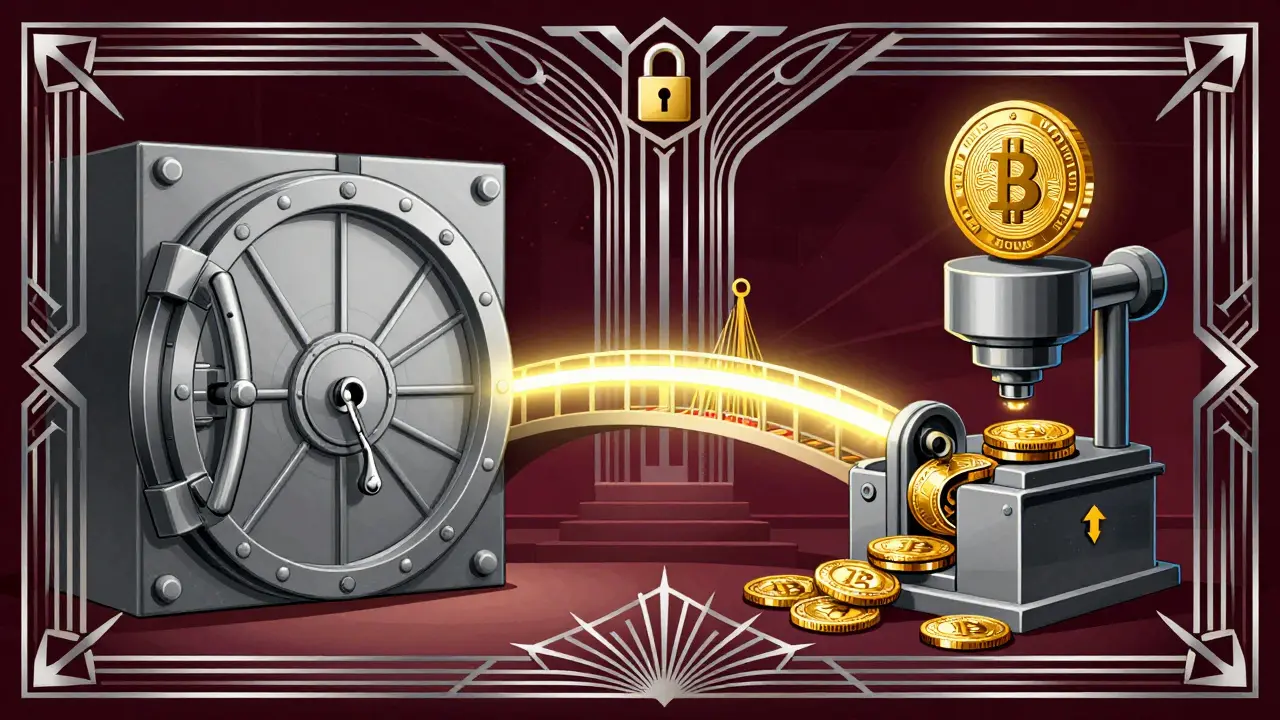
The heartbeat of any sidechain connection is the Two-Way Peg, which is a protocol mechanism that allows assets to be transferred from the main chain to the sidechain and back again securely. Without this, the chains are isolated islands, and the technology loses its utility. The process works differently depending on the direction of the transfer, but the fundamental logic relies on a "lock-and-mint" strategy.
Here is exactly what happens when you move assets:
- Locking Assets on Mainchain: When you initiate a transfer from Ethereum to a sidechain like Polygon, your tokens aren't sent directly. Instead, they are deposited into a special smart contract on the mainnet. This contract locks the tokens, rendering them temporarily unusable on the main network.
- Minting on Sidechain: Once the lock is confirmed, the sidechain receives a signal via the bridge. The sidechain then mints an equivalent amount of "wrapped" tokens representing your locked assets. These new tokens operate natively on the sidechain.
- Spending on Sidechain: You can now use these minted tokens freely within the sidechain ecosystem for gaming, trading, or decentralized finance (DeFi) operations.
- Burning and Un-locking: To reverse the process, you burn your wrapped tokens on the sidechain. The bridge verifies the burn event, and the original smart contract on the mainnet releases your locked assets back to your wallet address.
This process ensures that supply parity is maintained. There is never more ETH on the sidechain than there is locked ETH on the mainnet. If someone hacked the sidechain and minted extra fake tokens, they couldn't spend those on the mainnet because the mainnet contract simply wouldn't see the corresponding release authorization.
However, this isn't instantaneous. For security, the mainnet needs time to confirm transactions. On Ethereum, waiting for sufficient block confirmations typically takes about 25 to 50 minutes. During this window, your funds are effectively in limbo, held in the bridge contract. Understanding this latency is crucial for user experience, especially if you are building applications that rely on fast settlements.
Bridge Architectures: Who Controls the Gate?
The physical implementation of the connection varies significantly. These implementations are known as Blockchain Bridges, which are software layers facilitating communication and asset transfer between different blockchain networks. Not all bridges are built equally. The architecture determines your trust assumptions-basically, how much you have to trust other parties not to steal your money.
| Bridge Type | Security Model | Speed | Risk Profile |
|---|---|---|---|
| Federated Bridge | Requires 2/3 consensus from specific validator nodes | Fast (Seconds to Minutes) | High: Relies on centralized trust |
| Proof-of-Stake Bridge | Uses staked economic collateral for security | Moderate (Minutes to Hours) | Medium: Economic attacks possible |
| Trustless Bridge | Cryptographic proofs only (no human intervention) | Slow (Hours to Days) | Low: Relies on math and mainnet security |
Federated bridges are the fastest but carry the highest risk. If the majority of the validators conspire to attack, they can drain the bridge. This was a major concern highlighted in security assessments regarding the Axie Infinity Ronin bridge. Proof-of-Stake (PoS) bridges, like the one used by Polygon, offer a middle ground. They require validators to stake real capital. If they act maliciously, their stakes are slashed (destroyed), creating an economic barrier against bad actors.
Trustless bridges are the gold standard for security but suffer from poor user experience due to long wait times. Withdrawals from Optimism, for example, historically took seven days. While new technologies aim to reduce this latency, the principle remains: the higher the security, the slower the process usually gets.
Real-World Implementation: Polygon and Beyond
Let's look at the most successful example in practice: Polygon (formerly Matic). It connects to Ethereum using a Proof-of-Stake bridge. According to technical whitepapers released in 2022, the system uses a set of roughly 100 validator nodes. To finalize a transaction, 67% of these validators must agree.
This setup processes over 7,200 transactions per second (TPS), compared to Ethereum's base limit of roughly 30 TPS. The cost difference is stark. An average transaction on Ethereum in late 2023 cost approximately $1.20 in gas fees, whereas a Polygon transaction cost roughly $0.0001. This price gap explains why gaming projects and NFT marketplaces migrated there.
Take Decentraland, for instance. Before moving to a sidechain, land purchase fees were often around $45 due to high gas costs on Ethereum. After migrating, fees dropped to less than $0.03. This change enabled daily active users to jump from 2,300 to over 12,000. For the application developer, sidechains meant they didn't have to compromise the core functionality of their app just because the main blockchain was congested.
The Dark Side: Bridge Vulnerabilities and Hacks
If you are managing assets, you cannot ignore the failure modes. The bridge is the single largest point of failure in the blockchain ecosystem. Research from Chainalysis indicates that between 2020 and 2023, 65% of all cross-chain exploits happened at the bridge layer. These incidents resulted in over $2.8 billion in lost funds.
The Ronin Network hack in March 2022 is the most famous case study here. Attackers compromised five out of nine validator keys, allowing them to bypass the security checks and withdraw $625 million in USDC and MATIC tokens. This proved that while the code might be sound, the human governance of the validator set can be weak.
For developers, this means you need rigorous risk management strategies. Enterprise implementations often include circuit breakers-mechanisms that pause the bridge if unusual volatility is detected. Multi-signature withdrawal requirements are also common, ensuring that no single entity can authorize a massive transfer. If you are integrating sidechains into your business model, you must assume the bridge could fail and plan for contingency exits.
Looking Ahead: Modular Blockchains and Shared Security
The technology isn't standing still. As of early 2026, we are seeing a shift toward modular blockchain designs. Projects are moving away from isolated sidechains toward architectures where multiple chains share a security layer. This concept is gaining traction through initiatives like Ethereum's Proto-Danksharding upgrade (EIP-4844).
This upgrade introduced "blob transactions," which allow data to be stored much more cheaply on the mainnet. This change reduced bridge operational costs by nearly 90%. Furthermore, protocols like Chainlink's Cross-Chain Interoperability Protocol (CCIP) are attempting to standardize connections. Instead of every bridge writing custom code, CCIP provides a universal interface verified by decentralized oracle networks.
However, experts remain cautious. Industry leaders warn that current security models may still be insufficient for holding life-changing wealth. The trend suggests a hybrid future: sidechains for computation and user interaction, backed increasingly by shared security guarantees from the mainnet to mitigate the risks identified in past years.
Frequently Asked Questions
Are sidechains safer than the mainnet?
No, sidechains are generally considered less secure than the mainnet. While they inherit the value of the mainnet through the bridge, the bridge itself and the sidechain's validator set represent potential points of failure. A mainnet like Ethereum has hundreds of thousands of validators globally, whereas a sidechain might have fewer than 100.
How long does it take to withdraw from a sidechain?
Withdrawal times depend heavily on the bridge type. Federated bridges can complete withdrawals in under 30 seconds. Proof-of-Stake bridges typically take 5-10 minutes for deposits and similar times for withdrawals if optimized, but security delays can extend this to hours. Trustless bridges relying on full cryptographic challenges can take 1-7 days to ensure funds are secure.
Can I lose my money when bridging?
Yes, though rare in modern systems. Risks include smart contract bugs in the bridge code, collusion among validators, or private key theft of validators. Historical data shows billions in losses from bridge exploits. Always start with a small test transaction before moving significant assets and choose bridges with insurance or audited security proofs.
Do sidechains support all Ethereum tokens?
Most popular ERC-20 tokens are supported, but it depends on the bridge liquidity. Some obscure tokens may not have a corresponding "wrapped" version on the sidechain. Bridges typically support native tokens (ETH) and major stablecoins (USDT, USDC) by default, while requiring manual requests or third-party wrappers for others.
Is there a difference between a sidechain and a Layer 2?
Technically, yes. A sidechain is fully independent with its own validator set. A Layer 2 (like a Rollup) posts data to the mainchain for security verification. However, from a user's perspective, both achieve the same goal: cheaper and faster transactions that connect back to the mainnet.


Shayne Cokerdem
March 27, 2026 AT 13:20this tech sounds cool but if america doesnt control it then who owns the money?? i dont trust foreign bridges
vu phung
March 28, 2026 AT 02:11The interoperability protocols are definitely evolving rapidly with zero knowledge proof integration enhancing the state verification process significantly. It is crucial to observe how these cryptographic primitives reduce dependency on external validator sets.
Misty Williams
March 29, 2026 AT 13:53People ought to understand the gravity of losing digital assets through such carelessness. It is morally irresponsible to ignore the security implications entirely.
Sarah Terry
March 31, 2026 AT 07:38That is a great point about verification processes improving security standards.
kavya barikar
April 2, 2026 AT 01:21The boundaries between mainnet and sidechain represent a fundamental shift in trust architecture.
Andy Green
April 4, 2026 AT 01:05The average person is simply too ignorant to appreciate the cryptographic subtleties described herein.
Cordany Harper
April 5, 2026 AT 04:33I hear you on the responsibility front but we also need innovation without fear.
Kevion Daley
April 6, 2026 AT 20:38This is obvious information for anyone paying attention :)
Neil MacLeod
April 6, 2026 AT 20:46Dismissing the broader audience diminishes the educational value of such discourse somewhat.
aravindsai pandla
April 8, 2026 AT 00:10Understanding bridge mechanics requires patience. We must examine the lock-and-mint protocol carefully. Validators play a critical role in this ecosystem. Economic incentives align behavior with network health. Security is never absolute in any system. Users should always verify transaction states manually. Latency is often misunderstood by beginners. Gas fees fluctuate based on demand. Wrapped tokens carry their own risk profile. Smart contracts need rigorous auditing procedures. Centralized points of failure remain dangerous. Decentralization offers robustness against censorship. Community vigilance is essential for long term stability. Future upgrades will likely address current limitations. Learning these concepts empowers everyone involved.
DarShawn Owens
April 8, 2026 AT 22:10Thanks for sharing all that detailed information with us today.
namrata singh
April 10, 2026 AT 18:28Your concern reflects a deeper anxiety about global power dynamics.
Jenni Moss
April 11, 2026 AT 11:19You really should put in more effort studying the whitepapers before commenting.
Andrea Zaszczynski
April 12, 2026 AT 03:12I wonder why you bring up foreign governments when talking about code structure.