
Imagine trying to buy a house in a neighborhood where only one person owns a home. You’d have no leverage, the price would be whatever they decide, and you might wait months for them to sell. That is exactly what happens on a Decentralized Exchange (DEX) with poor liquidity. If there isn't enough money sitting in the trading pools, your simple trade can cause massive price swings-known as slippage-or fail entirely. For anyone building or using DeFi platforms in 2026, fixing this isn't just nice-to-have; it’s the difference between a thriving marketplace and a ghost town.
Liquidity is the fuel that keeps these engines running. It refers to how easily an asset can be bought or sold without moving its price significantly. When liquidity is deep, trades execute instantly at fair market rates. When it’s shallow, every transaction feels like a tug-of-war. The good news? We’ve moved past the early days of DeFi where we relied solely on hope and hype. Today, we have sophisticated tools, algorithmic strategies, and incentive structures designed specifically to deepen those pools.
The Core Problem: Why DEXs Struggle With Depth
To fix liquidity, you first have to understand why it leaks out. In centralized exchanges like Binance or Coinbase, professional market makers provide constant buy and sell orders. They eat the risk so traders don’t have to. On a DEX, there are no middlemen. Instead, we rely on Automated Market Makers (AMMs), which use mathematical formulas to determine prices based on the ratio of assets in a pool.
The problem with traditional AMMs, like the original Uniswap V2 model, is inefficiency. Liquidity is spread across every possible price point, from zero to infinity. Most of that capital sits idle, doing nothing because trades rarely happen at extreme prices. This means providers need massive amounts of capital to support even moderate trading volumes. If you’re running a new DEX, asking users to lock up millions of dollars in idle capital is a tough sell. We need smarter ways to make that capital work harder.
Concentrated Liquidity: Making Every Dollar Count
The biggest leap forward in recent years has been concentrated liquidity, popularized by Uniswap V3. Instead of spreading funds everywhere, providers can now choose specific price ranges where they believe trading will occur. Think of it like parking your car in a spot close to the entrance rather than the back corner of the lot. You pay more attention, but you get in and out faster.
By narrowing the range, you increase your share of the fees earned from trades happening within that window. Capital efficiency skyrockets. However, this introduces a new challenge: concentration risk. If the price moves outside your chosen range, your position stops earning fees and converts entirely into the less valuable asset. This is where active management becomes critical. Static positions no longer cut it for serious providers.
Algorithmic Optimization: Let AI Handle the Rebalancing
Manually adjusting concentrated liquidity positions is tedious and often too late. By the time you notice the price has drifted out of your range, you’ve already missed out on fees or incurred losses. This is where advanced technical solutions step in.
Recent developments have introduced schemes like LiqBoost, designed specifically for Uniswap V3 environments. These systems dynamically reallocate LP positions based on real-time market conditions. Imagine having a personal assistant who watches the charts 24/7 and shifts your funds to the most profitable range instantly. Simulations using historical data show that such dynamic approaches significantly reduce trading costs for users while boosting returns for providers compared to standard, static operations.
We are also seeing the rise of Deep Reinforcement Learning (DRL) in this space. Algorithms using Proximal Policy Optimization (PPO) can train active agents to systematically rebalance positions over time. These AI-driven agents learn from market patterns, predicting volatility and adjusting liquidity accordingly. They treat Loss versus Rebalancing (LVR) as a penalty, ensuring that the cost of managing the position doesn’t outweigh the benefits. For institutional players and large-scale providers, this automation is becoming non-negotiable.

Incentive Structures: Beyond Simple Yield Farming
Technology alone won’t fill the pools. You need people willing to put their skin in the game. Early DeFi relied heavily on yield farming-offering high token rewards to attract liquidity. While effective for bootstrapping, this often led to mercenary capital that left as soon as better offers appeared elsewhere.
Sustainable liquidity requires deeper engagement. Here are three proven strategies:
- Tiered Reward Systems: Offer bonus tokens not just for providing liquidity, but for keeping it there. Rewards should scale with duration. A provider who stays for 30+ days deserves more than someone who joins for 30 minutes. This encourages stability and reduces churn.
- Governance Token Alignment: Distribute governance tokens to long-term LPs. When providers have a say in the protocol’s future, they become stakeholders rather than mere speculators. This aligns their interests with the health of the DEX.
- Volatility Protection: Professional market makers fear extreme market movements. Offering risk-sharing arrangements or insurance during high-volatility events can make your DEX more attractive to sophisticated players. If you protect their downside, they’ll commit more capital to the upside.
Aggregation and Smart Order Routing
You don’t always need to build liquidity from scratch. Sometimes, you just need to borrow it. Smart Order Routing (SOR) technology acts as a traffic controller for trades. It automatically splits large orders across multiple platforms to find the best available price, reducing slippage for traders.
For newer or smaller DEXs, integrating with established markets via cross-exchange liquidity sharing is a game-changer. By connecting to global liquidity pools, a small exchange can offer deep order books instantly. This creates a self-reinforcing cycle: better pricing attracts more traders, higher volume sustains liquidity, and deeper pools improve the experience further. Platforms on alternative blockchains like Polygon or NEAR benefit immensely from bridging Ethereum mainnet liquidity, allowing them to compete with giants without starting from zero.
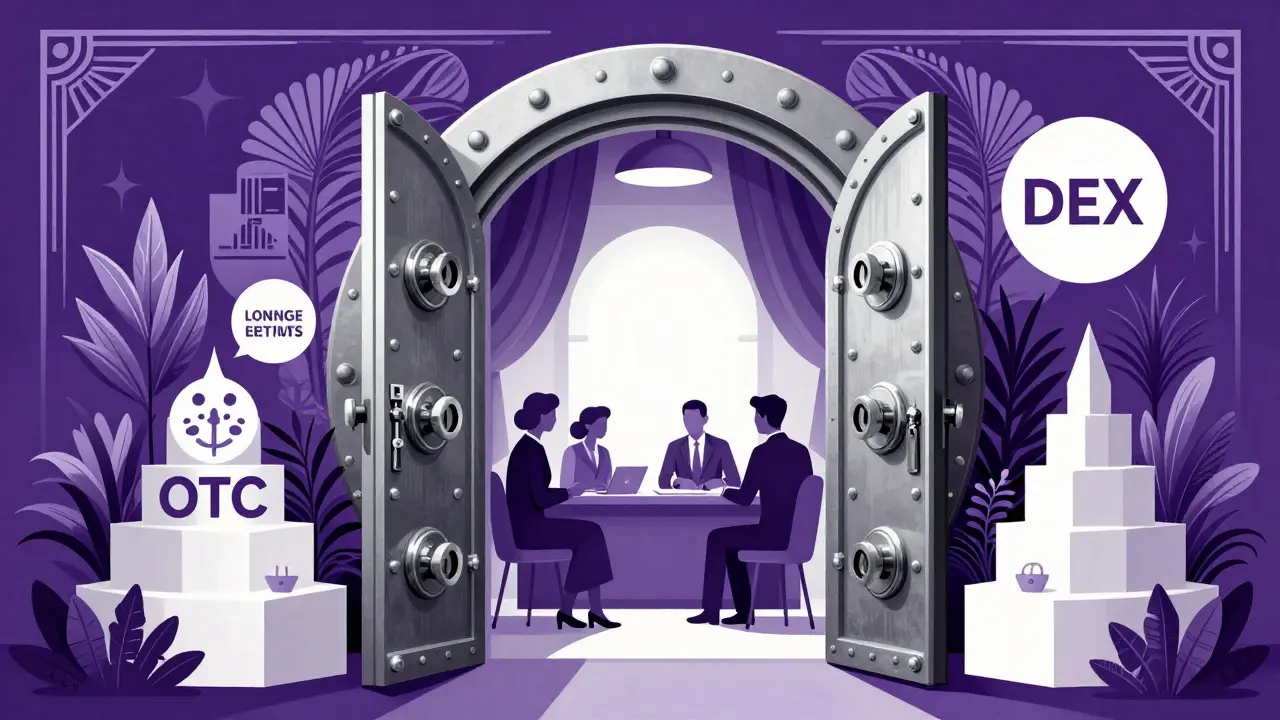
Institutional Onboarding: The Next Wave of Depth
Retail traders bring volume, but institutions bring depth. Institutional investors manage billions and require different features than the average DeFi user. To attract them, your DEX must meet strict standards:
- Regulatory Compliance: Adherence to AML (Anti-Money Laundering) and KYC (Know Your Customer) requirements, including FATF Travel Rule compliance, is essential. Institutions cannot operate in legal gray areas.
- OTC Desks: Large trades can slip badly on public order books. Over-the-counter (OTC) desks allow institutions to settle large transactions privately, minimizing market impact.
- Custody Solutions: Cold storage wallets with multi-signature security are mandatory. Institutions need assurance that their assets are protected against hacks and unauthorized access.
When you onboard these players, you aren’t just adding money; you’re adding credibility. Their presence signals to retail users that the platform is safe and stable, driving further adoption.
| Strategy | Best For | Key Benefit | Risk Factor |
|---|---|---|---|
| Concentrated Liquidity | Active Providers | High Capital Efficiency | Impermanent Loss if Price Drifts |
| Yield Farming | New Protocols | Quick Initial Growth | Mercenary Capital Churn |
| Smart Order Routing | Traders & Aggregators | Reduced Slippage | Complex Integration |
| Institutional OTC | Large Volume Markets | Deep Stability | High Compliance Costs |
Building a Sustainable Ecosystem
Improving liquidity isn’t a one-time fix. It’s an ongoing operational discipline. You need to maintain deep order books through active participation, keep trading fees competitive to attract volume, and support both fiat and cryptocurrency deposits to reduce friction for new users. Listing popular pairs like Bitcoin (BTC), Ethereum (ETH), and major stablecoins ensures consistent activity, as these assets naturally draw buyers and sellers.
User engagement plays a huge role here. Cashback programs, reduced fees for active traders, and referral bonuses create a community that feels invested in the platform’s success. But remember, incentives must be sustainable. Burning through your treasury to pay for temporary spikes in volume is a recipe for collapse. Focus on retention mechanisms that reward loyalty and long-term commitment.
The most successful DEX platforms in 2026 don’t rely on a single mechanism. They combine technical innovations like SOR and concentrated liquidity with robust economic incentives and institutional-grade security. By coordinating these efforts, you create compounding effects that progressively deepen pools, reduce slippage, and establish your platform as a leader in the decentralized finance landscape.
What is the biggest risk for liquidity providers in Uniswap V3?
The primary risk is impermanent loss combined with concentration risk. Because providers select narrow price ranges, if the asset price moves outside that range, the position stops earning fees and may convert entirely into the depreciating asset. Active management or automated tools like LiqBoost are needed to mitigate this.
How does Smart Order Routing improve the user experience?
Smart Order Routing (SOR) breaks down large trades and executes them across multiple liquidity sources to find the best price. This minimizes slippage, ensuring users get closer to the market rate rather than paying a premium due to low liquidity on a single platform.
Why do institutions require OTC desks on DEXs?
Institutions trade in large volumes that can significantly move prices on public order books. OTC desks allow them to negotiate and settle trades privately, preventing market impact and ensuring execution stability without exposing their strategy to the broader market.
Is yield farming still effective for attracting liquidity?
Yield farming is effective for initial bootstrapping but often attracts "mercenary capital" that leaves quickly. To retain liquidity, protocols must pair yield farming with long-term incentives like governance rights, tiered rewards for duration, and strong community engagement.
What role does AI play in modern liquidity provision?
AI, particularly Deep Reinforcement Learning, helps automate the rebalancing of concentrated liquidity positions. Algorithms can predict market trends and adjust price ranges in real-time, maximizing fee earnings while minimizing the risks associated with price drift.