
Stables Labs USDX (USDX) isn’t another stablecoin that just holds dollars in a bank. It doesn’t rely on traditional banking at all. Instead, it’s a synthetic USD stablecoin built on Bitcoin’s blockchain, using complex trading strategies to stay pegged to $1 - even when Bitcoin’s price swings wildly. If you’ve ever wondered how a crypto can be stable without holding cash, USDX is one of the most unusual answers out there.
How USDX Stays at $1 Without Bank Reserves
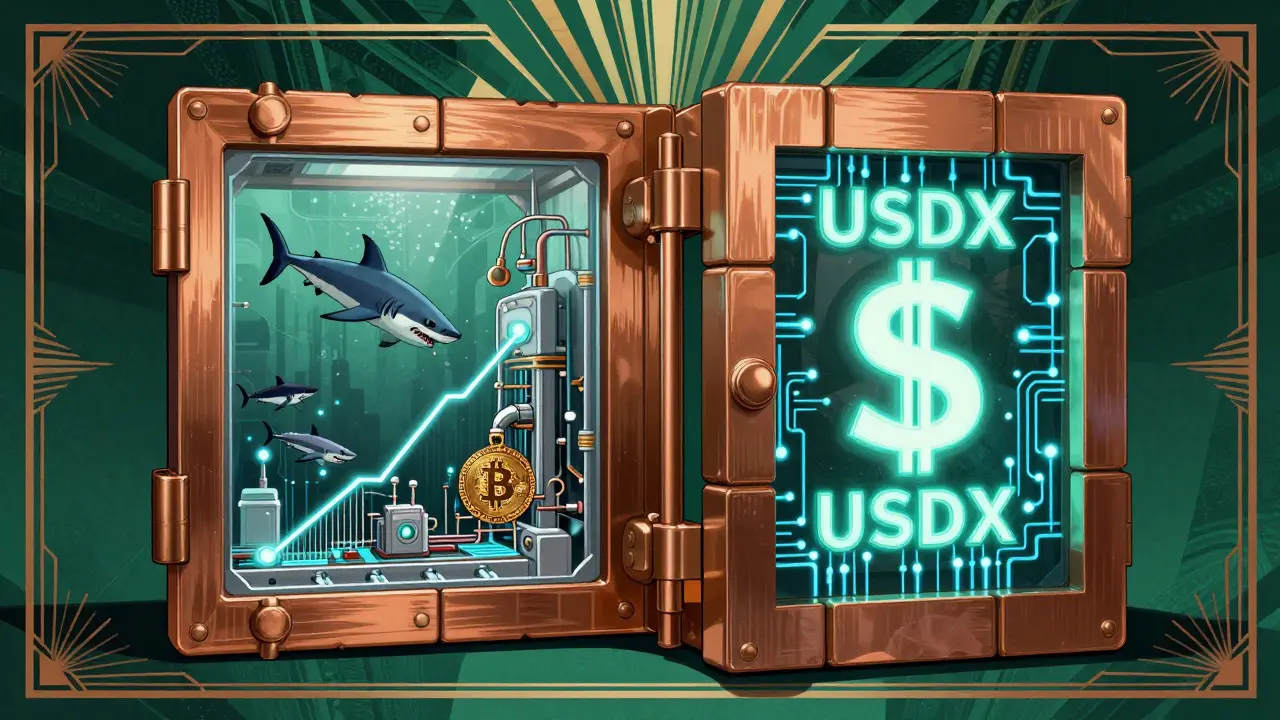
Most stablecoins like USDT or USDC are backed by actual U.S. dollars held in bank accounts. DAI is backed by locked-up crypto like ETH. USDX does neither. It’s backed by Bitcoin - but not directly. Every USDX token is created when someone deposits Bitcoin as collateral. But here’s the twist: the protocol immediately takes that Bitcoin and hedges it in derivatives markets. It goes short on Bitcoin futures or options, balancing the position so that if Bitcoin crashes, the short position makes money to cover the loss. If Bitcoin surges, the collateral gains value and offsets the short loss. This is called a delta-neutral hedge.
This isn’t magic. It’s math. The protocol uses real-time price feeds from multiple exchanges to adjust the hedge every few minutes. If Bitcoin drops 5%, the short position gains roughly 5% in value, keeping the USDX peg intact. The system was designed to work without needing to trust banks, custody firms, or auditors - just code, markets, and collateral.
USDX vs. Other Stablecoins: What Makes It Different
Here’s how USDX stacks up against the big names:
| Stablecoin | Backing | Collateral Type | Peg Mechanism | Trading Volume (24h) |
|---|---|---|---|---|
| USDX (Stables Labs) | Bitcoin + Derivatives | Decentralized | Delta-neutral hedging | $109 |
| USDT (Tether) | USD reserves | Centralized | Direct fiat backing | $50B+ |
| USDC (Circle) | USD reserves | Regulated banks | Direct fiat backing | $15B+ |
| DAI (MakerDAO) | Over-collateralized crypto | ETH, BTC, etc. | Over-collateralization + fees | $800M+ |
USDX’s biggest advantage? It doesn’t need banks. That makes it potentially more resilient in places where crypto-friendly banks are banned or restricted. But its biggest weakness? Liquidity. While USDT trades over $50 billion a day, USDX trades under $110. That’s not a typo. You won’t find it on Coinbase, Binance, or Kraken. It’s mostly on smaller DEXs like Uniswap V3 on Ethereum L2s or Bitcoin L2s like Lightning or Stacks.
Staking USDX: Earn Yield Without Rebase
Staking USDX doesn’t work like most crypto staking. You don’t get more tokens. Instead, you lock your USDX into a smart contract and get sUSDX - a staked version that doesn’t change in quantity but grows in value over time. The protocol generates yield from funding rates and basis spreads in its hedging trades. When those trades are profitable, sUSDX appreciates. If the market turns against the hedge, the protocol’s insurance fund absorbs the loss - not the staker.
Users on Reddit have reported earning between 3% and 5% APY over 3-6 months. One user on Medium documented $1,245 in yield over six months by combining staking with small trades when USDX dipped below $0.99. But remember: this yield isn’t guaranteed. During periods of extreme volatility - like the March 2023 banking crisis - USDX briefly dropped to $0.948. Those who didn’t exit in time lost money.
How to Get Started With USDX
Getting USDX isn’t plug-and-play. You need to understand Bitcoin layer protocols. Here’s the process:
- Get a Bitcoin wallet that supports smart contracts - like Leather or Xverse.
- Deposit Bitcoin into the Stables Labs app.
- Lock it as collateral and mint USDX at a 150%+ ratio (you need $150 in BTC to get $100 in USDX).
- Use your USDX on DeFi platforms or stake it for sUSDX.
It’s not beginner-friendly. CryptoSlate estimates you’ll need 20-30 hours to fully grasp the mechanics - even if you’ve used DeFi before. The documentation is thorough, but it reads like a graduate-level finance paper. The Telegram group has over 8,000 members, mostly experienced traders who help each other navigate the system.
Why USDX Hasn’t Taken Off (Yet)
Despite its clever design, USDX has a market cap of just $30.8 million as of February 2024 - less than 0.02% of the entire stablecoin market. Why? Three big reasons:
- Low liquidity: No major exchanges list it. You can’t easily buy or sell without slippage.
- Complexity: Most users don’t want to learn delta-neutral hedging. They just want a stable dollar.
- Trust: USDT and USDC have years of audits, regulatory compliance, and institutional backing. USDX has a GitHub repo with 42 commits in the last 30 days and a 3.2/5 Trustpilot rating.
Plus, the protocol has had issues. In late 2023, users reported losing hundreds of dollars when USDX briefly de-pegged. One Bitcointalk user lost $287 during a market crash. The team says it’s fixed now, but trust is slow to rebuild.

The Future of USDX: What’s Next?
Stables Labs isn’t sitting still. In late 2023, they replaced X-Points with S-Points - a new reward system that gives users daily tokens for using the protocol. They also launched USD0x, a new stablecoin meant to complement USDX. Their roadmap includes integration with Ethereum L2s like Arbitrum and zkSync, and expansion to more Bitcoin layer-2 networks.
Analysts are split. Dr. Elena Rodriguez from the University of Zurich calls it a “promising evolution,” while Frank Chapman from The Block says its success depends on market makers staying active. The Block’s December 2023 survey showed 55% of analysts were cautiously optimistic, 45% were skeptical.
What’s clear? USDX is a bold experiment. It’s trying to solve a real problem - how to create a bankless stablecoin - and it’s doing it in a way no one else has. Whether it survives the next crypto winter depends on whether enough traders believe in the model to keep the hedge working, the liquidity flowing, and the peg intact.
Is USDX Right for You?
Here’s who should consider USDX:
- You’re a DeFi power user who understands derivatives and Bitcoin L2s.
- You want exposure to a stablecoin that doesn’t rely on banks.
- You’re willing to accept lower liquidity for a novel, decentralized model.
- You’re comfortable with technical complexity and potential short-term price deviations.
Here’s who should avoid it:
- You’re new to crypto and just want a safe place to hold USD.
- You need to trade USDX on Binance or Coinbase.
- You can’t tolerate even a 2-5% deviation from $1.
USDX isn’t the future of stablecoins - at least not yet. But it’s one of the most interesting attempts to break free from traditional finance. If it works, it could inspire a new wave of bankless stablecoins. If it fails, it’ll be a case study in how clever math can’t always overcome market trust.
Is USDX really pegged to $1?
Yes - but not perfectly. USDX aims to stay at $1 using delta-neutral hedging. In normal markets, it holds within 0.1-0.3% of $1. But during extreme volatility - like the March 2023 banking crisis - it briefly dropped to $0.948. The protocol’s insurance fund covers losses, but users who sold during the dip lost money. It’s designed to be stable, not immune to shocks.
Can I buy USDX on Coinbase or Binance?
No. USDX is not listed on any major centralized exchanges. You can only trade it on decentralized platforms like Uniswap V3 on Ethereum L2s, or Bitcoin L2s such as Stacks or Lightning. This limits its accessibility and contributes to its low trading volume.
How do I stake USDX and earn rewards?
Lock your USDX tokens in the Stables Labs staking contract to receive sUSDX. Unlike rebasing tokens, sUSDX doesn’t increase in quantity. Instead, its value increases over time as the protocol earns yield from its hedging trades. Rewards are distributed daily through S-Points, which can be claimed or reinvested. APY has ranged from 3% to 5% in recent months, but it’s not guaranteed.
What’s the difference between USDX and USD0x?
USDX is the original synthetic stablecoin backed by Bitcoin and hedged via derivatives. USD0x is a newer token launched in late 2023 as part of the protocol’s expansion. USD0x is designed for faster transactions and lower fees, targeting users who want to use the stablecoin for payments or DeFi swaps. Both are part of the Stables Labs ecosystem, but USDX remains the flagship asset.
Is USDX safe? Has it been audited?
Yes, the smart contracts have been audited by third-party firms like CertiK and OpenZeppelin. The protocol also publishes on-chain proof of collateral and hedging positions. However, safety isn’t just about code - it’s about market mechanics. If market makers stop providing liquidity or hedging becomes too costly, the peg could break. There’s no FDIC insurance. You’re trusting math, not banks.
Why does CoinGecko show USDX at $0.01 while others show $1?
There’s confusion because multiple tokens use the ticker USDX. The real Stables Labs USDX is pegged to $1 and trades on DeFi platforms. The $0.01 price on CoinGecko likely refers to an unrelated token with the same symbol - possibly a meme coin or scam token on a different blockchain. Always verify the contract address before trading.

Jack Petty
February 3, 2026 AT 10:30Raymond Pute
February 5, 2026 AT 09:21Freddy Wiryadi
February 6, 2026 AT 17:44Meenal Sharma
February 8, 2026 AT 06:55Gavin Francis
February 9, 2026 AT 03:04Rob Duber
February 10, 2026 AT 21:07Gary Gately
February 11, 2026 AT 18:45Joshua Clark
February 12, 2026 AT 20:50Brandon Vaidyanathan
February 13, 2026 AT 03:35Gareth Fitzjohn
February 13, 2026 AT 10:54Katie Teresi
February 14, 2026 AT 18:07Moray Wallace
February 16, 2026 AT 16:32Dahlia Nurcahya
February 17, 2026 AT 14:01Dylan Morrison
February 17, 2026 AT 17:12William Hanson
February 19, 2026 AT 08:59Lori Quarles
February 20, 2026 AT 04:21Jeremy Dayde
February 20, 2026 AT 04:37josh gander
February 20, 2026 AT 21:40Raymond Pute
February 22, 2026 AT 03:13josh gander
February 22, 2026 AT 21:35