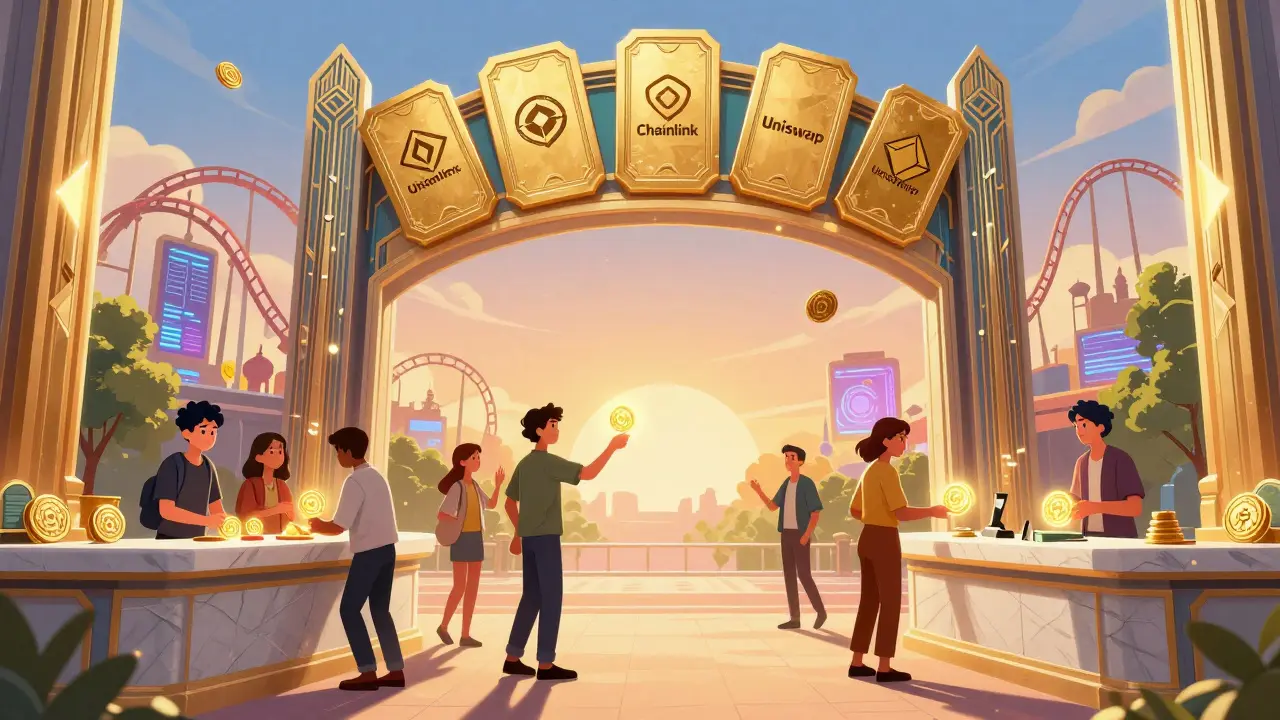
Platform tokens aren’t just another crypto fad. They’re the engine inside digital platforms - the fuel that makes apps, marketplaces, and services actually work. Think of them like tickets at an amusement park: you don’t ride the roller coaster with cash. You use tickets. Platform tokens work the same way. You don’t pay with Bitcoin to buy a digital asset on a decentralized marketplace. You use the platform’s native token.
This isn’t theoretical. In 2026, over 60% of active blockchain-based platforms rely on their own tokens to operate. These aren’t speculative coins like Dogecoin. They’re built for function. And that function creates real investment value - if you know how to spot the right ones.
How Platform Tokens Are Different from Bitcoin or Ethereum
Bitcoin is digital gold. Ethereum is a global computer. Platform tokens? They’re the keys to specific doors.
Bitcoin’s value comes from scarcity and network trust. Ethereum’s value comes from being the backbone of decentralized apps. But a platform token like Chainlink’s LINK? It’s used to pay for data feeds on the Chainlink network. Uniswap’s UNI? It’s used to vote on protocol changes and pay for trading fees. Filecoin’s FIL? It pays for decentralized cloud storage.
That’s the difference. Bitcoin doesn’t need to do anything except be trusted. Platform tokens need to be used. Their price doesn’t rise just because people believe in them. It rises because more people are using the platform - and buying the token to do it.
This makes them less volatile than pure speculation coins - but also more dependent on the platform’s success. If the app fails, the token fails. That’s the trade-off.
Why Platform Tokens Are Growing Fast
Tokenization is no longer a tech experiment. It’s becoming business infrastructure.
Look at real estate. Companies like RealT and Propy now sell fractional ownership of properties using tokens. You don’t need to buy a whole house. You buy a token that represents 1% of a rental property in Texas. That token gives you a share of the rent. It’s not speculation - it’s ownership, digitized.
Healthcare? Companies like Medibloc use tokens to let patients control who sees their medical records. Each access request costs a small token fee. It’s secure, transparent, and gives patients power.
Even sports teams are jumping in. The NBA’s Top Shot platform lets fans buy and trade highlight clips as NFTs - but the whole ecosystem runs on Flow’s FLOW token. You can’t buy a highlight without it.
These aren’t niche cases. A 2025 Deloitte report found that 42% of Fortune 500 companies are testing or deploying token-based systems. That’s not hype. That’s adoption.
What Makes a Platform Token Valuable
Not all platform tokens are created equal. Here’s what separates the winners from the trash:
- Real utility: Does the token solve a real problem? Or is it just a way to raise money? If the platform can function without the token, it’s not a good investment.
- Tokenomics: How many tokens exist? Is there a cap? Are tokens burned when used? Tokens that get destroyed (burned) with every transaction create scarcity - and that can push prices up.
- Adoption rate: Are people actually using the platform? Check daily active users, transaction volume, and developer activity. A token with 10,000 daily users is better than one with 1 million fake wallets.
- Team and roadmap: Who built this? Do they have a track record? Is there a clear plan for growth? Many tokens fail because the team disappears after the ICO.
- Regulatory safety: Is the project designed to comply with global regulations? Tokens that avoid being classified as securities have more staying power.
Take Polygon (MATIC). It started as a scaling solution for Ethereum. Now, over 20,000 dApps use it. Its token isn’t just for fees - it’s used for staking, governance, and paying for gas. That’s utility. That’s why it’s still in the top 10 by market cap in 2026.
How Platform Tokens Compare to Other Crypto Investments
Let’s break it down simply:
| Feature | Platform Tokens | Bitcoin/Ethereum | Stablecoins | NFTs |
|---|---|---|---|---|
| Primary Purpose | Access and use within a platform | Store of value / network fuel | Price stability | Digital ownership of unique items |
| Value Driver | Platform usage and demand | Market sentiment and adoption | Backing by fiat reserves | Rarity and collector demand |
| Scarcity | Often capped or burned | Fixed supply (BTC: 21M) | Supply adjusts to demand | Unique per NFT |
| Liquidity | Varies - some on major exchanges, others not | High - traded globally | Very high | Low - hard to sell quickly |
| Risk Level | Medium-High - tied to one platform | Medium | Low | Very High |
Platform tokens sit in the middle. They’re riskier than stablecoins and Bitcoin, but less random than NFTs. Their upside comes from real-world use - not just hype.
The Biggest Risks You Can’t Ignore
Yes, platform tokens can grow. But they can also vanish overnight.
Here’s what kills them:
- Platform shutdown: If the company behind it folds, the token becomes worthless. Look at the hundreds of tokens from 2021 that disappeared after the crypto winter.
- Regulatory crackdown: The SEC and EU regulators are now actively targeting tokens that act like securities. If your token is used for profit-sharing without proper licensing, it could get banned.
- Competition: New platforms with better tech or lower fees can steal users. Remember when EOS tried to beat Ethereum? It failed. Its token dropped 90%.
- Security breaches: If the platform gets hacked, users lose trust. Tokens tied to that platform follow the same path.
- Low liquidity: Some tokens trade on obscure exchanges. If you need to sell fast, you might not find a buyer - or you’ll have to accept a huge discount.
The key? Don’t invest in a token unless you understand the platform. Read their whitepaper. Check their GitHub. See if developers are still active. If the last commit was 6 months ago - walk away.
Where to Find the Best Platform Tokens in 2026
You won’t find the next big platform token by scrolling TikTok. You need to look where the builders are.
- Decentralized finance (DeFi): Projects like Aave, Compound, and Uniswap still lead. Their tokens are used for lending, borrowing, and trading. They’re mature, with proven usage.
- Web3 infrastructure: Chainlink, The Graph, Filecoin. These aren’t apps you use directly - but every app you use relies on them. They’re the hidden engines.
- Enterprise blockchains: Companies like ConsenSys and Hedera are building token systems for supply chains, logistics, and government services. These are low-profile but high-potential.
- AI + blockchain hybrids: Projects like SingularityNET (AGIX) and Fetch.ai (FET) use tokens to pay for AI services on decentralized networks. This is the next frontier.
Don’t chase the latest launch. Look for tokens with:
- At least 12 months of live usage
- Clear revenue model tied to token use
- Backed by reputable investors or partners (like Coinbase, Andreessen Horowitz, etc.)
- Active community and transparent governance
How to Start Investing (Without Getting Burned)
Here’s a simple plan:
- Start small: Put in only what you can afford to lose. Even the best tokens can drop 50% in a month.
- Buy on major exchanges: Use Coinbase, Kraken, or Binance. Avoid obscure platforms with no security.
- Track usage, not price: Check Dune Analytics or DeFi Llama. See how many people are using the platform daily. If usage is rising, the token has a chance.
- Diversify: Don’t put all your money into one token. Spread it across 3-5 platforms in different sectors (finance, storage, AI, etc.).
- Hold for the long game: Platform tokens grow with adoption. If you think the platform will be big in 3 years, hold through the dips.
There’s no magic formula. But if you treat platform tokens like business investments - not lottery tickets - you’ll do far better than 90% of crypto traders.
Final Thought: It’s Not About the Token. It’s About the System.
The token is just the tip of the iceberg. The real value is in the system it powers.
Investing in a platform token means betting on a new way of doing business - one that’s faster, cheaper, and more open than the old system. Some will fail. Some will change the world.
If you’re looking for the next big thing, don’t ask, "Will this token go up?" Ask: "Will this platform still be running in 5 years?" If the answer is yes - and you’ve done your homework - you’re not just buying a token. You’re buying into the future of digital economies.
Are platform tokens the same as cryptocurrencies?
No. Cryptocurrencies like Bitcoin and Ethereum are digital money or network fuels. Platform tokens are utility keys tied to specific apps or services. You need a platform token to use that platform - but you don’t need Bitcoin to use a decentralized marketplace. Bitcoin can be used to buy the token, but it doesn’t power the app itself.
Can platform tokens become securities?
Yes. If a token is sold as an investment with the expectation of profit based on others’ efforts - like a stock - regulators may classify it as a security. That means stricter rules, reporting requirements, and potential bans in some countries. Projects that avoid promising returns and focus on utility are less likely to get flagged.
What’s the best way to store platform tokens?
Use a non-custodial wallet like MetaMask or Trust Wallet. Never leave large amounts on exchanges. Exchanges can get hacked or freeze accounts. Your private keys = your control. If you don’t hold them, you don’t own the tokens.
Do platform tokens pay dividends?
Not directly. But some platforms distribute a portion of fees or revenue to token holders through staking rewards or buybacks. For example, Binance Coin (BNB) burns tokens quarterly, reducing supply and increasing value for holders. That’s not a dividend - but it’s a similar effect.
How do I know if a platform token is legitimate?
Check three things: 1) Is the code open-source and audited? Look on GitHub. 2) Is there a clear team with LinkedIn profiles? 3) Are there real users and transactions? Use tools like Etherscan or Solana Explorer to check live activity. If the project has no public code or no usage data - it’s a red flag.
Platform tokens are one of the most underappreciated opportunities in crypto today. They’re not flashy. They don’t make headlines. But they’re quietly powering the next generation of digital businesses. The ones that succeed won’t be the loudest. They’ll be the most useful.
Nishakar Rath
January 14, 2026 AT 09:29They're not utility they're lock-in
You think you're buying access but you're buying a membership to a club that can kick you out anytime
Remember when Facebook credits died?
Same thing just with more blockchain buzzwords
Tokenomics my ass
It's all about who controls the keys and who gets paid when the lights go out
Jason Zhang
January 14, 2026 AT 14:25Like yeah tokens are used for stuff but so are loyalty points
And we all know how those turned out
Also why is everyone acting like this is new? I've seen this exact pitch since 2017
Same words different blockchain
Katherine Melgarejo
January 14, 2026 AT 22:26And you're calling this innovation?
My grandma's coupon book has better ROI
Rod Petrik
January 15, 2026 AT 20:05Every single one of these "utility" tokens is secretly a security
SEC already has the names
They're waiting for the next bull run to crush everyone
And the "team" behind them? Half are ex-bankers who got fired for fraud
Look at the domain registration dates
Most were created 3 days before the ICO
They're not building anything
They're just printing money before the scam collapses
Andre Suico
January 17, 2026 AT 07:23Bill Sloan
January 18, 2026 AT 06:50JUST THINK ABOUT IT
YOU CAN OWN PART OF A HOUSE WITH A TOKEN
OR GET PAID IN TOKENS FOR DOING AI WORK
THIS ISN'T JUST CRYPTO
THIS IS THE NEXT INTERNET
WHY AREN'T MORE PEOPLE TALKING ABOUT THIS
GO CHECK OUT FLOW AND AGIX RIGHT NOW
THEY'RE GOING TO 100X
ASHISH SINGH
January 19, 2026 AT 21:07The real power isn't in the token
It's in the people who control the smart contracts
And who controls them?
The same people who controlled the stock market before
They just swapped suits for hoodies
And now they're selling you tickets to a carnival where the rides are rigged
Wake up
The algorithm isn't free
It's owned
Vinod Dalavai
January 21, 2026 AT 17:54Don't get swept up in the hype
Look at Polygon
It's got real usage
Real devs
Real partnerships
That's what matters
Not the price chart
Not the meme
Just check if people are actually using it every day
If yes then maybe
If no then walk away
And don't put more than 5% of your portfolio in this stuff
Been there done that
Tony Loneman
January 21, 2026 AT 21:12Platform tokens are just Wall Street's new Ponzi scheme
They took the same playbook from 2017
Just added some fancy graphs and called it "tokenomics"
And now they're selling you "ownership" in a company that doesn't even exist yet
Meanwhile the founders are cashing out through private sales
While you're buying on DEX with your life savings
Wake up
They're not building the future
They're building their yachts
Anthony Ventresque
January 22, 2026 AT 03:42Most people just see price charts but this explains why some actually work
I've been holding MATIC since 2021 and it's not because I thought it'd pump
It's because I saw the dApp growth
The devs were active
The fees were being burned
That's the real signal
Don't chase coins
Chase systems
Anna Gringhuis
January 23, 2026 AT 22:38Everyone's acting like this is some revolutionary concept
But it's literally how video game economies have worked for 20 years
Gold coins in WoW
Steam points
Robux
Same thing
Just now they're calling it "blockchain" and charging you 30% gas fees to buy a virtual sword
Progress?
Michael Jones
January 24, 2026 AT 08:19Lauren Bontje
January 26, 2026 AT 04:52They're building sovereign digital currencies while we're selling NFTs of cartoon apes
This whole post is just crypto bro nonsense
Real power is in state-backed tokens
Not some decentralized marketplace where you pay 10 bucks in gas to buy a digital baseball card
Wake up America
Haley Hebert
January 26, 2026 AT 22:33I used to just buy Bitcoin and hope
Now I look at how many people are using the app
Are devs still pushing code?
Is the team responding to community questions?
I put $200 into Filecoin last year
Didn't expect much
But now I get paid in FIL just for letting them store my photos
It's not about getting rich
It's about being part of something that actually works
And yeah I cried when my first payout hit
It felt real