
Remember when swapping tokens felt like gambling with your gas fees? That era is mostly behind us, but the landscape of decentralized finance (DeFi) has shifted dramatically since then. If you are looking at SushiSwap V3 (Core) as a primary venue for your trades in 2026, you need to know exactly what you are getting into. It is not just another copycat exchange; it is a mature, albeit complex, Automated Market Maker (AMM) that sits squarely between beginner-friendly interfaces and advanced yield farming mechanics.
This review cuts through the hype. We will look at the hard numbers: the $3.99 billion in Total Value Locked (TVL), the specific fee structures that differentiate it from Uniswap, and the real-world usability of its concentrated liquidity features. Whether you are a casual trader wanting lower fees or a liquidity provider chasing yields, here is the unvarnished truth about SushiSwap V3 in the current market.
The Core Identity: What Is SushiSwap V3?
At its heart, SushiSwap is a decentralized cryptocurrency exchange built on the Ethereum blockchain that operates without a central operator. Originally launched as a fork of Uniswap, it has evolved into an independent entity with its own governance structure and reward mechanisms. The "V3" designation refers to its third-generation protocol, which introduced concentrated liquidity-a feature that allows providers to allocate capital within specific price ranges rather than across the entire curve.
Why does this matter? Because efficiency. In older versions (V1 and V2), your capital was spread thin, making it less effective unless you were providing massive amounts of funds. With V3, even smaller players can compete more effectively by targeting specific price ticks. As of late 2025 and moving into 2026, SushiSwap supports over 3.99 billion dollars in TVL. While this number might seem modest compared to giants like Aave or Compound, it represents highly active, liquid markets capable of handling significant volume without excessive slippage.
| Metric | Value / Detail |
|---|---|
| Total Value Locked (TVL) | $3.99 Billion+ |
| Cumulative Trading Volume | $69.32 Billion+ |
| Average Bid-Ask Spread | 0.634% |
| Supported Chains | Ethereum, Polygon, and others via multichain deployment |
| Trading Pairs | 5 core pairs (with broader support via aggregators) |
Fees and Rewards: How You Actually Make Money
Let’s talk money. On centralized exchanges like Coinbase or Binance, fees often go straight to the company’s bottom line. On SushiSwap, the model is different. It uses a dual-tier reward system that incentivizes both liquidity providers and token holders.
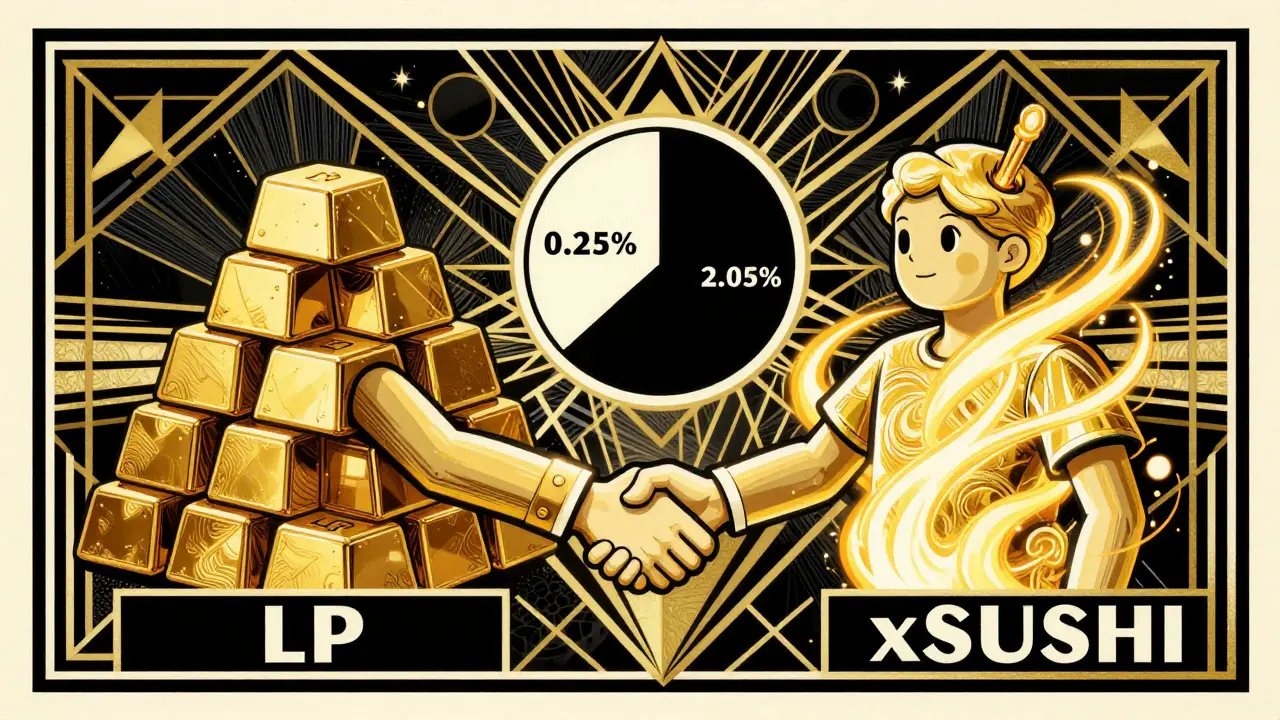
When you execute a trade, the standard fee is typically 0.30% (though dynamic fees exist for certain pairs). Here is how that slice gets divided:
- 0.25% goes directly to Liquidity Providers (LPs). This is your cut if you have deposited assets into the pool.
- 0.05% goes to xSUSHI stakers. This is where the platform’s native token comes into play.
This structure creates a unique economic loop. If you hold SUSHI is the native governance and utility token of the SushiSwap ecosystem, you don’t just hope for price appreciation. By staking your SUSHI into SushiBar, you convert it to xSUSHI, which accrues value based on those 0.05% trading fees. This makes holding the token fundamentally tied to the platform’s usage volume, not just speculation.
Compared to Uniswap, which allocates 100% of trading fees to LPs, SushiSwap’s split might seem less generous at first glance. However, the continuous liquidity mining programs-where users earn additional SUSHI tokens for providing liquidity-often offset this difference. For example, the Onsen Program offers enhanced rewards for new tokens, giving early supporters a significant boost in potential returns.
User Experience: From Wallet Connection to Limit Orders
Getting started is straightforward if you already have a crypto wallet. SushiSwap integrates with six major wallets, including MetaMask, WalletConnect, and Coinbase Wallet. Once connected, the interface is clean and intuitive. You select your input token, choose your output token, and swap. Simple enough.
But the real power lies in the advanced features rolled out recently. In July 2025, SushiSwap launched Limit Orders and Dollar Cost Averaging (DCA) tools. These are game-changers for retail traders who previously had to rely on complex bots or external platforms to automate their strategies.
- Limit Orders: Set a target price, and the protocol executes the swap only when the market hits that level. No more refreshing the page hoping for a dip.
- DCA: Automatically buy small amounts of a token over time, smoothing out volatility and reducing the risk of buying at a peak.
For beginners, the learning curve is manageable thanks to Sushi Academy is an educational resource hub provided by SushiSwap to help users understand DeFi concepts. It covers everything from basic wallet security to the intricacies of impermanent loss. However, there is no demo account. You are playing with real money from day one, which adds a layer of psychological pressure that paper-trading enthusiasts might miss.
Risks and Realities: What They Don’t Tell You
No DeFi platform is risk-free, and SushiSwap is no exception. Here are the critical pitfalls you must consider before depositing significant capital.
Impermanent Loss (IL): This is the silent killer of liquidity provision. When you provide liquidity to a pair (e.g., ETH/USDC), you are exposed to IL if the price ratio of the two assets changes significantly. Concentrated liquidity in V3 amplifies this risk because your capital is focused in a narrower range. If the price moves out of your selected range, your position becomes inactive, and you may suffer greater losses compared to simply holding the assets. Think of it like options trading: higher potential yield, but higher complexity and risk.
Smart Contract Risk: Like all DeFi protocols, SushiSwap relies on code. While the platform has undergone numerous audits and has been battle-tested since 2020, bugs can still exist. The unregulated nature of DeFi means there is no customer support hotline to call if something goes wrong. Your keys, your coins-and your responsibility.
Gas Fees: Operating on Ethereum mainnet can be expensive during periods of high congestion. A simple swap might cost $5-$10 in gas, while providing or adjusting concentrated liquidity positions can run $20-$50 or more. This makes small trades economically inefficient. This is why SushiSwap’s expansion to Polygon is a Layer 2 scaling solution that enables faster and cheaper transactions for SushiSwap users is crucial. On Polygon, gas fees are fractions of a cent, making frequent trading and yield farming viable for smaller portfolios.
SushiSwap vs. Uniswap: Which One Wins?
You cannot discuss SushiSwap without mentioning its biggest competitor, Uniswap. Both are AMMs, both use concentrated liquidity in V3, and both dominate the DEX space. So, why choose one over the other?
| Feature | SushiSwap V3 | Uniswap V3 |
|---|---|---|
| Fee Distribution | Split between LPs (0.25%) and xSUSHI stakers (0.05%) | 100% to Liquidity Providers |
| Reward Mechanism | Continuous liquidity mining + Onsen Program for new tokens | Standard fee earnings; no native token rewards for LPs |
| Governance | SUSHI token holders vote on proposals | UNI token holders vote on proposals |
| Advanced Tools | Limit Orders, DCA, SushiBar staking | Basic swaps and liquidity provision |
| Best For | Users seeking passive income via staking and active yield farmers | Pure traders prioritizing deep liquidity and simplicity |
If you want maximum simplicity and the deepest liquidity for large trades, Uniswap often edges ahead. But if you are interested in earning additional yield through token staking, participating in governance, or accessing innovative tools like DCA directly within the interface, SushiSwap offers more utility. The Onsen Program, specifically, provides a unique opportunity to get early exposure to new tokens with boosted rewards, something Uniswap lacks.
Verdict: Is SushiSwap V3 Worth Your Time in 2026?
SushiSwap V3 (Core) is not a get-rich-quick scheme. It is a sophisticated financial tool that rewards knowledge and patience. For beginners, it serves as an excellent gateway into DeFi, offering user-friendly features and educational resources. For experienced users, the concentrated liquidity pools and staking mechanisms provide competitive yields that rival traditional finance instruments.
The platform’s commitment to innovation-evidenced by the recent launch of Limit Orders and DCA-shows that development is far from stagnant. With a robust TVL of nearly $4 billion and a clear path toward multichain expansion, SushiSwap remains a cornerstone of the decentralized exchange ecosystem.
Just remember: do your homework. Understand impermanent loss. Watch your gas fees. And never invest more than you can afford to lose. If you approach SushiSwap with respect for its complexity, it can be a powerful asset in your crypto portfolio.
Is SushiSwap safe to use in 2026?
SushiSwap has a strong track record since 2020 and undergoes regular audits. However, as a decentralized platform, it carries inherent smart contract risks. Always verify URLs, use hardware wallets for large amounts, and diversify your holdings to mitigate risk.
What is the minimum amount to start trading on SushiSwap?
There is no official minimum. However, due to Ethereum gas fees, it is recommended to have at least $50-$100 in ETH to cover transaction costs for swaps. On Polygon, you can trade with much smaller amounts due to negligible gas fees.
How do I earn rewards with SUSHI tokens?
You can stake your SUSHI tokens in the SushiBar to receive xSUSHI. xSUSHI automatically accrues a portion of trading fees (0.05%) generated across the platform. Additionally, providing liquidity in certain pools earns you extra SUSHI rewards through liquidity mining programs.
Can I use SushiSwap on mobile devices?
Yes, SushiSwap is fully responsive and works well on mobile browsers. You can connect mobile wallets like MetaMask Mobile or Trust Wallet to access all features, including swaps, limit orders, and liquidity provision.
What is Impermanent Loss and how does V3 affect it?
Impermanent Loss occurs when the price of deposited assets changes relative to each other. In V3, because you concentrate liquidity in a narrow range, IL can accumulate faster if the price exits your range. Careful monitoring and rebalancing are essential to manage this risk.