
When you hear the name Filda (FILDA), you might think of another promising crypto project that took off during the 2021 DeFi boom. But Filda isn’t just another token-it was a full lending protocol built to move money across blockchains, and for a while, it worked remarkably well. Then everything changed.
What Filda (FILDA) Actually Is
Filda isn’t a coin in the traditional sense. It’s a decentralized finance (DeFi) protocol that lets users lend and borrow crypto assets across multiple blockchains. Think of it like a bank, but without banks. You deposit your USDT, ETH, or other tokens, and earn interest. Others borrow those same tokens, pay interest, and the protocol distributes the earnings to depositors. The FILDA token is the backbone-it’s used to vote on changes and reward early users.
What made Filda different? It was built as a modified version of Compound, the original DeFi lending protocol, but optimized for the Huobi ECO Chain (HECO). While most DeFi apps ran on Ethereum, Filda focused on HECO, a faster, cheaper blockchain backed by the Huobi exchange. This wasn’t an accident-it was a strategy. HECO had transaction fees under $0.001, while Ethereum often cost over $1.75 per transaction. For everyday users, especially in China, that difference was everything.
How Filda Worked: The Mechanics
Filda’s system was simple on the surface but clever underneath. Users deposited assets like USDT, BTC, or HECO into smart contracts. The protocol then matched them with borrowers who paid interest. That interest didn’t go to a company-it went straight to depositors. The more people borrowed, the higher the interest rates. The less they borrowed, the lower the rates. It was all automated.
One standout feature? Filda accepted LP tokens as collateral. LP tokens are proof that you’ve provided liquidity to a DeFi pool-like a farming position. Most protocols wouldn’t let you use them to borrow more. Filda did. That meant users could farm yield on one platform, then use that yield as collateral to borrow more assets and farm again. It was leverage, but without needing a centralized exchange.
It ran on EVM-compatible chains-Ethereum, HECO, NEO, and Elastos. To interact with Filda, you needed a wallet like MetaMask or TokenPocket. You’d switch networks, connect your wallet, and start depositing. The interface wasn’t perfect, but it worked. According to user tests from 2021, someone with basic DeFi experience could complete their first loan cycle in about 45 minutes.
Why Filda Exploded in 2021
In early 2021, Filda hit its peak. Total Value Locked (TVL)-the amount of crypto locked in the protocol-reached $2.1 billion on HECO alone. That made it the third-largest lending protocol on non-Ethereum chains, behind Venus on BSC and Cream Finance.
Why? Three reasons:
- Low fees: HECO transactions cost pennies. On Ethereum, users paid $1-$5 just to deposit. Filda made DeFi accessible.
- High yields: Users earned up to 18.7% APY on stablecoins. One Reddit user reported earning 14.2% on USDT for six months with zero issues.
- HECO’s ecosystem: Huobi pushed Filda hard. It was promoted in their wallet, on their exchange, and in Chinese-language communities. Over 68% of users accessed Filda through Huobi Wallet.
By August 2021, Filda controlled 7.3% of HECO’s total ecosystem value. It was everywhere.

The Downfall: What Went Wrong
Then came the cracks.
In August 2021, a hacker exploited a flaw in Filda’s oracle system-the part that feeds real-world price data into the protocol. The exploit cost $500,000. It wasn’t catastrophic, but it scared users. Trust dropped. Then, in September 2021, China banned all cryptocurrency trading. Filda’s biggest user base-Chinese retail investors-vanished overnight.
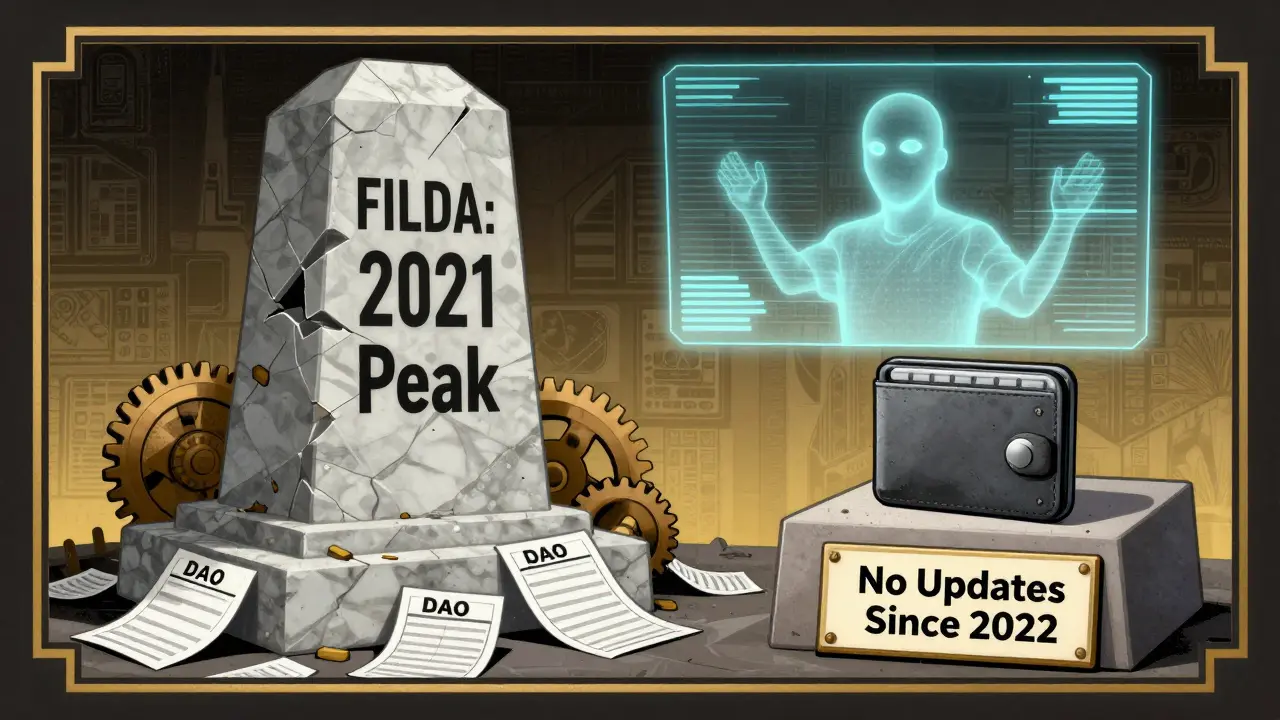
TVL plunged. From $2.1 billion in August 2021, it fell to $378 million by December. By December 2022, it was down to $41.2 million. That’s a 98% drop.
The protocol didn’t stop working. But it stopped evolving. The last major code update was in March 2022. The GitHub repo went quiet. The roadmap promised integrations with Polygon and BSC. None happened. The team never explained why.
Even the governance system failed. Only 3.7% of FILDA token holders voted in the first major proposal. The DAO was supposed to be democratic. In practice, it was a ghost town.
FILDA Token: What’s Left
The FILDA token hit an all-time high of $4.35 in May 2021. As of December 2023, it trades at $0.078. That’s a 98.2% drop. It’s still listed on a few exchanges like Bitget and HTX, but trading volume is near zero. Most holders are either holding onto hope or stuck with a dead asset.
There’s no burning mechanism. No buybacks. No new features. The token supply remains fixed at 1 billion. No one’s mining more. No one’s adding liquidity. It’s a relic.
How Filda Compared to the Competition
At its peak, Filda had strengths and weaknesses no one else had.
| Feature | Filda (FILDA) | Compound | Aave |
|---|---|---|---|
| Primary Chain | HECO | Ethereum | Ethereum |
| Peak TVL | $2.1B | $18.4B | $14.6B |
| Transaction Fees | $0.0003 | $1.75 | $1.60 |
| Supported Assets | 12 | 19 | 28 |
| LP Token Collateral | Yes | No | Yes |
| DAO Participation | 3.7% | 12.1% | 8.9% |
Filda won on speed and cost. It lost on diversity and community trust. Compound and Aave had global reach. Filda had one region-and when that region shut down, it had nowhere to go.
Who Was Filda For?
Filda wasn’t built for institutions. It wasn’t designed for long-term stability. It was built for one group: retail crypto users in China who wanted high yields without high fees. It delivered. But it didn’t plan for what came next.
It didn’t have a backup plan when China banned trading. It didn’t have a global marketing team. It didn’t have a developer pipeline. It had a single chain, a single user base, and a single moment in time.
Today, Filda is a case study in DeFi fragility. A protocol that rose fast because it solved a real problem-but collapsed because it solved only one problem, and only for one market.
Is Filda Still Active?
Technically, yes. The smart contracts are still live. You can still deposit or withdraw. But no new users are coming. No new features are being added. The Telegram group has 12,487 members, but most are silent. Support tickets go unanswered. The last meaningful code commit was in May 2022.
If you’re holding FILDA, you’re holding a token with no utility beyond speculation. There’s no roadmap. No team updates. No new partnerships. The protocol is in maintenance mode-barely breathing.
What Lessons Does Filda Teach?
Filda’s story isn’t just about a failed coin. It’s about how DeFi projects can rise on timing, not technology.
- Regional focus is risky: Betting everything on one country or chain can backfire hard.
- Low fees aren’t enough: You need innovation, community, and long-term development.
- DAOs need participation: If no one votes, it’s not governance-it’s theater.
- Regulation matters: No protocol is immune to government action.
Filda didn’t fail because it was badly coded. It failed because it was too narrow. Too dependent. Too temporary.
Today, if you’re looking for a lending protocol, Filda isn’t a choice. But if you’re studying how DeFi projects rise-and fall-Filda’s story is still worth learning.
Is Filda (FILDA) still a viable crypto investment?
No, Filda is not a viable investment. The protocol has been inactive since early 2022, with no new updates, no development activity, and a 98% drop in token value. The total value locked (TVL) has fallen from $2.1 billion to under $50 million. The token has no utility beyond speculative trading, and there is no evidence of future development.
Can I still use Filda to earn interest on my crypto?
Technically, yes-you can still connect your wallet and deposit assets into the existing smart contracts. But no new users are joining, and interest rates are stagnant. There’s no guarantee of liquidity, and withdrawals may become difficult if the remaining user base shrinks further. The protocol is effectively in maintenance mode.
Why did Filda collapse so quickly after its peak?
Filda’s collapse was caused by two major events: a $500,000 exploit in August 2021 that damaged trust, and China’s September 2021 ban on cryptocurrency trading, which removed its primary user base. With no global expansion plan, no institutional backing, and no new development, the protocol lost momentum and never recovered.
How did Filda differ from Compound or Aave?
Filda was built as a fork of Compound but optimized for the HECO blockchain, offering much lower transaction fees than Ethereum-based protocols. It also allowed LP tokens as collateral, a feature not originally available in Compound. However, it supported far fewer assets (12 vs. 19-28) and had minimal governance participation, making it less resilient than its competitors.
What happened to the FILDA token’s value?
The FILDA token reached an all-time high of $4.35 in May 2021. By December 2023, it was trading at $0.078-a 98.2% decline. The drop was driven by the collapse of the underlying protocol, lack of trading volume, and the absence of any new use cases or partnerships.



YANG YUE
March 25, 2026 AT 06:28Filda was like that one friend who shows up to every party with a six-pack and a dance move-everyone loves them until the cops show up.
Turns out, betting your whole project on one country’s regulatory whims is less ‘smart strategy’ and more ‘Russian roulette with a DeFi twist.’
It’s not that the tech failed-it was built for a moment, not a movement.
And now? It’s just a ghost in the blockchain cemetery, haunting wallets with 0.078% hope.
Lesson: Never build a castle on sand… especially if the tide is a government decree.
Anna Lee
March 26, 2026 AT 09:48OMG this was such a wild ride!! 🥹
I remember when I first staked my USDT on Filda and got 18% APY-it felt like magic!
Even though it’s dead now, I still kinda miss it, you know?
It made DeFi feel *accessible* for regular folks, not just crypto bros with 7 wallets.
Maybe one day someone revives it with a better team… fingers crossed!! 💖
Alice Clancy
March 28, 2026 AT 06:54China banned crypto so Filda died? LOL. You built a house on a fault line and you’re surprised when the earthquake hits?
Pathetic. No global vision? No backup plan? You don’t get to cry when your empire crumbles because you were too lazy to think ahead.
And now you’re still holding FILDA like it’s a lottery ticket?
Bro, it’s not a ‘relic’-it’s a warning label.
Waste of time. Waste of gas. Waste of life.
Shana Brown
March 30, 2026 AT 03:57It’s okay to feel sad about Filda. It gave so many people their first real taste of DeFi.
Low fees, high yields, easy interface-it was a gateway drug to blockchain.
And even though it’s gone, the *idea* of making finance open and cheap? That’s still alive.
Let’s honor it by building something better next time. 💪
Not everyone has to be a global giant to make a difference.
Marie Mapilar
March 30, 2026 AT 15:31One thing that always struck me about Filda was how it democratized LP token collateralization-something even Aave didn’t do at first.
It was a subtle innovation, but it unlocked leverage for retail users in a way that felt organic.
And the integration with Huobi Wallet? Genius localization.
It’s heartbreaking that regulatory overreach, not technical failure, killed it.
DAO participation was low, yes-but that’s a cultural issue, not a code issue.
Maybe we need better onboarding, not just better contracts.
Dominic Taylor
March 31, 2026 AT 14:43From a protocol architecture standpoint, Filda was a textbook case of regional optimization with zero contingency planning.
The HECO-centric design was brilliant for cost efficiency, but it created a single point of systemic failure.
Compare that to Compound’s Ethereum-native, multi-chain-agnostic model-scalability isn’t just about throughput, it’s about resilience.
And the LP collateral feature? That was genuinely ahead of its time.
Still, without governance participation, even elegant code becomes a tombstone.
Shelley Dunbrook
April 1, 2026 AT 05:54How ironic that a protocol named after a fictional Chinese folk hero (Filda) became the poster child for geopolitical fragility.
It’s almost poetic: built to empower, crushed by bureaucracy.
And yet, we still call it a ‘failure’-as if the fact that it worked for 18 months, helped thousands, and taught us so much doesn’t count.
Maybe the real failure is our obsession with binary outcomes: alive or dead.
Some things live on in lessons, not in smart contracts.
Aman Kulshreshtha
April 3, 2026 AT 05:42I used Filda back in 2021 when I was in Delhi and couldn’t afford Ethereum fees.
It was my first time earning interest on USDT-no KYC, no drama.
Then China banned crypto and the whole thing went quiet.
I still have my FILDA tokens in my wallet.
Not selling. Not buying. Just… keeping it as a reminder.
That’s the thing about crypto-sometimes the value isn’t in the price, it’s in the memory.
Leona Fowler
April 3, 2026 AT 18:43It’s worth noting that Filda’s collapse wasn’t due to bad code-it was due to lack of community resilience.
When the regulatory hammer fell, there was no movement, no advocacy, no backup chain migration.
Compare that to Aave’s response to the Terra collapse-quick, transparent, adaptive.
DeFi isn’t just about yields. It’s about culture.
And Filda never built one.
Neil MacLeod
April 4, 2026 AT 13:20Let’s be real: Filda was a glorified yield farm with a fancy whitepaper.
It didn’t innovate-it repackaged Compound and slapped ‘HECO’ on it.
And now? A $4.35 token worth 7 cents? Congrats, you’ve invented a crypto coffin.
Not even a meme coin would take this seriously.
At least Dogecoin had a sense of humor.
Misty Williams
April 6, 2026 AT 06:22People who still hold FILDA are either delusional or emotionally attached to a dead asset.
This isn’t a lesson in DeFi-it’s a lesson in financial irresponsibility.
Why would anyone invest in a protocol that’s 98% dead and has zero roadmap?
It’s not ‘nostalgia.’ It’s stupidity.
And if you’re still hoping for a revival? You’re not a crypto believer-you’re a sucker.
Anand Makawana
April 6, 2026 AT 22:53Actually, Filda’s design was brilliant in its simplicity: low fees, high yields, LP collateral, and Huobi integration.
It’s not fair to blame it for China’s ban-it was a victim of circumstance, not incompetence.
And the fact that it reached $2.1B TVL on a non-Ethereum chain? That’s monumental.
Maybe we should be asking: why didn’t others copy its model?
Because innovation doesn’t always survive politics.
But it still deserves recognition.
Mohammed Tahseen Shaikh
April 7, 2026 AT 16:33