
Upbit vs. Binance Fee Calculator
Compare Trading Fees
Upbit charges 0.25% maker/taker fees while Binance charges 0.1%. This calculator shows the actual fee difference for your trades.
Upbit isn't just another crypto exchange. It's the biggest one in South Korea, handling over $1.8 billion in trades every day. If you're looking to trade Bitcoin or Ethereum with Korean Won (KRW), Upbit is probably your only realistic option. But if you're in the U.S. or other restricted countries, you won't even be able to sign up. This isn't a platform for global traders-it's a powerhouse built for one market, and it shows in every detail.
Why Upbit Exists: Built for Korea, Not the World
Upbit launched in October 2017, right after South Korea's crypto boom turned the country into a trading frenzy. The founders-Dunamu and Kakao’s blockchain arm Ground X-didn’t want to compete with Binance or Coinbase. They wanted to solve a local problem: how do you let regular Koreans buy crypto safely, legally, and with real money? The answer was KRW integration. Upbit made it possible to deposit Korean Won directly, trade instantly, and withdraw back to local banks. No more jumping through hoops with third-party payment processors. That simplicity made it explode. Today, Upbit controls 55% of South Korea’s $42.7 billion crypto market. That’s more than double its closest rival, Bithumb. It’s not because it has the lowest fees or the most coins. It’s because it’s the only exchange that fully complies with Korea’s strict rules. If you want to trade KRW on a major platform, Upbit is the only game in town.Security: The Gold Standard in Crypto
Security isn’t a feature on Upbit-it’s the entire business model. After losing $51 million in an Ethereum hack back in 2019, Upbit didn’t just patch the漏洞. They paid every single user back. In full. 8.5 billion won ($6.3 million) came out of their own pocket within 72 hours. That’s unheard of in crypto. Most exchanges blame hackers and move on. Upbit took responsibility. That single act built more trust than any marketing campaign ever could. Fast forward to 2025, and Upbit’s security setup is among the most advanced in the world. 70% of all user funds are stored in cold wallets-offline, air-gapped, and physically secured. Their AI system watches over 1.2 million transactions per minute, flagging anything unusual in real time. It processes 14 million data points every second, according to Seoul National University’s Dr. Lee Min-jae. That’s 37% more than any other major exchange. They’ve also earned ISO 27001, 27017, and 27018 certifications-the same standards banks use. And in November 2025, they took things further: they blocked access to Cambodia’s Huewn Exchange, two months before the U.S. FinCEN even labeled it a threat. They froze 259 suspicious accounts. That’s not reactive security. That’s proactive enforcement.Trading and Fees: High Costs, High Control
Upbit’s fees aren’t cheap. Maker fees start at 0.25%, and taker fees are the same. Compare that to Binance’s 0.1% and you’ll see why traders outside Korea often avoid it. But here’s the catch: Upbit doesn’t compete on price. It competes on reliability. If you’re trading KRW, you’re not looking for the lowest fee-you’re looking for a platform that won’t vanish overnight. They support over 300 cryptocurrencies, but the real action is in KRW pairs. 92% of all trading volume is in KRW/BTC, KRW/ETH, and a few other major pairs. If you want to trade obscure altcoins like Shiba Inu or Dogecoin, you’re better off using another exchange. Upbit’s selection of altcoins is smaller than Coinbase’s, and many tokens are only listed after they’ve proven stable in the Korean market. Withdrawal fees are fixed: 0.0005 BTC for Bitcoin, around 0.01 ETH for Ethereum. Processing times? Usually 3-5 seconds. That’s faster than most banks.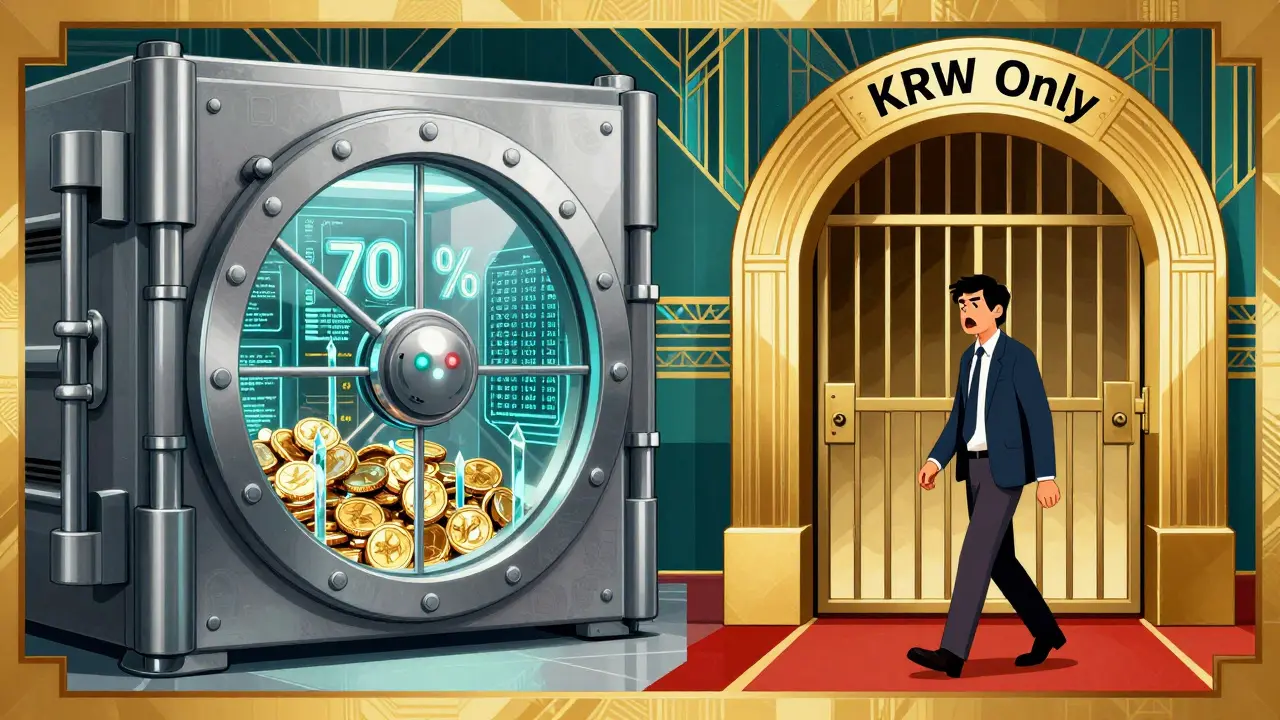
KYC and Verification: A Necessary Pain
If you’re outside South Korea, you might think KYC is just a formality. On Upbit, it’s a gatekeeper. To deposit or withdraw KRW, you must be a Korean resident with a valid national ID. No exceptions. Even if you live in Singapore or Japan, you can’t use KRW unless you’re legally based in Korea. For international users, Upbit offers USD and SGD trading pairs, but with strict limits. Level 2 users (basic verification) can only withdraw up to SGD 5,000 per day. Level 4 users (full verification) can go up to SGD 100,000. But getting to Level 4 takes weeks. Documents are reviewed manually. Delays are common. Over 500,000 accounts were flagged in 2025 for incomplete KYC-despite Upbit’s certifications. That’s a red flag. The system is strong, but it’s not flawless. Reddit users in Singapore and Australia complain daily about the 3-5 day wait for verification. One user, u/SeoulTrader2025, praised the quick reimbursement after the 2019 hack. Another, Chen Wei, said: “SGD 5,000 daily cap is useless if you’re managing a small fund.”What’s Broken: The KRW Dependency
Upbit’s biggest weakness is its reliance on Korean banking partners. On September 25, 2025, all KRW deposits were suspended for 14 days. Why? Because one of their banking partners was under regulatory inspection. No warning. No notice. Just a system-wide freeze. Traders lost an estimated $2.3 million in opportunity cost during that time. And the worst part? Upbit didn’t even announce it clearly. Users found out through community forums. They also suspended trading for BABY and BCH tokens in September 2025, claiming it was a “security upgrade.” But no one outside their internal team knew what that meant. The tokens came back after two weeks. But the damage was done: trust eroded. When a platform makes unilateral decisions without transparency, users start to wonder: who’s really in control?
Who Should Use Upbit?
Upbit isn’t for everyone. If you’re in the U.S., Canada, or most of Europe, you can’t even create an account with KRW. Even if you could, the limits make it useless for serious traders. But if you’re a Korean resident? Upbit is the only exchange you need. It’s secure, compliant, and deeply integrated with the local financial system. If you’re a Singaporean or Japanese trader with a Korean bank account? You can use it-but you’ll be fighting the limits. For institutional traders? The SGD limits are too low. For crypto enthusiasts who want the latest altcoins? The selection is too narrow. For those who value speed and reliability over low fees? Upbit delivers.The Future: AI Assistants and Global Limits
Upbit isn’t standing still. By Q2 2026, they plan to launch AI trading assistants that analyze market trends and suggest trades based on your history. They’re also working on adding 12 new fiat currencies by 2027. But here’s the catch: they’re not trying to become global. They’re trying to become the most trusted exchange in Asia. Industry analysts predict Upbit will grow to 41% of the Asian crypto exchange market by 2027. Why? Because Binance is being squeezed by regulators everywhere. Upbit, on the other hand, is already compliant. They’re the model other exchanges wish they could copy. But the cracks are showing. KYC gaps, KRW dependency, and opaque decisions could cost them users. If they don’t fix those, even their security won’t save them.Final Verdict: A Regional Titan with Global Flaws
Upbit is the most secure, most compliant, and most trusted crypto exchange in South Korea. Period. If you live there, it’s your best-and only-option for KRW trading. The reimbursement after the 2019 hack alone proves they care about users. But if you’re outside Korea, Upbit feels like a locked door. The fees are high, the limits are tight, and the access is restricted. It’s not designed for you. And that’s okay. Not every exchange needs to be global. Sometimes, being the best in one place is more valuable than being everywhere. If you’re in Korea? Use Upbit. If you’re not? Look elsewhere. Don’t waste time trying to force your way in.Can I use Upbit if I live in the United States?
No, you cannot. Upbit blocks access from the United States and 31 other countries due to regulatory restrictions. Even if you try to sign up with a U.S. address, your account will be flagged and frozen. The platform is designed exclusively for users in South Korea and a few other Asian markets with KRW or SGD support.
Why are Upbit’s fees higher than Binance’s?
Upbit charges 0.25% for both maker and taker fees, while Binance charges 0.1%. That’s because Upbit doesn’t compete on price. It competes on compliance and stability. The higher fees help fund their advanced security systems, regulatory infrastructure, and 24/7 customer support. For Korean users, that trade-off is worth it-especially when you consider the risk of using an unregulated exchange.
How long does KYC verification take on Upbit?
Basic verification (Level 2) takes 1-2 business days. Full verification (Level 4) can take 3-5 days, sometimes longer. Documents are reviewed manually, and delays are common during peak times. If you’re outside Korea, expect longer waits due to additional checks on foreign IDs and proof of address.
Is Upbit safe from hacks?
Yes, it’s one of the safest exchanges in the world. After losing $51 million in 2019, Upbit rebuilt its entire security system. Now, 70% of funds are in cold storage, AI monitors millions of transactions per minute, and all withdrawals require a fund password and two-factor authentication. They’ve also earned top global security certifications. No major hack has occurred since 2019.
What cryptocurrencies can I trade on Upbit?
Upbit supports over 300 cryptocurrencies, but the vast majority of trading volume is in Bitcoin, Ethereum, and a few major Korean-listed tokens. While it has more coins than some exchanges, it lags behind global platforms like Coinbase, which lists over 350. Many altcoins are only added after they’ve proven stable in the Korean market, so you won’t find the latest meme coins right away.
Can I deposit USD on Upbit?
Yes, but only if you’re outside Korea and have a verified account. Upbit supports USD and SGD deposits for international users, but you can’t use KRW unless you’re a Korean resident. USD deposits are processed through partner banks, and withdrawal limits apply based on your KYC level. For most users, KRW remains the primary and most efficient option.
What happened during the September 2025 KRW suspension?
In September 2025, Upbit suspended all KRW deposits and withdrawals for 14 days because one of its banking partners was under regulatory inspection. No public announcement was made in advance, causing confusion and lost trading opportunities. This exposed a critical vulnerability: Upbit’s entire KRW system depends on a small number of Korean banks. If one fails, the whole flow stops.
Does Upbit offer a mobile app?
Yes, Upbit has official apps for Android (8.0+) and iOS (12+). The app is fast for basic trades but can lag during high volatility. Users report delays in order execution and chart loading during market spikes. Many traders use the web platform for serious trading and the app only for checking balances or small transactions.


Patricia Amarante
December 16, 2025 AT 12:03Upbit’s 2019 reimbursement was the only time I’ve ever seen a crypto exchange act like a human.
Elvis Lam
December 17, 2025 AT 17:34Let’s be real-Upbit’s fees are ridiculous for anyone outside Korea. But if you’re in Seoul and want to trade without getting your account frozen by the government, it’s the only game in town. The security? Top-tier. The customer service? Nonexistent unless you’re Korean. That’s the trade-off.
Jonny Cena
December 19, 2025 AT 08:44I get why people are frustrated with the KYC delays, but let’s not ignore the context. South Korea has some of the strictest crypto laws in the world. Upbit isn’t being difficult-they’re just trying not to get shut down by regulators. If you’re outside Korea and need to move big money, maybe try a regulated US exchange instead. It’s not personal, it’s just how the system works.
Amy Copeland
December 20, 2025 AT 20:45Oh wow, a crypto exchange that actually follows the law? How quaint. I guess that’s why it’s the only one that didn’t vanish into thin air after a hack. Meanwhile, Binance is out here buying stadiums and calling it ‘community building.’ Cute.
Timothy Slazyk
December 22, 2025 AT 16:53Upbit’s model isn’t about innovation-it’s about institutional inertia. It thrives because Korea’s financial system is closed, rigid, and deeply suspicious of decentralization. Upbit didn’t win because it’s better-it won because it was the only one willing to become a proxy for the state. The real question is: is compliance the same as trust? Or is it just another form of control dressed up in cold wallets and ISO certifications?
Samantha West
December 23, 2025 AT 23:27They blocked Huewn Exchange before FinCEN even flagged it? That’s not security-that’s surveillance capitalism with a Korean accent. They’re not protecting users, they’re policing behavior under the guise of safety. And don’t get me started on how they just yank trading pairs without warning. This isn’t a platform, it’s a gated community for crypto.
Donna Goines
December 24, 2025 AT 06:2570% cold storage? Yeah right. That’s what they want you to think. The real funds? All in hot wallets, hidden behind shell companies in the Caymans. The 2019 hack? Staged. They needed the PR win. And the KRW freeze? That was a controlled burn to scare off retail traders so the whales could dump. You think they care about you? They care about their regulatory license. That’s it.
Sean Kerr
December 26, 2025 AT 00:50bro upbit is legit tho 🤝 like yeah the fees are high but when your krw deposit hits in 3 secs and you don’t have to worry about your account getting nuked? priceless. i’ve used binance, kraken, coinbase-none of them feel as safe as upbit. also they fixed the app, it’s actually usable now 😎
Kelsey Stephens
December 27, 2025 AT 05:42Just want to say thank you to whoever wrote this. I’m a Korean expat in the U.S., and I’ve been trying to explain to my friends why I can’t use Upbit the way I used to. This breakdown helped me finally articulate it. The KRW dependency is everything.
Abby Daguindal
December 28, 2025 AT 10:08It’s fascinating how people treat Upbit like a saint because it didn’t disappear after a hack. But let’s not forget: it was a massive failure. The fact that they paid back users doesn’t undo the breach-it just makes them look better than the usual crypto crooks. Still a broken system.
Mark Cook
December 29, 2025 AT 11:18Upbit’s the only exchange that actually listens to regulators? Cool. So it’s not crypto anymore-it’s fintech with a side of bureaucracy. Next they’ll be requiring you to submit your tax returns before buying BTC. 😂
Jack Daniels
December 30, 2025 AT 14:10I used to trade on Upbit. Then I got locked out for 3 weeks because my passport photo had a shadow. I didn’t cry. I just deleted the app. And now I’m fine. Not everyone needs to be in the system.
Cheyenne Cotter
December 30, 2025 AT 21:14Let’s be honest-Upbit’s dominance in Korea is a product of cultural conformity, not superior technology. Koreans value order, compliance, and institutional trust above all else. That’s why they tolerate high fees and opaque decisions. It’s not about crypto-it’s about identity. The platform mirrors Korea’s social contract: sacrifice freedom for safety. And most people are okay with that. The rest? They just leave.
Jesse Messiah
January 1, 2026 AT 16:33if you’re outside korea and trying to use upbit… just don’t. i tried for months. kyc took 4 weeks, then they asked for my birth certificate AND my parents’ tax forms. i gave up. there are better options. upbit isn’t for you. it’s for koreans. respect that. 🙏
Sally Valdez
January 3, 2026 AT 15:31Why does everyone act like Upbit is some kind of moral hero? Because it didn’t run away after a hack? Big deal. Every other exchange in the world would’ve done the same if they had the cash. The real issue? It’s a national champion, not a global one. And that’s fine-but don’t pretend it’s better. It’s just protected.
Sammy Tam
January 4, 2026 AT 13:39Upbit’s like that one friend who shows up with a first-aid kit when you cut your finger-but also insists on driving you to the hospital, filling out your insurance forms, and asking if you’ve seen your therapist this week. Annoying? Maybe. But you kinda love them for it.
Emma Sherwood
January 4, 2026 AT 23:47As someone who grew up in Seoul and now lives in LA, I can tell you: Upbit isn’t just an exchange. It’s a cultural artifact. The way it handles KYC, the way it freezes trades, the way it pays back losses-it’s all shaped by Korean collectivism. You don’t get that in the West. We want freedom. Korea wants stability. Neither is wrong. Just different.
Tom Joyner
January 6, 2026 AT 11:02It’s amusing how the same people who scream about decentralization worship an exchange that operates like a state monopoly. Upbit doesn’t empower users-it manages them. And the fact that users defend it as ‘secure’ just proves how deeply they’ve internalized control as safety. Sad, really.
Rebecca Kotnik
January 7, 2026 AT 19:43Upbit’s model raises profound ethical questions about the relationship between financial sovereignty and national identity. When a platform’s entire architecture is predicated on geographic exclusion-when access is not a function of technological capability but of citizenship-it forces us to confront whether decentralization is a technical ideal or a Western fantasy. The fact that Upbit’s security protocols are superior is not incidental; it is the direct result of regulatory alignment, not market competition. This is not innovation-it is institutional capture. And while it may serve its domestic users well, it reinforces the very centralization that crypto was meant to dismantle. One must ask: is trust built on compliance, or on liberation? Upbit answers the former. But the question remains: at what cost to the ethos of the movement?