When you buy crypto, you probably think of apps like Coinbase or Binance. You sign up, verify your ID, and trade. But there’s another way-one that doesn’t need your name, doesn’t hold your money, and runs entirely on code. That’s a decentralized exchange, or DEX.
Unlike traditional exchanges, a DEX lets you trade crypto directly with other people. No middleman. No bank. No company sitting between you and your money. Instead, smart contracts on a blockchain handle everything. These are self-executing programs that automatically swap tokens when conditions are met. If you send 1 ETH, the contract sends you 3,200 USDC in return-no human approval needed.
How Do Decentralized Exchanges Work?
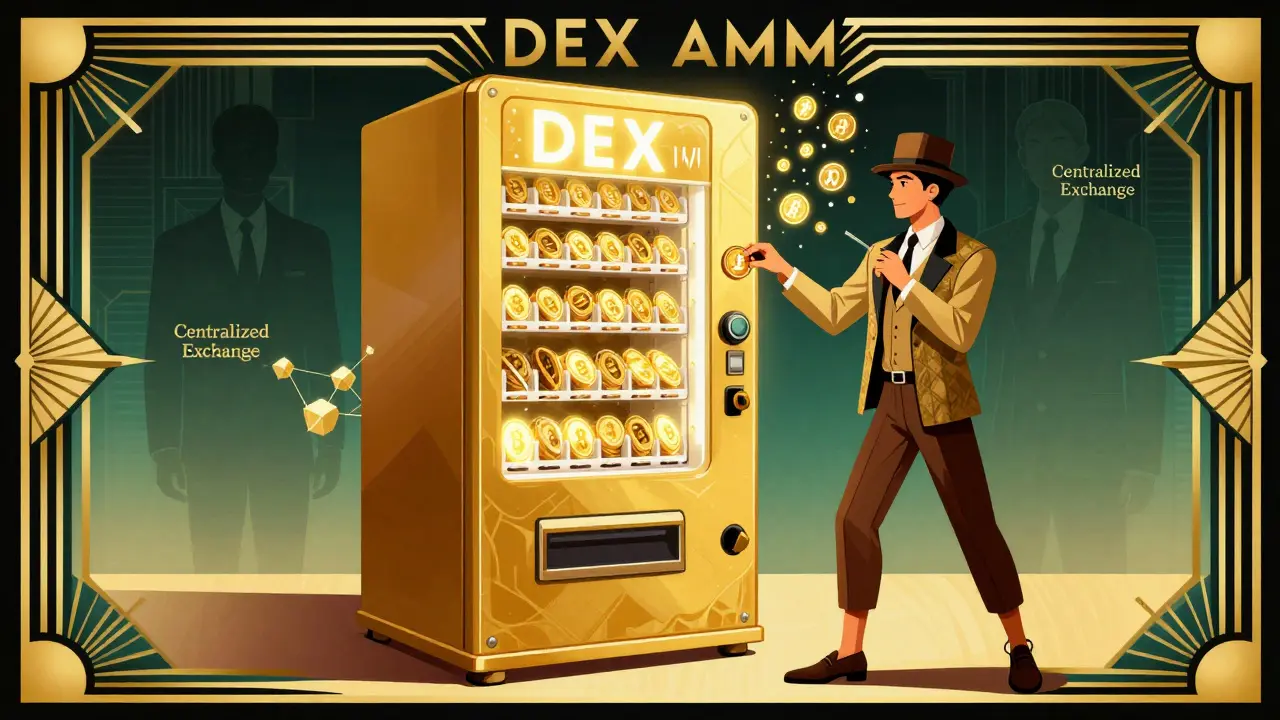
There are three main ways DEXs make trades happen. The most popular today is the Automated Market Maker, or AMM. Think of it like a vending machine for crypto. Instead of matching buyers and sellers, it uses pools of tokens-say, 100 ETH and $200,000 USDC-to set prices. The math is simple: the ratio of tokens in the pool determines the price. If someone buys ETH, the pool has less ETH and more USDC, so ETH gets more expensive. This keeps prices stable without order books.
Uniswap, launched in 2018, made this model famous. Its latest version, Uniswap v3, lets liquidity providers put their money in specific price ranges-like only supporting ETH between $1,800 and $2,200. This cuts wasted capital by up to 4,000 times compared to older versions. You’re not just a passive investor; you’re actively shaping the market.
Other DEXs use order books, like dYdX. These look more like stock exchanges-you place a buy or sell order, and it waits until someone matches it. The difference? Everything happens on-chain. No central server stores your order. It’s recorded on the blockchain, visible to everyone.
Then there are aggregators like 1inch. They don’t trade themselves. Instead, they scan dozens of DEXs at once and split your trade across them to get the best price. If Uniswap has bad rates but PancakeSwap has deep liquidity, 1inch will route part of your trade there. It’s like using Google Flights to find the cheapest flight across airlines.
Why Use a DEX Instead of a Centralized Exchange?
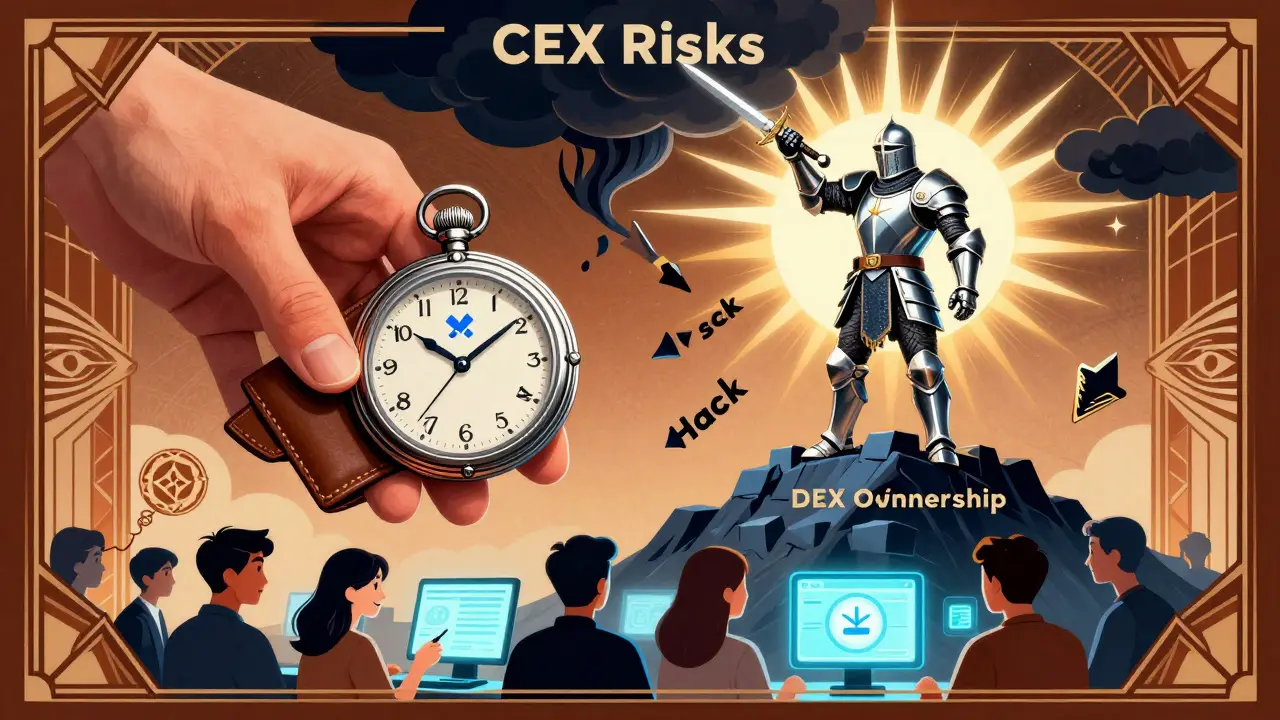
Let’s compare. On Coinbase or Binance, you give them your crypto. They hold it. That’s called custodial control. If they get hacked-or worse, freeze your account-you lose access. DEXs don’t do that. You keep your keys. Your wallet. Your money. No one else touches it. That’s why 98.7% of DEX users don’t even need to show ID, according to Chainalysis. CEXs? Almost all require KYC.
Token variety is another big difference. Uniswap supports over 250,000 token pairs. Binance? Around 1,500. Why? Because on a DEX, anyone can list a token. No approval process. No gatekeepers. That’s great for new projects. It’s also risky-scams thrive here too.
And then there’s access. If you’re in a country where Binance is blocked, or your bank won’t let you buy crypto, a DEX still works. All you need is internet and a wallet like MetaMask. No paperwork. No delays.
What Are the Downsides?
It’s not perfect. First, gas fees. On Ethereum, trading can cost $1-$5 depending on network traffic. During peak times, it’s been over $50. That’s not practical for small trades. That’s why many users switch to Layer 2 chains like Arbitrum or Base-where fees are pennies.
Then there’s slippage. If you want to trade $5,000 worth of a low-liquidity token, the price might move sharply as the trade executes. You end up getting less than you expected. Experienced traders set slippage tolerance at 0.5%-2%, but beginners often lose money because they don’t understand it.
Smart contract risk is real. In 2022, $2.8 billion was lost to DeFi hacks, and 65% of those hit DEXs. A bug in the code, a misconfigured pool, or a malicious token can drain funds. You’re not protected by customer service. You’re on your own.
And user experience? Still rough. A 2023 Crypto.com survey found 78% of new users prefer CEXs because DEXs feel like a puzzle. You need to understand approvals, gas limits, RPCs, and transaction hashes. One Reddit user lost $200 in gas fees because they didn’t adjust slippage settings. That’s not a bug-it’s a learning curve.

Who Uses DEXs and Why?
DEXs aren’t for everyone. But they’re vital for certain groups.
- Early adopters-They buy new tokens before they hit CEXs. CoinGecko says 78% of new tokens launch first on DEXs. That’s where SHIB, PEPE, and other memecoins started.
- Liquidity providers-They earn yield by depositing tokens into pools. Some make 20-30% APR by locking ETH and USDC in concentrated ranges on Uniswap v3.
- Censorship-resistant traders-In countries with capital controls or unstable banks, DEXs are a lifeline. Over 48% of users come from Asia, especially Vietnam and the Philippines.
- DeFi power users-They use DEXs as building blocks. Swap tokens, lend them, stake them, borrow against them-all in one flow.
On the flip side, 63% of experienced traders (over 2 years in crypto) prefer DEXs. Beginners? Only 22% do. The gap is wide-but it’s closing as wallets get smarter and interfaces improve.
What’s Changing in 2026?
DEXs are evolving fast. Uniswap v4, launching in early 2024, introduces "hooks"-custom code that lets developers build new trading logic. Imagine a DEX that auto-rebalances your portfolio or executes trades based on price alerts. That’s possible now.
Ethereum’s Dencun upgrade, expected in Q1 2024, will slash transaction costs by up to 100x. That’s because of proto-danksharding-a new way to store data more efficiently. Lower fees mean more everyday users can trade without worrying about $10 gas.
Regulation is catching up. The SEC fined Uniswap Labs $50 million in October 2023 for operating an unregistered exchange. The EU’s MiCA rules, active in 2024, will require DEXs serving Europeans to enforce KYC for fiat on-ramps. This could force DEXs to become hybrid platforms-keeping core trading decentralized but adding regulated entry points.
Big players are watching. Coinbase invested $100 million in Base’s DEX ecosystem. Binance bought Matcha, a DEX aggregator. JPMorgan tested DEX trades internally. This isn’t a fringe experiment anymore-it’s infrastructure.
How to Get Started Safely
If you want to try a DEX, here’s how to do it right:
- Install a wallet: MetaMask or Trust Wallet. Never share your seed phrase.
- Buy ETH or native chain token (like BNB or SOL) to pay gas fees.
- Connect your wallet to a DEX like Uniswap or PancakeSwap.
- Check the token’s liquidity. If the pool has less than $5 million, avoid it.
- Set slippage tolerance: 0.5% for stablecoins, 1-2% for volatile tokens.
- Only approve tokens you trust. Use Revoke.cash to cancel old allowances.
- Start small. Trade $50 before risking $500.
And always double-check the contract address. Scammers copy popular DEXs with fake sites. If the URL isn’t app.uniswap.org, it’s fake.
Final Thoughts
Decentralized exchanges aren’t just a tech novelty. They’re a reimagining of financial access. No permission. No gatekeepers. No single point of failure. They’re slower, riskier, and harder to use-but they give you back control. That’s the original promise of Bitcoin: money you own, not money you borrow from a bank.
Right now, DEXs handle about 18% of all crypto trading. That’s $1.2 trillion a year. In five years, it could be half. The tech is improving. Fees are falling. Interfaces are getting simpler. And regulators? They’re trying to catch up.
For now, DEXs are for those who want true ownership. Not everyone needs them. But for those who do? There’s nothing else like them.
Are decentralized exchanges safe?
DEXs are safe for your funds because you keep control of your private keys-unlike centralized exchanges that hold your crypto. But they’re not risk-free. Smart contracts can have bugs, and scams are common. Always check contract addresses, avoid low-liquidity pools, and never approve unlimited token spending. Use tools like Revoke.cash to manage permissions.
Do I need KYC to use a DEX?
No, you don’t need KYC to use a DEX. That’s one of their biggest advantages. You only need a crypto wallet like MetaMask. However, if you’re using a DEX that connects to a fiat on-ramp (like Coinbase’s integration), you might need to verify your identity there. The core DEX trading itself remains anonymous.
What’s the difference between AMM and order book DEXs?
AMM DEXs like Uniswap use liquidity pools and mathematical formulas to set prices automatically. You trade against the pool, not another person. Order book DEXs like dYdX work like traditional exchanges-you place buy and sell orders, and they match when prices align. AMMs are simpler and more common, but order books offer better pricing for large trades.
Why are gas fees so high on some DEXs?
Gas fees are high on networks like Ethereum because they’re congested. Every transaction needs to be processed by thousands of nodes, and users bid for priority. During peak times, fees can exceed $10. Switching to Layer 2 networks like Arbitrum, Base, or Polygon reduces fees to under $0.10. Most new DEX users now avoid Ethereum for small trades because of this.
Can I lose money just by providing liquidity?
Yes. This is called impermanent loss. If the price of one token in your pool changes dramatically compared to the other, you can end up with less value than if you’d just held the tokens. For stablecoin pairs like USDC/ETH, loss is usually under 5%. For volatile pairs like DOGE/ETH, it can hit 30% during big swings. It’s not a loss until you withdraw, but it’s a real risk.
Which DEX is the best to use?
For Ethereum users, Uniswap is the most trusted and has the deepest liquidity. For BNB Chain, PancakeSwap leads. For low fees, try Curve Finance for stablecoins or SushiSwap on Arbitrum. Aggregators like 1inch are great for finding the best rate across all DEXs. The "best" depends on which chain you’re on and what tokens you’re trading.

Colin Lethem
February 25, 2026 AT 00:37lori sims
February 25, 2026 AT 20:35Reggie Fifty
February 26, 2026 AT 02:50Kristi Emens
February 26, 2026 AT 21:16Deborah Robinson
February 28, 2026 AT 01:02Vishakha Singh
February 28, 2026 AT 06:19Andrew Hadder
March 1, 2026 AT 17:19Derek Sasser
March 3, 2026 AT 06:30Neeti Sharma
March 3, 2026 AT 22:32Nadia Shalaby
March 5, 2026 AT 06:43John Fuller
March 5, 2026 AT 14:03Maggie House
March 7, 2026 AT 11:38Robert Kromberg
March 7, 2026 AT 17:29Curtis Dunnett-Jones
March 9, 2026 AT 14:47Sean Logue
March 10, 2026 AT 07:06Carl Gaard
March 11, 2026 AT 06:55bella gonzales
March 11, 2026 AT 20:27Colin Lethem
March 12, 2026 AT 09:40