
Have you ever wondered if your trading activity could actually earn you rewards instead of just costing you fees? That is the core promise behind Maiga (MAIGA), a cryptocurrency designed to power an AI-driven ecosystem where your market participation matters. Unlike typical tokens that rely on passive holding or complex staking, MAIGA introduces a novel concept called Proof of Trading. This mechanism ties token rewards directly to verifiable trading volume and liquidity contributions, aiming to align incentives between traders, liquidity providers, and autonomous AI agents.
If you are looking into Maiga (MAIGA) crypto coin, you are likely navigating the crowded space of AI-meets-DeFi projects. Maiga.ai positions itself as a Web3-native platform that acts as an "AI co-pilot" for crypto trading, decentralized finance strategies, and prediction markets. But what exactly does this mean for you as a user or investor? Let’s break down how the technology works, who backs it, and whether the current market data supports its ambitious claims.
Key Takeaways
- Utility First: MAIGA is not just a speculative asset; it is used to deploy AI agents, access premium features, and participate in launchpad allocations within the Maiga.ai ecosystem.
- Proof of Trading: The project uses a unique consensus model where rewards are linked to actual trading volume and liquidity provision, verified via zero-knowledge proofs.
- Micro-Cap Status: As of mid-2026, MAIGA has a circulating supply of 280 million tokens and a market cap under $2 million, making it a high-risk, high-volatility micro-cap asset.
- Technical Stack: The platform runs on BNB Chain and utilizes Trusted Execution Environments (TEEs) and Model Context Protocol (MCP) to ensure secure, multi-venue AI agent operations.
What Is Maiga.ai and How Does It Work?
To understand the token, you first need to understand the platform it powers. Maiga.ai is described as a decentralized "DeFAI" economy-short for Decentralized Finance plus Artificial Intelligence. In simple terms, it combines the automation of DeFi protocols with the analytical power of AI agents.
Imagine having a digital assistant that doesn’t just give you generic advice but actively analyzes real-time data from multiple sources. Maiga’s AI agents ingest heterogeneous data, including price charts, order-book heatmaps, funding rates, on-chain liquidity flows, and even off-chain prediction-market signals. These agents run inside Trusted Execution Environments (TEEs), which are hardware-based secure enclaves. This ensures that the trading logic and user data remain private and tamper-proof while still being verifiable by the network.
The platform uses a Multi-Venue Model Context Protocol (MCP) interface. Think of MCP as a universal translator that allows the AI agents to pull context from various exchanges and liquidity pools simultaneously. Whether you are trading on a centralized exchange like Binance or swapping on a decentralized platform like PancakeSwap, the AI can contextualize that data to provide actionable insights. For everyday users, this means access to technical analysis assistance, prediction analysis, and gamified trading features that were previously reserved for institutional desks.
The Proof of Trading (PoT) Mechanism
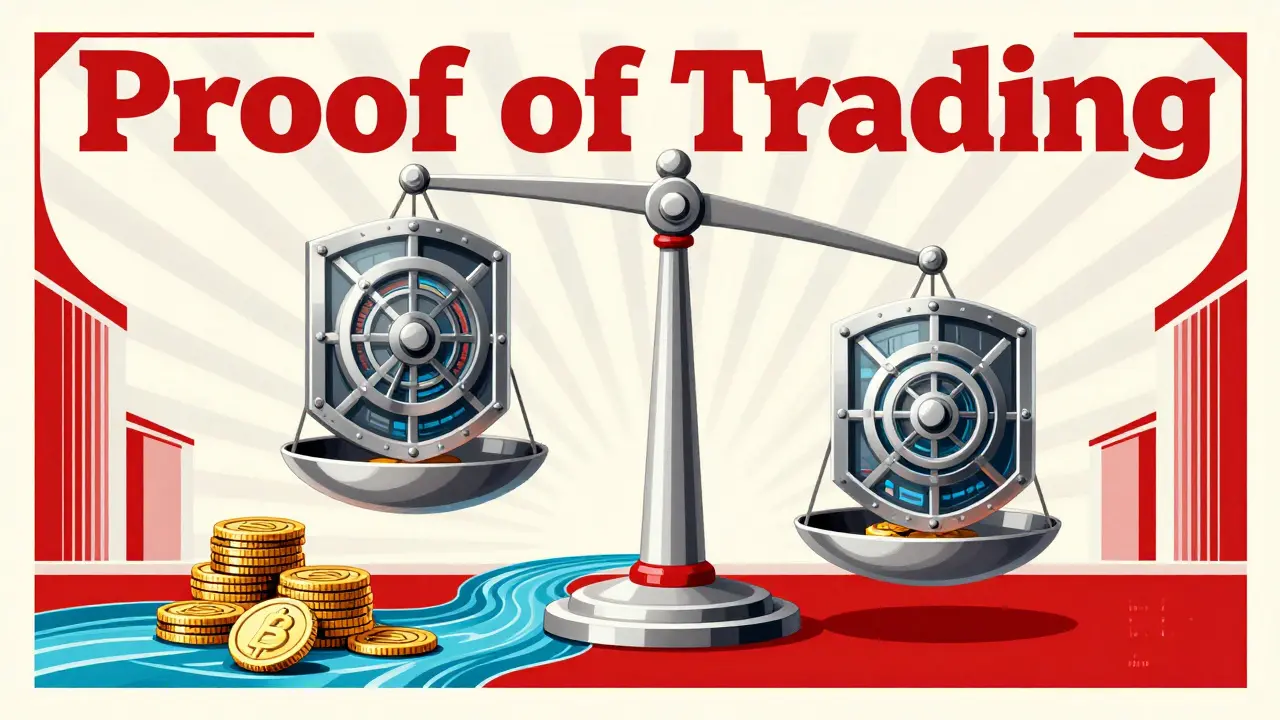
The standout feature of the MAIGA ecosystem is its distribution and consensus model: Proof of Trading (PoT). Most cryptocurrencies use Proof of Stake (PoS) or Proof of Work (PoW), where security and rewards are tied to holding coins or mining power. PoT flips this script.
In the Maiga system, your trading activity and liquidity provision are measured and verified. Rewards in MAIGA are then linked to this activity rather than static staking balances. Here is why that matters:
- Verifiable Activity: Using zero-knowledge proofs (ZK-proofs), the system can prove that trading volume originates from actual users without revealing sensitive personal data.
- Aligned Incentives: Instead of encouraging "wash trading" or speculative farming detached from real liquidity, PoT rewards contributions to market depth and genuine activity.
- Agent Incentives: The AI agents themselves are incentivized based on the quality of their signals and the resulting trading volume they generate, creating a self-reinforcing loop of value creation.
This approach attempts to solve a common problem in DeFi: low liquidity and inactive participants. By rewarding active engagement, Maiga aims to build a more robust and responsive market environment.
Tokenomics and Supply Details
Understanding the supply dynamics is crucial for any potential investor. MAIGA operates on the BNB Chain as a BEP-20 token. Its contract address begins with `0xcd1679f117e81defc4f0009311ddc23fc1ae4a5e`.
| Attribute | Value |
|---|---|
| Total Supply | 1,000,000,000 MAIGA (Hard-capped) |
| Circulating Supply | 280,000,000 MAIGA (28% of total) |
| Locked/Reserved | 720,000,000 MAIGA (72% of total) |
| Launchpool Allocation | 5,000,000 MAIGA (0.5% of total) |
| Token Generation Event | July 17, 2025 |
All 1 billion tokens were created at the Token Generation Event (TGE) on July 17, 2025, meaning there is no inflationary minting mechanism. The remaining 72% of the supply is locked or reserved for future distributions, launchpool programs, and ecosystem incentives. This structure suggests that significant selling pressure could emerge if these reserves are released quickly, so monitoring the unlock schedule is essential for risk management.
Market Performance and Volatility
As of early July 2026, MAIGA is classified as a micro-cap cryptocurrency. Market data varies slightly across aggregators due to indexing differences, but the general picture is one of high volatility and low liquidity relative to major assets.
According to CoinGecko and CoinMarketCap, the price hovers around $0.0044-$0.0055 per token. The market capitalization sits between $1.5 million and $2.3 million, depending on whether you look at fully diluted valuation or circulating supply metrics. To put this in perspective, the total crypto market cap is over $2.7 trillion, meaning MAIGA represents less than 0.0001% of the entire industry.
Historically, the token has experienced extreme swings. It reached an all-time high (ATH) of approximately $0.1183 to $0.1982 in late 2025, depending on the data source. From that peak, the price has dropped by over 95%, a drawdown typical of speculative micro-cap assets during bearish phases. However, short-term rallies have been sharp, with weekly gains exceeding 140% reported in some periods. This indicates that while long-term holders may be underwater, active traders see opportunities in the intraday volatility.
Where to Buy and Trade MAIGA
Accessing MAIGA is relatively straightforward thanks to its presence on both centralized and decentralized platforms. You don’t need to navigate obscure peer-to-peer markets.
- Centralized Exchanges (CEX): MAIGA is listed on major venues including Binance Alpha, Gate.io, KuCoin, and Coinbase. These platforms offer higher liquidity and easier fiat on-ramps. On KuCoin, for example, 24-hour trading volumes have exceeded $1.6 million, indicating decent daily turnover.
- Decentralized Exchanges (DEX): You can swap MAIGA directly on BNB Chain using PancakeSwap or Uniswap. This requires a Web3 wallet like MetaMask or Bitget Wallet. Note that wrapped versions of the token exist on other chains like Solana, but the primary contract is on BNB Chain.
When buying on DEXs, always verify the contract address to avoid scams. The official address starts with `0xcd16...`. Additionally, check the slippage settings, as micro-cap tokens can suffer from thin order books, leading to higher price impact on larger trades.
Risks and Considerations
No investment is without risk, and MAIGA carries several specific concerns that you should weigh carefully.
High Volatility: With a sub-$2 million market cap, large buys or sells can move the price significantly. A single whale transaction could trigger a 10-20% swing in minutes.
Liquidity Depth: While trading volume exists, it fluctuates wildly. Some days see only $30,000 in volume, while others spike to millions. Low liquidity days can make it difficult to exit positions without slippage.
Technological Complexity: The reliance on TEEs, ZK-proofs, and AI agents is innovative but also introduces smart contract and execution risks. If the AI models fail or the TEEs are compromised, the value proposition collapses.
Team Anonymity: Public profiles do not extensively detail the core developers or founders. While the project raised $2 million in September 2025, suggesting institutional interest, the lack of transparent team information adds a layer of counterparty risk.
Future Outlook
Maiga.ai continues to develop its platform, emphasizing its role as an AI co-pilot for everyday users. The roadmap focuses on expanding agent capabilities, integrating more prediction markets, and refining the Proof of Trading mechanism. The project’s viability will depend on its ability to convert its technical novelty into sustained user adoption. If it can attract a critical mass of active traders who benefit from the AI insights, the demand for MAIGA as a utility token could grow organically. However, until then, it remains a speculative play in the broader AI-crypto narrative.
Is MAIGA a good investment in 2026?
MAIGA is a high-risk, high-reward micro-cap asset. Its potential depends on the success of the Maiga.ai platform and adoption of its Proof of Trading model. Given its 95% drawdown from all-time highs and low market cap, it is suitable only for investors with a high risk tolerance and a long-term horizon. Always conduct your own research and never invest more than you can afford to lose.
What is Proof of Trading (PoT)?
Proof of Trading is a consensus and reward mechanism used by Maiga.ai. Instead of rewarding passive holding (staking), it rewards active trading volume and liquidity provision. These activities are verified using zero-knowledge proofs to ensure authenticity without compromising privacy. This aligns incentives between traders, liquidity providers, and AI agents.
Which blockchain does MAIGA run on?
MAIGA primarily operates on the BNB Chain (formerly Binance Smart Chain) as a BEP-20 token. While wrapped versions may exist on other networks like Solana for cross-chain compatibility, the native contract and primary liquidity reside on BNB Chain.
How many MAIGA tokens are in circulation?
As of mid-2026, the circulating supply is 280 million MAIGA, which is 28% of the total fixed supply of 1 billion tokens. The remaining 720 million tokens are locked or reserved for future ecosystem incentives, launchpools, and distributions.
Can I buy MAIGA on Coinbase?
Yes, MAIGA is listed on several centralized exchanges including Coinbase, Binance Alpha, KuCoin, and Gate.io. You can purchase it using USDT or other supported base currencies. For decentralized trading, you can use PancakeSwap or Uniswap on the BNB Chain.


Eric Braddock
July 12, 2026 AT 13:28Proof of Trading is just a fancy euphemism for wash trading incentivized by the dev team to pump the chart before the rug pull. The zero-knowledge proofs are likely obfuscating the fact that the liquidity is synthetic and controlled by a single wallet cluster. I have seen this pattern before with other micro-caps on BNB Chain, where the 'AI agents' are merely scripts executing pre-programmed market manipulation strategies to create an illusion of organic volume. The TEEs are a red herring designed to sound impressive to retail investors who don't understand hardware security enclaves. This is not innovation; it is predatory financial engineering disguised as technological advancement.
Nick Wengel
July 13, 2026 AT 00:20I find the concept interesting because it tries to solve the liquidity problem in DeFi. It seems like a fair way to reward people who actually use the platform instead of just holding tokens. The idea of AI helping with trading decisions could be useful for beginners who do not know how to analyze charts. I think we should wait and see if the user base grows naturally over time.
Alicia Hull
July 13, 2026 AT 09:55You are completely ignoring the fundamental flaws in the tokenomics structure! How can you trust a project with 72% of the supply locked and reserved when the team is anonymous? That is not a feature; that is a massive risk factor waiting to explode. You need to look at the vesting schedule closely because those unlocks will dump millions of dollars worth of pressure onto a sub-$2 million market cap. Do not let the shiny AI buzzwords distract you from the basic reality of supply and demand dynamics here.
Johan Otto
July 13, 2026 AT 17:50Boring read. Just another scam coin trying to use AI hype to trick grandmas into buying worthless pixels on a blockchain. Stay away unless you want to lose everything instantly.
Anuj Kashyap
July 14, 2026 AT 04:24The philosophical implication of rewarding 'activity' rather than 'ownership' is quite profound, isn't it? 🤔 It shifts the paradigm from passive accumulation to active participation in the economic ecosystem. However, one must ask: does activity equate to value creation, or merely churn? The entropy of the market suggests that without genuine utility, such mechanisms often devolve into gambling disguised as trading. 😂
Tracy Marshall
July 15, 2026 AT 07:53i feel like these ai agents are watching us all the time its scary how they track every move we make on the chain they say its secure but who knows what data is being sold to advertisers or worse government agencies we need to protect our privacy at all costs dont trust the tech giants behind this
Guy Davis
July 16, 2026 AT 11:52This whole thing feels wrong ethically. Rewarding trading volume encourages speculative behavior which hurts the real economy. People should save their money not gamble it on volatile tokens. Its irresponsible to promote this kind of financial toxicity.
KEITH WONG
July 16, 2026 AT 13:00Look at the chart boys 📉📈. Classic pump and dump setup. The devs are going to exit soon so don't be that guy holding the bag. Smart money is already out. #CryptoRealityCheck 💸
Natalie Lucas
July 18, 2026 AT 00:03Im excited about the potential for AI in crypto! It sounds like a fun way to learn more about trading without needing to be an expert. Maybe i will try a small amount just to see how it works. Lets support new projects and grow together! 🚀✨
Curtis Johnson
July 18, 2026 AT 15:25Oh wow this is really intense stuff! I mean on one hand the technology sounds super cool but on the other hand its so risky. I just hope everyone stays safe and doesnt invest more than they can afford to lose. Its a wild ride out there in crypto land!
Steven Briggs
July 19, 2026 AT 11:01Seems risky. I prefer stablecoins.
Hamza k
July 21, 2026 AT 00:09Absolute circus! The drama surrounding these micro-cap AI coins is exhausting. One day they are the next Bitcoin, the next day they are down 95%. It is a rollercoaster of emotions and financial ruin for the unprepared. Keep your distance from this chaotic mess.
Kim Kay
July 22, 2026 AT 13:11I tried to read through the whitepaper but it was hard to follow. The language is very technical. I wish there were simpler explanations for people like me who are new to this space. Maybe someone could summarize the key points in plain english?
Brad Semp
July 23, 2026 AT 15:18The notion that 'Proof of Trading' constitutes a legitimate consensus mechanism is intellectually bankrupt. It lacks the cryptographic rigor of Proof of Work and the economic finality of Proof of Stake. This is merely a marketing construct designed to exploit the current zeitgeist surrounding artificial intelligence. True innovation requires substantive architectural breakthroughs, not semantic rebranding of existing incentive structures. The reliance on centralized exchanges for liquidity verification further undermines the purported decentralization of the protocol.
Korn Arrieta
July 24, 2026 AT 20:04Let's cut the fluff. The price action is weak. Volume is low. The AI narrative is oversaturated. If you are buying this based on the 'co-pilot' hype, you are falling for a classic FOMO trap. The fundamentals do not support the valuation even at these lows. Wait for a clear breakout above resistance before considering any entry. Until then, it is dead money.
Jackie D
July 25, 2026 AT 21:36I am curious about how the AI agents actually interact with the prediction markets. Is it fully automated or does it require user input? The colorful description of the multi-venue interface sounds intriguing but I need more concrete examples of how it benefits the average trader. Can anyone share a screenshot of the dashboard?
Ruth Williams
July 27, 2026 AT 16:07It is astonishing how many individuals lack the discernment to recognize the obvious deficiencies in this project. The anonymity of the development team is not a quirky feature; it is a glaring indicator of potential malfeasance. To suggest otherwise is to display a troubling ignorance of basic due diligence principles. One would expect a higher standard of scrutiny from participants in this marketplace.