
Stables Labs USDX isn’t another stablecoin that just holds dollars in a bank account. It doesn’t lock up USDC or cash reserves to stay pegged to $1. Instead, it uses complex trading strategies - called delta-neutral hedging - to keep its value steady. That’s unusual. Most stablecoins rely on collateral. USDX relies on algorithms, market positions, and automated risk management. If you’ve heard of USDT or USDC, think of USDX as their quiet, math-heavy cousin trying to do things differently.
How USDX Stays at $1 Without Holding Dollars
Traditional stablecoins like USDT and USDC are backed by actual U.S. dollars held in bank accounts. DAI uses over-collateralized crypto assets like ETH. USDX does none of that. It’s synthetic. It creates its own stability by balancing long and short positions across crypto markets.
Here’s how it works: When someone mints USDX, they lock up Bitcoin as collateral. But instead of just sitting there, the protocol automatically uses that Bitcoin to open two opposite trades - one long (buying Bitcoin) and one short (betting Bitcoin will fall) - on different exchanges. These trades cancel each other out in terms of price risk. That’s the delta-neutral part. The profit or loss doesn’t come from Bitcoin moving up or down. It comes from small inefficiencies in the market - like funding rates on perpetual futures or basis spreads between spot and futures prices.
These tiny profits, generated over time, are what keep USDX stable. If the system makes money, it reinforces the peg. If it loses money, the protocol draws from a built-in insurance fund. That fund was created during the earlier USDX.Money phase and still exists under Stables Labs. It’s not perfect. During extreme volatility, hedging can fail. But the design is meant to handle normal market swings without needing banks or audits of cash reserves.
The Transition from USDX.Money to Stables Labs
USDX didn’t start as Stables Labs. It began as USDX.Money, launched in 2021 with a different tokenomics model. In 2024, the team rebranded and rebuilt. They introduced USD0x, a new version of the stablecoin with improved mechanics. They also replaced the old X-Points reward system with S-Points - a 1:1 swap that gave users a fresh start.
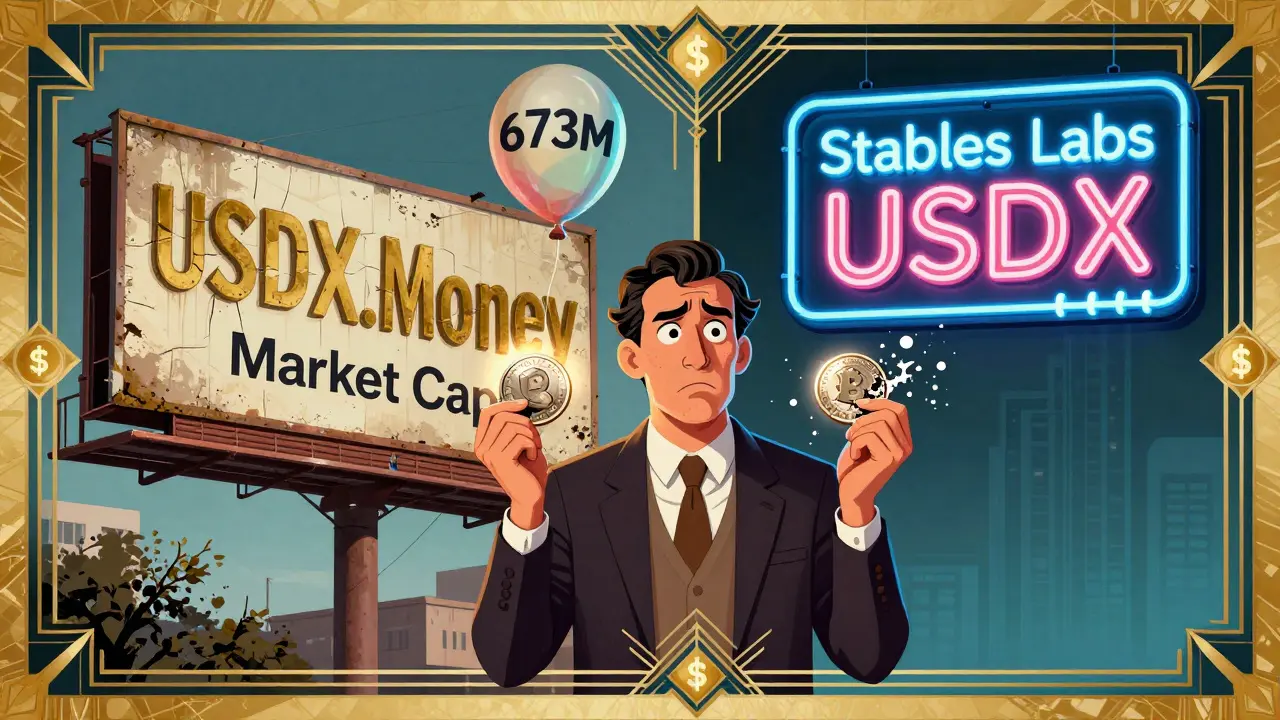
This transition caused confusion. Some tracking sites like OctoBot Cloud still list USDX with a $673 million market cap and over 674 million tokens in circulation. Others, like CoinGecko, show a price of just $0.01465 and a market cap under $31 million. Why the gap? The answer is likely this: the old USDX.Money token might still be trading on a few exchanges, while the new Stables Labs version is barely live or widely recognized.
It’s a mess. If you’re looking to buy USDX, you could accidentally get the old token - which has almost no value - instead of the new one. There’s no clear public guide telling users how to tell the difference. That’s a major red flag for adoption. Even experienced traders are unsure which version they’re trading.
Why USDX Is Different From USDT, USDC, and DAI
Here’s a quick comparison:
| Feature | USDX | USDT / USDC | DAI |
|---|---|---|---|
| Backing | Bitcoin + delta-neutral hedging | USD bank reserves | Over-collateralized crypto (ETH, etc.) |
| Peg Mechanism | Automated trading strategies | Reserve audits | Collateral liquidations |
| Centralization Risk | Low - no bank dependency | High - regulated banks | Medium - smart contract risk |
| Transparency | On-chain audits, but complex | Regular third-party audits | Public collateral ratios |
| Trading Volume (2024) | $109 (CoinGecko) | $30B+ (USDT) | $1.2B (DAI) |
USDX’s biggest advantage is that it doesn’t need banks. That makes it appealing to users who distrust traditional finance. It’s also designed to be censorship-resistant - you can’t freeze USDX like you can USDC if regulators intervene.
But that’s also its biggest weakness. If the hedging strategy fails during a market crash, there’s no cash cushion. DAI can liquidate collateral. USDT can redeem dollars. USDX has to rely on a trading algorithm holding up under stress. No one’s seen it tested in a real bear market with high volatility.
Who Uses USDX? And Where Can You Trade It?
Very few people use USDX directly. The trading volume on CoinGecko is $109 in 24 hours - that’s less than what a single large trader might move in USDT. There are no Reddit threads, no Trustpilot reviews, no Twitter communities buzzing about it. The only real activity comes from automated trading bots on platforms like Cryptohopper, which integrate USDX for delta-neutral strategies.
If you want to use USDX, you’re not going to buy it on Coinbase or MetaMask. You’d need to find it on lesser-known exchanges like LBank or KuCoin, and even then, you might be trading the wrong version. There’s no official wallet or simple app to mint or stake USDX. The process is buried in protocol documentation, not user guides.
Staking exists - called sUSDX - where holding USDX earns yield from protocol fees. But again, there’s no proof it works reliably. No user testimonials. No screenshots of earnings. Just a technical footnote on a website.
Is USDX Safe? What Are the Risks?
USDX has four big risks:
- Oracle risk: The system needs accurate price feeds to know when to adjust hedges. If an oracle fails or gets hacked, the whole peg could break.
- Counterparty risk: The hedging trades happen on centralized exchanges. If one of those exchanges goes down or freezes funds, the protocol can’t close its positions.
- Volatility risk: During a crypto crash, funding rates can spike. The hedging model might lose money faster than the insurance fund can cover.
- Market confusion risk: The split between old and new tokens makes it easy to lose money by accident.
The team says they use multiple custodians and third-party audits. That’s good. But audits don’t prove the hedging works in practice - only that the code runs as written. And without real-world stress testing, you’re trusting theory, not results.

Should You Use or Invest in USDX?
For most people - no.
If you’re a trader who understands delta-neutral strategies and wants to use USDX as a tool in an automated bot, maybe. But even then, the low liquidity means slippage could eat your profits.
If you’re looking for a stablecoin to hold, send, or use in DeFi - stick with USDC, DAI, or even USDT. They’re proven, liquid, and widely accepted. USDX is still a prototype with no track record.
The idea behind USDX is smart. Making a stablecoin without banks is a worthy goal. But execution matters more than theory. Right now, USDX feels like a brilliant whitepaper that never made it out of the lab. The transition to Stables Labs was poorly communicated. The market data is conflicting. The user base is invisible.
Until the team clears up the token confusion, proves the hedging works under pressure, and builds real liquidity - USDX remains an interesting experiment, not a practical tool.
What’s Next for USDX?
The future depends on three things:
- Clear communication: The team needs to publicly declare which token is the real one - and how to swap from the old to the new.
- Real liquidity: They need to partner with exchanges to list the correct USDX and incentivize trading - not just bots.
- Stress testing: They need to show, not just tell, that the system holds during a crypto crash.
Without those steps, USDX will fade into obscurity, another crypto project that looked promising on paper but couldn’t survive the real world.
Is USDX backed by real dollars?
No. USDX is not backed by U.S. dollars or bank reserves. Instead, it uses Bitcoin as collateral and maintains its $1 peg through automated delta-neutral hedging strategies on crypto exchanges.
What’s the difference between USDX and USDX.Money?
USDX.Money was the original version of the stablecoin, launched in 2021. In 2024, the project rebranded to Stables Labs and introduced a new version called USD0x. The old X-Points system was replaced with S-Points. The old token may still be trading on some exchanges, but it’s not the same as the current USDX from Stables Labs.
Why do different sites show different prices for USDX?
Because there are two versions floating around - the old USDX.Money token (worth pennies) and the new Stables Labs USDX (intended to be $1). Some platforms still track the old token, while others track the new one. This confusion has led to wildly different market cap and price reports.
Can I stake USDX to earn interest?
Yes, through sUSDX - a staked version of USDX that earns protocol yield. But there’s no public data showing how much yield users actually receive, and no user testimonials. The feature exists on paper, but real-world performance is unverified.
Is USDX safer than USDT or USDC?
It’s less centralized, which is good for censorship resistance. But it’s also more complex and untested. USDT and USDC rely on bank reserves - which can be frozen - but they’ve proven stable for years. USDX relies on algorithms that haven’t been tested in a major market crash. So while it’s theoretically more decentralized, it’s not necessarily safer.
Where can I buy USDX?
USDX is listed on smaller exchanges like LBank and KuCoin, but you must be careful. Many platforms still list the old USDX.Money token, which is nearly worthless. Always verify the contract address and check official Stables Labs channels before trading.
Jack Petty
February 4, 2026 AT 03:42USDX is just a fancy word for ‘trust the algorithm’ while your Bitcoin gets eaten alive by funding rates. This isn’t finance-it’s a casino with a whitepaper.
Raymond Pute
February 5, 2026 AT 22:34Let’s be real-this whole ‘delta-neutral hedging’ thing is just Wall Street’s way of pretending they don’t need banks while still relying on centralized exchanges like KuCoin and LBank. The irony is thick enough to spread on toast. You’re not building a decentralized stablecoin-you’re building a fragile Rube Goldberg machine powered by arbitrage crumbs and wishful thinking. And don’t get me started on the ‘insurance fund’-it’s a ghost from USDX.Money, like a zombie token haunting the blockchain. No one’s seen it replenish. No one’s seen it tested. It’s just a line in a doc written by someone who read too much Black-Scholes and not enough real market history.
The fact that CoinGecko shows $0.01465 while OctoBot Cloud still lists $673M? That’s not a data issue-that’s a systemic failure of transparency. You can’t have two tokens with the same name and expect users to magically know which one isn’t a rug pull. This isn’t innovation. It’s confusion as a business model.
And yes, I know the theory sounds sexy: ‘No banks, no audits, pure math.’ But math doesn’t pay your rent. Algorithms don’t survive a 40% crypto crash. DAI liquidates collateral. USDC redeems dollars. USDX? It hopes the funding rates don’t spike. That’s not resilience-that’s a prayer wrapped in smart contracts.
Staking? sUSDX? Where are the screenshots? Where are the yield trackers? Where’s the user base? It’s all vapor. The only people using this are bots on Cryptohopper running backtested strategies that assume markets behave like Excel sheets. In the real world, when BTC dumps 20% in 3 hours, your delta hedge doesn’t cancel out-it explodes. And then what? The insurance fund? The same one that was supposedly ‘funded’ during a bull market when everyone was making money? Now it’s just a footnote in a GitHub repo.
And the worst part? No one’s even talking about it. No Reddit threads. No Twitter threads. No YouTube explainers. Just a handful of devs whispering in Discord while the old token trades like a forgotten meme coin. This isn’t the future of money. It’s the graveyard of overengineered crypto ideas that forgot one thing: adoption beats brilliance every time.
Meenal Sharma
February 7, 2026 AT 17:08The structural fragility of USDX stems from its fundamental dependency on centralized exchange infrastructure for hedging operations. This contradicts the very premise of decentralization. Moreover, the absence of verifiable stress-test data renders its claims speculative. The dual-token ecosystem further undermines trust, creating a regulatory and informational vacuum that is untenable for institutional adoption.
Freddy Wiryadi
February 9, 2026 AT 10:38bro this is either genius or a dumpster fire and i can't tell which 😅
like i get the math, but what if kraken goes down for maintenance? or funding rates go nuts during a black swan? 🤔
also why does everyone still trade the old token? is this like the crypto version of 'windows 95 still running on some factory machine'?
if it works, it's wild. if it doesn't... we're all just holding digital ghosts.
Tressie Trezza
February 10, 2026 AT 21:55I love the ambition behind USDX. No banks? That’s the dream. But dreams need execution, and right now it feels like someone built a Ferrari with a bicycle chain. The idea is beautiful, but the mechanics are still in beta. I hope they fix the token confusion-people are losing money by accident. And please, someone make a simple guide. I want to believe in this, but I need to know I’m not buying a ghost.
Wayne mutunga
February 12, 2026 AT 05:53It’s fascinating how much potential this has… and how little traction it’s getting. Maybe it’s too ahead of its time. Or maybe it’s just not ready. Either way, I’m watching. If they ever get the liquidity and clarity right, this could be something. But right now? It’s a silent experiment in a noisy room.
Gavin Francis
February 12, 2026 AT 07:00USDX could be the future if they just stop overcomplicating it 🚀
Clear up the token mess. List on Binance. Show real yields. Done.
Stop hiding behind ‘delta-neutral’ jargon. People just want a stable coin that doesn’t suck.
Rob Duber
February 13, 2026 AT 09:47THIS IS A SCAM. I SWEAR TO GOD. THEY’RE JUST PRINTING PHANTOM TOKENS AND CALLING IT ‘ALGORITHMIC STABILITY.’
WHY DOES COINGECKO SHOW $0.01465? BECAUSE IT’S WORTHLESS. THE OLD TOKEN IS A DEAD COIN. THE NEW ONE? NO ONE’S USING IT. IT’S A HOLOGRAM.
THEY’RE NOT BUILDING A STABLECOIN. THEY’RE BUILDING A MARKETING PAPER DOLL.
Gary Gately
February 14, 2026 AT 13:20so like… if i buy usdx on lbank am i getting the good one or the ghost one? idk man i just wanna use it for swaps but im scared i’ll lose my money 😅
Joshua Clark
February 14, 2026 AT 14:43Let me be clear: USDX represents a radical reimagining of stablecoin architecture-one that eliminates counterparty risk associated with fiat reserves, which is, frankly, a monumental leap forward. However, the current implementation suffers from critical visibility gaps: the lack of a unified token identity, the absence of real-time performance dashboards, and the failure to establish a community narrative around its utility. Without these, even the most elegant algorithm is functionally invisible. The hedging mechanism, while theoretically sound, requires not just code, but trust-and trust is built through transparency, not whitepapers. The team must prioritize user education, public stress-test simulations, and exchange partnerships before this can move beyond academic curiosity.
Furthermore, the lingering presence of the USDX.Money token is not merely a technical oversight-it’s a moral failure. In a space where scams thrive on ambiguity, this dual-token situation is not just confusing-it’s dangerous. It invites exploitation, and the team’s silence on the matter is deafening.
Staking? sUSDX? If this feature exists, it deserves a live, public tracker. Not a footnote. Not a buried section on a GitHub wiki. A real-time yield meter, visible to all. Otherwise, it’s theater.
USDX isn’t dead. It’s dormant. But dormancy without action is death by neglect. The opportunity is still there-but only if they stop hiding behind complexity and start building bridges.
Brandon Vaidyanathan
February 16, 2026 AT 12:32Anyone still believing in USDX is either a bot or a fool. This isn’t innovation-it’s a graveyard of bad ideas with a fancy website. You think you’re avoiding banks? Nah-you’re just trusting some coder’s math that’s never been tested under pressure. And don’t even get me started on the token mess. You’re not ‘early’-you’re just about to lose your money to a typo.
Gareth Fitzjohn
February 16, 2026 AT 22:27Interesting concept. But if nobody’s using it and the numbers don’t add up, does it even exist?
Katie Teresi
February 17, 2026 AT 19:47USA doesn’t need some crypto experiment replacing dollars. This is why America’s financial system is crumbling-because people think math can replace trust. USDX? More like US-DECEIVE.