
Every time a new Bitcoin block is added to the chain, it’s not just another entry-it’s a cryptographic lock that secures the entire history of Bitcoin. If you’ve ever wondered how Bitcoin stays tamper-proof without a bank or central authority, the answer lies in its block structure. It’s simple, elegant, and brutally secure. And once you understand how it works, you’ll see why changing even one transaction would require rewriting the entire blockchain from that point forward.
What’s Inside a Bitcoin Block?
A Bitcoin block has two main parts: the block header and the transaction body. The header is just 80 bytes long-smaller than a typical emoji. But inside that tiny space lives the entire security mechanism of Bitcoin. The transaction body holds everything else: the actual money transfers, the inputs, the outputs, and the signatures that prove you own the Bitcoin you’re spending.The header doesn’t contain any transaction data. Instead, it holds six pieces of metadata that link this block to the one before it and prove it was mined correctly. These six fields are the foundation of Bitcoin’s trustless system.
The Block Header: Six Fields, One Purpose
Let’s break down each of the six fields in the block header, byte by byte.
- Version (4 bytes) - This tells the network which rules the block follows. For example, version 1 means basic Bitcoin rules. Version 2 or higher might include SegWit or Taproot features. Miners set this when they start hashing, and nodes reject blocks with versions they don’t recognize.
- Previous Block Hash (32 bytes) - This is the SHA-256 hash of the previous block’s header. It’s what creates the "chain" in blockchain. If you change any data in Block 100, its hash changes. That breaks the link to Block 101, which references Block 100’s hash. To fix it, you’d have to re-mine Block 101, then 102, then 103… all the way to the current block. That’s why tampering is practically impossible.
- Merkle Root (32 bytes) - This is a single hash that represents every transaction in the block. It’s built by hashing transaction pairs together in a binary tree structure. Even if one transaction changes by a single bit, the Merkle root changes completely. This lets nodes verify all transactions in a block with just one hash check.
- Timestamp (4 bytes) - This is the Unix timestamp (seconds since January 1, 1970) when the miner started working on the block. It can’t be more than two hours ahead of network time, and it must be later than the median of the last 11 blocks. This prevents miners from faking timestamps to manipulate difficulty.
- nBits (4 bytes) - This is the encoded target threshold. It’s not the actual number miners are trying to beat-it’s a compact way to represent a 256-bit number. The lower the target, the harder the mining puzzle. This value adjusts every 2,016 blocks (about every two weeks) based on how fast blocks have been found.
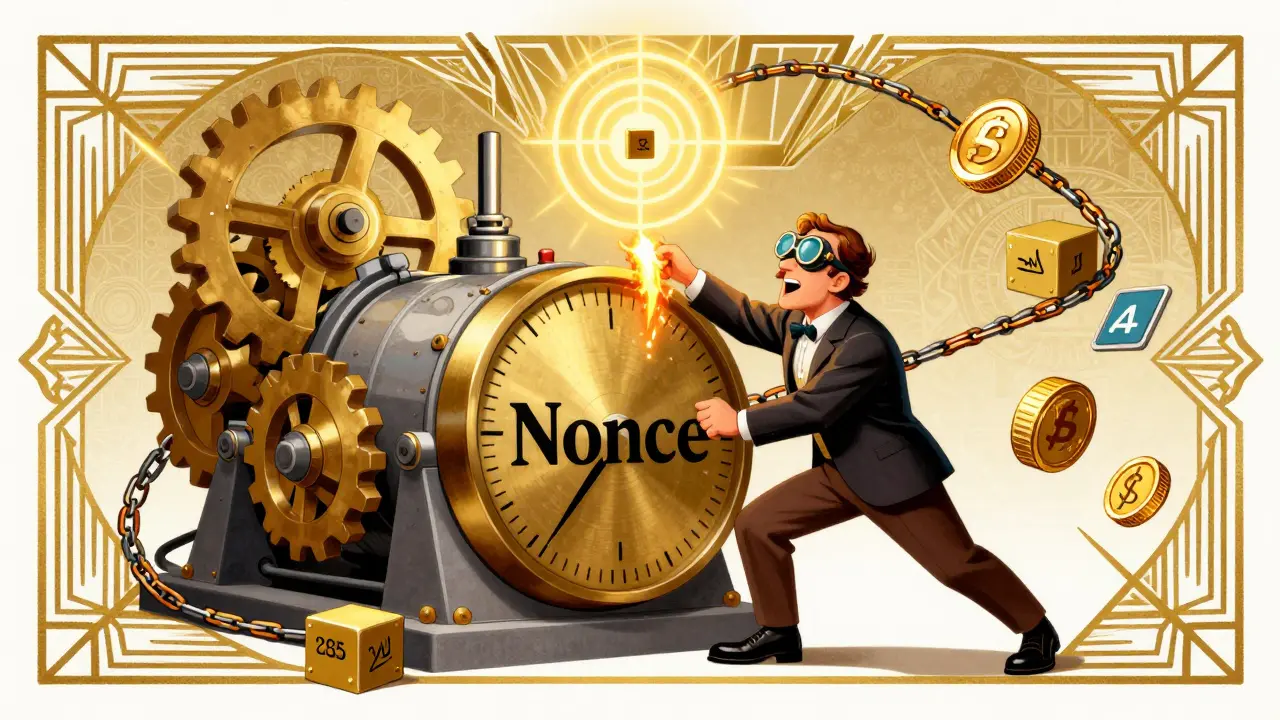
- Nonce (4 bytes) - This is the number miners change over and over again to try and find a valid block hash. It starts at zero and increments until the resulting hash is below the target. The nonce is the only part of the header that miners can freely change without breaking the structure.
Together, these six fields form a digital fingerprint. Miners hash the entire header using SHA-256 twice-SHA256(SHA256(header)). If the result is lower than the target set by nBits, the block is valid and gets added to the chain.
Transactions: The Real Value
After the 80-byte header comes the transaction section. It starts with a compact size integer that tells you how many transactions are in the block-anything from 1 to over 4,000. Then comes each transaction, one after another.
Each transaction has four parts:
- Version - Usually 1 or 2. Version 2 enables relative locktimes and is required for SegWit.
- Inputs - These reference previous transaction outputs (UTXOs). Each input includes the transaction ID of the output being spent, the index number of that output, a scriptSig (signature and public key), and a sequence number (used for replace-by-fee or time-locked transactions).
- Outputs - These define where the Bitcoin goes. Each output has a value (in satoshis) and a locking script (scriptPubKey). That script says who can spend it-usually a Bitcoin address derived from a public key hash.
- Locktime - A timestamp or block number that says when the transaction can be added to the blockchain. Most are set to zero, meaning they’re valid immediately.
For SegWit transactions (activated in 2017), there’s an extra section called the witness. It contains the signatures and public keys separately from the main transaction data. This reduces the size of transactions, increases capacity, and fixes a flaw called transaction malleability. SegWit doesn’t change the block header-it just changes how the transaction body is interpreted.
How Mining Works: Finding the Right Hash
Miners don’t just pick a block and submit it. They build a candidate block from scratch. They grab unconfirmed transactions from the mempool, arrange them in a Merkle tree, set the timestamp, copy the previous block’s hash, and set the nBits based on the current difficulty.
Then they start guessing. They change the nonce, hash the header, and check if the result is low enough. If not, they try the next nonce. A modern ASIC miner can try trillions of hashes per second. The first one to find a valid hash broadcasts the block to the network.
Other nodes check it: Are the transactions valid? Is the Merkle root correct? Is the hash below target? Is the timestamp reasonable? If everything checks out, they accept the block and start building on top of it.
This process is called proof-of-work. It’s expensive, slow, and energy-intensive-but that’s the point. The cost of attacking the network is higher than the value of stealing Bitcoin.
Why This Structure Is Unbreakable
Imagine you try to alter a transaction in Block 500,000. You change the amount from 1 BTC to 10 BTC. Now:
- The transaction ID changes.
- The Merkle root changes.
- The block header changes.
- The block hash changes.
- Block 500,001’s "previous block hash" no longer matches.
- So Block 500,001 becomes invalid.
- You have to re-mine 500,001, then 500,002, then 500,003… all the way to the current block.
At current network difficulty, re-mining even 10 blocks would take a single miner over 100 years. And that’s assuming you have all the world’s mining power. The network has over 1,000 exahashes per second. You’d need more than 10% of that just to keep up.
That’s not just security-it’s economic deterrence.
How Block Structure Enables Trust
You don’t need to trust a bank to use Bitcoin. You don’t need to trust the miner who found the block. You don’t even need to trust the node you’re connected to.
All you need is the block structure and a few lines of code to verify it yourself. You can download the entire blockchain (over 600 GB as of 2025) and run a full node. Then, you can check every transaction, every block, every signature. You can see that the Merkle root matches the transactions. You can confirm the hash is below target. You can verify the timestamp isn’t fake.
That’s why Bitcoin is called a system of trustless verification. The structure does the work. The math enforces the rules.

Evolution Without Breakage
Since 2009, the block structure has barely changed. That’s rare in software. Most systems need complete overhauls. Bitcoin upgrades through soft forks-changes that are backward compatible.
SegWit (2017) didn’t alter the header. It just added a witness section to transactions. Taproot (2021) changed how scripts are built and signed, but the block header stayed the same. Miners could still mine blocks with old software, and old nodes could still validate them.
This design choice is intentional. Stability matters more than flashy features. If the block structure changed every year, no wallet, exchange, or mining pool could keep up. Bitcoin survives because its foundation doesn’t wobble.
What You Can Do With This Knowledge
If you’re a developer, you can build tools that parse blocks, track UTXOs, or analyze transaction patterns. If you’re a miner, you’ll understand how your hardware fits into the puzzle. If you’re a user, you can use a blockchain explorer like Blockstream.info to look up any block and see its header, transactions, and Merkle root for yourself.
Want to verify a transaction? Go to a block explorer. Find the block it’s in. Check the Merkle root. Confirm the transaction ID is part of that root. You’ve just done what the entire Bitcoin network does every 10 minutes-without asking anyone’s permission.
That’s the power of structure. Simple. Transparent. Unstoppable.
What is the size limit of a Bitcoin block?
The base block size limit is 1 MB, but with SegWit, blocks can be larger because witness data is counted at a quarter weight. This allows blocks to hold up to 4 MB worth of transactions in practice, though most blocks today are between 1.2 MB and 1.8 MB. The actual limit depends on how many SegWit transactions are included.
Can a block have zero transactions?
Yes. The Genesis Block had only one transaction-the coinbase reward. Blocks with no transactions (other than the coinbase) are rare but valid. Miners sometimes create them to claim the block reward without including any user transactions, especially during low network activity.
How often are Bitcoin blocks created?
On average, every 10 minutes. The Bitcoin protocol adjusts the mining difficulty every 2,016 blocks to keep this timing consistent-even as more or less mining power joins the network. In practice, blocks can come faster or slower, but the network self-corrects over time.
What’s the difference between a block header and a full block?
The block header is the 80-byte summary that links blocks together and proves proof-of-work. The full block includes the header plus all the transactions. Full nodes store both. Lightweight wallets (SPV nodes) only store headers to save space, trusting that the transactions are valid based on the header’s Merkle root.
Why is the previous block hash so important?
It creates the chain. Without it, blocks would be disconnected. The previous block hash ensures that every block depends on the one before it. Changing any past block would break every subsequent block’s link, making tampering instantly detectable. This is what makes Bitcoin’s ledger immutable.
Can the Merkle root be faked?
No. The Merkle root is a cryptographic hash of all transactions in the block. To fake it, you’d need to find a different set of transactions that produces the same hash-which is computationally impossible with SHA-256. Even changing one byte in one transaction changes the entire Merkle root. Nodes verify this by reconstructing the Merkle tree from the transactions in the block.
What happens if two miners find a block at the same time?
You get a temporary fork. Two blocks are broadcast, and different nodes accept different ones. Miners then start building on whichever block they received first. Within a few blocks, one chain becomes longer, and the network abandons the shorter one. The transactions in the abandoned block go back to the mempool and get included in a future block. This is normal and is called an orphan block.
Do all Bitcoin nodes store the full block structure?
Full nodes do-they download and verify every block since the Genesis Block. Lightweight nodes (SPV) only store block headers and rely on full nodes to verify transactions. Exchange servers and wallets often use SPV mode for speed and storage efficiency, but they can’t independently verify the entire chain.
Next Steps: Explore a Block Yourself
Go to Blockstream.info and look up Block 840,000 (or any recent block). Click on the block header. You’ll see the version, previous hash, Merkle root, timestamp, nBits, and nonce-all laid out in hex. Now click on "Transactions." See how each one references inputs and outputs. Try finding a SegWit transaction-it’ll have a witness section marked with 00 and 01 bytes.
You’re not just reading about Bitcoin anymore. You’re reading its code.


Ellen Sales
December 22, 2025 AT 19:28Collin Crawford
December 24, 2025 AT 01:52Aaron Heaps
December 25, 2025 AT 17:21Tristan Bertles
December 25, 2025 AT 23:22Earlene Dollie
December 27, 2025 AT 19:15Dusty Rogers
December 29, 2025 AT 07:09Kevin Karpiak
December 30, 2025 AT 01:06Amit Kumar
December 30, 2025 AT 11:36chris yusunas
December 31, 2025 AT 14:50Mmathapelo Ndlovu
December 31, 2025 AT 23:39Tyler Porter
January 1, 2026 AT 17:26SHEFFIN ANTONY
January 3, 2026 AT 02:42Zavier McGuire
January 4, 2026 AT 03:57Sybille Wernheim
January 4, 2026 AT 08:04