Imagine buying a Bitcoin for $45,000 in New York and selling it instantly for $47,000 in Seoul. Sounds like free money, right? For years, traders have watched this exact scenario play out on screens, yet very few actually make the profit. This price gap is known as the Kimchi Premium, a phenomenon where cryptocurrencies trade at significantly higher prices on South Korean exchanges compared to global platforms. It’s not just a quirk of the market; it’s a direct result of strict financial walls that keep money from flowing freely across borders.
If you’ve ever wondered why your favorite coin costs more in one country than another, or if you’re curious about how regulations can distort even a decentralized asset like Bitcoin, you’re in the right place. We’re going to break down exactly what causes this premium, why it persists despite obvious arbitrage opportunities, and what it tells us about the broader state of digital assets. By the end, you’ll understand why South Korea remains one of the most unique and volatile players in the global crypto ecosystem.
Key Takeaways
- The Kimchi Premium is the price difference between South Korean crypto exchanges and international markets, often ranging from 3% to over 10%, with historical peaks near 55%.
- Strict capital controls and anti-money laundering laws prevent easy arbitrage, meaning traders cannot simply buy low abroad and sell high in Korea without significant friction.
- High retail demand in South Korea drives prices up locally, creating a feedback loop where speculative trading inflates premiums during bull markets.
- The premium serves as a real-time indicator of local market sentiment and regulatory pressure, often signaling upcoming government interventions.
- While technically an arbitrage opportunity, practical barriers like residency requirements and transfer delays make it difficult for outsiders to profit consistently.
What Exactly Is the Kimchi Premium?
Let’s start with the basics. The term "Kimchi Premium" isn’t official financial jargon; it was coined by traders because kimchi is a staple of Korean cuisine, much like Bitcoin has become a staple of the local investment portfolio. Technically, it refers to the percentage difference in the price of a cryptocurrency-most commonly Bitcoin (BTC) or Ethereum (ETH)-when traded on major South Korean exchanges like Upbit or Bithumb versus global giants like Binance or Coinbase.
For example, if Bitcoin is trading at $60,000 on Coinbase but hits $63,000 on Upbit, that’s a 5% Kimchi Premium. In January 2018, during the height of the first great crypto boom, this gap widened dramatically. At its peak, Bitcoin traded for nearly 55% more in South Korea than in the US. That means for every dollar spent globally, a Korean buyer paid fifty-five cents extra for the same digital asset. While those extreme numbers have cooled, the premium rarely disappears entirely. As of late 2025, it typically hovers between 3% and 8%, fluctuating based on news cycles, regulatory announcements, and global market trends.
You might ask, "Why doesn’t everyone just buy cheap coins abroad and sell them in Korea?" That’s the million-dollar question-or rather, the billion-won question. The answer lies in the fact that money doesn’t move as fast as data. While blockchain transactions are instant, moving fiat currency (like USD to KRW) across borders involves banks, regulations, and time delays that kill most quick-profit strategies.
Why Does the Premium Exist?
The existence of the Kimchi Premium defies the efficient market hypothesis, which suggests that identical assets should have identical prices everywhere. So, what keeps these prices apart? It boils down to three main factors: isolated demand, capital controls, and regulatory friction.
Isolated Demand and Cultural Factors
South Korea has one of the highest rates of cryptocurrency adoption in the world. A massive portion of the population, particularly younger generations facing high housing costs and competitive job markets, views crypto as a viable path to wealth. This creates intense local demand. When thousands of retail investors rush to buy Bitcoin simultaneously, they bid up the price on local exchanges faster than global markets can adjust. Unlike institutional-driven markets in the US, Korea’s market is heavily driven by retail speculation, leading to sharper spikes and deeper dips.
Capital Controls: The Invisible Wall
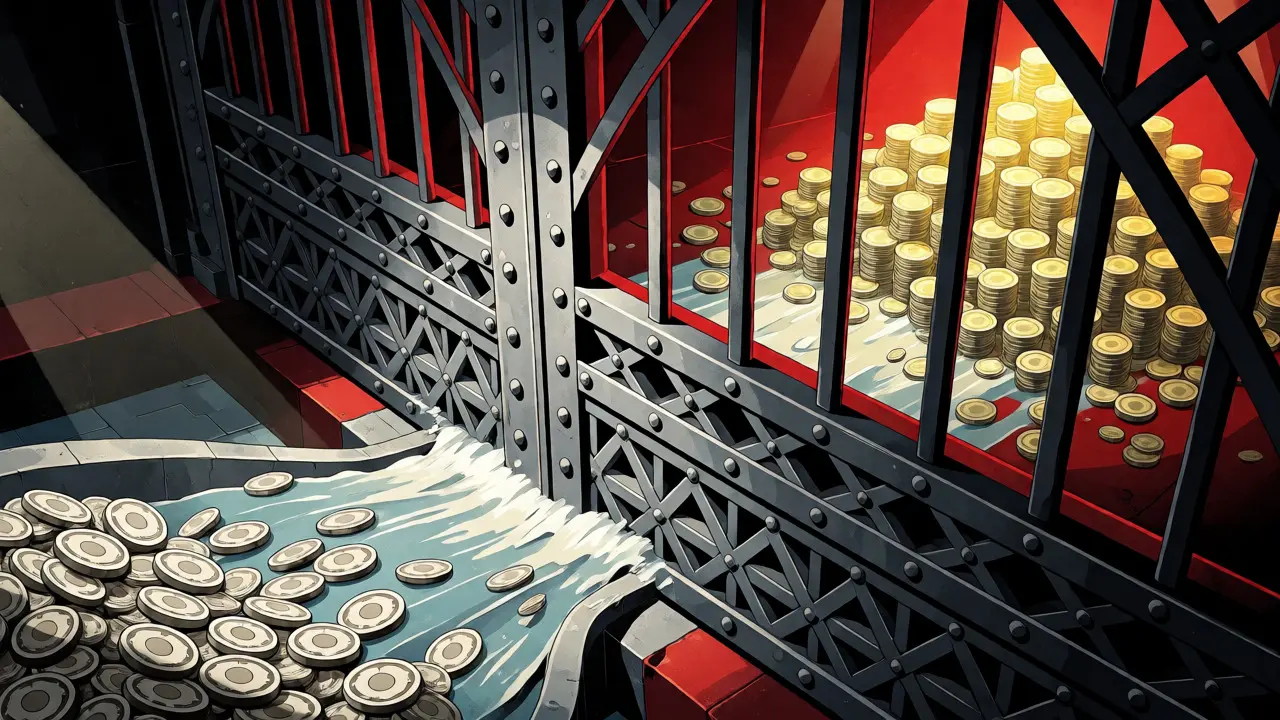
This is the biggest reason the premium persists. South Korea enforces strict capital controls managed by the Bank of Korea. These rules limit how quickly and how much money can leave or enter the country. If you want to buy Bitcoin in Korea using dollars earned abroad, you face bureaucratic hurdles. You need a verified local bank account, proof of residence, and compliance with anti-money laundering (AML) checks. These steps take time-often days. By the time your money arrives and converts to Won (KRW), the price gap may have closed, or worse, reversed.
Regulatory Restrictions
The South Korean government treats cryptocurrency with a mix of caution and control. Laws prohibit anonymous accounts, requiring all traders to use their real identities linked to bank accounts. Furthermore, foreign exchanges are restricted from offering services directly to Korean residents without specific licenses, effectively forcing users onto domestic platforms like Upbit and Bithumb. This isolation prevents global liquidity from smoothing out local price discrepancies. The government also periodically threatens bans or stricter taxes, which fuels uncertainty and drives speculative behavior, further widening the premium.
Can You Actually Profit From Arbitrage?
In theory, yes. In practice, it’s incredibly hard. Let’s look at the mechanics of trying to exploit the Kimchi Premium. Suppose you see Bitcoin at $50,000 on a US exchange and $54,000 on a Korean exchange. You decide to execute an arbitrage trade.
- Buy Bitcoin: You purchase BTC on the US exchange. Easy enough.
- Transfer Funds: You send your USD to a Korean bank account. This step triggers compliance checks. Banks scrutinize large transfers for crypto-related purposes. This can take 2-5 business days.
- Convert Currency: Your USD becomes KRW. Exchange rates fluctuate daily, adding another layer of risk.
- Deposit and Trade: You deposit KRW into Upbit and buy Bitcoin. But wait-the price in Korea might have dropped while you were waiting for your money to clear.
- Sell and Withdraw: You sell the BTC and try to withdraw the profits back to the US. Now you face withdrawal limits and fees on the way out.
The time lag is the killer. Crypto markets move in seconds, not days. Most retail traders don’t have the infrastructure to hedge against this timing risk. Institutional players with dedicated legal teams and pre-approved banking channels can manage this better, but even they find margins thin once fees and slippage are accounted for. For the average person, the "free lunch" usually comes with a hefty bill of transaction costs and missed opportunities.
The Impact of Market Volatility and Speculation
The Kimchi Premium isn’t static; it breathes with the market. During periods of high volatility, such as when Elon Musk tweets about Dogecoin or when the SEC approves a new ETF, Korean traders react aggressively. Because the market is smaller and less liquid than the global aggregate, large orders can move prices significantly. This amplifies the premium.
There’s also a psychological component known as FOMO (Fear Of Missing Out). When Korean media reports on rising crypto prices, retail investors pile in, assuming the trend will continue. This herd mentality pushes local prices above global averages. Conversely, when regulators announce crackdowns, panic selling occurs locally, sometimes causing the premium to invert temporarily (a discount) before stabilizing.
| Feature | Global Markets (e.g., Binance, Coinbase) | South Korean Market (e.g., Upbit, Bithumb) |
|---|---|---|
| Liquidity | Very High; deep order books absorb large trades easily. | Moderate; large trades can cause significant price slippage. |
| User Base | Mixed: Institutions, whales, and retail globally. | Heavily Retail-dominated; high participation rate among young adults. |
| Regulations | Varies by jurisdiction; generally open to foreign access. | Strict KYC/AML; real-name accounts required; capital controls apply. |
| Price Discovery | Reflects global sentiment and macroeconomic factors. | Reflects local sentiment, news, and regulatory rumors. |
| Arbitrage Ease | N/A (Baseline). | Difficult due to transfer times and banking restrictions. |
What the Premium Tells Us About the Future
Watching the Kimchi Premium is like watching a weather vane for the Asian crypto market. A widening premium often signals strong bullish sentiment in Asia, suggesting that capital is flooding into the region seeking yield. A narrowing or disappearing premium might indicate that global markets are catching up, or that regulatory fears are dampening local enthusiasm.
As of November 2026, the conversation around the premium has shifted. With the rise of stablecoins and improved cross-border payment rails, some analysts predict the gap will shrink permanently. However, as long as sovereign nations maintain control over their fiat currencies, some degree of price disparity will remain. The Kimchi Premium is a reminder that cryptocurrency, despite its borderless nature, still operates within the physical constraints of national economies.
For investors, understanding this dynamic helps in timing entries and exits. If you’re holding assets in USD, be aware that converting them to KRW during a high-premium period could erode your gains. Conversely, if you’re based in Korea, remember that your local prices include a "risk premium" for the regulatory environment. Don’t assume that a high local price means the asset is fundamentally stronger there-it just means the doors are harder to open and close.
Why is it called the Kimchi Premium?
It is named after kimchi, a traditional fermented vegetable dish that is a staple of Korean cuisine. The name was adopted by traders to highlight that the price discrepancy is uniquely characteristic of the South Korean market, much like kimchi is unique to Korean culture.
Is the Kimchi Premium always present?
Not always, but it is frequent. Under normal conditions, it averages around 3-5%. However, during periods of extreme volatility or regulatory uncertainty, it can spike to double digits or even drop to zero if global prices surge faster than local ones.
Can foreigners trade on Korean crypto exchanges?
Generally, no. Most major Korean exchanges require a local bank account and proof of residency to comply with strict anti-money laundering laws. This excludes most international tourists and remote workers from accessing the lower-priced global markets directly via Korean platforms.
How do capital controls affect crypto prices?
Capital controls restrict the speed and volume of money leaving South Korea. This prevents arbitrageurs from quickly moving funds to balance prices. If you can’t move money out of the country easily, you can’t sell high in Korea and buy low elsewhere, allowing the price gap to persist.
Does the Kimchi Premium apply to all cryptocurrencies?
Primarily, it is tracked for Bitcoin (BTC) and Ethereum (ETH) due to their high liquidity and global recognition. However, smaller altcoins listed on Korean exchanges can experience even larger premiums or discounts depending on local listing pumps and hype cycles.