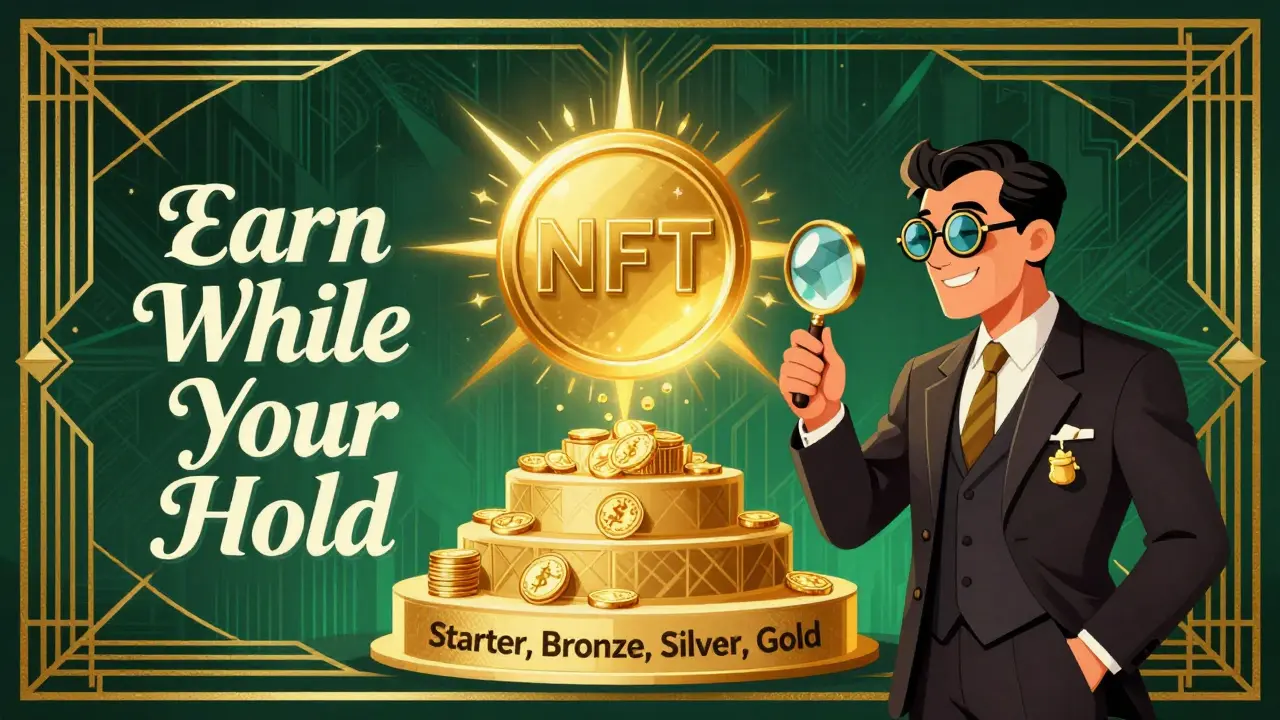
CoinCollect isn’t another crypto project promising moonshots. It’s a working platform that lets you earn crypto just by holding NFTs - no trading, no farming, no guesswork. If you’ve ever owned an NFT and wondered what good it does besides sitting in your wallet, CoinCollect answers that question. The platform’s native token, COLLECT, powers everything: staking rewards, governance, NFT purchases, and even burning supply to fight inflation. But here’s the catch - it’s not listed on Binance, doesn’t have trading volume, and most people haven’t heard of it. So is it real? Or just another ghost project?
How CoinCollect actually works
CoinCollect runs on a simple idea: your NFTs shouldn’t just be digital art. They should earn you money. The platform lets you stake your NFTs as collateral and get paid in COLLECT tokens - automatically. No need to lock up crypto. No complex yield strategies. Just hold the right NFT, and you get daily or weekly payouts. The NFTs themselves aren’t random pictures. They’re called Utility NFTs and come in four tiers: Starter, Bronze, Silver, and Gold. Each has a power multiplier (1x to 9x) and a star rating (1 to 5 stars). A Gold 5-star NFT with 9x power earns significantly more than a Starter 1-star. These aren’t just for show. The higher the tier, the more COLLECT tokens you earn per day, week, or month - depending on the NFT’s settings. Ownership is full and open. You can trade your NFTs on the CoinCollect marketplace, stake them, or even sell them elsewhere. Every time someone buys an NFT on the platform, a small portion of the COLLECT tokens used in the transaction gets burned. That means less supply over time - and potentially more value for those who hold.The COLLECT token: more than just a reward
COLLECT isn’t just the reward token. It’s the engine. You need it to mint new NFTs. You need it to vote on platform changes. You need it to farm additional rewards. And yes, you need it to buy other NFTs on the marketplace. The tokenomics are built around three core rules:- Burn mechanism: A percentage of every trade fee is used to buy back COLLECT tokens and destroy them. Less supply = higher scarcity.
- Anti-whale rules: The team limits how many tokens any single wallet can hold early on, preventing big investors from controlling the market.
- Governance rights: Holders vote on upgrades, fee structures, and new features. If you own COLLECT, you have a say in where the platform goes.
Where to buy COLLECT and how to get started
You won’t find COLLECT on Coinbase, Kraken, or Binance. Not yet. Right now, it’s only available on decentralized exchanges (DEXs) like Uniswap or PancakeSwap - but only if you already have crypto to trade with. Here’s the real-world process:- Buy ETH, BNB, or USDT on a centralized exchange like KuCoin or Crypto.com.
- Transfer it to a Web3 wallet like MetaMask or Trust Wallet.
- Connect your wallet to a DEX that lists COLLECT.
- Swap your base currency for COLLECT tokens.

Why trading volume is zero - and what that means
CoinMarketCap, LiveCoinWatch, and Binance all show 24-hour trading volume for COLLECT as $0. That’s not a typo. It’s a red flag. Price data varies wildly between platforms: $0.00042 on CoinMarketCap, $0.00046 on LiveCoinWatch. That kind of spread only happens when there’s no real trading - just bots or isolated trades. If no one’s buying or selling, the price is just a guess. This isn’t necessarily a scam. Many early-stage DeFi projects start with zero volume. But it does mean one thing: liquidity is nonexistent. If you need to sell your COLLECT tokens tomorrow, you might not find a buyer. Or you’ll have to sell at a huge discount. The platform’s success hinges on one thing: adoption. If more people start buying NFTs on CoinCollect, trading volume will rise. If NFT holders start earning real income, more people will join. But right now, it’s a chicken-and-egg problem. No volume → no trust → no new users.Who is CoinCollect for?
This isn’t for speculators chasing quick gains. It’s for people who already own NFTs and want them to do more. Think of it like owning a rental property - you don’t buy it to flip it next week. You buy it because it pays rent. If you’re into:- Passive income from digital assets
- Decentralized platforms with real utility
- Long-term NFT strategies over hype cycles
The risks you can’t ignore
There are three big risks with CoinCollect:- No exchange listings: Without Binance or Coinbase, mainstream adoption is impossible. This could stay a niche project forever.
- Zero volume: If no one’s trading, the token’s price is meaningless. You could buy at $0.00045 and never find someone to pay $0.00046.
- Unproven team: No public team members, no LinkedIn profiles, no verified social media. That’s common in DeFi, but it’s still a risk.
Is CoinCollect worth your time?
If you have $20-$50 to spare and want to test a new kind of NFT earning model - go for it. Buy a Starter or Bronze NFT, stake it, and see what you earn over 30 days. Track it. Compare it to other NFT staking platforms like Yield Guild Games or Axie Infinity. But don’t bet your savings on it. Don’t FOMO in because someone on Twitter says it’s the next big thing. The data doesn’t support that. CoinCollect has a solid idea: turn NFTs into income machines. But ideas don’t pay bills. Adoption does. And right now, adoption is barely there. If you’re patient, observant, and willing to experiment - this could be a hidden gem. If you want safety and liquidity - look elsewhere.Is CoinCollect (COLLECT) a scam?
No, it’s not a scam - at least not based on what’s publicly available. The platform has a working NFT staking system, a transparent token burn model, and documented utility for COLLECT tokens. But it’s extremely low-risk because there’s no trading volume, no major exchange listings, and no verified team. That doesn’t mean it’s safe - it means it’s unproven. Treat it like a prototype, not an investment.
Can I earn real money with CoinCollect NFTs?
Technically, yes. If you own a high-tier NFT (Silver or Gold), you’ll receive daily COLLECT tokens. But those tokens are worth pennies right now - and you can’t easily cash them out. You’d need to sell them on a DEX, which may have no buyers. So while you’re earning, you’re not necessarily profiting. Real money means liquidity - and that’s missing here.
Do I need to stake COLLECT tokens to earn rewards?
No. You stake your NFTs, not the tokens. The NFTs are the collateral that generates rewards in COLLECT. You can hold COLLECT tokens separately and use them for voting, minting, or buying more NFTs. The earning comes from the NFT, not the token balance.
Why is COLLECT not on Binance or Coinbase?
Binance and Coinbase require projects to meet strict criteria: liquidity, trading volume, team transparency, and legal compliance. CoinCollect has none of those yet. Zero volume means it doesn’t qualify. Listing on a major exchange is a goal, not a current reality. Until trading picks up, it won’t happen.
What’s the best NFT tier to start with on CoinCollect?
Start with Bronze or Silver. Starter NFTs have low power multipliers (1x-3x) and earn very little. Gold NFTs are expensive and carry higher risk since they’re harder to sell if the project fails. Bronze and Silver offer a balance: decent rewards without a huge upfront cost. You can always upgrade later if the platform grows.
Can I sell my CoinCollect NFTs on other marketplaces?
Yes. You own your NFTs outright. You can list them on OpenSea, Blur, or any other marketplace that supports the blockchain they’re built on. But if you sell them outside CoinCollect’s platform, you’ll lose access to the staking rewards. The earning only works if the NFT is staked on CoinCollect’s system.
How does the COLLECT token burn work?
Every time someone buys or sells an NFT on the platform, a small percentage of the COLLECT tokens used in the transaction (usually 1-3%) is automatically sent to a burn address - a wallet that can never be accessed again. This reduces the total supply. Over time, fewer tokens in circulation can increase scarcity, which may push the price up - if demand exists.
Is CoinCollect multi-chain? Which blockchains does it support?
The platform claims to be multi-chain, but public documentation doesn’t specify which networks it uses. Based on wallet compatibility and DEX listings, it’s likely built on Ethereum, BNB Chain, or Polygon. Until the team publishes official details, assume it’s on one or two major chains. Always check the NFT’s blockchain before buying - you’ll need the right network and gas tokens to interact with it.
Shawn Roberts
December 25, 2025 AT 11:14Jake West
December 26, 2025 AT 18:28Andrea Stewart
December 28, 2025 AT 13:26Andrew Prince
December 29, 2025 AT 14:50prashant choudhari
December 31, 2025 AT 12:05Josh Seeto
January 1, 2026 AT 06:16Willis Shane
January 1, 2026 AT 21:19Khaitlynn Ashworth
January 2, 2026 AT 13:23dina amanda
January 2, 2026 AT 16:58NIKHIL CHHOKAR
January 3, 2026 AT 17:05SUMIT RAI
January 3, 2026 AT 17:11Mike Pontillo
January 4, 2026 AT 07:12Jordan Fowles
January 4, 2026 AT 18:17Joydeep Malati Das
January 4, 2026 AT 22:52rachael deal
January 6, 2026 AT 06:57Abhisekh Chakraborty
January 6, 2026 AT 23:49