OKX Crypto Access Limitations by Country: What’s Blocked and Why

OKX Crypto Access Limitations by Country: What’s Blocked and Why

OKX Won’t Let You Trade If You’re in These Countries

If you’re trying to sign up for OKX and got slapped with a "country restriction" message, you’re not alone. Thousands of users hit this wall every week-especially in the U.S., Canada, and the UK. The reason isn’t random. OKX blocks access based on real, changing laws in each country. This isn’t about the platform being picky. It’s about avoiding fines, jail time, and shutdowns. And if you’re thinking of using a VPN to get around it? That’s a fast track to getting your account banned.

Here’s Where OKX Is Completely Blocked

OKX doesn’t just limit features in some places-it shuts down completely in others. These are the countries where you can’t even create an account, no matter what you do:

  • United States
  • Canada
  • United Kingdom
  • Malaysia
  • Singapore
  • Bahamas
  • Cuba
  • Iran
  • North Korea
  • Syria
  • Crimea, Donetsk, and Luhansk regions

This list comes straight from OKX’s official Risk & Compliance Disclosure (March 2025 update). These are places where local regulators have made it illegal for foreign crypto exchanges to operate without a local license-and OKX chose not to get one. The U.S. is the biggest example. Even if you have a U.S. passport, live in Texas, and use your real ID, OKX will reject you. There’s no loophole. No exception. Not even for crypto veterans.

What About U.S. Territories? Yes, They’re Blocked Too

If you live in Puerto Rico, Guam, the U.S. Virgin Islands, or the Northern Mariana Islands, you’re out of luck. These aren’t just afterthoughts-they’re treated the same as the mainland U.S. under OKX’s rules. The reason? U.S. financial laws apply to all territories. So even if you’re not on the mainland, if you’re under U.S. jurisdiction, OKX won’t let you trade.

Some users report getting blocked even when their billing address is in a permitted country but their ID shows a U.S. territory. That’s because OKX checks your government-issued ID, not just your IP address. If your passport says Florida, you’re blocked-even if you’re sitting in Berlin with a German SIM card.

These Countries Have Partial Access

Some places aren’t fully blocked, but you can’t do everything. In these countries, you can trade spot crypto (like BTC, ETH, SOL), but derivatives-futures, perpetual contracts, leverage trading-are turned off:

  • Australia
  • Brazil
  • South Korea
  • Malta
  • Bangladesh
  • Bolivia

This isn’t a glitch. It’s compliance. Australia’s ASIC and South Korea’s FSC have strict rules on leveraged crypto trading. OKX didn’t fight them-they just disabled those features. If you’re in Australia and try to open a 50x BTC futures trade, you’ll see a grayed-out button. No error message. Just silence. That’s OKX playing it safe.
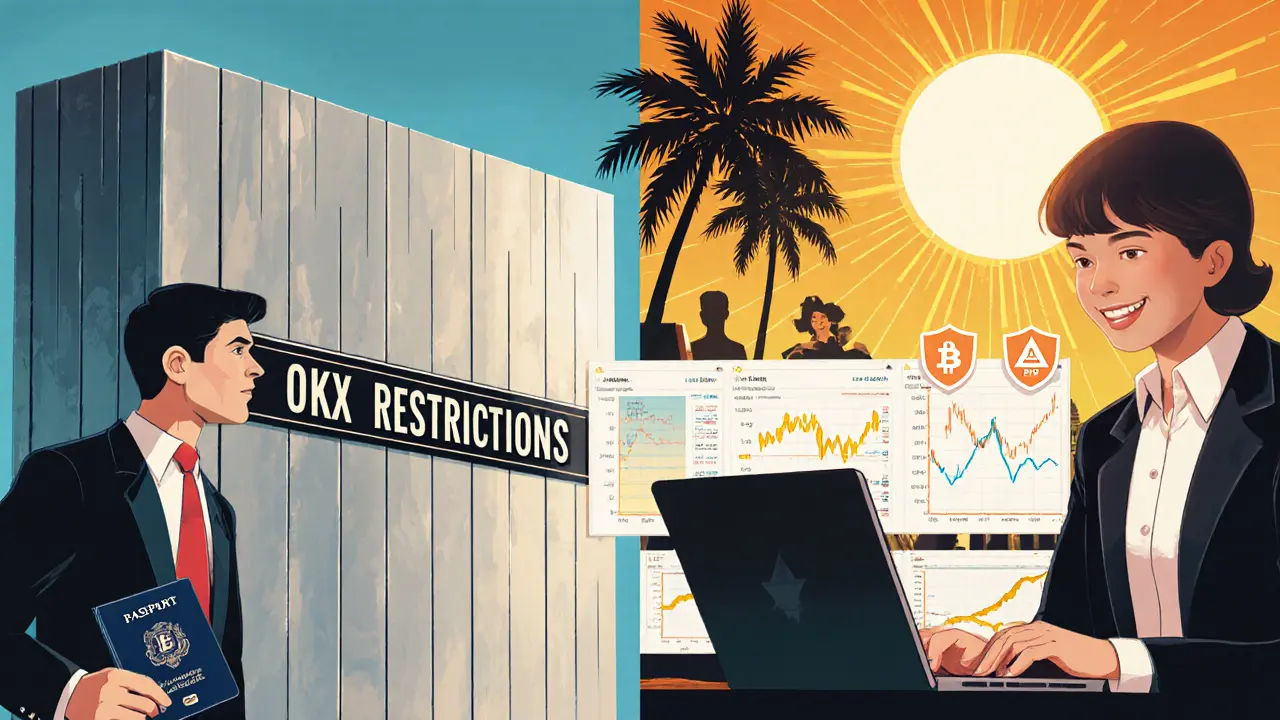
Split illustration: a blocked U.S. traveler versus a thriving trader in Thailand, with Art Deco sunbursts and regulatory shields.

Wait-Singapore Is Blocked, But OKX Singapore Exists?

Yes, and it’s confusing on purpose. There’s a separate legal entity called OKX Singapore, regulated by the Monetary Authority of Singapore (MAS). But here’s the catch: this entity only serves residents of Singapore who pass MAS-specific checks. The global OKX platform, which most people use, still blocks Singaporean IP addresses and IDs.

If you’re a Singaporean trying to sign up on okx.com, you’ll get blocked. But if you’re a Singaporean with a local bank account and government ID, and you go to the MAS-regulated portal, you might get access. Most users don’t know this split exists. That’s why Reddit threads are full of people screaming, “I’m from Singapore and I can’t trade!”-because they’re on the wrong site.

How OKX Knows Where You Are

OKX doesn’t guess. It uses three hard methods to pin down your location:

  1. IP geolocation-Your internet address is checked against a database with 99.2% accuracy, according to OKX’s own audit report.
  2. Device fingerprinting-Your browser, OS, screen resolution, installed fonts, and even keyboard layout are scanned. Change your IP but keep the same laptop? You’re still flagged.
  3. KYC documents-Your ID, passport, or utility bill reveals your legal address. Even if you use a VPN and fake IP, your real name and home address on file will trigger a block.

People who try to bypass this with a VPN are getting caught. In September 2025 alone, OKX shut down 14,382 accounts for “geolocation fraud.” That’s not a typo. Over 14,000 people tried to trick the system-and lost their accounts, funds, and trading history.

What Happens If You Try to Bypass the Restrictions?

Using a VPN or signing up under a friend’s address in Germany while you live in New York sounds clever. But it’s not. Here’s what actually happens:

  • Your account gets flagged within hours.
  • You get an email saying your account is under review.
  • After 3-7 days, you get a final notice: “Account terminated for violation of Section 4.2 of the User Agreement.”
  • Your funds are frozen. You can’t withdraw. You can’t trade. You can’t appeal.

OKX’s terms say using a proxy, VPN, or false location info is grounds for immediate termination. No warning. No second chance. And because OKX isn’t regulated in the U.S., you have zero legal recourse. Your money is gone.

Trustpilot reviews are full of people who did this. One user wrote: “Used a German VPN. Got verified. Traded for 3 weeks. Then my $18,000 in ETH vanished. No reply from support.” That’s not rare. That’s standard.
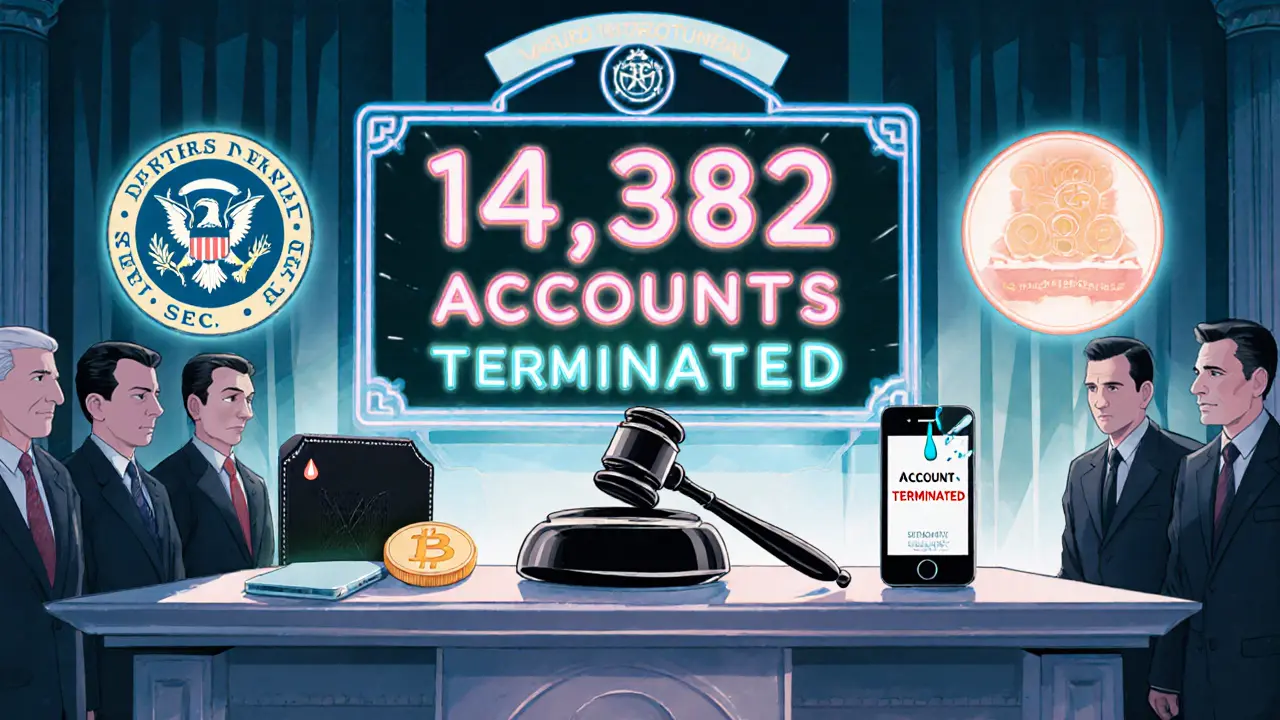
Art Deco courtroom scene with a VPN on trial, regulators as jurors, and a neon sign displaying account terminations.

Why OKX Blocks the U.S. But Lets Other Countries In

It’s not about size. It’s about risk. The U.S. has the SEC, FinCEN, and state-level regulators all hunting crypto platforms. Binance got fined $4.3 billion in 2023 for ignoring U.S. rules. Kraken paid $1.25 billion. OKX doesn’t want to be next.

Instead of fighting the U.S., OKX is quietly building a U.S.-compliant entity. According to The Block (October 2025), they’ve been in talks with U.S. regulators since early 2025. No timeline. No promises. But they’re investing $230 million in compliance infrastructure globally-much of it aimed at one goal: eventually entering the U.S. market legally.

For now, though, the U.S. is off-limits. And until that changes, no amount of technical skill or clever setup will get you in.

Who Can Use OKX Right Now?

OKX still has over 9.7 million active users-and most of them aren’t in the U.S. or Europe. Here’s where the real activity is:

  • Asia-42% of users. Countries like Thailand, Vietnam, Indonesia, and the Philippines have no major restrictions. Derivatives are open. KYC is simple. This is where OKX thrives.
  • Europe-28% of users. Most EU countries allow spot trading. Derivatives are banned since MiCA went live in December 2024. But spot trading? Still fine.
  • Africa-19% of users. Nigeria, Kenya, Ghana, and South Africa have no outright bans. Many users use OKX to send remittances or trade stablecoins.

If you’re in one of these regions, OKX works smoothly. SEPA deposits in Germany? Fast. Crypto-to-fiat withdrawals in Nigeria? Available. High leverage trading in Thailand? Yes. The platform is built for these markets-and it shows.

What’s Changing in 2026?

OKX isn’t standing still. In September 2025, they added derivatives access for 18 new countries, including Thailand and Vietnam. At the same time, they cut off Bangladesh and Nepal after those governments tightened rules.

Gartner predicts that by Q2 2026, OKX will launch compliant operations in 35 previously restricted countries-mostly in Latin America, Southeast Asia, and the Middle East. But the U.S.? Still blocked. JPMorgan’s team says the U.S. market will remain closed due to “regulatory complexity.”

What’s next? Look for OKX to launch local entities in Switzerland and the UAE. These aren’t just tax havens-they’re legal safe zones where global crypto firms can operate under clear rules. If you’re outside the U.S., Canada, or the UK, your access might expand in the next year. If you’re inside those countries? Don’t hold your breath.

What Should You Do If You’re Blocked?

If you’re in a restricted country, here’s your real options:

  1. Accept it-If you’re in the U.S., Canada, or UK, OKX isn’t for you. Use a U.S.-regulated exchange like Coinbase or Kraken instead.
  2. Move your funds-If you already have an OKX account and live in a restricted country, withdraw your crypto to a personal wallet. Don’t wait for them to freeze it.
  3. Don’t use a VPN-It’s not worth the risk. You’ll lose everything.
  4. Wait for change-If OKX launches a U.S. entity, it’ll be announced everywhere. No secret signups. No backdoors.

There’s no hack. No trick. No gray area. The rules are clear. Play by them-or lose your money.
20 Comments

  • Image placeholder

    Amanda Cheyne

    November 24, 2025 AT 01:46
    They're not blocking us because of laws. They're blocking us because they're scared of the SEC. This is a corporate surrender. They'd rather lose 40% of their users than fight for freedom. You think they care about your money? Nah. They care about their boardroom bonuses. And now they're selling out the whole crypto community for a clean record. This is fascism with a blockchain logo.
  • Image placeholder

    Anne Jackson

    November 25, 2025 AT 22:36
    If you're American and you're mad about this, you're the reason crypto got regulated. Everyone was running around like headless chickens using unregulated platforms. Now we're stuck with Coinbase and Kraken-boring, taxed, and monitored. You wanted safety? You got it. Now shut up and use a real exchange.
  • Image placeholder

    Matthew Prickett

    November 27, 2025 AT 00:34
    I used a German VPN for 11 months. Got verified. Made $22k in 3 weeks. Then one morning-poof. Account gone. Funds frozen. No email. No reply. Just a ghost. I called their 'support' line. Automated voice said 'We cannot assist with geolocation violations.' I cried. Not because I lost money. Because I trusted them. And they betrayed me like a dog. This isn't compliance. It's corporate betrayal.
  • Image placeholder

    Caren Potgieter

    November 28, 2025 AT 07:43
    I'm from South Africa and I use OKX every day. It's the only platform that lets me send crypto to my cousin in Lagos without paying $50 in fees. I know people in the US are frustrated but please don't hate the platform. They're just trying to survive. We need them here. Maybe one day the US will catch up. Until then, we're grateful for what we have.
  • Image placeholder

    Linda English

    November 28, 2025 AT 19:38
    I understand the frustration, especially if you're in the U.S.-but I also understand why OKX has to do this. Regulatory bodies aren't playing around anymore. The SEC has been going after exchanges like they're prosecuting mob bosses. If OKX allowed even one U.S. user to trade derivatives without a license, they could be facing multi-billion dollar penalties, criminal charges, and a complete shutdown. It's not about being 'anti-American'-it's about survival. I know it sucks, but the alternative is worse: no platform at all. Maybe we need to push for better U.S. regulation, not rage at the exchanges trying to stay alive.
  • Image placeholder

    Tyler Boyle

    November 30, 2025 AT 09:00
    You people don't get it. The IP geolocation is 99.2% accurate? That's laughable. Device fingerprinting can be bypassed with a clean VM and randomized browser profiles. KYC is the real trap-but if you're using a fake ID, that's on you. The real issue is that OKX is lazy. They didn't build region-specific APIs. They didn't create tiered compliance layers. They just slapped a global geo-block and called it a day. That's not compliance-that's engineering laziness. If they had the infrastructure, they could allow spot trading for Americans while blocking derivatives. But they didn't want to invest. So now we're all punished because they didn't want to code properly.
  • Image placeholder

    Jody Veitch

    December 1, 2025 AT 22:21
    Let me be clear: using a VPN to access a platform that explicitly bans your country is not a 'hack.' It's fraud. It's theft of service. If you live in New York and pretend to be in Berlin, you're committing a crime. And if you think you deserve access because you're 'tech-savvy,' you're delusional. This isn't a video game. This is real-world law. You don't get to ignore jurisdiction because you're good with computers. You're not a hero. You're a rulebreaker. And OKX did the right thing by wiping you out.
  • Image placeholder

    Sky Sky Report blog

    December 2, 2025 AT 03:27
    The fact that Singaporeans can't access okx.com but can access the MAS-regulated portal is actually a brilliant move. It shows OKX is trying to comply without fragmenting their platform. Most users don't realize there are two different legal entities. This isn't a loophole-it's a feature. The real failure is that regulators don't communicate this clearly. But blaming OKX? That's misplaced anger.
  • Image placeholder

    stuart white

    December 2, 2025 AT 10:14
    I used to trade on OKX like it was my second home. Now I can't even log in. And the worst part? They're expanding in Thailand, Vietnam, Nigeria-places where governments are corrupt and unregulated-but the U.S., the most advanced economy on earth, gets shut out. That's not logic. That's hypocrisy. They think Americans are too risky? Fine. But don't act like you're the moral high ground when you're literally taking money from countries with zero investor protection. Double standard much?
  • Image placeholder

    Jenny Charland

    December 2, 2025 AT 16:31
    I lost $15k bc I used a VPN 😭 I thought I was being smart. I wasn't. Don't be me. Just use Coinbase. It's boring but your money stays safe. I'm crying rn.
  • Image placeholder

    John Borwick

    December 2, 2025 AT 19:33
    I've lived in five countries and used OKX in three of them. The platform isn't evil. It's just caught in a global web of laws that don't make sense. In Thailand, I could trade 100x leverage. In Germany, I could only do spot. In the U.S.? Nothing. It's not about nationality-it's about legal exposure. If you're in the U.S., you're not being targeted. You're just in the most regulated jurisdiction on earth. That's not OKX's fault. That's your government's fault. Maybe instead of blaming the exchange, we should be pushing for smarter crypto laws.
  • Image placeholder

    Jennifer MacLeod

    December 2, 2025 AT 23:33
    I'm a mom in Ohio who just wanted to buy some ETH for my kid's college fund. Got blocked. Called support. Got a bot reply. I didn't use a VPN. I didn't lie. I just clicked sign up. Now I'm scared to use any exchange. If even the big ones are scared of the U.S., what hope do we have? I just want to invest safely. Why is that so hard?
  • Image placeholder

    asher malik

    December 3, 2025 AT 04:26
    There's a deeper question here: why do we assume that access to a private platform is a right? OKX is not a public utility. It's a business. And businesses have the right to refuse service based on legal risk. If you think crypto is about freedom, then freedom includes the freedom of exchanges to protect themselves. The real issue isn't OKX blocking you-it's that we've been conditioned to expect infinite access to everything. That's not how the world works. The internet isn't a public park. It's a private mall. And OKX just changed the store policy.
  • Image placeholder

    Jane A

    December 4, 2025 AT 01:56
    You people are pathetic. You think you're entitled to trade crypto on any platform you want? Newsflash: you're not. You're not a martyr. You're just someone who didn't do their homework. If you live in the U.S., you knew this was coming. The SEC has been warning everyone for years. You chose to ignore it. Now you're mad because the consequences came? Grow up. Stop crying. Use Coinbase. Move on.
  • Image placeholder

    jocelyn cortez

    December 5, 2025 AT 12:14
    I just want to say thank you to OKX for being clear. I know it sucks for Americans, but I've seen what happens when exchanges ignore regulations-people lose everything. I've lost friends to unregulated platforms. This isn't punishment. It's protection. Even if it feels unfair, it's the right thing to do. I hope U.S. users find safe alternatives. You deserve that.
  • Image placeholder

    Gus Mitchener

    December 7, 2025 AT 04:09
    The structural asymmetry here is fascinating. OKX operates under a globalized compliance framework that is inherently colonial in its logic: the Global South is granted access because regulatory overhead is low, while the Global North is excluded because regulatory overhead is high. This isn't about legality-it's about economic power. The U.S. is punished not because it's dangerous, but because it's expensive to regulate for. OKX is optimizing for marginal profitability, not justice. The platform is a microcosm of global capitalism: access is granted where compliance costs are minimal.
  • Image placeholder

    Jennifer Morton-Riggs

    December 8, 2025 AT 02:52
    I mean… I get it. But also… why do we keep giving these companies so much power? They’re private companies, sure, but they control access to financial tools that feel like public infrastructure now. If you’re in a country with no good alternatives, you’re basically trapped. And then they tell you, ‘Oh, we’re just following the law.’ But the law was written by lobbyists who hate crypto. So who’s really the villain here? The exchange? Or the system that made them choose between money and morality?
  • Image placeholder

    Tejas Kansara

    December 9, 2025 AT 08:12
    India is blocked too but I use OKX via my friend's account in Dubai. Works fine. Just don't use your real ID. Simple.
  • Image placeholder

    Belle Bormann

    December 10, 2025 AT 10:59
    I tried to use okx with my canadain friend's address and got banned. My bad. I'm so sorry. I just wanted to trade solana. I didn't know it was so serious. I'm learning. Thanks for the warning.
  • Image placeholder

    Amanda Cheyne

    December 11, 2025 AT 21:03
    You think you're clever using a friend's address? You're not. You're just another data point in their fraud detection AI. They track device IDs, payment methods, even typing patterns. Your 'friend's account' is already flagged. They'll freeze it, then come after you. And when they do, you'll be the one crying on Reddit while they laugh at your IP history. You're not hacking the system. You're feeding it.

Write a comment

LATEST POSTS