
You hold Bitcoin. You want to use a lending protocol on Ethereum. But Bitcoin doesn't live on Ethereum. It lives on its own isolated network. This is the fundamental problem of blockchain technology: networks are silos. They don't talk to each other natively. That's where cross-chain bridges come in.
Cross-chain bridges are protocols that connect separate blockchain networks, allowing digital assets and data to move between them seamlessly. Think of them as the internet's TCP/IP for crypto. Without them, you'd need a centralized exchange to swap every asset, paying fees and giving up custody. With them, you can move value directly from your wallet to another chain.
Why Do We Need Bridges?
Blockchain fragmentation is real. In 2026, there are hundreds of active blockchains-Ethereum, Solana, Avalanche, Polygon, Arbitrum, Optimism, and many more. Each has its own rules, consensus mechanisms, and native tokens. If you have USDC on Ethereum but want to earn yield on a DeFi protocol on Solana, you can't just send it there. The chains are incompatible.
Bridges solve this by creating interoperability. They allow assets to flow freely across ecosystems, increasing liquidity and utility. For users, this means faster transactions, lower fees, and access to a wider range of decentralized applications (dApps). For developers, it means building apps that can leverage multiple chains without locking users into one ecosystem.
Without bridges, the crypto world would remain a collection of isolated islands. With them, it becomes a connected continent.
How Cross-Chain Bridges Work: The Lock-and-Mint Mechanism
The most common way bridges work is through a process called lock-and-mint. Here’s how it plays out step-by-step:
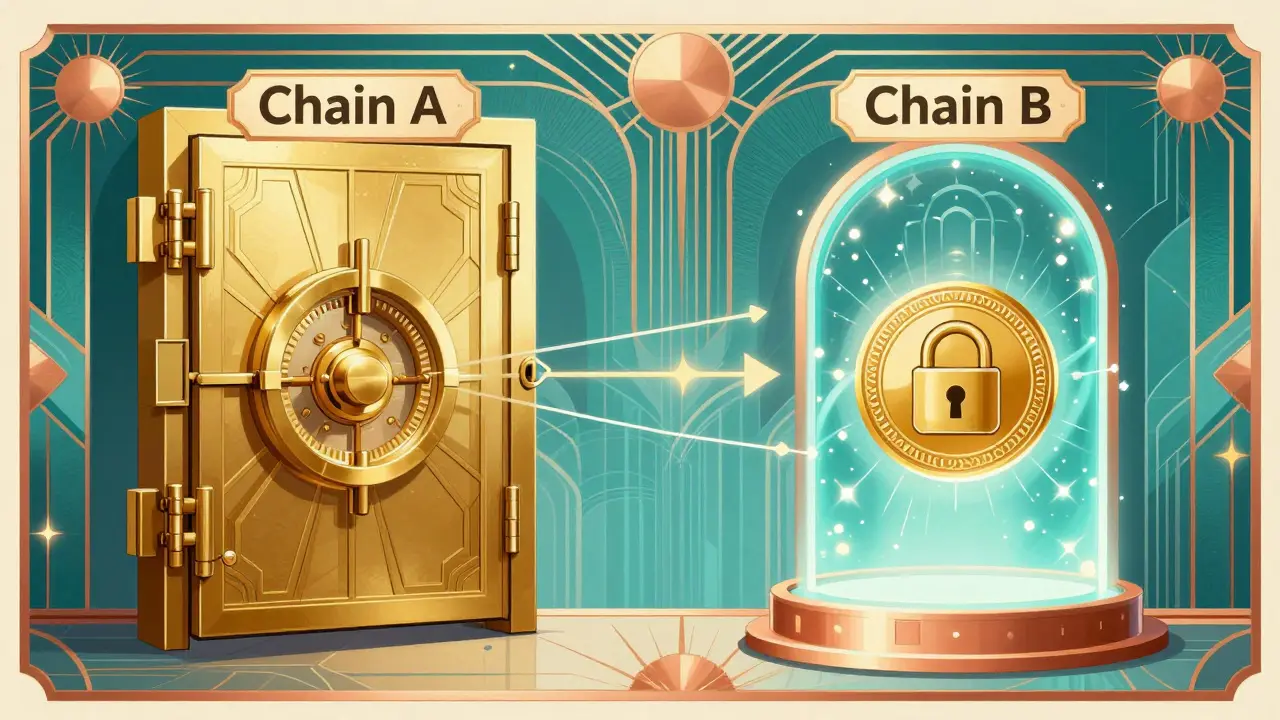
- Locking: You initiate a transfer from Chain A (e.g., Ethereum). The bridge’s smart contract locks your original asset in a vault on Chain A. These tokens are now frozen; you can’t spend them there.
- Minting: The bridge mints an equivalent amount of a "wrapped" version of your asset on Chain B (e.g., Solana). This wrapped token (like wBTC or wETH) is pegged 1:1 to the original.
- Usage: You can now use the wrapped token on Chain B-trade it, lend it, or stake it in dApps.
- Burning: When you want to go back, you burn the wrapped tokens on Chain B. The bridge verifies this and unlocks your original assets on Chain A.
This mechanism ensures that the total supply of the asset remains consistent across both chains. There’s no double-spending because the original is locked while the wrapped version exists elsewhere.
| Feature | Trusted (Centralized) | Trustless (Decentralized) |
|---|---|---|
| Control | Single entity or small group | Distributed validators or algorithms |
| Security | Lower (single point of failure) | Higher (decentralized consensus) |
| Speed | Faster finality | Slower due to verification steps |
| Cost | Often lower fees | Higher gas/validation costs |
| Examples | Early WBTC, some CEX bridges | Wormhole, LayerZero, IBC |
Types of Cross-Chain Bridges
Not all bridges are built the same. They fall into two main categories based on trust assumptions.
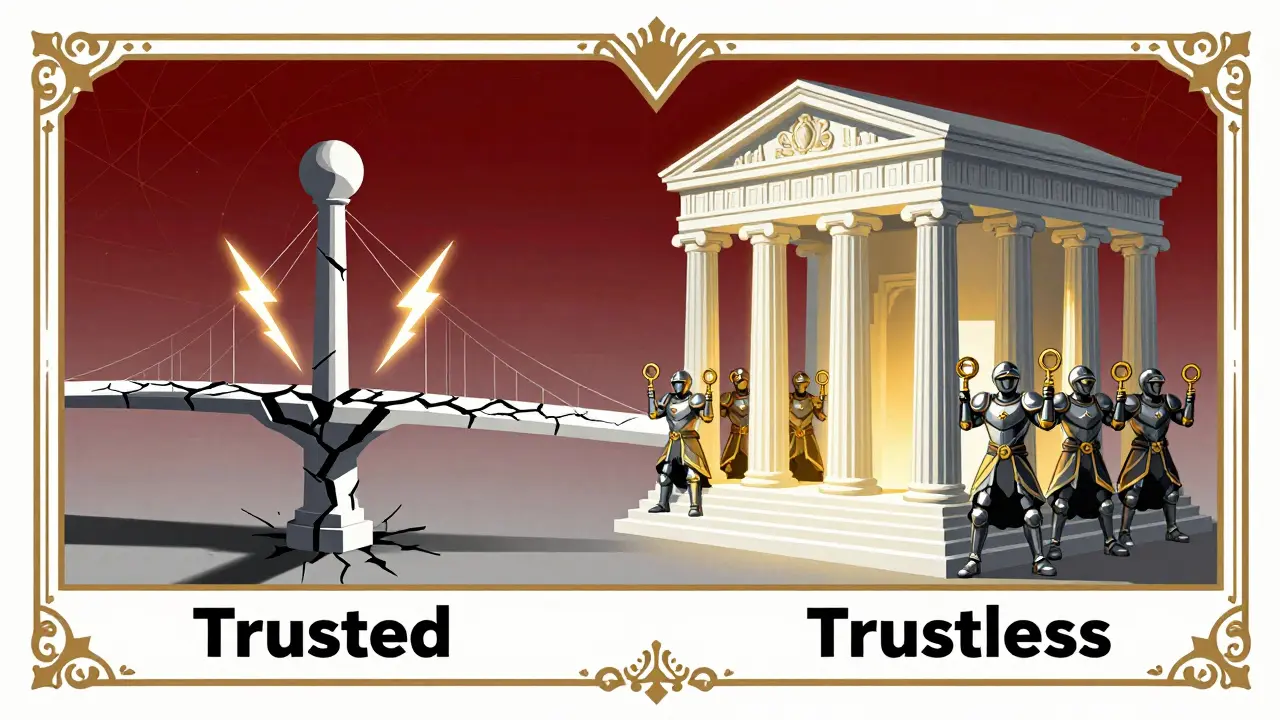
Trusted Bridges rely on a central authority or a small group of validators to confirm transactions. These are easier to set up and often faster, but they introduce counterparty risk. If the custodian gets hacked or acts maliciously, your funds are at risk. Wrapped Bitcoin (WBTC) started as a trusted model, though it has evolved over time.
Trustless Bridges operate without a central intermediary. They use cryptographic proofs, decentralized validator networks, or light clients to verify transactions. Examples include Wormhole, which connects dozens of chains using a guardian network, and the Inter-Blockchain Communication (IBC) protocol used in the Cosmos ecosystem. These are generally considered more secure because there’s no single point of failure.
Another emerging type is atomic swaps, which allow peer-to-peer exchanges across chains without any bridge infrastructure. However, these are still limited in scope and not yet widely adopted for large-scale transfers.
Real-World Use Cases for Users
So why should you care about bridges? Here are practical scenarios where they make a difference:
- Yield Farming: Move USDC from Ethereum to Arbitrum to earn higher APY on a lending platform like Aave or GMX.
- NFT Trading: Transfer an NFT from Ethereum to Polygon to list it on a marketplace with lower gas fees.
- DeFi Access: Bring Bitcoin into the Ethereum DeFi ecosystem by converting it to wBTC, then use it as collateral for loans.
- Portfolio Diversification: Spread assets across multiple chains to mitigate risks associated with any single network’s congestion or outage.
For example, imagine you’re holding ETH on Mainnet. Gas fees spike during a busy period. Instead of waiting days for fees to drop, you can bridge your ETH to Base or Optimism, perform your transaction cheaply, and bridge back later. This flexibility is only possible thanks to cross-chain infrastructure.
Security Risks: The Dark Side of Bridges
If bridges are so useful, why aren’t they perfect? Because they’re also prime targets for hackers. In fact, cross-chain bridges have been the biggest source of crypto losses since 2022.
Here’s why: bridges hold massive amounts of value. When a bridge is compromised, attackers can drain millions-or even billions-in seconds. Notable hacks include:
- Ronin Network (2022): $625 million stolen after attackers compromised six of nine validator nodes.
- Wormhole (2022): $320 million drained via a bug in the Ethereum-Solana bridge.
- Poly Network (2021): $600 million exploited, though most was returned by the hacker.
Common vulnerabilities include smart contract bugs, private key leaks, and flaws in validator consensus. Unlike exchanges, bridges rarely have insurance funds. If you lose funds in a bridge hack, recovery is unlikely.
To protect yourself:
- Use well-audited, established bridges (e.g., official chain-native bridges).
- Avoid bridging large sums all at once.
- Check if the bridge uses multi-signature wallets or decentralized validation.
- Stay updated on security advisories from projects like CertiK or OpenZeppelin.
Major Players in the Bridge Space
Several protocols dominate the cross-chain landscape today:
- Wormhole: One of the most widely used general-purpose bridges, supporting over 30 chains including Ethereum, Solana, and Terra. Uses a decentralized guardian network for message passing.
- LayerZero: An omnichain interoperability protocol that enables direct communication between chains without relying on intermediate hubs. Powers integrations with Stargate Finance and Synapse.
- IBC (Inter-Blockchain Communication): Native to the Cosmos ecosystem, allowing Tendermint-based chains to communicate securely. Used by projects like Osmosis and Secret Network.
- Stargate Finance: Built on LayerZero, offering unified liquidity pools for seamless asset transfers across supported chains.
Each has trade-offs in terms of speed, cost, and security. Always research the specific bridge before using it.
The Future of Cross-Chain Technology
As blockchain adoption grows, so does the demand for seamless interoperability. We’re moving toward a multi-chain future where users won’t even notice they’re switching networks. Advances in zero-knowledge proofs, improved validator models, and standardized messaging protocols will make bridges faster, cheaper, and safer.
Regulators are also taking notice. Expect clearer guidelines around bridge audits, custody practices, and user protections in the coming years. Projects that prioritize transparency and security will thrive.
Cross-chain bridges aren’t just a technical solution-they’re the backbone of a truly open financial system. As long as blockchains remain diverse, bridges will remain essential.
Are cross-chain bridges safe to use?
It depends on the bridge. Trusted bridges carry higher risk due to centralization, while trustless bridges offer better security but may be slower. Always choose audited, reputable protocols and avoid sending large amounts at once. Check recent security reports and community feedback before bridging.
What is a wrapped token?
A wrapped token is a representation of an asset from one blockchain on another. For example, wBTC is Bitcoin wrapped on Ethereum. It’s backed 1:1 by the original asset held in a vault and allows you to use Bitcoin in Ethereum-based DeFi applications.
How long does a cross-chain transfer take?
Transfer times vary by bridge and network congestion. Some take minutes, others hours. Trustless bridges often require multiple confirmations and validator checks, which can delay finality. Always check estimated times on the bridge interface before initiating.
Can I reverse a cross-chain bridge transaction?
No, once confirmed, cross-chain transactions are irreversible. Make sure you’ve entered the correct address, selected the right destination chain, and verified the amount before confirming. Double-check everything twice.
Which bridge is best for beginners?
Start with official, native bridges provided by major chains like Ethereum’s Dencun upgrade-enabled rollup bridges or Polygon’s PoS bridge. These are well-tested, have clear documentation, and are less likely to have hidden risks compared to third-party aggregators.